PDFTests Originals

Prueba de nivel de inglés B1 – Test 2

B1 Intermedio Prueba de nivelInglés

Esta prueba de nivel B1 comprueba si el alumno domina con seguridad el nivel intermedio. Abarca la gramática clave del B1, vocabulario y comunicación cotidiana, y termina con un breve texto de comprensión lectora. Está pensada para adolescentes y adultos que quieran confirmar su nivel o dar el salto al B2.

Preguntas
50
Tiempo
60 min
PDF
7 páginas
Soluciones
Incluidas
  • 100 % gratis
  • Sin registro
  • PDF A4 listo para imprimir
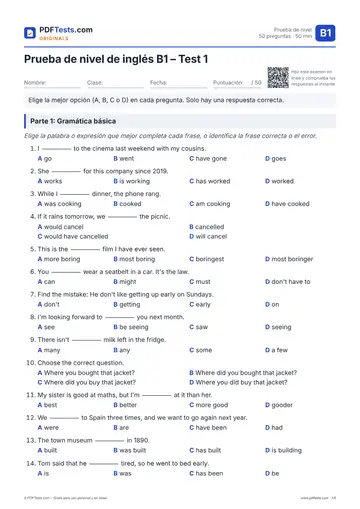
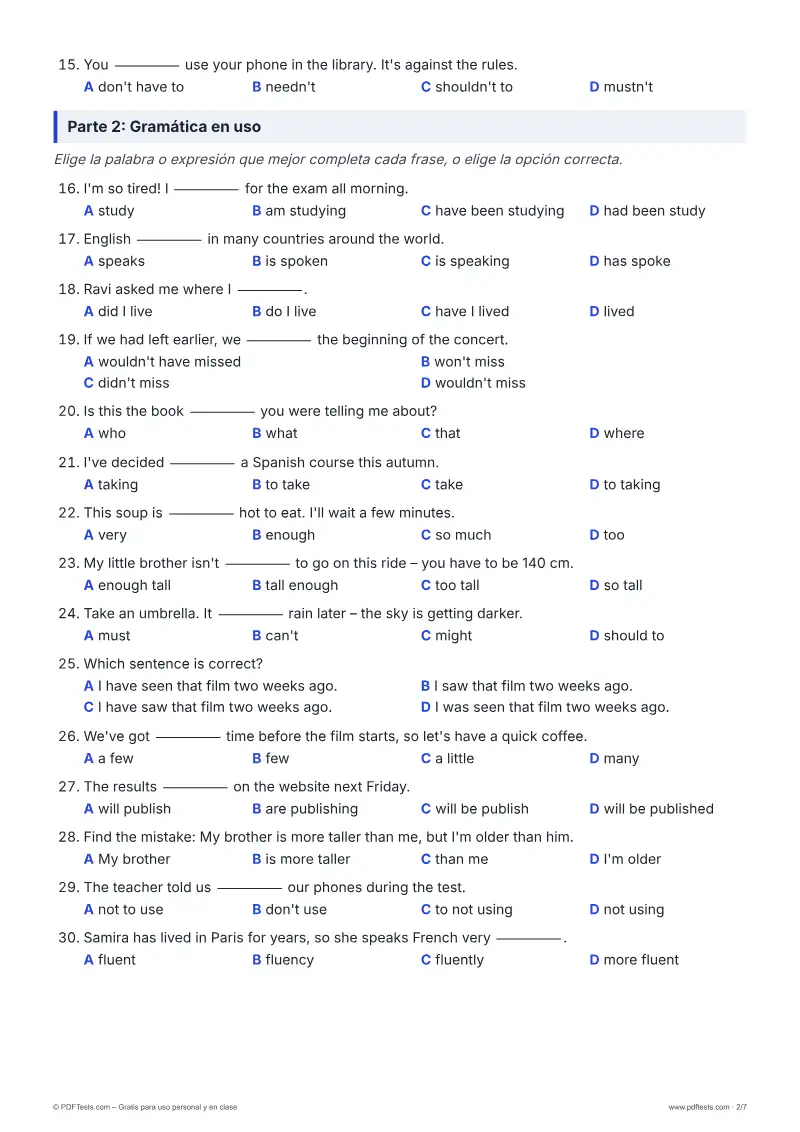
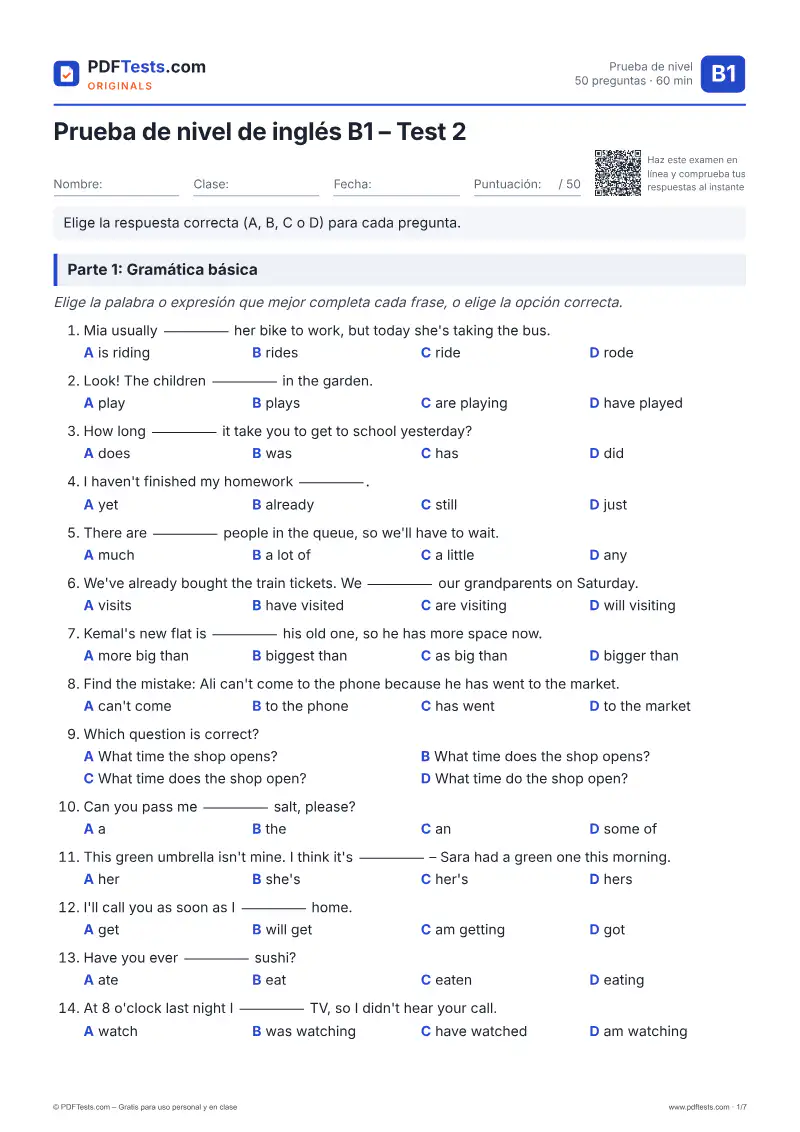
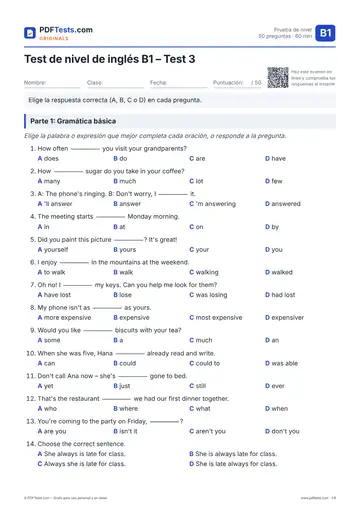
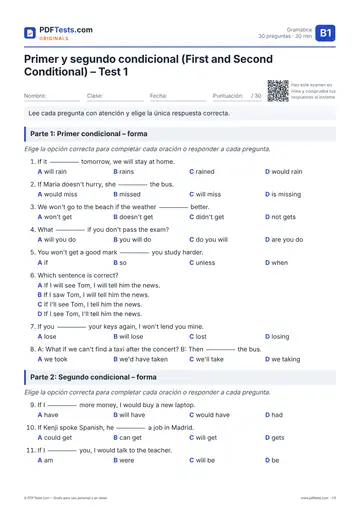
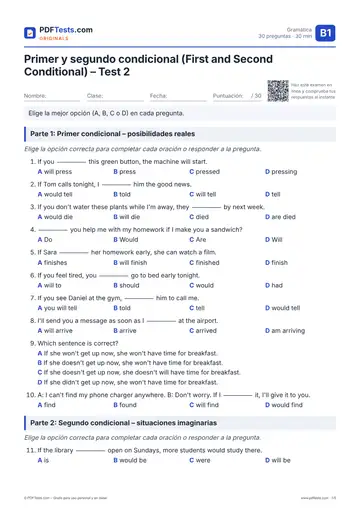
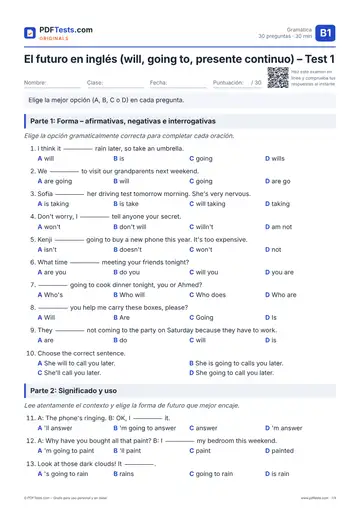
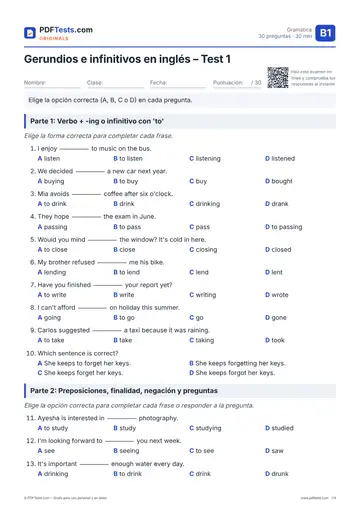
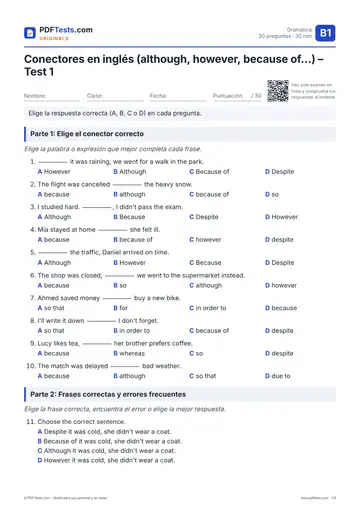
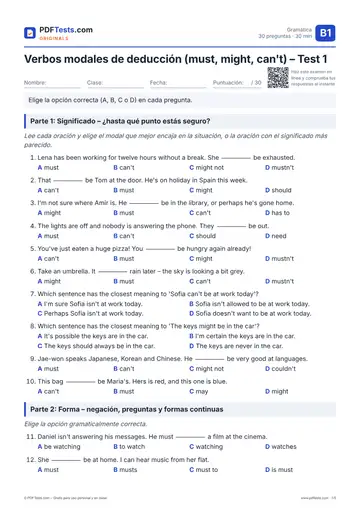
Vista previa de la página 1: Prueba de nivel de inglés B1 – Test 2 Abrir PDF

Haz el examen en línea

Elige la respuesta correcta (A, B, C o D) para cada pregunta. Elige tus respuestas y pulsa «Comprobar respuestas».

Parte 1: Gramática básica

Elige la palabra o expresión que mejor completa cada frase, o elige la opción correcta.

  1. Mia usually _____ her bike to work, but today she's taking the bus.

  2. Look! The children _____ in the garden.

  3. How long _____ it take you to get to school yesterday?

  4. I haven't finished my homework _____.

  5. There are _____ people in the queue, so we'll have to wait.

  6. We've already bought the train tickets. We _____ our grandparents on Saturday.

  7. Kemal's new flat is _____ his old one, so he has more space now.

  8. Find the mistake: Ali can't come to the phone because he has went to the market.

  9. Which question is correct?

  10. Can you pass me _____ salt, please?

  11. This green umbrella isn't mine. I think it's _____ – Sara had a green one this morning.

  12. I'll call you as soon as I _____ home.

  13. Have you ever _____ sushi?

  14. At 8 o'clock last night I _____ TV, so I didn't hear your call.

  15. You _____ use your phone in the library. It's against the rules.

Parte 2: Gramática en uso

Elige la palabra o expresión que mejor completa cada frase, o elige la opción correcta.

  1. I'm so tired! I _____ for the exam all morning.

  2. English _____ in many countries around the world.

  3. Ravi asked me where I _____.

  4. If we had left earlier, we _____ the beginning of the concert.

  5. Is this the book _____ you were telling me about?

  6. I've decided _____ a Spanish course this autumn.

  7. This soup is _____ hot to eat. I'll wait a few minutes.

  8. My little brother isn't _____ to go on this ride – you have to be 140 cm.

  9. Take an umbrella. It _____ rain later – the sky is getting darker.

  10. Which sentence is correct?

  11. We've got _____ time before the film starts, so let's have a quick coffee.

  12. The results _____ on the website next Friday.

  13. Find the mistake: My brother is more taller than me, but I'm older than him.

  14. The teacher told us _____ our phones during the test.

  15. Samira has lived in Paris for years, so she speaks French very _____.

Parte 3: Vocabulario e inglés cotidiano

Elige la palabra, el significado o la respuesta más adecuada para cada pregunta.

  1. Please _____ your shoes before you come in – I've just cleaned the floor.

  2. I need to _____ a decision about which university to apply to.

  3. It was a difficult _____, but in the end I chose to study abroad. (DECIDE)

  4. Be _____ when you cross the road – there's a lot of traffic. (CARE)

  5. Excuse me, could you _____ me how to get to the train station?

  6. The outdoor concert was cancelled at the last minute because of a storm. What does 'at the last minute' mean?

  7. After the long walk, we were all very _____ and went straight to bed.

  8. A: Thank you so much for helping me move house! B: _____

  9. A: Shall we meet at the café at six? B: _____

  10. We booked a hotel room with a beautiful _____ of the mountains.

  11. I'm going to the shop. Do you want me to _____ you anything?

  12. Karim was late because his car broke down on the way to work. What does 'broke down' mean here?

  13. Lena always tells the truth, even when it's difficult. She's very _____.

  14. Could I _____ your pen for a moment? I've left mine at home.

Parte 4: Comprensión lectora

Lee el texto y elige la respuesta correcta para cada pregunta.

When Marta Kowalski retired from her job as an electrician two years ago, she expected to spend her days reading and walking her dog. But after a few months, she started to feel bored. 'I missed using my hands,' she says. 'And I hated seeing my neighbours throw away things that only needed a small repair.'

So Marta had an idea. She asked the manager of the local community centre if she could use a room there once a month. The manager agreed, and the first Repair Café opened last spring. Anyone can bring a broken lamp, a radio, a bike or a piece of clothing, and volunteers try to fix it for free. Visitors only pay for new parts, if they are needed.

At first, only Marta and two friends worked as volunteers, and just six people came. Now more than fifteen volunteers help out, including a retired tailor and a teenager called Joel who is brilliant with computers. On a busy Saturday, they repair up to forty items.

For Marta, the most important thing is not saving money. 'People don't just leave with a working toaster,' she explains. 'They watch and ask questions, so next time they can do the repair themselves. They also meet their neighbours over a cup of coffee.'

Of course, not everything can be saved. Some things are too old or too badly damaged, and the volunteers are always honest about this. But Marta believes that every repair makes a difference. 'Each thing we fix is one less thing in the rubbish,' she says. 'That's good for everyone.'

  1. Why did Marta start the Repair Café?

  2. How much do visitors pay at the Repair Café?

  3. When the Repair Café first opened, _____.

  4. In paragraph 4, Marta says visitors 'can do the repair themselves' next time. This means _____.

  5. What do the volunteers do when something cannot be repaired?

  6. What is the main idea of the text?

¿Te ha resultado útil esta página?

Informar de un error

¿Has visto una respuesta incorrecta, una errata o una explicación poco clara? Avísanos y lo corregiremos.

Vista previa

Sobre este examen

Esta prueba de nivel B1 comprueba si el alumno domina con seguridad el nivel intermedio. Abarca la gramática clave del B1, vocabulario y comunicación cotidiana, y termina con un breve texto de comprensión lectora. Está pensada para adolescentes y adultos que quieran confirmar su nivel o dar el salto al B2.

Temas

Tiempos de presente y pasadoPretérito perfecto (Present Perfect)Voz pasiva (Passive Voice)Oraciones condicionales (Conditionals)Verbos modales (Modal Verbs)Estilo indirecto (Reported Speech)Vocabulario y formación de palabrasComprensión lectora

Cómo usar este examen

  1. Descarga el PDF e imprímelo, o haz el examen en línea más abajo.
  2. Responde todas las preguntas sin diccionario y sin prisas.
  3. Comprueba tus respuestas y apunta los temas que debes repasar.

Notas para el profesor

Dé a los alumnos unos 60 minutos, sin diccionario. Una puntuación de 40/50 o más indica que el alumno domina el nivel B1. Entre 30 y 39 puntos, conviene repasar los puntos débiles; por debajo de 30, se recomienda consolidar el nivel A2. La prueba se centra en errores frecuentes como 'has went', 'more taller', 'explain me', el Present Perfect con 'ago' o el orden de las palabras con 'enough'. Repase las explicaciones con la clase y aproveche el texto de lectura como punto de partida para una actividad oral sobre proyectos comunitarios.