PDFTests Originals

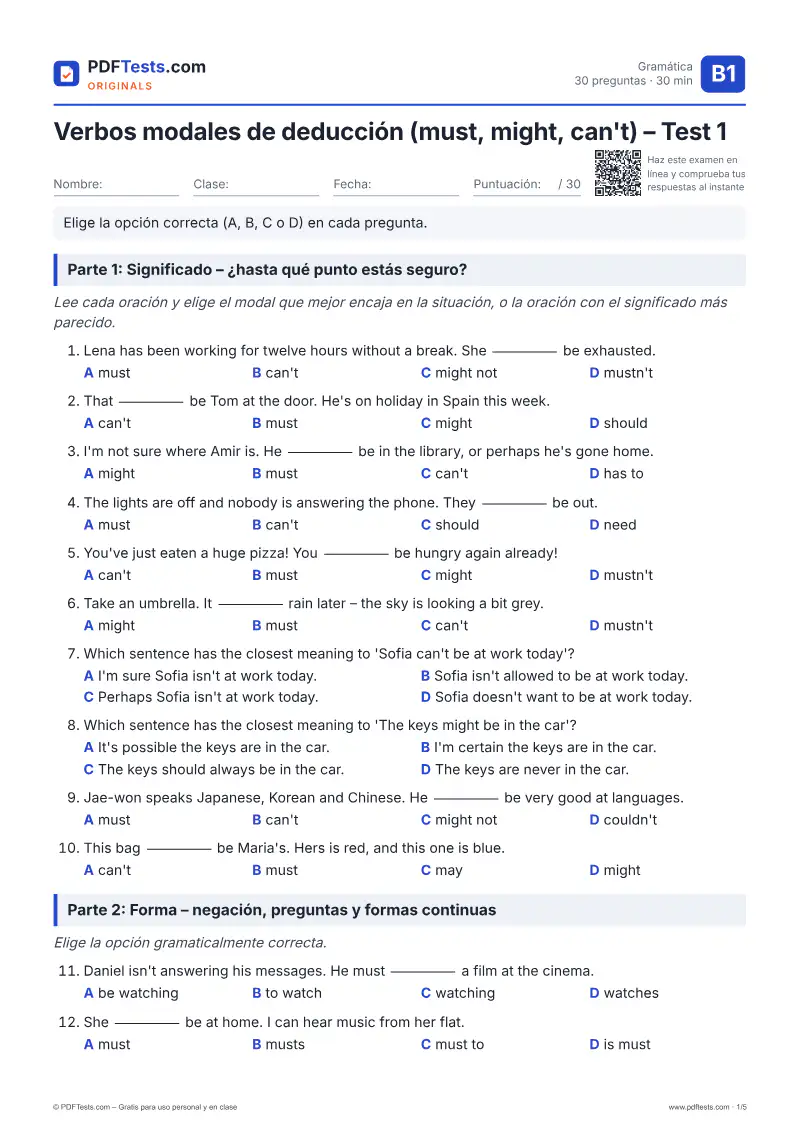
Verbos modales de deducción (must, might, can't) – Test 1

B1 Intermedio GramáticaInglés

Este test de gramática inglesa de nivel B1 comprueba si sabes usar must, might, may, could y can't para hacer deducciones sobre el presente y el pasado. Trabaja el significado, la estructura de la oración, la negación y las preguntas, además de los errores más habituales. Está pensado para alumnos de nivel intermedio, para profesores que buscan un ejercicio listo para usar y para quienes repasan este tema por su cuenta.
Preguntas
30
Tiempo
30 min
PDF
5 páginas
Soluciones
Incluidas
  • 100 % gratis
  • Sin registro
  • PDF A4 listo para imprimir
Vista previa de la página 1: Verbos modales de deducción (must, might, can't) – Test 1 Abrir PDF

Haz el examen en línea

Elige la opción correcta (A, B, C o D) en cada pregunta. Elige tus respuestas y pulsa «Comprobar respuestas».

Parte 1: Significado – ¿hasta qué punto estás seguro?

Lee cada oración y elige el modal que mejor encaja en la situación, o la oración con el significado más parecido.

  1. Lena has been working for twelve hours without a break. She _____ be exhausted.

  2. That _____ be Tom at the door. He's on holiday in Spain this week.

  3. I'm not sure where Amir is. He _____ be in the library, or perhaps he's gone home.

  4. The lights are off and nobody is answering the phone. They _____ be out.

  5. You've just eaten a huge pizza! You _____ be hungry again already!

  6. Take an umbrella. It _____ rain later – the sky is looking a bit grey.

  7. Which sentence has the closest meaning to 'Sofia can't be at work today'?

  8. Which sentence has the closest meaning to 'The keys might be in the car'?

  9. Jae-won speaks Japanese, Korean and Chinese. He _____ be very good at languages.

  10. This bag _____ be Maria's. Hers is red, and this one is blue.

Parte 2: Forma – negación, preguntas y formas continuas

Elige la opción gramaticalmente correcta.

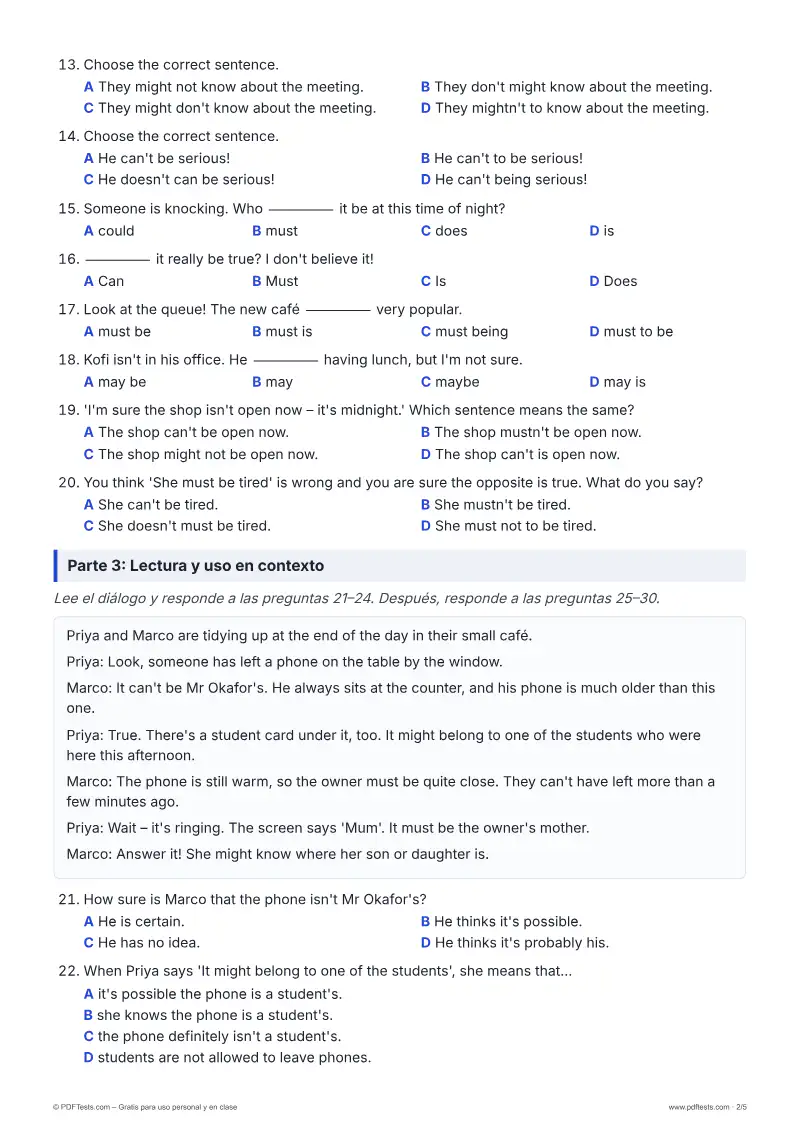
  1. Daniel isn't answering his messages. He must _____ a film at the cinema.

  2. She _____ be at home. I can hear music from her flat.

  3. Choose the correct sentence.

  4. Choose the correct sentence.

  5. Someone is knocking. Who _____ it be at this time of night?

  6. _____ it really be true? I don't believe it!

  7. Look at the queue! The new café _____ very popular.

  8. Kofi isn't in his office. He _____ having lunch, but I'm not sure.

  9. 'I'm sure the shop isn't open now – it's midnight.' Which sentence means the same?

  10. You think 'She must be tired' is wrong and you are sure the opposite is true. What do you say?

Parte 3: Lectura y uso en contexto

Lee el diálogo y responde a las preguntas 21–24. Después, responde a las preguntas 25–30.

Priya and Marco are tidying up at the end of the day in their small café.

Priya: Look, someone has left a phone on the table by the window.

Marco: It can't be Mr Okafor's. He always sits at the counter, and his phone is much older than this one.

Priya: True. There's a student card under it, too. It might belong to one of the students who were here this afternoon.

Marco: The phone is still warm, so the owner must be quite close. They can't have left more than a few minutes ago.

Priya: Wait – it's ringing. The screen says 'Mum'. It must be the owner's mother.

Marco: Answer it! She might know where her son or daughter is.

  1. How sure is Marco that the phone isn't Mr Okafor's?

  2. When Priya says 'It might belong to one of the students', she means that…

  3. Why is Marco sure that the owner must be quite close?

  4. Which sentence from the dialogue is a deduction about the past?

  5. Which part of this sentence is wrong? 'You mustn't be cold – you're wearing three jumpers!'

  6. Which part of this sentence is wrong? 'That man must to be the new manager – he's wearing a suit and giving orders.'

  7. The ground is wet this morning. It _____ last night.

  8. I sent Tariq the address, but he hasn't arrived yet. He _____ my message.

  9. A: Hiro has bought a new car and a big house this year. B: _____

  10. A: I can't find my glasses anywhere. B: _____

Vista previa

Sobre este examen

Este test de gramática inglesa de nivel B1 comprueba si sabes usar must, might, may, could y can't para hacer deducciones sobre el presente y el pasado. Trabaja el significado, la estructura de la oración, la negación y las preguntas, además de los errores más habituales. Está pensado para alumnos de nivel intermedio, para profesores que buscan un ejercicio listo para usar y para quienes repasan este tema por su cuenta.

Temas

Must para expresar certezaMight, may y could para expresar posibilidadCan't para expresar certeza negativaMust be + -ingPreguntas con could y canCan't frente a mustn'tDeducción en pasado: must have / can't have

Cómo usar este examen

  1. Descarga el PDF e imprímelo, o haz el examen en línea más abajo.
  2. Responde todas las preguntas sin diccionario y sin prisas.
  3. Comprueba tus respuestas y apunta los temas que debes repasar.

Notas para el profesor

Utiliza este test después de presentar los verbos modales de deducción o como prueba diagnóstica antes de un repaso. Se centra en los errores típicos del nivel B1: usar mustn't en lugar de can't para la deducción negativa, añadir to después de un modal, confundir maybe con may be y elegir must cuando las pruebas solo indican una posibilidad. Como actividad de seguimiento, pide a los alumnos que observen fotos o describan objetos misteriosos y hagan sus propias deducciones con must, might y can't.