PDFTests Originals

Einstufungstest Englisch B1 – Test 2

B1 Mittelstufe EinstufungstestEnglisch

Dieser Einstufungstest auf Niveau B1 prüft, ob Lernende die Mittelstufe sicher beherrschen. Er deckt zentrale B1-Grammatik, Wortschatz und Alltagskommunikation ab und schließt mit einem kurzen Lesetext. Geeignet für Jugendliche und Erwachsene, die ihr Niveau bestätigen oder auf B2 aufsteigen möchten.

Fragen
50
Zeit
60 Min.
PDF
7 Seiten
Lösungen
Enthalten
  • 100 % kostenlos
  • Ohne Anmeldung
  • Druckfertiges A4-PDF
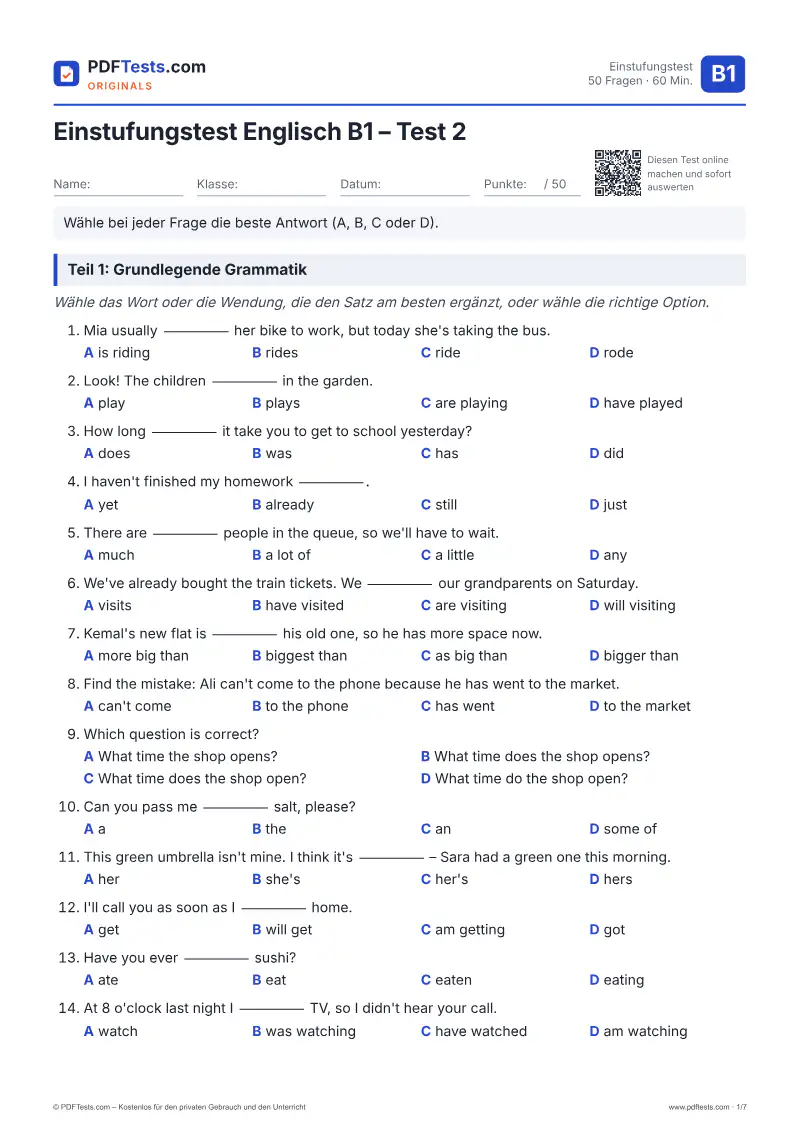
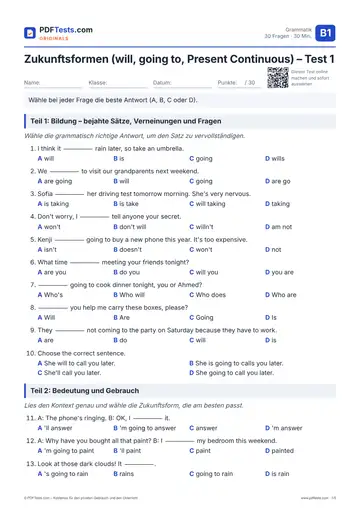
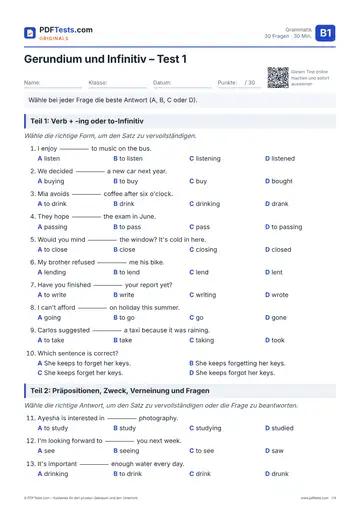
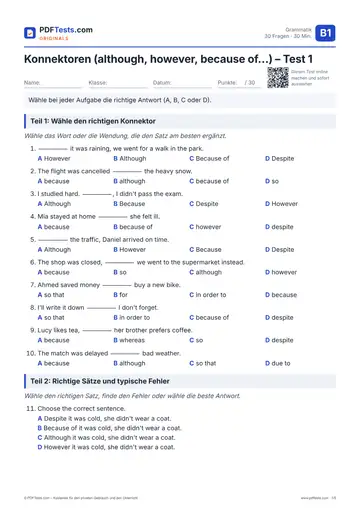
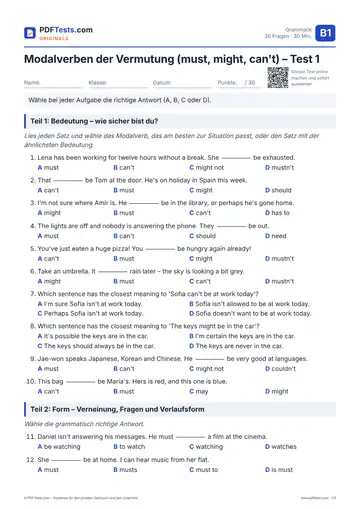
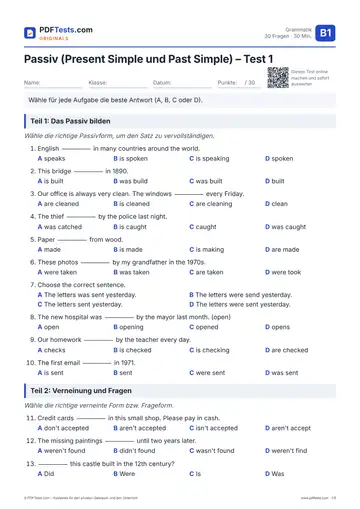
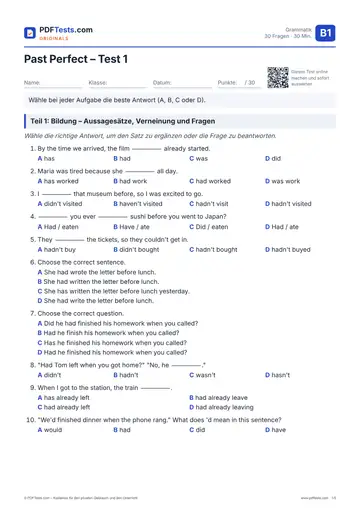
Vorschau von Seite 1: Einstufungstest Englisch B1 – Test 2 PDF öffnen

Test online machen

Wähle bei jeder Frage die beste Antwort (A, B, C oder D). Wählen Sie Ihre Antworten und klicken Sie auf „Antworten prüfen“.

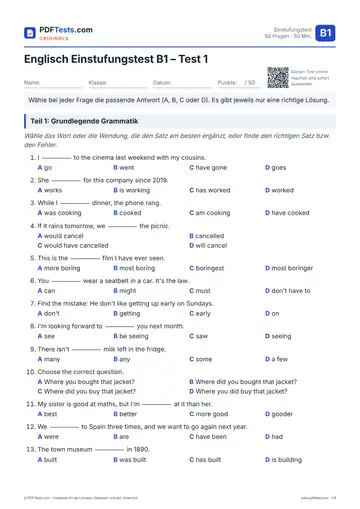
Teil 1: Grundlegende Grammatik

Wähle das Wort oder die Wendung, die den Satz am besten ergänzt, oder wähle die richtige Option.

  1. Mia usually _____ her bike to work, but today she's taking the bus.

  2. Look! The children _____ in the garden.

  3. How long _____ it take you to get to school yesterday?

  4. I haven't finished my homework _____.

  5. There are _____ people in the queue, so we'll have to wait.

  6. We've already bought the train tickets. We _____ our grandparents on Saturday.

  7. Kemal's new flat is _____ his old one, so he has more space now.

  8. Find the mistake: Ali can't come to the phone because he has went to the market.

  9. Which question is correct?

  10. Can you pass me _____ salt, please?

  11. This green umbrella isn't mine. I think it's _____ – Sara had a green one this morning.

  12. I'll call you as soon as I _____ home.

  13. Have you ever _____ sushi?

  14. At 8 o'clock last night I _____ TV, so I didn't hear your call.

  15. You _____ use your phone in the library. It's against the rules.

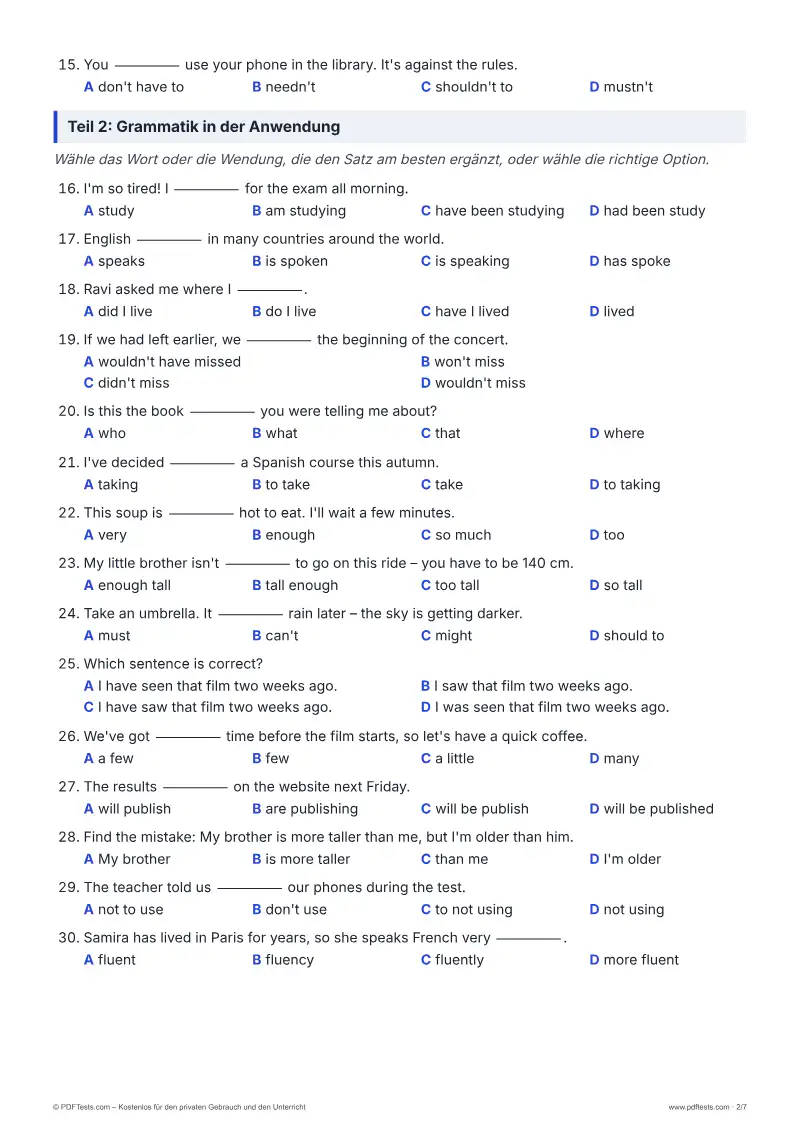
Teil 2: Grammatik in der Anwendung

Wähle das Wort oder die Wendung, die den Satz am besten ergänzt, oder wähle die richtige Option.

  1. I'm so tired! I _____ for the exam all morning.

  2. English _____ in many countries around the world.

  3. Ravi asked me where I _____.

  4. If we had left earlier, we _____ the beginning of the concert.

  5. Is this the book _____ you were telling me about?

  6. I've decided _____ a Spanish course this autumn.

  7. This soup is _____ hot to eat. I'll wait a few minutes.

  8. My little brother isn't _____ to go on this ride – you have to be 140 cm.

  9. Take an umbrella. It _____ rain later – the sky is getting darker.

  10. Which sentence is correct?

  11. We've got _____ time before the film starts, so let's have a quick coffee.

  12. The results _____ on the website next Friday.

  13. Find the mistake: My brother is more taller than me, but I'm older than him.

  14. The teacher told us _____ our phones during the test.

  15. Samira has lived in Paris for years, so she speaks French very _____.

Teil 3: Wortschatz und Alltagsenglisch

Wähle bei jeder Frage das passende Wort, die richtige Bedeutung oder die passende Reaktion.

  1. Please _____ your shoes before you come in – I've just cleaned the floor.

  2. I need to _____ a decision about which university to apply to.

  3. It was a difficult _____, but in the end I chose to study abroad. (DECIDE)

  4. Be _____ when you cross the road – there's a lot of traffic. (CARE)

  5. Excuse me, could you _____ me how to get to the train station?

  6. The outdoor concert was cancelled at the last minute because of a storm. What does 'at the last minute' mean?

  7. After the long walk, we were all very _____ and went straight to bed.

  8. A: Thank you so much for helping me move house! B: _____

  9. A: Shall we meet at the café at six? B: _____

  10. We booked a hotel room with a beautiful _____ of the mountains.

  11. I'm going to the shop. Do you want me to _____ you anything?

  12. Karim was late because his car broke down on the way to work. What does 'broke down' mean here?

  13. Lena always tells the truth, even when it's difficult. She's very _____.

  14. Could I _____ your pen for a moment? I've left mine at home.

Teil 4: Leseverstehen

Lies den Text und wähle bei jeder Frage die beste Antwort.

When Marta Kowalski retired from her job as an electrician two years ago, she expected to spend her days reading and walking her dog. But after a few months, she started to feel bored. 'I missed using my hands,' she says. 'And I hated seeing my neighbours throw away things that only needed a small repair.'

So Marta had an idea. She asked the manager of the local community centre if she could use a room there once a month. The manager agreed, and the first Repair Café opened last spring. Anyone can bring a broken lamp, a radio, a bike or a piece of clothing, and volunteers try to fix it for free. Visitors only pay for new parts, if they are needed.

At first, only Marta and two friends worked as volunteers, and just six people came. Now more than fifteen volunteers help out, including a retired tailor and a teenager called Joel who is brilliant with computers. On a busy Saturday, they repair up to forty items.

For Marta, the most important thing is not saving money. 'People don't just leave with a working toaster,' she explains. 'They watch and ask questions, so next time they can do the repair themselves. They also meet their neighbours over a cup of coffee.'

Of course, not everything can be saved. Some things are too old or too badly damaged, and the volunteers are always honest about this. But Marta believes that every repair makes a difference. 'Each thing we fix is one less thing in the rubbish,' she says. 'That's good for everyone.'

  1. Why did Marta start the Repair Café?

  2. How much do visitors pay at the Repair Café?

  3. When the Repair Café first opened, _____.

  4. In paragraph 4, Marta says visitors 'can do the repair themselves' next time. This means _____.

  5. What do the volunteers do when something cannot be repaired?

  6. What is the main idea of the text?

Vorschau

Über diesen Test

Dieser Einstufungstest auf Niveau B1 prüft, ob Lernende die Mittelstufe sicher beherrschen. Er deckt zentrale B1-Grammatik, Wortschatz und Alltagskommunikation ab und schließt mit einem kurzen Lesetext. Geeignet für Jugendliche und Erwachsene, die ihr Niveau bestätigen oder auf B2 aufsteigen möchten.

Themen

Gegenwarts- und VergangenheitszeitenPresent PerfectPassiv (Passive Voice)Bedingungssätze (Conditionals)ModalverbenIndirekte Rede (Reported Speech)Wortschatz und WortbildungLeseverstehen

So nutzen Sie diesen Test

  1. Laden Sie das PDF herunter und drucken Sie es aus – oder machen Sie den Test unten online.
  2. Beantworten Sie alle Fragen ohne Wörterbuch und ohne Zeitdruck.
  3. Prüfen Sie Ihre Antworten und notieren Sie, was Sie wiederholen sollten.

Hinweise für Lehrkräfte

Planen Sie etwa 60 Minuten ohne Wörterbuch ein. Ab 40/50 Punkten beherrschen die Lernenden B1 sicher. Bei 30–39 Punkten sollten die Schwachstellen wiederholt werden; unter 30 Punkten empfiehlt sich eine Festigung auf A2-Niveau. Der Test zielt auf typische Fehler wie 'has went', 'more taller', 'explain me', Present Perfect mit 'ago' und die Wortstellung bei 'enough'. Besprechen Sie die Erklärungen mit der Klasse und nutzen Sie den Lesetext als Einstieg in eine Sprechaufgabe zu Nachbarschafts- und Gemeinschaftsprojekten.