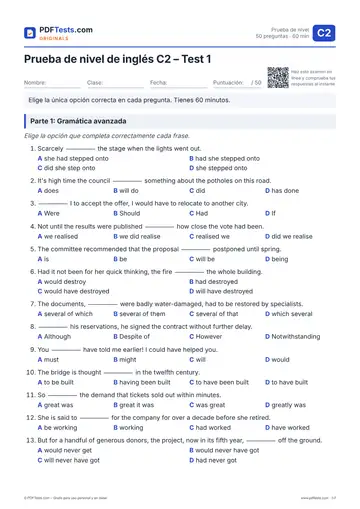
PDFTests Originals

Formación de palabras en inglés (C2) – Test 1

C2 Maestría VocabularioInglés

Este test de vocabulario de nivel C2 trabaja la formación de palabras a nivel avanzado: prefijos negativos, sufijos para formar sustantivos y adjetivos, miembros de una misma familia léxica que se confunden con facilidad y colocaciones fijas. Está pensado para estudiantes con un dominio muy alto del inglés, candidatos al CPE (C2 Proficiency) y profesores que buscan una práctica exigente y lista para imprimir.

Preguntas
30
Tiempo
35 min
PDF
5 páginas
Soluciones
Incluidas
  • 100 % gratis
  • Sin registro
  • PDF A4 listo para imprimir
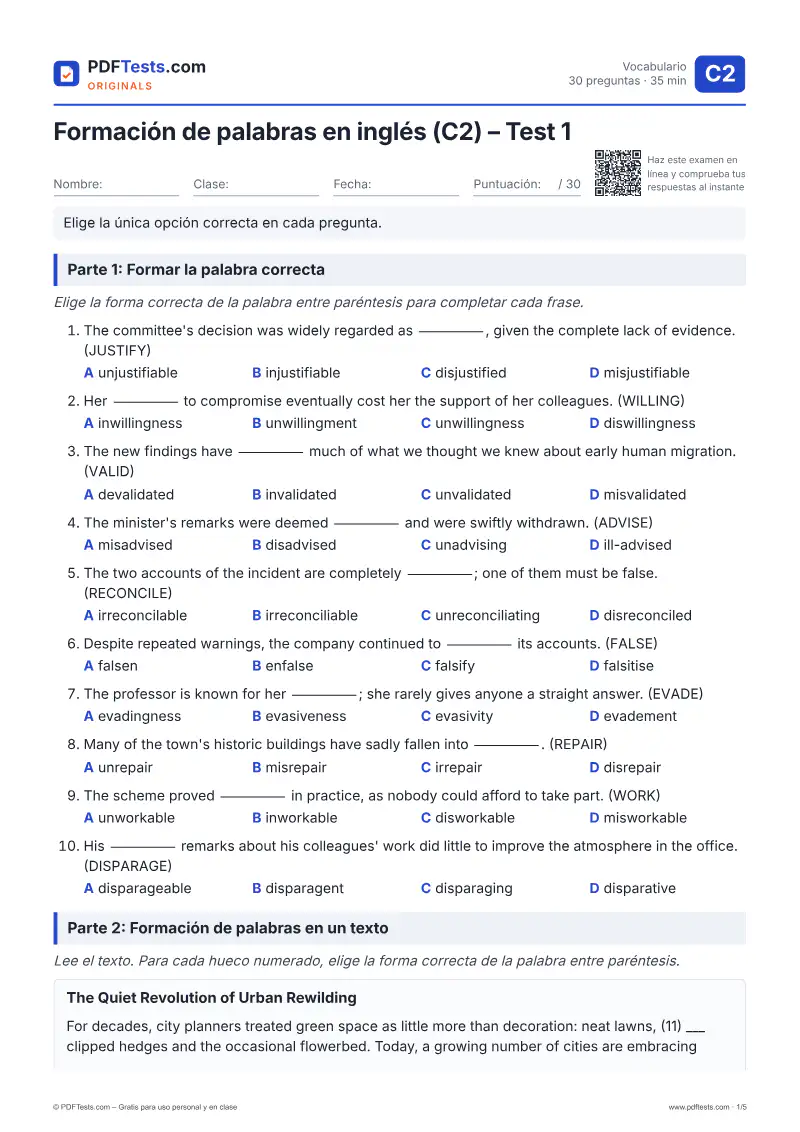
Vista previa de la página 1: Formación de palabras en inglés (C2) – Test 1 Abrir PDF

Haz el examen en línea

Elige la única opción correcta en cada pregunta. Elige tus respuestas y pulsa «Comprobar respuestas».

Parte 1: Formar la palabra correcta

Elige la forma correcta de la palabra entre paréntesis para completar cada frase.

  1. The committee's decision was widely regarded as _____, given the complete lack of evidence. (JUSTIFY)

  2. Her _____ to compromise eventually cost her the support of her colleagues. (WILLING)

  3. The new findings have _____ much of what we thought we knew about early human migration. (VALID)

  4. The minister's remarks were deemed _____ and were swiftly withdrawn. (ADVISE)

  5. The two accounts of the incident are completely _____; one of them must be false. (RECONCILE)

  6. Despite repeated warnings, the company continued to _____ its accounts. (FALSE)

  7. The professor is known for her _____; she rarely gives anyone a straight answer. (EVADE)

  8. Many of the town's historic buildings have sadly fallen into _____. (REPAIR)

  9. The scheme proved _____ in practice, as nobody could afford to take part. (WORK)

  10. His _____ remarks about his colleagues' work did little to improve the atmosphere in the office. (DISPARAGE)

Parte 2: Formación de palabras en un texto

Lee el texto. Para cada hueco numerado, elige la forma correcta de la palabra entre paréntesis.

The Quiet Revolution of Urban Rewilding

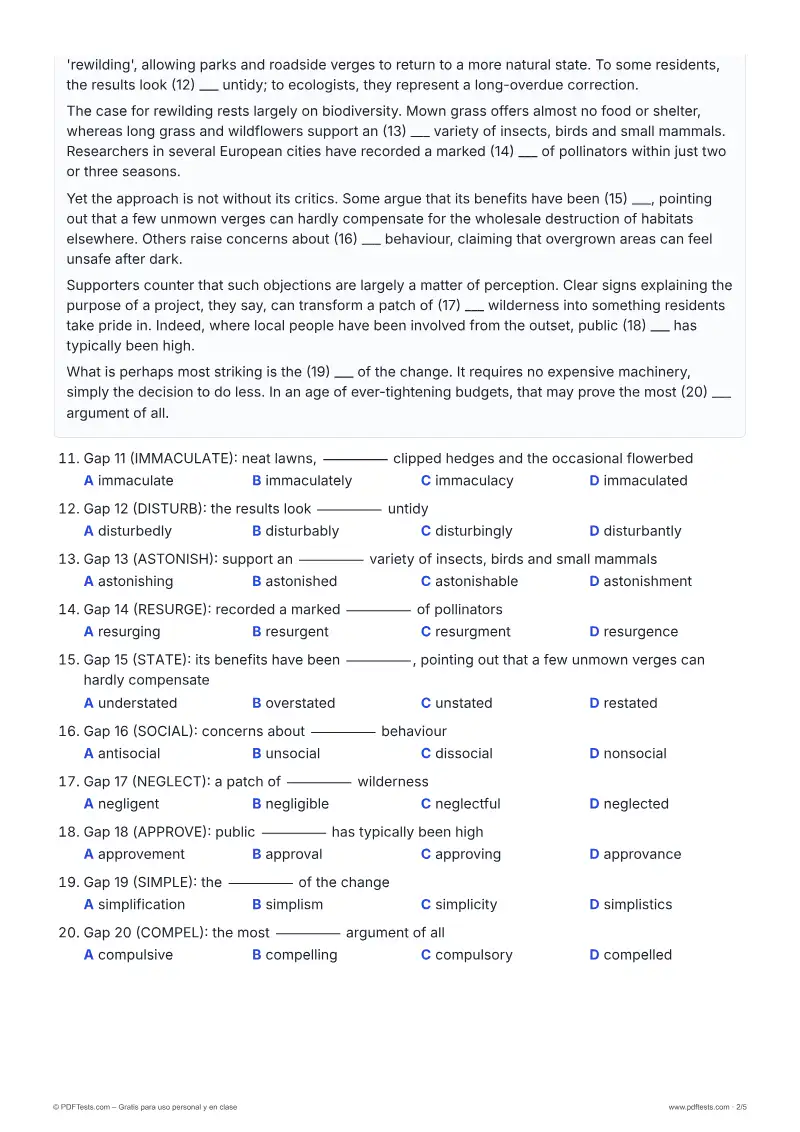
For decades, city planners treated green space as little more than decoration: neat lawns, (11) ___ clipped hedges and the occasional flowerbed. Today, a growing number of cities are embracing 'rewilding', allowing parks and roadside verges to return to a more natural state. To some residents, the results look (12) ___ untidy; to ecologists, they represent a long-overdue correction.

The case for rewilding rests largely on biodiversity. Mown grass offers almost no food or shelter, whereas long grass and wildflowers support an (13) ___ variety of insects, birds and small mammals. Researchers in several European cities have recorded a marked (14) ___ of pollinators within just two or three seasons.

Yet the approach is not without its critics. Some argue that its benefits have been (15) ___, pointing out that a few unmown verges can hardly compensate for the wholesale destruction of habitats elsewhere. Others raise concerns about (16) ___ behaviour, claiming that overgrown areas can feel unsafe after dark.

Supporters counter that such objections are largely a matter of perception. Clear signs explaining the purpose of a project, they say, can transform a patch of (17) ___ wilderness into something residents take pride in. Indeed, where local people have been involved from the outset, public (18) ___ has typically been high.

What is perhaps most striking is the (19) ___ of the change. It requires no expensive machinery, simply the decision to do less. In an age of ever-tightening budgets, that may prove the most (20) ___ argument of all.

  1. Gap 11 (IMMACULATE): neat lawns, _____ clipped hedges and the occasional flowerbed

  2. Gap 12 (DISTURB): the results look _____ untidy

  3. Gap 13 (ASTONISH): support an _____ variety of insects, birds and small mammals

  4. Gap 14 (RESURGE): recorded a marked _____ of pollinators

  5. Gap 15 (STATE): its benefits have been _____, pointing out that a few unmown verges can hardly compensate

  6. Gap 16 (SOCIAL): concerns about _____ behaviour

  7. Gap 17 (NEGLECT): a patch of _____ wilderness

  8. Gap 18 (APPROVE): public _____ has typically been high

  9. Gap 19 (SIMPLE): the _____ of the change

  10. Gap 20 (COMPEL): the most _____ argument of all

Parte 3: Familias léxicas, significado y precisión

Elige la mejor opción en cada pregunta.

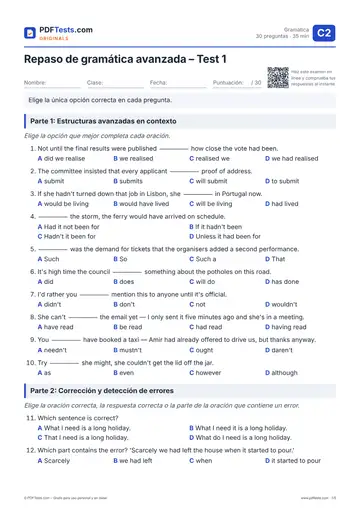
  1. Which sentence is correct?

  2. Which sentence contains an error in word formation?

  3. 'The minister's reply was decidedly noncommittal.' This means that the minister:

  4. Which prefix completes the word? 'The figures had been _____calculated, which explained the unexpected shortfall.'

  5. There is a growing _____ that the policy has failed. (PERCEIVE)

  6. The documentary offers a _____ look at life on a remote island. (HEART / WARM)

  7. Their relationship had deteriorated to the point where it was beyond _____. (REDEEM)

  8. Which sentence uses the word in CAPITALS correctly?

  9. A person with a 'self-effacing manner' is someone who:

  10. The two languages are mutually _____; speakers of one can easily understand the other.

Vista previa

Sobre este examen

Este test de vocabulario de nivel C2 trabaja la formación de palabras a nivel avanzado: prefijos negativos, sufijos para formar sustantivos y adjetivos, miembros de una misma familia léxica que se confunden con facilidad y colocaciones fijas. Está pensado para estudiantes con un dominio muy alto del inglés, candidatos al CPE (C2 Proficiency) y profesores que buscan una práctica exigente y lista para imprimir.

Temas

Formación de palabras (word formation)Prefijos negativosSufijos nominalesFormas de adjetivo y adverbioFamilias léxicasColocaciones (collocations)Palabras que se confunden fácilmente

Cómo usar este examen

  1. Descarga el PDF e imprímelo, o haz el examen en línea más abajo.
  2. Responde todas las preguntas sin diccionario y sin prisas.
  3. Comprueba tus respuestas y apunta los temas que debes repasar.

Notas para el profesor

Use la Parte 1 como calentamiento, la Parte 2 como práctica con el formato de la tarea de word formation del Use of English del CPE y la Parte 3 para comprobar si el alumnado distingue formas que se confunden. El test se centra en errores frecuentes en niveles avanzados, como sufijos inventados (disapprovement), el prefijo negativo equivocado (inreconcilable) o la confusión dentro de una misma familia léxica (neglected vs negligent, historic vs historical). Como actividad de seguimiento, pida a los alumnos que escriban sus propias frases con los distractores que sí existen, como negligible, compulsive y perceptiveness.