PDFTests Originals

Repaso de gramática avanzada – Test 1

C2 Maestría GramáticaInglés

Este repaso de gramática de nivel C2 evalúa las estructuras que distinguen a un usuario competente del inglés: la inversión, el subjuntivo, las condicionales mixtas, las oraciones escindidas (cleft sentences), las oraciones de participio y la elipsis. Está pensado para estudiantes avanzados que preparan exámenes de nivel Proficiency y para profesores que buscan comprobar de forma rápida y rigurosa la forma, el significado y el uso.
Preguntas
30
Tiempo
35 min
PDF
5 páginas
Soluciones
Incluidas
  • 100 % gratis
  • Sin registro
  • PDF A4 listo para imprimir
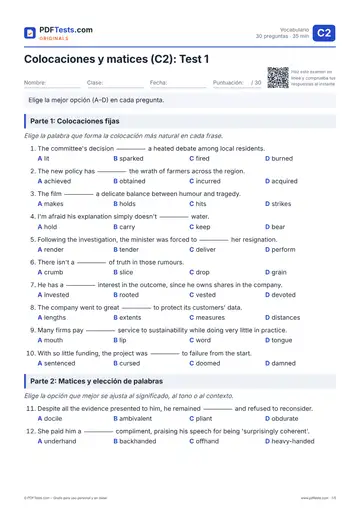
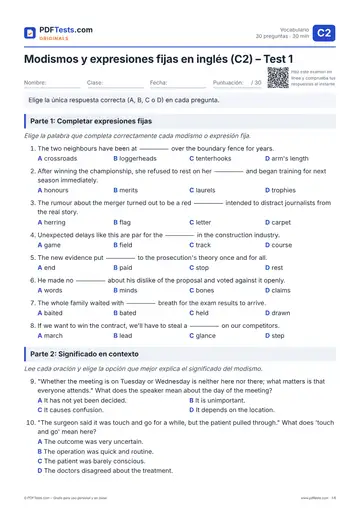
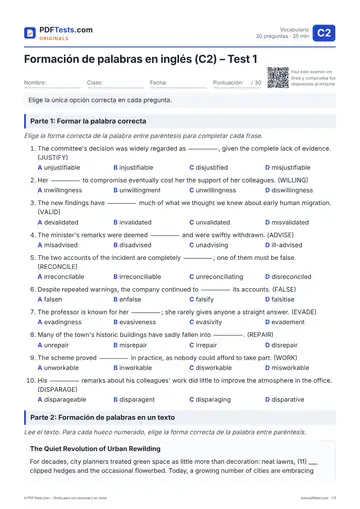
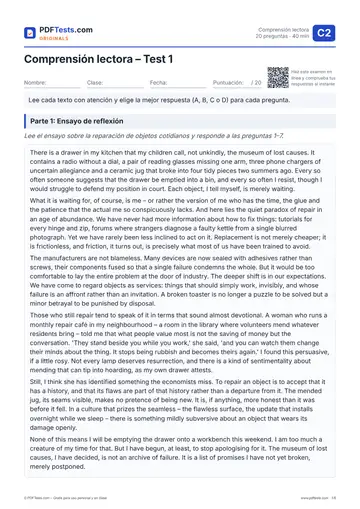
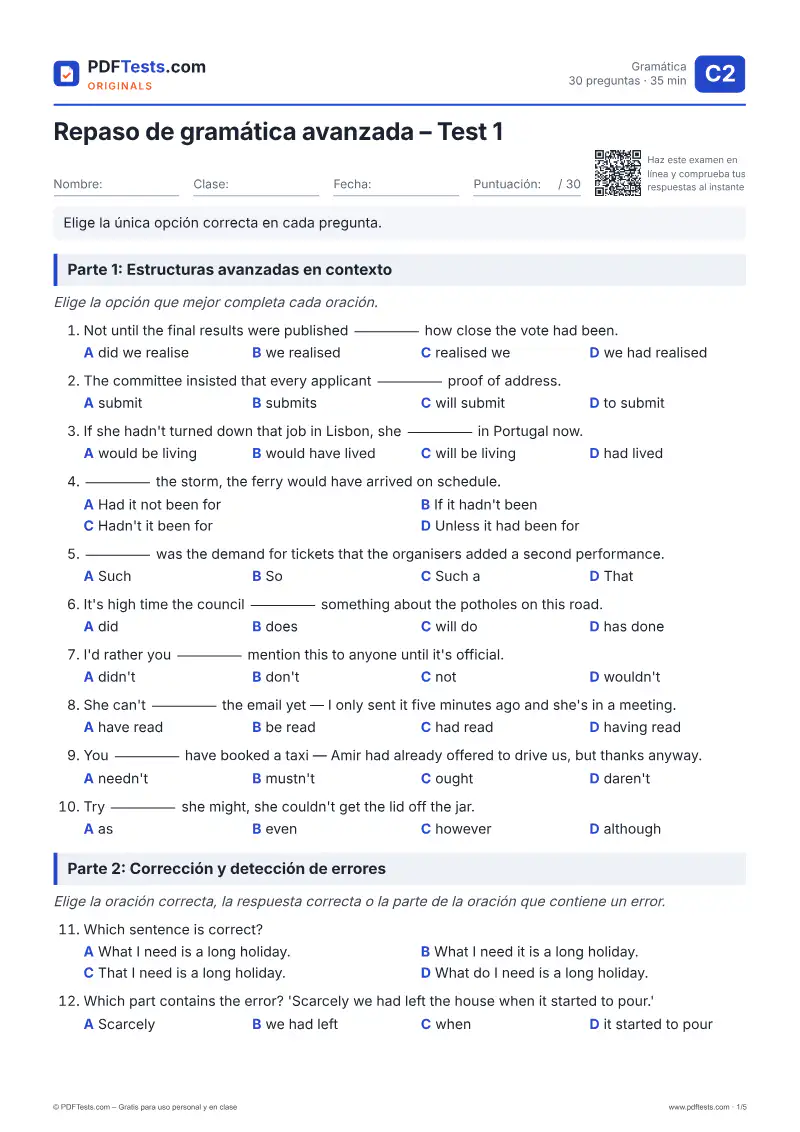
Vista previa de la página 1: Repaso de gramática avanzada – Test 1 Abrir PDF

Haz el examen en línea

Elige la única opción correcta en cada pregunta. Elige tus respuestas y pulsa «Comprobar respuestas».

Parte 1: Estructuras avanzadas en contexto

Elige la opción que mejor completa cada oración.

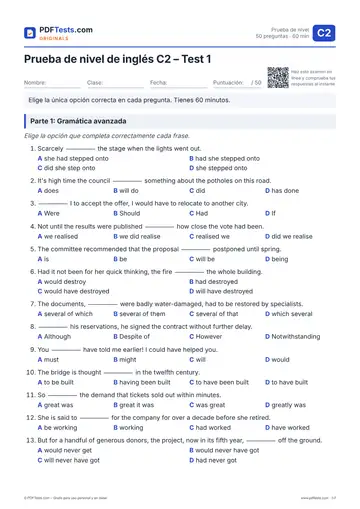
  1. Not until the final results were published _____ how close the vote had been.

  2. The committee insisted that every applicant _____ proof of address.

  3. If she hadn't turned down that job in Lisbon, she _____ in Portugal now.

  4. _____ the storm, the ferry would have arrived on schedule.

  5. _____ was the demand for tickets that the organisers added a second performance.

  6. It's high time the council _____ something about the potholes on this road.

  7. I'd rather you _____ mention this to anyone until it's official.

  8. She can't _____ the email yet — I only sent it five minutes ago and she's in a meeting.

  9. You _____ have booked a taxi — Amir had already offered to drive us, but thanks anyway.

  10. Try _____ she might, she couldn't get the lid off the jar.

Parte 2: Corrección y detección de errores

Elige la oración correcta, la respuesta correcta o la parte de la oración que contiene un error.

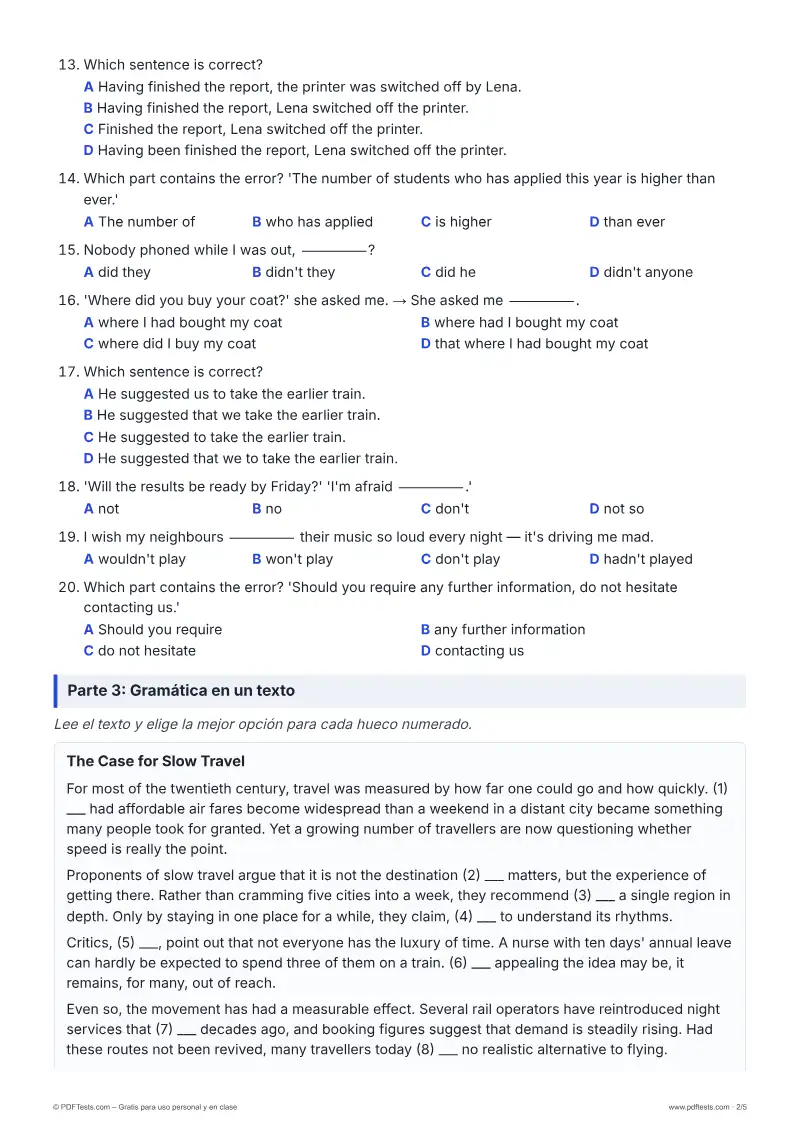
  1. Which sentence is correct?

  2. Which part contains the error? 'Scarcely we had left the house when it started to pour.'

  3. Which sentence is correct?

  4. Which part contains the error? 'The number of students who has applied this year is higher than ever.'

  5. Nobody phoned while I was out, _____?

  6. 'Where did you buy your coat?' she asked me. → She asked me _____.

  7. Which sentence is correct?

  8. 'Will the results be ready by Friday?' 'I'm afraid _____.'

  9. I wish my neighbours _____ their music so loud every night — it's driving me mad.

  10. Which part contains the error? 'Should you require any further information, do not hesitate contacting us.'

Parte 3: Gramática en un texto

Lee el texto y elige la mejor opción para cada hueco numerado.

The Case for Slow Travel

For most of the twentieth century, travel was measured by how far one could go and how quickly. (1) ___ had affordable air fares become widespread than a weekend in a distant city became something many people took for granted. Yet a growing number of travellers are now questioning whether speed is really the point.

Proponents of slow travel argue that it is not the destination (2) ___ matters, but the experience of getting there. Rather than cramming five cities into a week, they recommend (3) ___ a single region in depth. Only by staying in one place for a while, they claim, (4) ___ to understand its rhythms.

Critics, (5) ___, point out that not everyone has the luxury of time. A nurse with ten days' annual leave can hardly be expected to spend three of them on a train. (6) ___ appealing the idea may be, it remains, for many, out of reach.

Even so, the movement has had a measurable effect. Several rail operators have reintroduced night services that (7) ___ decades ago, and booking figures suggest that demand is steadily rising. Had these routes not been revived, many travellers today (8) ___ no realistic alternative to flying.

Perhaps the most valuable lesson of slow travel is not about transport at all. It is a reminder that (9) ___ we hurry, the less we notice. Whether or not we ever board a sleeper train, it is worth asking ourselves how much we (10) ___ by always rushing to the next thing.

  1. Gap (1)

  2. Gap (2)

  3. Gap (3)

  4. Gap (4)

  5. Gap (5)

  6. Gap (6)

  7. Gap (7)

  8. Gap (8)

  9. Gap (9)

  10. Gap (10)

Vista previa

Sobre este examen

Este repaso de gramática de nivel C2 evalúa las estructuras que distinguen a un usuario competente del inglés: la inversión, el subjuntivo, las condicionales mixtas, las oraciones escindidas (cleft sentences), las oraciones de participio y la elipsis. Está pensado para estudiantes avanzados que preparan exámenes de nivel Proficiency y para profesores que buscan comprobar de forma rápida y rigurosa la forma, el significado y el uso.

Temas

Inversión y anteposición (fronting)Subjuntivo y pasado irreal (unreal past)Condicionales mixtas (mixed conditionals)Verbos modales perfectos (modal perfects)Oraciones escindidas (cleft sentences)Oraciones de participio (participle clauses)Elipsis y sustituciónEstructuras concesivas

Cómo usar este examen

  1. Descarga el PDF e imprímelo, o haz el examen en línea más abajo.
  2. Responde todas las preguntas sin diccionario y sin prisas.
  3. Comprueba tus respuestas y apunta los temas que debes repasar.

Notas para el profesor

Utilice este test como prueba diagnóstica o como repaso antes de un examen C2. Se centra en errores persistentes del nivel avanzado: la falta de inversión del auxiliar tras adverbiales negativos, el uso del indicativo tras verbos de mandato, los participios colgantes (dangling participles), la estructura incorrecta 'suggest + objeto + infinitivo' y la concordancia sujeto-verbo con 'the number of'. Como actividad de seguimiento, pida a los alumnos que corrijan las opciones incorrectas o que reescriban el texto de lectura en un registro más o menos formal.