PDFTests Originals

Test de niveau d'anglais C1 – Test 1

C1 Avancé Test de niveauAnglais

Ce test de positionnement C1 évalue la grammaire, le vocabulaire et la compréhension écrite attendus d'un utilisateur expérimenté de l'anglais : inversion, conditionnels mixtes, collocations, expressions idiomatiques et formation des mots. Il s'adresse aux enseignants qui orientent leurs élèves vers des cours de niveau avancé, ainsi qu'aux apprenants qui souhaitent vérifier s'ils maîtrisent vraiment le niveau C1.

Questions
50
Durée
60 min
PDF
7 pages
Corrigé
Inclus
  • 100 % gratuit
  • Sans inscription
  • PDF A4 prêt à imprimer
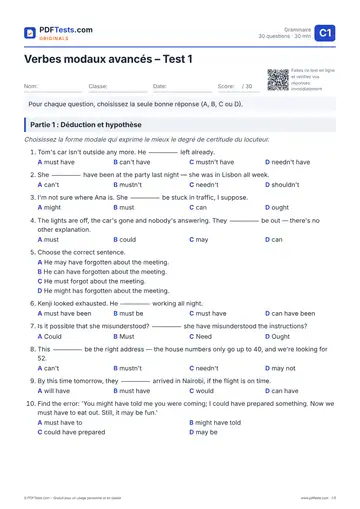
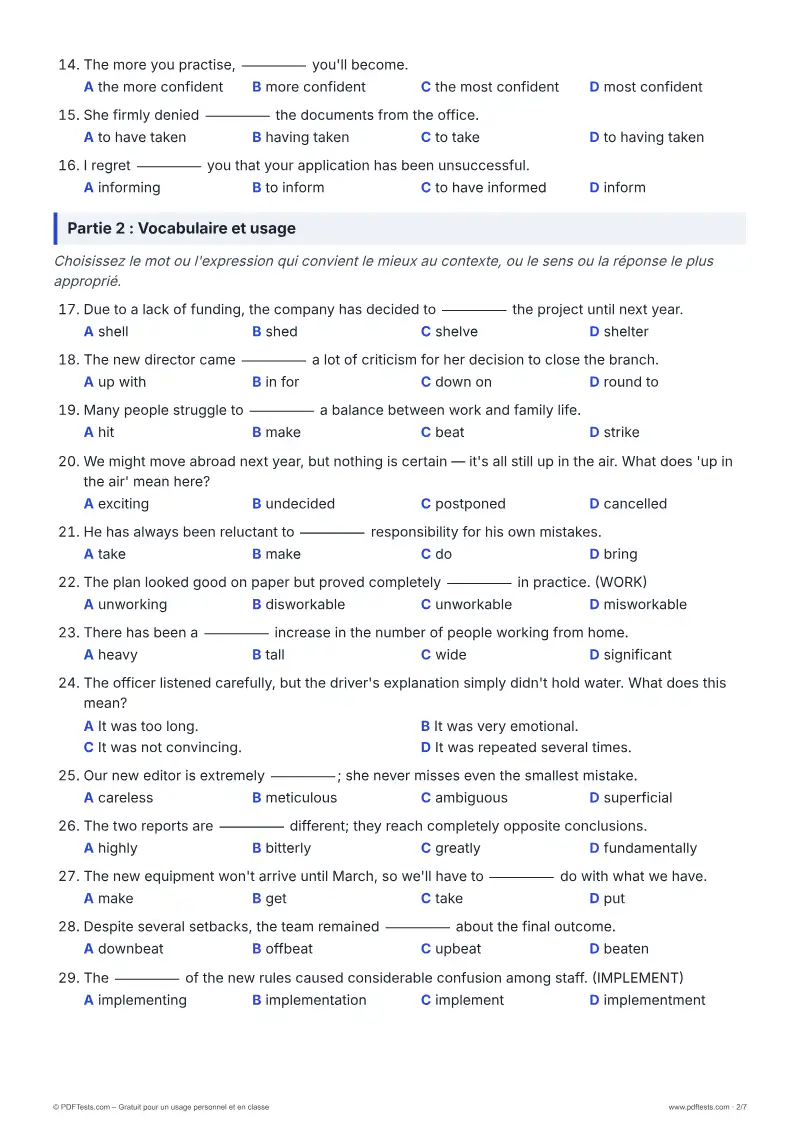
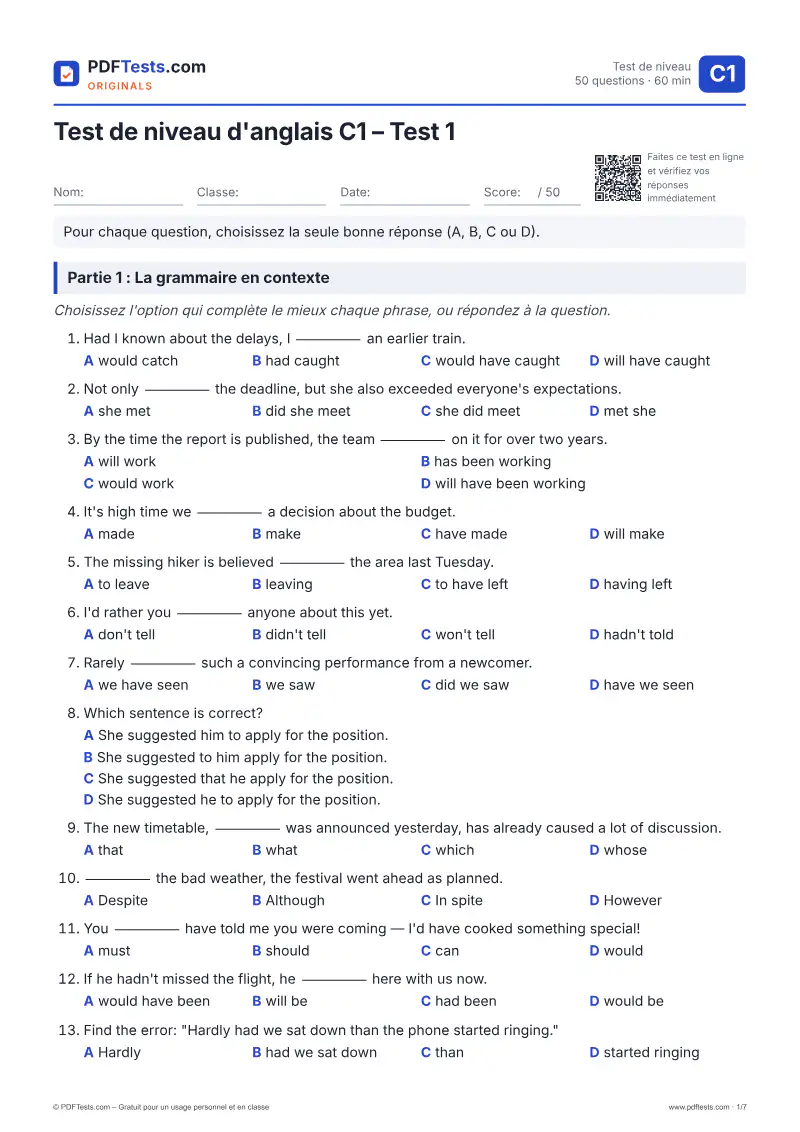
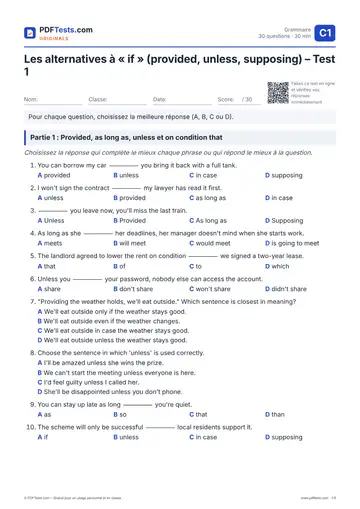
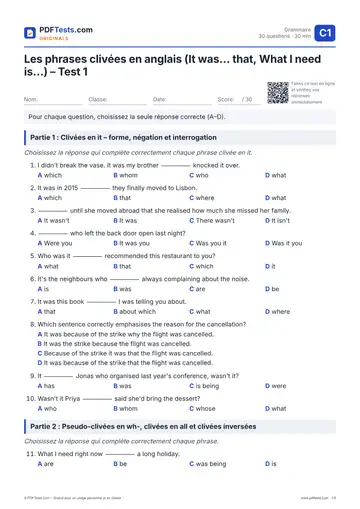
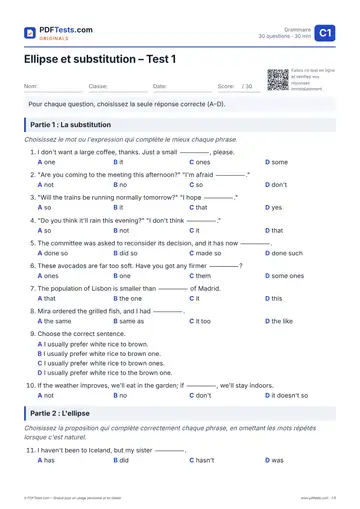
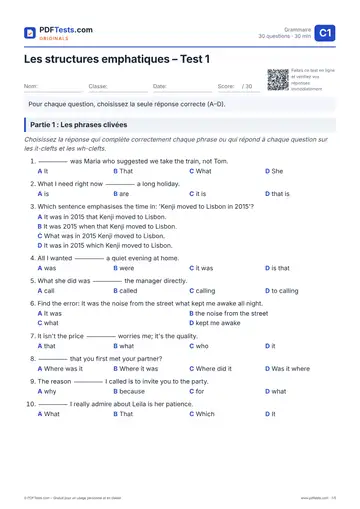
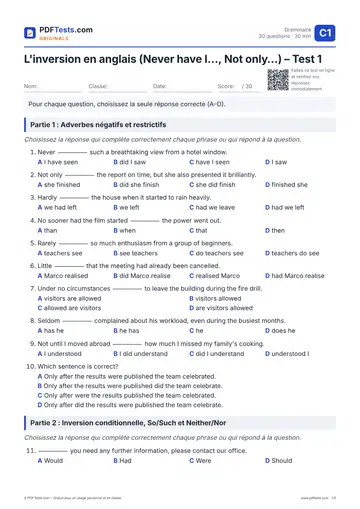
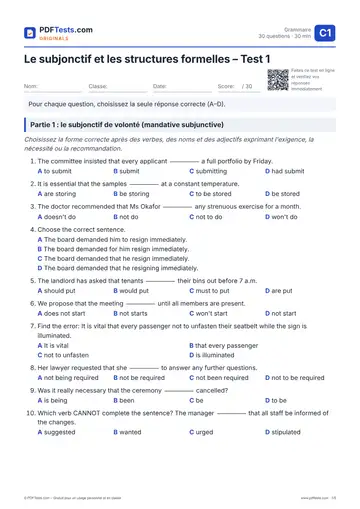
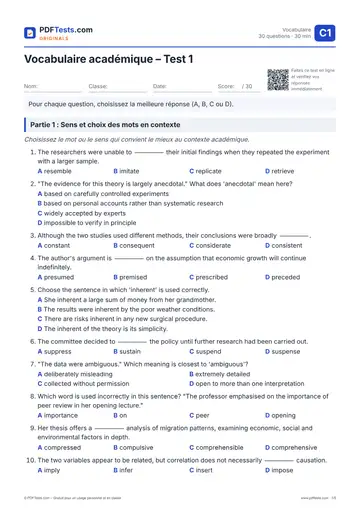
Aperçu de la page 1 : Test de niveau d'anglais C1 – Test 1 Ouvrir le PDF

Faire le test en ligne

Pour chaque question, choisissez la seule bonne réponse (A, B, C ou D). Choisissez vos réponses, puis cliquez sur « Vérifier mes réponses ».

Partie 1 : La grammaire en contexte

Choisissez l'option qui complète le mieux chaque phrase, ou répondez à la question.

  1. Had I known about the delays, I _____ an earlier train.

  2. Not only _____ the deadline, but she also exceeded everyone's expectations.

  3. By the time the report is published, the team _____ on it for over two years.

  4. It's high time we _____ a decision about the budget.

  5. The missing hiker is believed _____ the area last Tuesday.

  6. I'd rather you _____ anyone about this yet.

  7. Rarely _____ such a convincing performance from a newcomer.

  8. Which sentence is correct?

  9. The new timetable, _____ was announced yesterday, has already caused a lot of discussion.

  10. _____ the bad weather, the festival went ahead as planned.

  11. You _____ have told me you were coming — I'd have cooked something special!

  12. If he hadn't missed the flight, he _____ here with us now.

  13. Find the error: "Hardly had we sat down than the phone started ringing."

  14. The more you practise, _____ you'll become.

  15. She firmly denied _____ the documents from the office.

  16. I regret _____ you that your application has been unsuccessful.

Partie 2 : Vocabulaire et usage

Choisissez le mot ou l'expression qui convient le mieux au contexte, ou le sens ou la réponse le plus approprié.

  1. Due to a lack of funding, the company has decided to _____ the project until next year.

  2. The new director came _____ a lot of criticism for her decision to close the branch.

  3. Many people struggle to _____ a balance between work and family life.

  4. We might move abroad next year, but nothing is certain — it's all still up in the air. What does 'up in the air' mean here?

  5. He has always been reluctant to _____ responsibility for his own mistakes.

  6. The plan looked good on paper but proved completely _____ in practice. (WORK)

  7. There has been a _____ increase in the number of people working from home.

  8. The officer listened carefully, but the driver's explanation simply didn't hold water. What does this mean?

  9. Our new editor is extremely _____; she never misses even the smallest mistake.

  10. The two reports are _____ different; they reach completely opposite conclusions.

  11. The new equipment won't arrive until March, so we'll have to _____ do with what we have.

  12. Despite several setbacks, the team remained _____ about the final outcome.

  13. The _____ of the new rules caused considerable confusion among staff. (IMPLEMENT)

  14. A: "I can't believe they've cancelled the concert again!" B: "_____"

Partie 3 : Structures avancées

Choisissez l'option qui complète le mieux chaque phrase, ou répondez à la question.

  1. _____ it not been for her quick thinking, the situation could have been much worse.

  2. Should you _____ any further assistance, please do not hesitate to contact us.

  3. The building, _____ roof was damaged in the storm, is now being repaired.

  4. So _____ was the demand that the tickets sold out within minutes.

  5. I'd sooner _____ at home than go to that party.

  6. Little _____ that his decision would change everything.

  7. Which sentence is correct?

  8. It was not until midnight _____ the last guests finally left.

  9. The proposal is unlikely to be accepted, _____ it is.

  10. Find the error: "The number of applicants have risen sharply this year."

  11. Suppose you _____ a large sum of money, what would you do with it?

  12. The results, _____ we had been waiting for weeks, finally arrived this morning.

  13. Under no circumstances _____ the door be left unlocked.

  14. Were the plan _____, thousands of new jobs would be created.

Partie 4 : Compréhension écrite

Lisez le texte et choisissez la meilleure réponse à chaque question.

For most of us, boredom is something to be avoided at all costs. The moment we find ourselves waiting in a queue or sitting on a train with nothing to do, we reach for our phones, scrolling through messages and headlines until the empty minutes have been filled. Yet a growing body of research suggests that this reflex may come at a price, and that the state we work so hard to escape could in fact serve a useful purpose.

Psychologists have long distinguished between boredom and simple inactivity. Boredom, they argue, is not the absence of stimulation but an uncomfortable signal that our current situation is failing to engage us. Seen in this light, it functions rather like hunger: unpleasant in itself, but valuable precisely because it prompts us to change what we are doing. Some studies have found that people who were first given a deliberately dull task, such as copying numbers from a long list, subsequently produced more original ideas in a creative exercise than those who had gone straight to it.

The explanation, researchers believe, lies in what happens when the mind is left to wander. Freed from the demands of an external task, it begins to make unexpected connections between memories, plans and half-formed thoughts. This is not to say that every idle moment yields a breakthrough; much of the time, mind-wandering is aimless. But the conditions for insight are rarely present when attention is constantly being captured by a screen.

None of this means that we should abandon our devices or romanticise tedium. Chronic boredom, particularly when it is linked to a lack of meaningful work or social contact, is associated with poorer wellbeing rather than greater creativity. The point is subtler: brief periods of unstructured time may be worth tolerating, and perhaps even protecting. Parents who feel obliged to fill every hour of their children's weekends with organised activities might, some educators suggest, be depriving them of the chance to learn how to entertain themselves.

Ultimately, the challenge is less about eliminating distraction than about noticing when we turn to it automatically. The next time you are tempted to fill a spare five minutes, you might simply let them pass and see where your thoughts take you.

  1. According to the first paragraph, what does recent research suggest?

  2. Why does the writer compare boredom to hunger?

  3. What did the studies mentioned in the second paragraph show?

  4. The word 'yields' in the third paragraph is closest in meaning to:

  5. What is the writer's view of chronic boredom?

  6. What is the main purpose of the final paragraph?

Aperçu

À propos de ce test

Ce test de positionnement C1 évalue la grammaire, le vocabulaire et la compréhension écrite attendus d'un utilisateur expérimenté de l'anglais : inversion, conditionnels mixtes, collocations, expressions idiomatiques et formation des mots. Il s'adresse aux enseignants qui orientent leurs élèves vers des cours de niveau avancé, ainsi qu'aux apprenants qui souhaitent vérifier s'ils maîtrisent vraiment le niveau C1.

Thèmes abordés

Conditionnels et inversionInfinitif passé et infinitif passifPropositions relativesCollocations et expressions idiomatiquesVerbes à particule (phrasal verbs)Formation des motsAccord sujet-verbeCompréhension écrite

Comment utiliser ce test

  1. Téléchargez le PDF et imprimez-le, ou faites le test en ligne ci-dessous.
  2. Répondez à toutes les questions sans dictionnaire et sans vous presser.
  3. Vérifiez vos réponses et notez les points à revoir.

Notes pour l’enseignant

Utilisez le score comme repère : 40 bonnes réponses ou plus indiquent un niveau C1 acquis, de 30 à 39 un niveau C1 en cours d'acquisition, et moins de 30 une orientation vers le niveau B2. Le test cible les erreurs typiques des apprenants avancés : absence d'inversion après une expression négative en tête de phrase, mauvaises constructions verbales (suggest, deny, regret), participes « orphelins » (dangling participles) et collocations approximatives. Analysez les erreurs par catégorie, puis proposez des exercices ciblés sur l'inversion et les collocations, les deux points qui posent le plus de difficultés à ce niveau.