PDFTests Originals

Formation des mots (C1) – Test 1

C1 Avancé VocabulaireAnglais

Ce test de vocabulaire C1 évalue votre capacité à former et à choisir la bonne forme d'un mot en anglais. Il porte sur les préfixes négatifs et les préfixes qui modifient le sens, sur les suffixes de noms, d'adjectifs, de verbes et d'adverbes, ainsi que sur la formation des mots dans un texte complet. Il s'adresse aux apprenants avancés qui préparent un examen de niveau C1 et aux enseignants qui cherchent un test prêt à l'emploi, en classe ou à la maison.
Questions
30
Durée
35 min
PDF
5 pages
Corrigé
Inclus
  • 100 % gratuit
  • Sans inscription
  • PDF A4 prêt à imprimer
Aperçu de la page 1 : Formation des mots (C1) – Test 1 Ouvrir le PDF

Faire le test en ligne

Pour chaque question, choisissez la meilleure réponse (A, B, C ou D). Choisissez vos réponses, puis cliquez sur « Vérifier mes réponses ».

Partie 1 : Les préfixes

Choisissez le mot ou la phrase dont le préfixe est correctement formé.

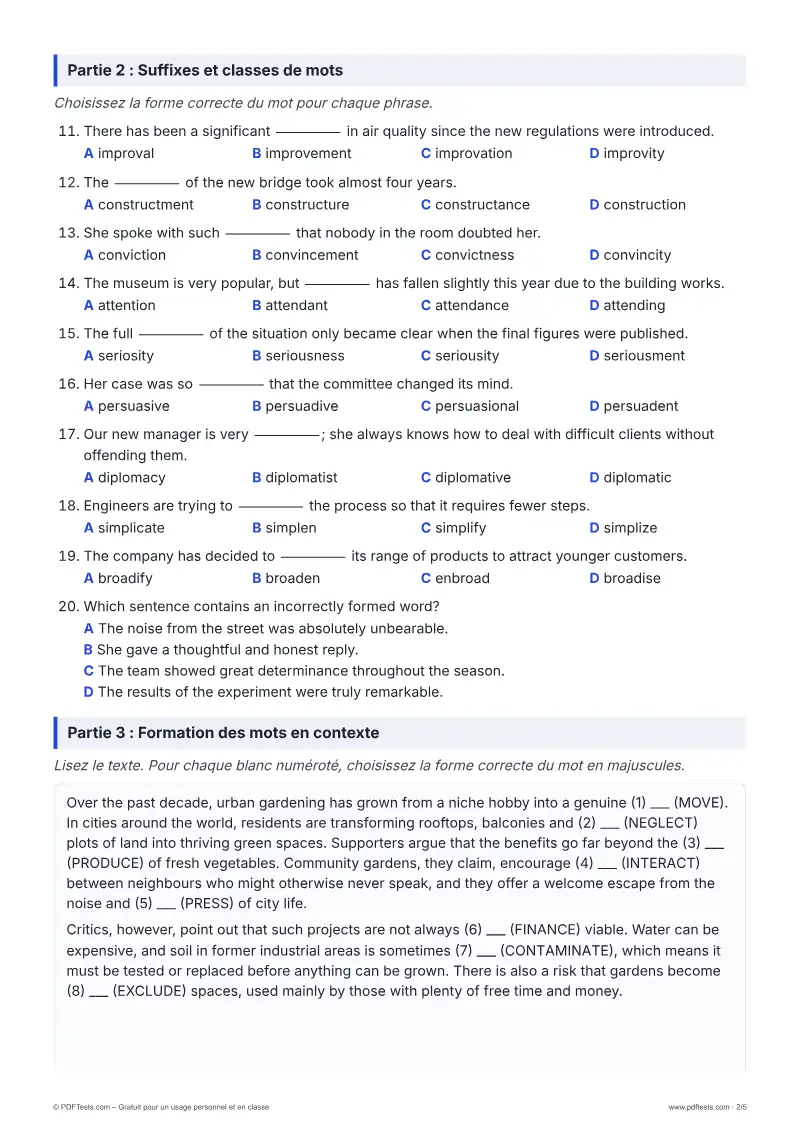
  1. The witness's account was so _____ that the police dismissed it within an hour.

  2. Many experts believe the company's sales target is _____ given the current state of the market.

  3. Choose the correct sentence.

  4. Children quickly _____ their shoes, so buying expensive ones is often a waste of money.

  5. Which word in this sentence is incorrectly formed? 'The new rules could disadvantage smaller businesses and have been widely criticised as irresponsible and unlogical.'

  6. The journalist was accused of deliberately _____ the facts to support her own argument.

  7. Children who are _____ often find it difficult to concentrate at school.

  8. The update was _____ with older devices, so many users were unable to install it.

  9. Punishing students too harshly can be _____: it often makes them less motivated rather than more.

  10. The manufacturer claimed the product was almost risk-free, but in reality the dangers had been seriously _____.

Partie 2 : Suffixes et classes de mots

Choisissez la forme correcte du mot pour chaque phrase.

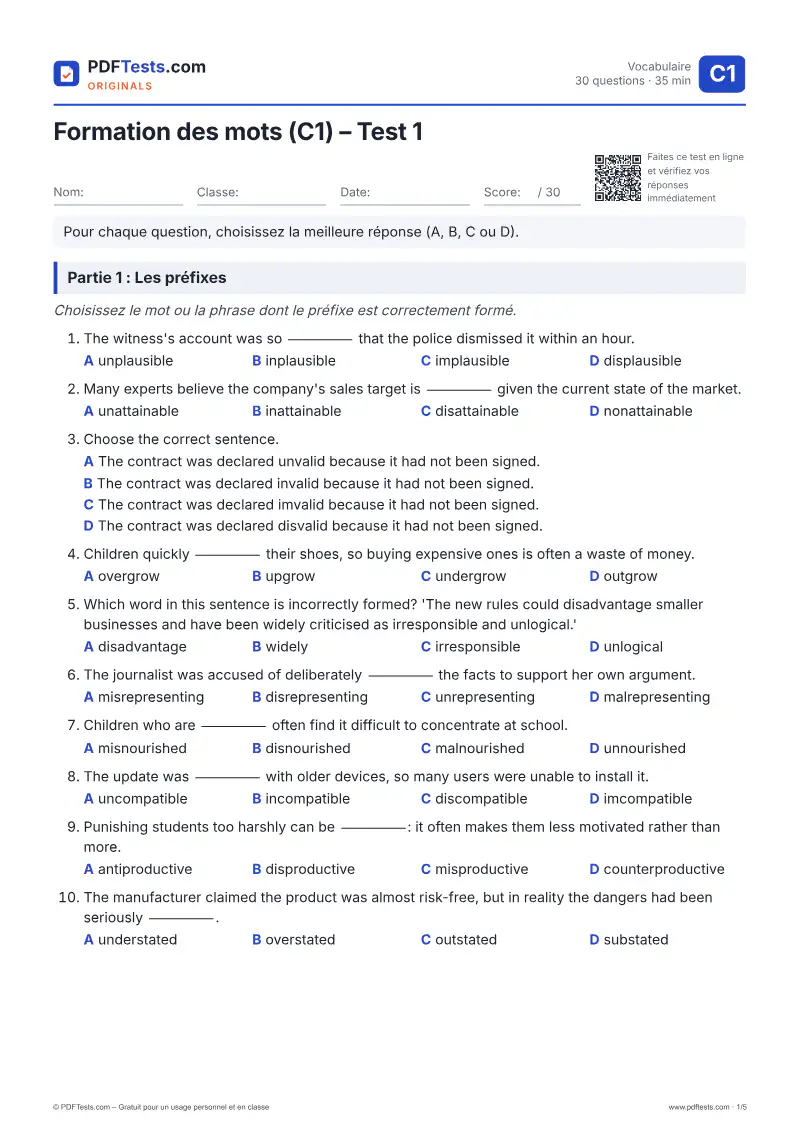
  1. There has been a significant _____ in air quality since the new regulations were introduced.

  2. The _____ of the new bridge took almost four years.

  3. She spoke with such _____ that nobody in the room doubted her.

  4. The museum is very popular, but _____ has fallen slightly this year due to the building works.

  5. The full _____ of the situation only became clear when the final figures were published.

  6. Her case was so _____ that the committee changed its mind.

  7. Our new manager is very _____; she always knows how to deal with difficult clients without offending them.

  8. Engineers are trying to _____ the process so that it requires fewer steps.

  9. The company has decided to _____ its range of products to attract younger customers.

  10. Which sentence contains an incorrectly formed word?

Partie 3 : Formation des mots en contexte

Lisez le texte. Pour chaque blanc numéroté, choisissez la forme correcte du mot en majuscules.

Over the past decade, urban gardening has grown from a niche hobby into a genuine (1) ___ (MOVE). In cities around the world, residents are transforming rooftops, balconies and (2) ___ (NEGLECT) plots of land into thriving green spaces. Supporters argue that the benefits go far beyond the (3) ___ (PRODUCE) of fresh vegetables. Community gardens, they claim, encourage (4) ___ (INTERACT) between neighbours who might otherwise never speak, and they offer a welcome escape from the noise and (5) ___ (PRESS) of city life.

Critics, however, point out that such projects are not always (6) ___ (FINANCE) viable. Water can be expensive, and soil in former industrial areas is sometimes (7) ___ (CONTAMINATE), which means it must be tested or replaced before anything can be grown. There is also a risk that gardens become (8) ___ (EXCLUDE) spaces, used mainly by those with plenty of free time and money.

Nevertheless, a growing number of local councils now recognise the (9) ___ (SIGNIFY) of green spaces for public health and well-being. Many have introduced schemes to make unused land more (10) ___ (ACCESS) to residents, and early results suggest that these efforts are paying off.

  1. Gap (1) – MOVE

  2. Gap (2) – NEGLECT

  3. Gap (3) – PRODUCE

  4. Gap (4) – INTERACT

  5. Gap (5) – PRESS

  6. Gap (6) – FINANCE

  7. Gap (7) – CONTAMINATE

  8. Gap (8) – EXCLUDE

  9. Gap (9) – SIGNIFY

  10. Gap (10) – ACCESS

Aperçu

À propos de ce test

Ce test de vocabulaire C1 évalue votre capacité à former et à choisir la bonne forme d'un mot en anglais. Il porte sur les préfixes négatifs et les préfixes qui modifient le sens, sur les suffixes de noms, d'adjectifs, de verbes et d'adverbes, ainsi que sur la formation des mots dans un texte complet. Il s'adresse aux apprenants avancés qui préparent un examen de niveau C1 et aux enseignants qui cherchent un test prêt à l'emploi, en classe ou à la maison.

Thèmes abordés

Préfixes négatifsPréfixes modifiant le sensSuffixes de nomsSuffixes d'adjectifs et de verbesFamilles de motsFormation des mots en contexte

Comment utiliser ce test

  1. Téléchargez le PDF et imprimez-le, ou faites le test en ligne ci-dessous.
  2. Répondez à toutes les questions sans dictionnaire et sans vous presser.
  3. Vérifiez vos réponses et notez les points à revoir.

Notes pour l’enseignant

Utilisez ce test après avoir étudié les schémas de préfixation et de suffixation, ou comme évaluation diagnostique avant une préparation à un examen C1. Il cible des erreurs typiques des apprenants avancés : choix du mauvais préfixe négatif (unlogical, inplausible), invention de noms inexistants (determinance, improval) et confusion entre mots d'une même famille (neglectful/negligent/negligible, exclusive/excluded). En prolongement, demandez aux élèves de construire des tableaux de familles de mots à partir des mots de base de la partie 3, puis de rédiger leurs propres phrases à trous.