PDFTests Originals

Révision de grammaire avancée – Test 1

C2 Maîtrise GrammaireAnglais

Cette révision de grammaire de niveau C2 porte sur les structures qui distinguent les utilisateurs expérimentés : inversion, subjonctif, conditionnels mixtes, phrases clivées (cleft sentences), propositions participiales et ellipse. Elle s'adresse aux apprenants avancés qui préparent un examen de niveau C2 et aux enseignants qui souhaitent vérifier rapidement et rigoureusement la maîtrise de la forme, du sens et de l'emploi.
Questions
30
Durée
35 min
PDF
5 pages
Corrigé
Inclus
  • 100 % gratuit
  • Sans inscription
  • PDF A4 prêt à imprimer
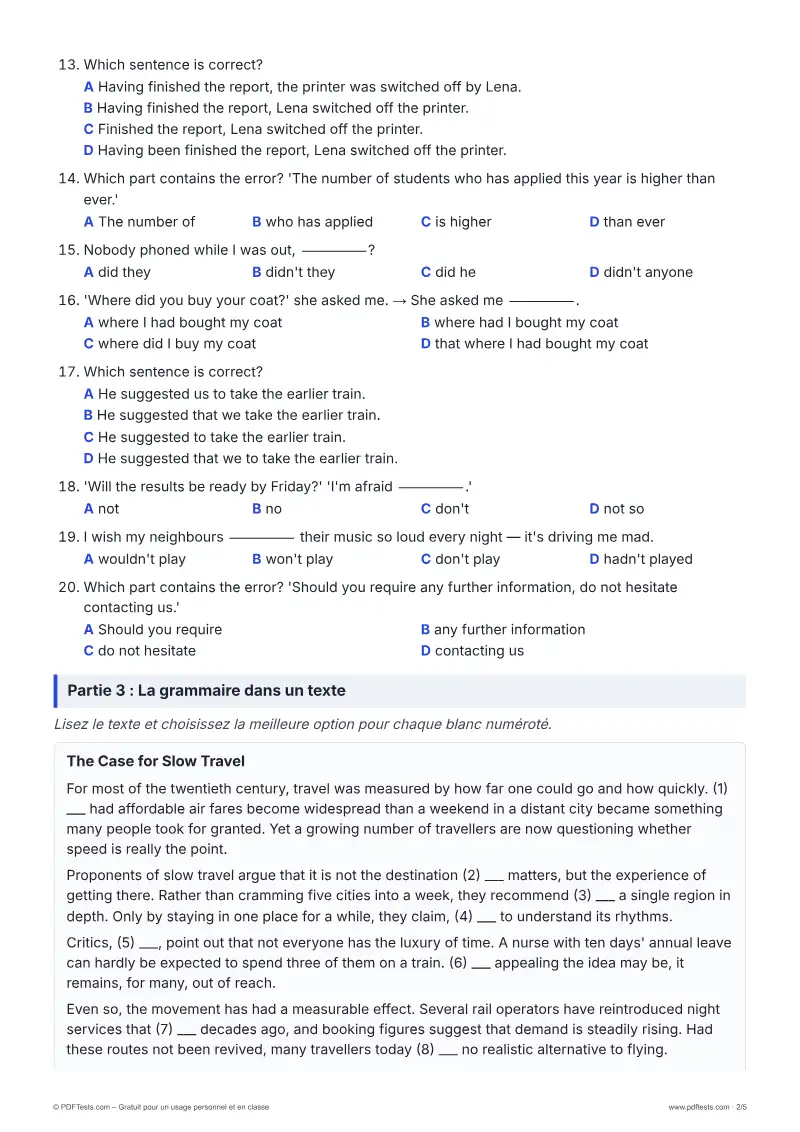
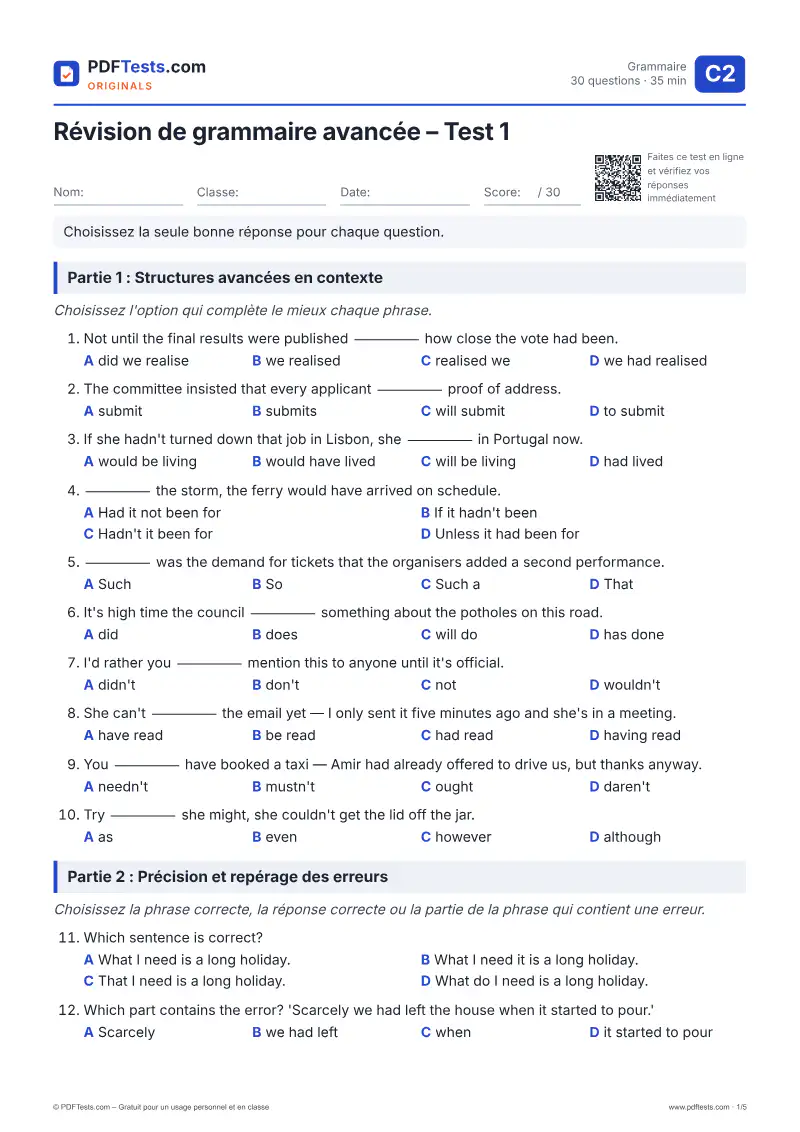
Aperçu de la page 1 : Révision de grammaire avancée – Test 1 Ouvrir le PDF

Faire le test en ligne

Choisissez la seule bonne réponse pour chaque question. Choisissez vos réponses, puis cliquez sur « Vérifier mes réponses ».

Partie 1 : Structures avancées en contexte

Choisissez l'option qui complète le mieux chaque phrase.

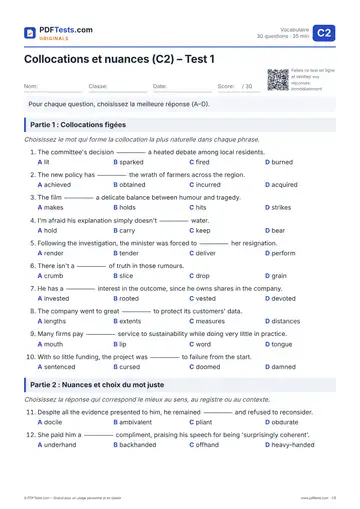
  1. Not until the final results were published _____ how close the vote had been.

  2. The committee insisted that every applicant _____ proof of address.

  3. If she hadn't turned down that job in Lisbon, she _____ in Portugal now.

  4. _____ the storm, the ferry would have arrived on schedule.

  5. _____ was the demand for tickets that the organisers added a second performance.

  6. It's high time the council _____ something about the potholes on this road.

  7. I'd rather you _____ mention this to anyone until it's official.

  8. She can't _____ the email yet — I only sent it five minutes ago and she's in a meeting.

  9. You _____ have booked a taxi — Amir had already offered to drive us, but thanks anyway.

  10. Try _____ she might, she couldn't get the lid off the jar.

Partie 2 : Précision et repérage des erreurs

Choisissez la phrase correcte, la réponse correcte ou la partie de la phrase qui contient une erreur.

  1. Which sentence is correct?

  2. Which part contains the error? 'Scarcely we had left the house when it started to pour.'

  3. Which sentence is correct?

  4. Which part contains the error? 'The number of students who has applied this year is higher than ever.'

  5. Nobody phoned while I was out, _____?

  6. 'Where did you buy your coat?' she asked me. → She asked me _____.

  7. Which sentence is correct?

  8. 'Will the results be ready by Friday?' 'I'm afraid _____.'

  9. I wish my neighbours _____ their music so loud every night — it's driving me mad.

  10. Which part contains the error? 'Should you require any further information, do not hesitate contacting us.'

Partie 3 : La grammaire dans un texte

Lisez le texte et choisissez la meilleure option pour chaque blanc numéroté.

The Case for Slow Travel

For most of the twentieth century, travel was measured by how far one could go and how quickly. (1) ___ had affordable air fares become widespread than a weekend in a distant city became something many people took for granted. Yet a growing number of travellers are now questioning whether speed is really the point.

Proponents of slow travel argue that it is not the destination (2) ___ matters, but the experience of getting there. Rather than cramming five cities into a week, they recommend (3) ___ a single region in depth. Only by staying in one place for a while, they claim, (4) ___ to understand its rhythms.

Critics, (5) ___, point out that not everyone has the luxury of time. A nurse with ten days' annual leave can hardly be expected to spend three of them on a train. (6) ___ appealing the idea may be, it remains, for many, out of reach.

Even so, the movement has had a measurable effect. Several rail operators have reintroduced night services that (7) ___ decades ago, and booking figures suggest that demand is steadily rising. Had these routes not been revived, many travellers today (8) ___ no realistic alternative to flying.

Perhaps the most valuable lesson of slow travel is not about transport at all. It is a reminder that (9) ___ we hurry, the less we notice. Whether or not we ever board a sleeper train, it is worth asking ourselves how much we (10) ___ by always rushing to the next thing.

  1. Gap (1)

  2. Gap (2)

  3. Gap (3)

  4. Gap (4)

  5. Gap (5)

  6. Gap (6)

  7. Gap (7)

  8. Gap (8)

  9. Gap (9)

  10. Gap (10)

Aperçu

À propos de ce test

Cette révision de grammaire de niveau C2 porte sur les structures qui distinguent les utilisateurs expérimentés : inversion, subjonctif, conditionnels mixtes, phrases clivées (cleft sentences), propositions participiales et ellipse. Elle s'adresse aux apprenants avancés qui préparent un examen de niveau C2 et aux enseignants qui souhaitent vérifier rapidement et rigoureusement la maîtrise de la forme, du sens et de l'emploi.

Thèmes abordés

Inversion et antéposition (fronting)Subjonctif et passé irréel (unreal past)Conditionnels mixtes (mixed conditionals)Modaux au passé (modal perfects)Phrases clivées (cleft sentences)Propositions participiales (participle clauses)Ellipse et substitutionStructures concessives

Comment utiliser ce test

  1. Téléchargez le PDF et imprimez-le, ou faites le test en ligne ci-dessous.
  2. Répondez à toutes les questions sans dictionnaire et sans vous presser.
  3. Vérifiez vos réponses et notez les points à revoir.

Notes pour l’enseignant

Utilisez ce test comme évaluation diagnostique ou comme révision avant un examen de niveau C2. Il cible des erreurs tenaces chez les apprenants avancés : absence d'inversion de l'auxiliaire après un adverbe négatif en tête de phrase, indicatif après les verbes de demande ou d'obligation (mandative verbs), participes « en l'air » (dangling participles), la construction fautive « suggest + objet + infinitif » et l'accord sujet-verbe avec « the number of ». En prolongement, demandez aux élèves de corriger les options incorrectes, ou de réécrire le texte de lecture dans un registre plus ou moins soutenu.