PDFTests Originals

Travel and Shopping – Test 1

A2 Elementary VocabularyFrench

This A2 French vocabulary test covers everyday words for travelling and shopping, such as transport, hotels, shops, prices, sizes and payment. It is for learners at the end of beginner level and for teachers who want a quick, printable check of topic vocabulary. The 30 questions move from basic word meaning to collocations and a short reading text with word families.
Questions
30
Time
30 min
PDF
4 pages
Answer key
Included
  • 100% free
  • No sign-up or email
  • Print-ready A4 PDF
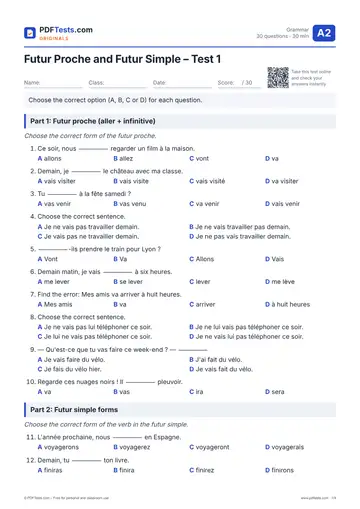
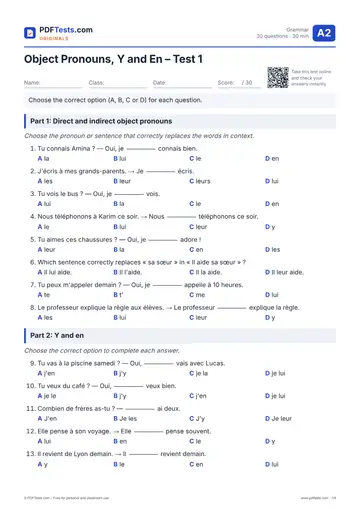
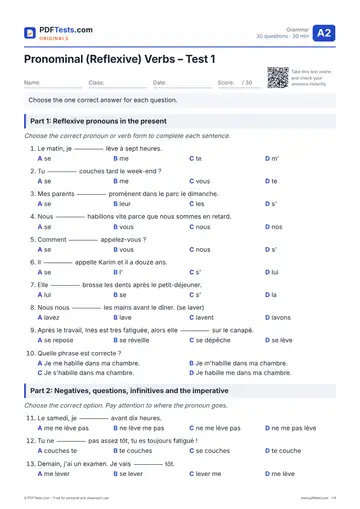
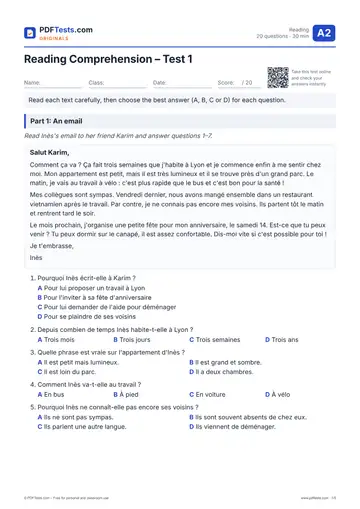
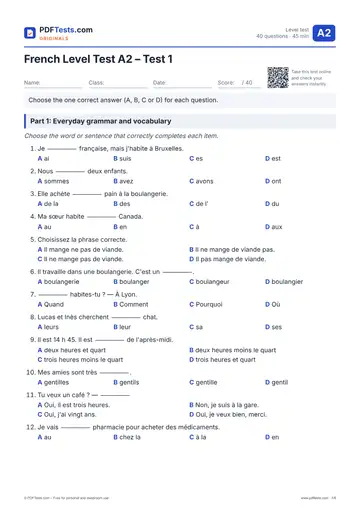
Preview of page 1 of Travel and Shopping – Test 1 Open PDF

Take the test online

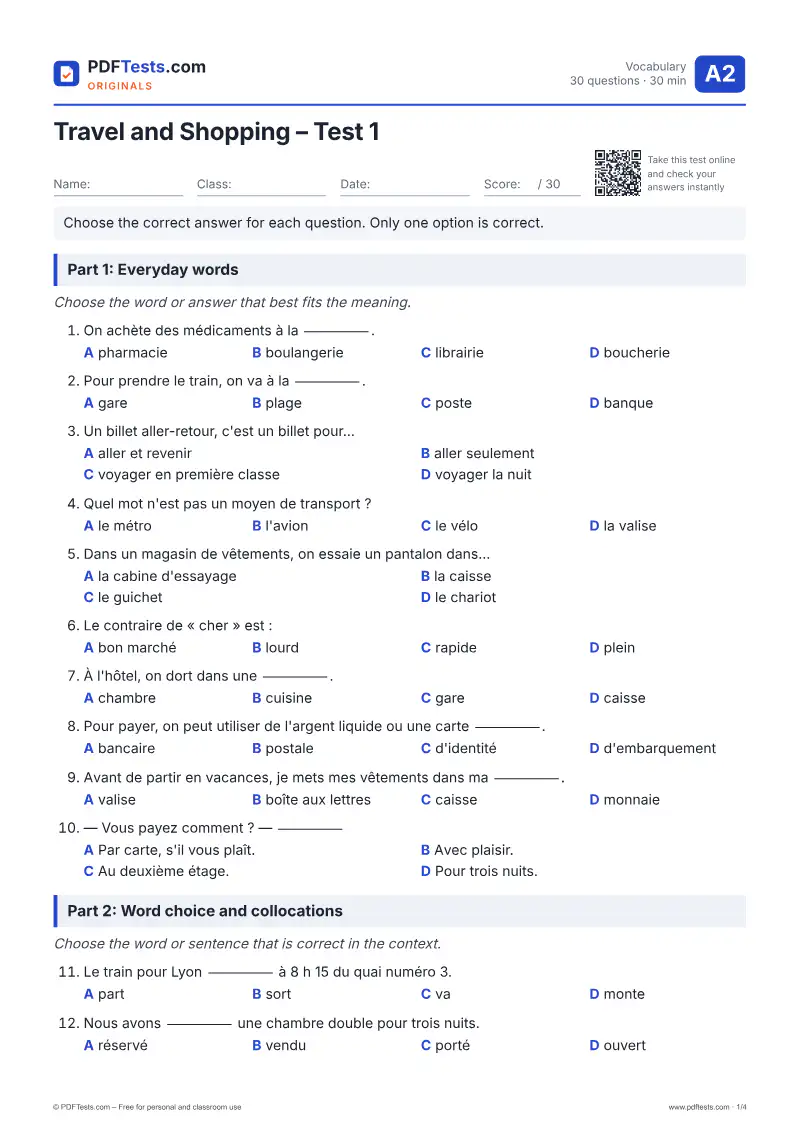
Choose the correct answer for each question. Only one option is correct. Choose your answers, then press “Check my answers”.

Part 1: Everyday words

Choose the word or answer that best fits the meaning.

  1. On achète des médicaments à la _____.

  2. Pour prendre le train, on va à la _____.

  3. Un billet aller-retour, c'est un billet pour…

  4. Quel mot n'est pas un moyen de transport ?

  5. Dans un magasin de vêtements, on essaie un pantalon dans…

  6. Le contraire de « cher » est :

  7. À l'hôtel, on dort dans une _____.

  8. Pour payer, on peut utiliser de l'argent liquide ou une carte _____.

  9. Avant de partir en vacances, je mets mes vêtements dans ma _____.

  10. — Vous payez comment ? — _____

Part 2: Word choice and collocations

Choose the word or sentence that is correct in the context.

  1. Le train pour Lyon _____ à 8 h 15 du quai numéro 3.

  2. Nous avons _____ une chambre double pour trois nuits.

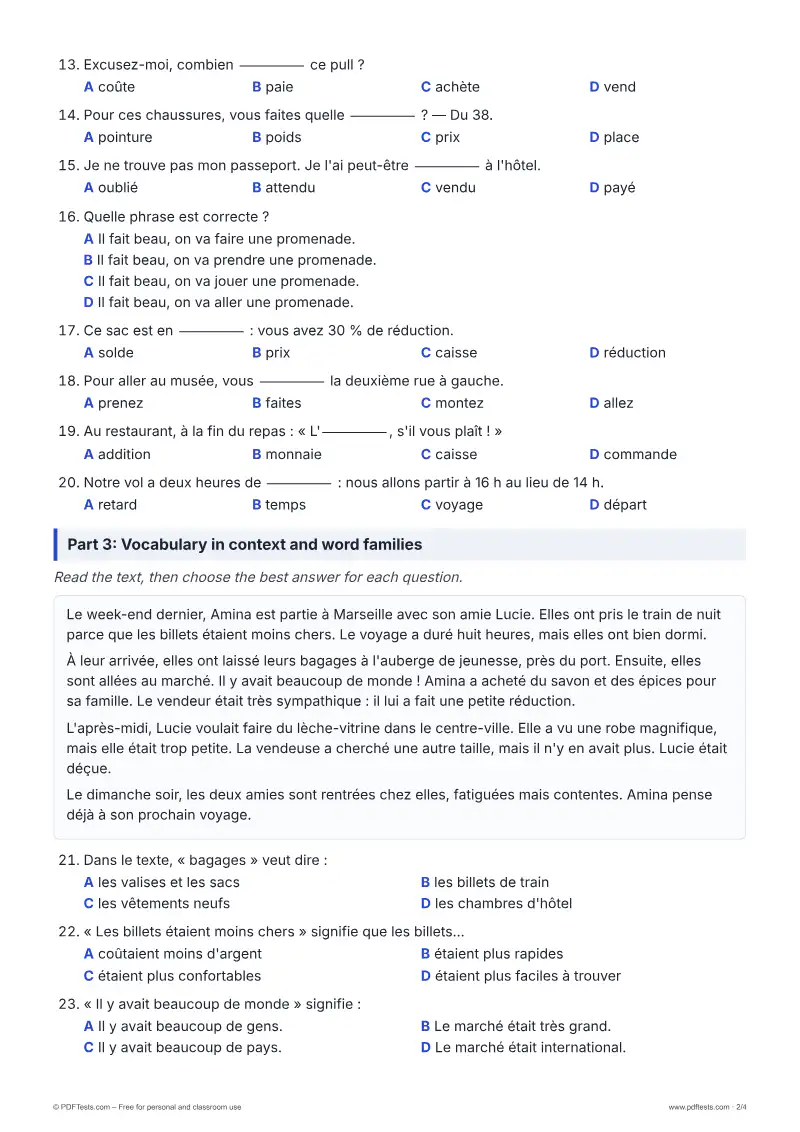
  3. Excusez-moi, combien _____ ce pull ?

  4. Pour ces chaussures, vous faites quelle _____ ? — Du 38.

  5. Je ne trouve pas mon passeport. Je l'ai peut-être _____ à l'hôtel.

  6. Quelle phrase est correcte ?

  7. Ce sac est en _____ : vous avez 30 % de réduction.

  8. Pour aller au musée, vous _____ la deuxième rue à gauche.

  9. Au restaurant, à la fin du repas : « L'_____, s'il vous plaît ! »

  10. Notre vol a deux heures de _____ : nous allons partir à 16 h au lieu de 14 h.

Part 3: Vocabulary in context and word families

Read the text, then choose the best answer for each question.

Le week-end dernier, Amina est partie à Marseille avec son amie Lucie. Elles ont pris le train de nuit parce que les billets étaient moins chers. Le voyage a duré huit heures, mais elles ont bien dormi.

À leur arrivée, elles ont laissé leurs bagages à l'auberge de jeunesse, près du port. Ensuite, elles sont allées au marché. Il y avait beaucoup de monde ! Amina a acheté du savon et des épices pour sa famille. Le vendeur était très sympathique : il lui a fait une petite réduction.

L'après-midi, Lucie voulait faire du lèche-vitrine dans le centre-ville. Elle a vu une robe magnifique, mais elle était trop petite. La vendeuse a cherché une autre taille, mais il n'y en avait plus. Lucie était déçue.

Le dimanche soir, les deux amies sont rentrées chez elles, fatiguées mais contentes. Amina pense déjà à son prochain voyage.

  1. Dans le texte, « bagages » veut dire :

  2. « Les billets étaient moins chers » signifie que les billets…

  3. « Il y avait beaucoup de monde » signifie :

  4. « Il lui a fait une petite réduction » signifie qu'Amina…

  5. « Faire du lèche-vitrine », c'est :

  6. « Il n'y en avait plus » signifie :

  7. Amina adore voyager : c'est une grande _____.

  8. Le contraire du mot « arrivée » est :

  9. Au marché, Amina a fait des _____ pour sa famille.

  10. Les amies sont rentrées « fatiguées ». Le nom de la même famille est :

Preview

About this test

This A2 French vocabulary test covers everyday words for travelling and shopping, such as transport, hotels, shops, prices, sizes and payment. It is for learners at the end of beginner level and for teachers who want a quick, printable check of topic vocabulary. The 30 questions move from basic word meaning to collocations and a short reading text with word families.

Topics covered

Travel vocabularyShops and shoppingTransport and stationsHotels and bookingsPrices and paymentCollocationsWord families

How to use this test

  1. Download the PDF and print it, or take the test online below.
  2. Answer every question without a dictionary or time pressure.
  3. Check your answers and note the topics you need to review.

Notes for teachers

Use this test after a unit on travel and shopping, or as a diagnostic before a trip-themed project. It targets common errors such as anglicisms (prendre une promenade), confusion between taille and pointure, and mixing up shop names. As a follow-up, ask learners to role-play a scene at a shop or a station using the key collocations from Part 2.