PDFTests Originals

Imparfait – Test 1

A2 Elementary GrammarFrench

This A2 French grammar test checks how well you form and use the imparfait. It covers regular and irregular forms and spelling changes like mangeais and commençait. It also covers habits and descriptions in the past, background actions, negatives and questions. It suits learners at the end of A2 and teachers who need a quick printable check.
Questions
30
Time
30 min
PDF
4 pages
Answer key
Included
  • 100% free
  • No sign-up or email
  • Print-ready A4 PDF
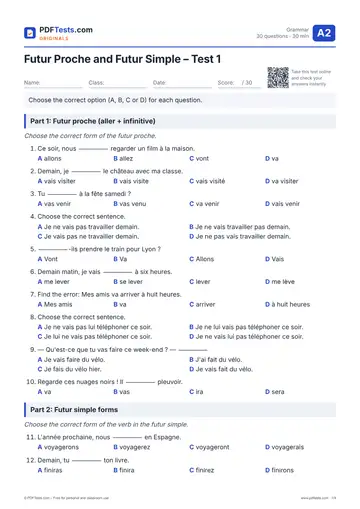
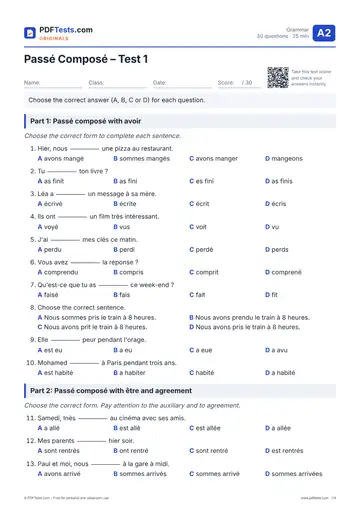
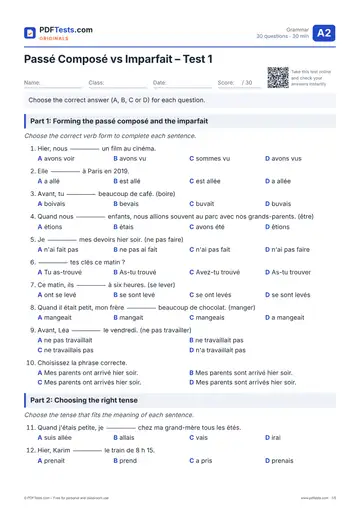
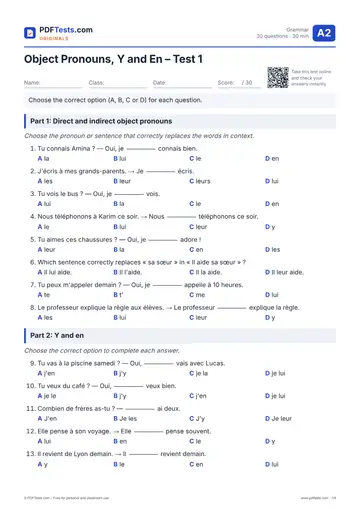
Preview of page 1 of Imparfait – Test 1 Open PDF

Take the test online

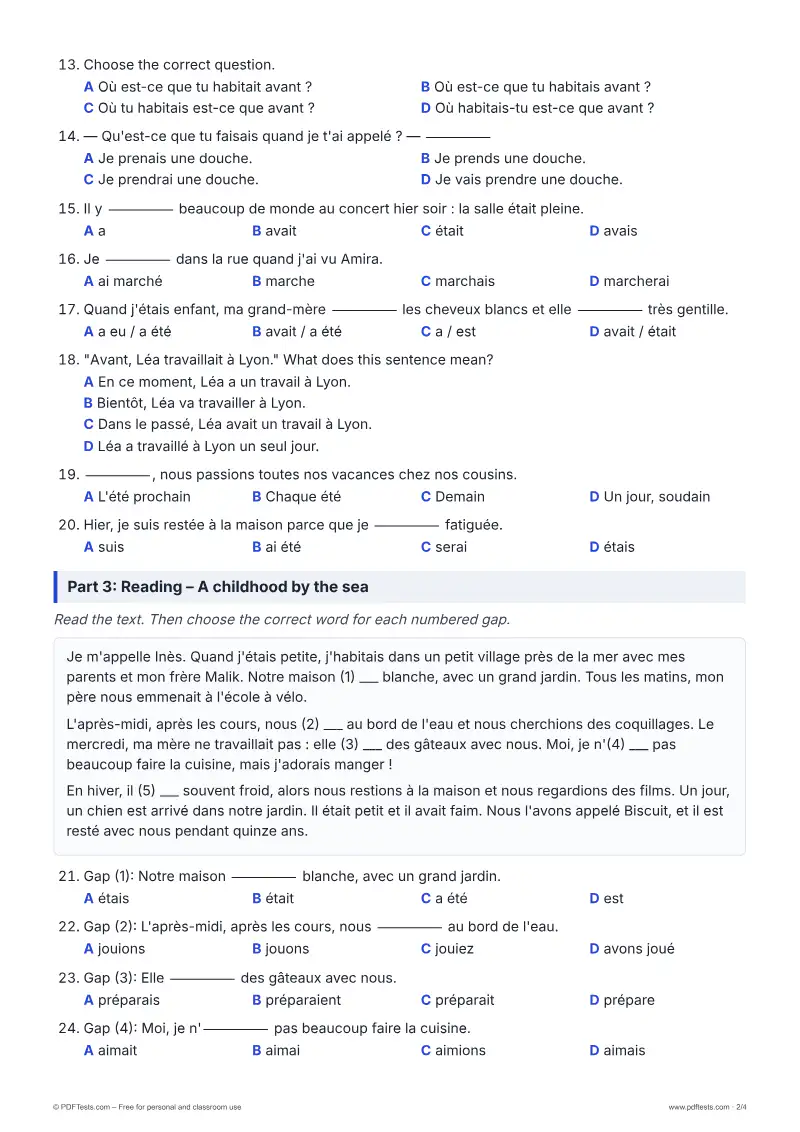
Choose the correct option (A, B, C or D) for each question. Choose your answers, then press “Check my answers”.

Part 1: Forms of the imparfait

Choose the correct imparfait form to complete each sentence.

  1. Quand j'étais petit, je _____ beaucoup de chocolat. (manger)

  2. Quand nous étions enfants, nous _____ souvent à la plage le dimanche. (aller)

  3. Autrefois, mes grands-parents _____ une grande maison à la campagne. (avoir)

  4. Quand tu avais dix ans, tu _____ en quelle classe ? (être)

  5. Quand vous étiez enfants, vous _____ vos devoirs le soir ? (faire)

  6. L'année dernière, elle _____ toujours ses cours à huit heures. (commencer)

  7. Il y a dix ans, au lycée, nous _____ l'anglais ensemble. (étudier)

  8. Autrefois, les enfants _____ toujours leur repas avant le dessert. (finir)

  9. Hier matin, il _____ beau, alors nous avons pris le petit-déjeuner dehors. (faire)

  10. Quand j'étais jeune, je ne _____ pas de café. (boire)

Part 2: Meaning and use

Choose the option that best completes or answers each item.

  1. Which sentence describes a habit in the past?

  2. Quand il était petit, Hugo _____ les légumes.

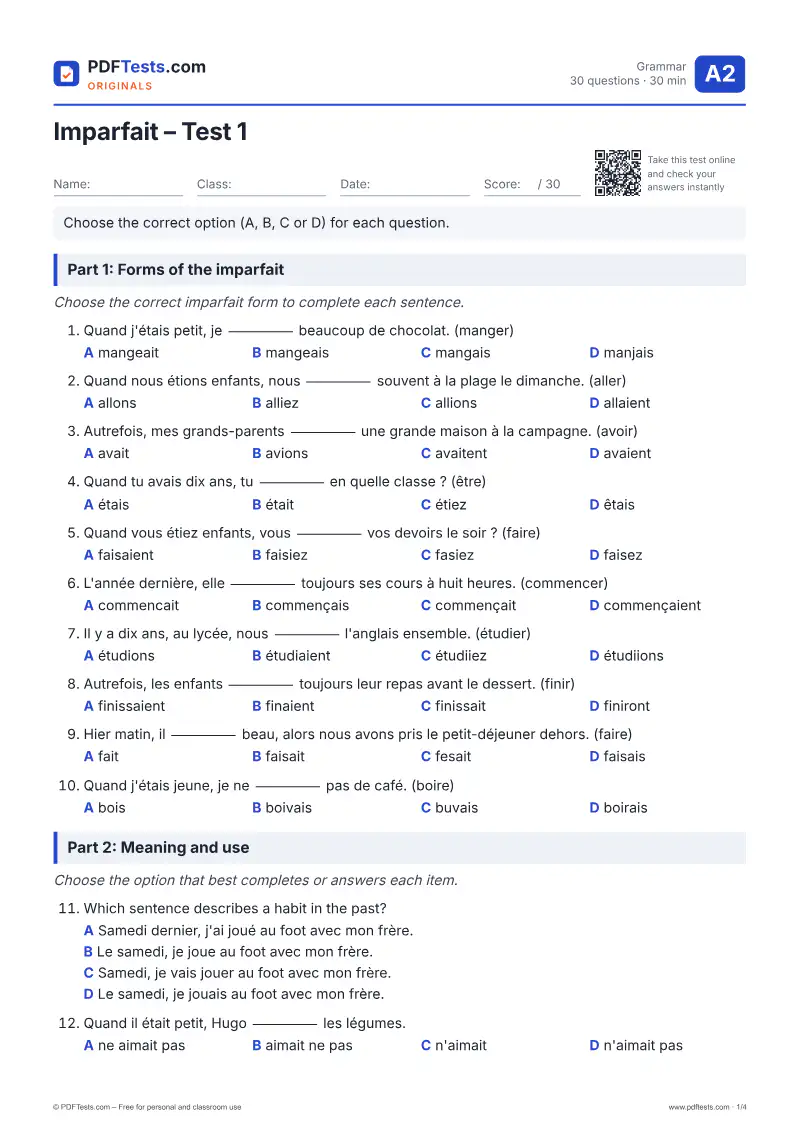
  3. Choose the correct question.

  4. — Qu'est-ce que tu faisais quand je t'ai appelé ? — _____

  5. Il y _____ beaucoup de monde au concert hier soir : la salle était pleine.

  6. Je _____ dans la rue quand j'ai vu Amira.

  7. Quand j'étais enfant, ma grand-mère _____ les cheveux blancs et elle _____ très gentille.

  8. "Avant, Léa travaillait à Lyon." What does this sentence mean?

  9. _____, nous passions toutes nos vacances chez nos cousins.

  10. Hier, je suis restée à la maison parce que je _____ fatiguée.

Part 3: Reading – A childhood by the sea

Read the text. Then choose the correct word for each numbered gap.

Je m'appelle Inès. Quand j'étais petite, j'habitais dans un petit village près de la mer avec mes parents et mon frère Malik. Notre maison (1) ___ blanche, avec un grand jardin. Tous les matins, mon père nous emmenait à l'école à vélo.

L'après-midi, après les cours, nous (2) ___ au bord de l'eau et nous cherchions des coquillages. Le mercredi, ma mère ne travaillait pas : elle (3) ___ des gâteaux avec nous. Moi, je n'(4) ___ pas beaucoup faire la cuisine, mais j'adorais manger !

En hiver, il (5) ___ souvent froid, alors nous restions à la maison et nous regardions des films. Un jour, un chien est arrivé dans notre jardin. Il était petit et il avait faim. Nous l'avons appelé Biscuit, et il est resté avec nous pendant quinze ans.

  1. Gap (1): Notre maison _____ blanche, avec un grand jardin.

  2. Gap (2): L'après-midi, après les cours, nous _____ au bord de l'eau.

  3. Gap (3): Elle _____ des gâteaux avec nous.

  4. Gap (4): Moi, je n'_____ pas beaucoup faire la cuisine.

  5. Gap (5): En hiver, il _____ souvent froid.

Part 4: Spot the mistake

Choose the correct sentence, or find the part of the sentence that contains a mistake.

  1. Which sentence is correct?

  2. Find the mistake: "Quand elle était jeune, Sofia habitait à Rome et elle parlait italien, mais elle n'aimais pas la pizza."

  3. Which sentence is correct?

  4. Choose the correct question.

  5. Find the mistake: "Quand j'avais dix ans, je me levais à sept heures et je étais toujours fatigué."

Preview

About this test

This A2 French grammar test checks how well you form and use the imparfait. It covers regular and irregular forms and spelling changes like mangeais and commençait. It also covers habits and descriptions in the past, background actions, negatives and questions. It suits learners at the end of A2 and teachers who need a quick printable check.

Topics covered

Imparfait endingsIrregular stem: êtreSpelling changes (-ger, -cer)Past habits and descriptionsBackground actionsNegatives and questionsImparfait vs passé composé (basic)

How to use this test

  1. Download the PDF and print it, or take the test online below.
  2. Answer every question without a dictionary or time pressure.
  3. Check your answers and note the topics you need to review.

Notes for teachers

Use this test after teaching imparfait forms and their basic uses, or as a review before introducing the full contrast with the passé composé. Distractors target typical A2 errors: confusing -ais/-ait, missing ç or e in -cer/-ger verbs, forgetting the double i in nous étudiions, using être instead of avoir for age, and missing elision (je étais). For follow-up, ask students to write five sentences about their own childhood using the imparfait. Then have them add one event in the passé composé.