PDFTests Originals

Gérondif and Present Participle – Test 1

B2 Upper-intermediate GrammarFrench

This 30-question B2 test checks how well you form and use the French gérondif (en + -ant) and the present participle. It covers irregular and spelling-change forms, negatives and pronouns, meanings such as manner, condition and opposition, compound forms such as ayant fini and étant parti, and the difference between the participle and the verbal adjective. It suits upper-intermediate learners and teachers who want a focused grammar check.
Questions
30
Time
30 min
PDF
5 pages
Answer key
Included
  • 100% free
  • No sign-up or email
  • Print-ready A4 PDF
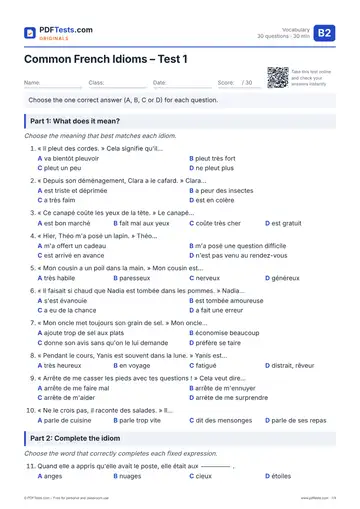
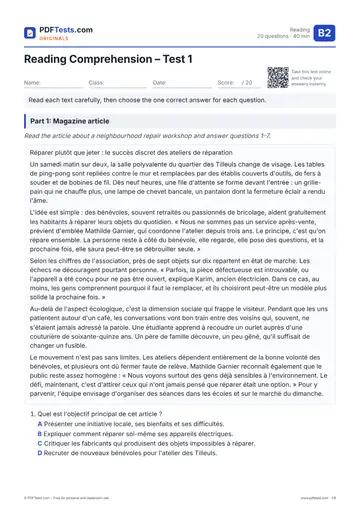
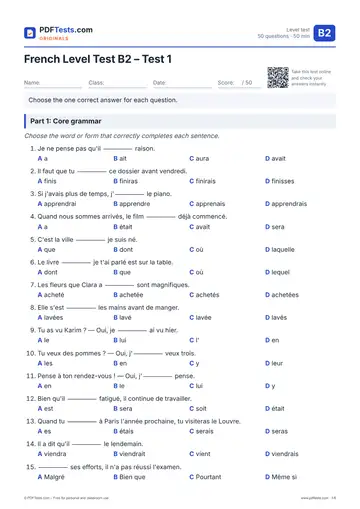
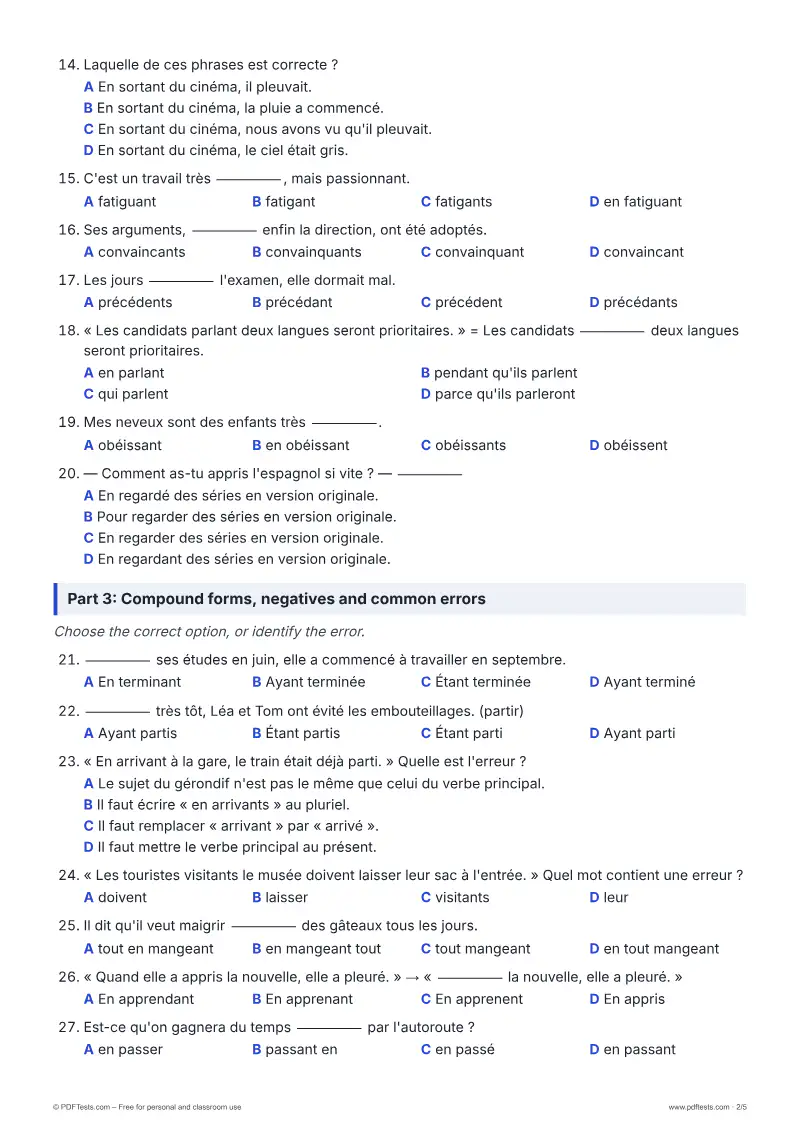
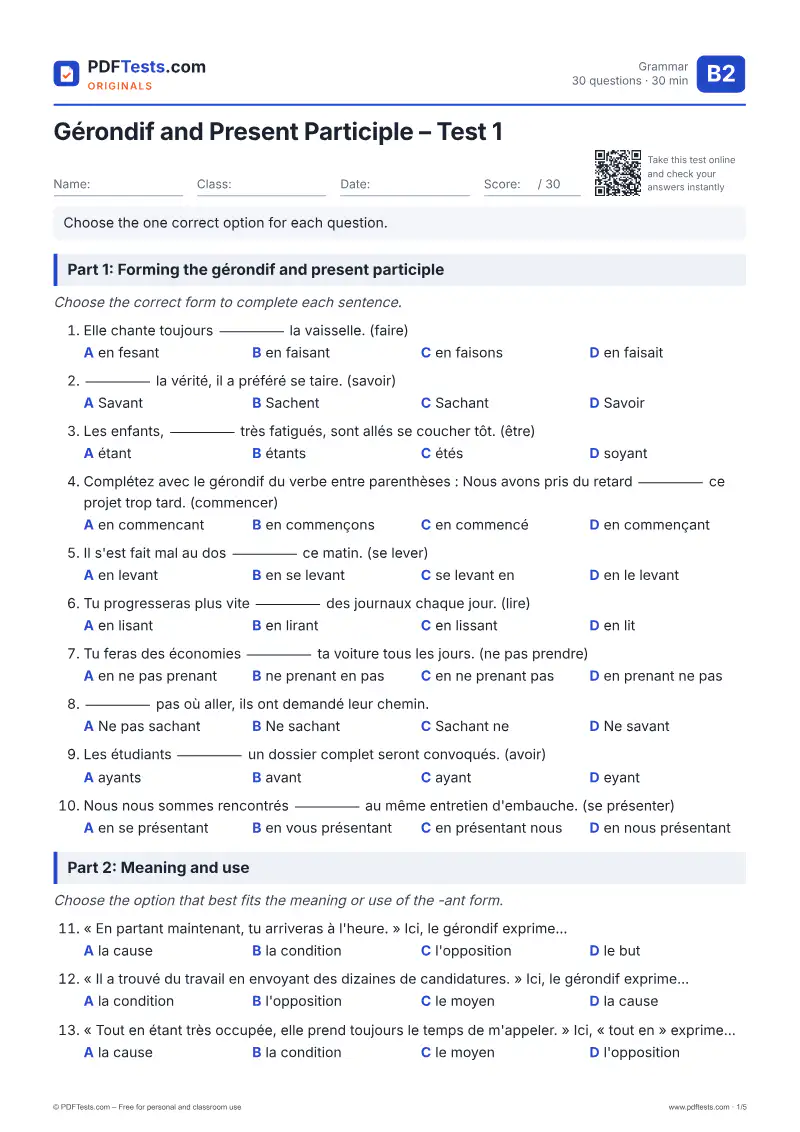
Preview of page 1 of Gérondif and Present Participle – Test 1 Open PDF

Take the test online

Choose the one correct option for each question. Choose your answers, then press “Check my answers”.

Part 1: Forming the gérondif and present participle

Choose the correct form to complete each sentence.

  1. Elle chante toujours _____ la vaisselle. (faire)

  2. _____ la vérité, il a préféré se taire. (savoir)

  3. Les enfants, _____ très fatigués, sont allés se coucher tôt. (être)

  4. Complétez avec le gérondif du verbe entre parenthèses : Nous avons pris du retard _____ ce projet trop tard. (commencer)

  5. Il s'est fait mal au dos _____ ce matin. (se lever)

  6. Tu progresseras plus vite _____ des journaux chaque jour. (lire)

  7. Tu feras des économies _____ ta voiture tous les jours. (ne pas prendre)

  8. _____ pas où aller, ils ont demandé leur chemin.

  9. Les étudiants _____ un dossier complet seront convoqués. (avoir)

  10. Nous nous sommes rencontrés _____ au même entretien d'embauche. (se présenter)

Part 2: Meaning and use

Choose the option that best fits the meaning or use of the -ant form.

  1. « En partant maintenant, tu arriveras à l'heure. » Ici, le gérondif exprime…

  2. « Il a trouvé du travail en envoyant des dizaines de candidatures. » Ici, le gérondif exprime…

  3. « Tout en étant très occupée, elle prend toujours le temps de m'appeler. » Ici, « tout en » exprime…

  4. Laquelle de ces phrases est correcte ?

  5. C'est un travail très _____, mais passionnant.

  6. Ses arguments, _____ enfin la direction, ont été adoptés.

  7. Les jours _____ l'examen, elle dormait mal.

  8. « Les candidats parlant deux langues seront prioritaires. » = Les candidats _____ deux langues seront prioritaires.

  9. Mes neveux sont des enfants très _____.

  10. — Comment as-tu appris l'espagnol si vite ? — _____

Part 3: Compound forms, negatives and common errors

Choose the correct option, or identify the error.

  1. _____ ses études en juin, elle a commencé à travailler en septembre.

  2. _____ très tôt, Léa et Tom ont évité les embouteillages. (partir)

  3. « En arrivant à la gare, le train était déjà parti. » Quelle est l'erreur ?

  4. « Les touristes visitants le musée doivent laisser leur sac à l'entrée. » Quel mot contient une erreur ?

  5. Il dit qu'il veut maigrir _____ des gâteaux tous les jours.

  6. « Quand elle a appris la nouvelle, elle a pleuré. » → « _____ la nouvelle, elle a pleuré. »

  7. Est-ce qu'on gagnera du temps _____ par l'autoroute ?

  8. « Comme il n'avait pas d'argent, il est resté chez lui. » → « _____ pas d'argent, il est resté chez lui. »

  9. Laquelle de ces phrases est correcte ?

  10. Tu risques de vexer Inès _____. (ne pas lui répondre)

Preview

About this test

This 30-question B2 test checks how well you form and use the French gérondif (en + -ant) and the present participle. It covers irregular and spelling-change forms, negatives and pronouns, meanings such as manner, condition and opposition, compound forms such as ayant fini and étant parti, and the difference between the participle and the verbal adjective. It suits upper-intermediate learners and teachers who want a focused grammar check.

Topics covered

Gérondif formationPresent participleNegation and pronouns with -ant formsMeaning: manner, condition, oppositionTout en + gérondifVerbal adjective vs present participleCompound participleSame-subject rule

How to use this test

  1. Download the PDF and print it, or take the test online below.
  2. Answer every question without a dictionary or time pressure.
  3. Check your answers and note the topics you need to review.

Notes for teachers

Use this test after teaching the gérondif and the present participle, or as a diagnostic before revising formal written French. It targets typical B2 errors. These include adding -s to the invariable participle, confusing fatigant and fatiguant or convaincant and convainquant, misplacing ne... pas and object pronouns, and breaking the same-subject rule (En arrivant, le train était parti). As a follow-up, ask learners to rewrite subordinate clauses with quand, si, comme or qui using -ant forms.