PDFTests Originals

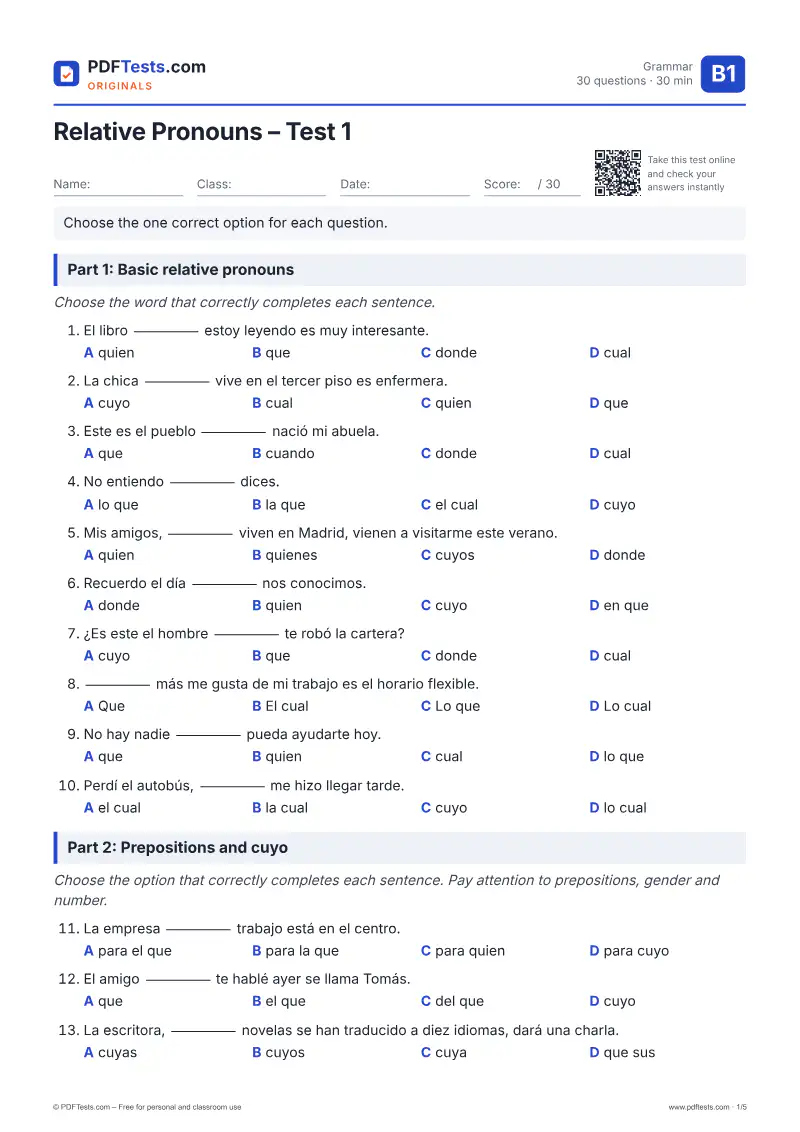
Relative Pronouns – Test 1

B1 Intermediate GrammarSpanish

This B1 grammar test checks how well you use Spanish relative pronouns: que, quien/quienes, lo que, lo cual, el/la que after prepositions, cuyo, donde and en que. It also covers defining and non-defining clauses, interrogatives versus relatives, and indicative or subjunctive in relative clauses. It suits intermediate learners and teachers who need a quick, reliable check.
Questions
30
Time
30 min
PDF
5 pages
Answer key
Included
  • 100% free
  • No sign-up or email
  • Print-ready A4 PDF
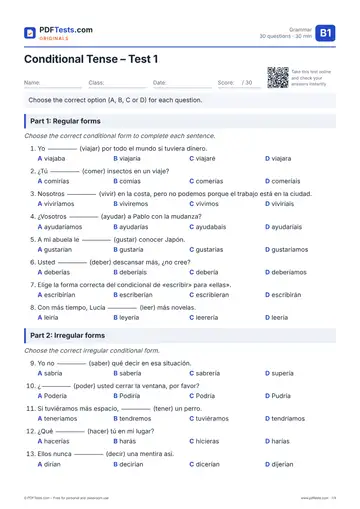
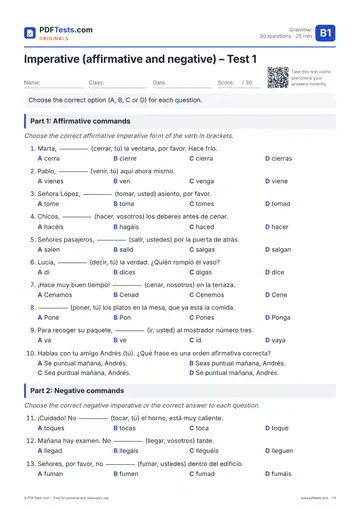
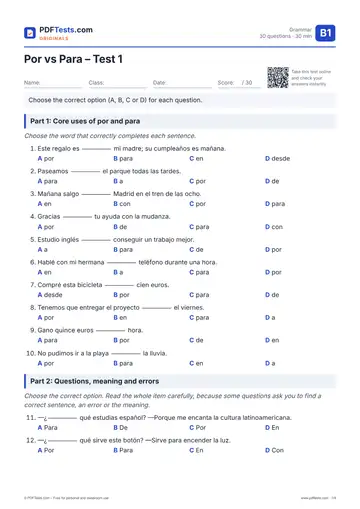
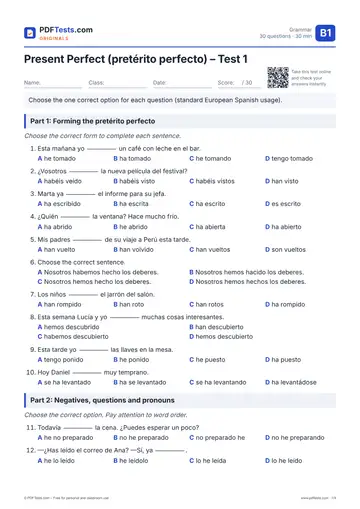
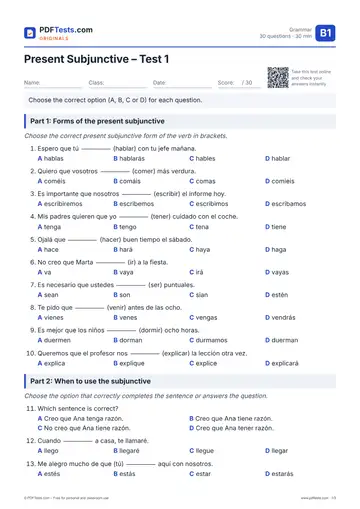
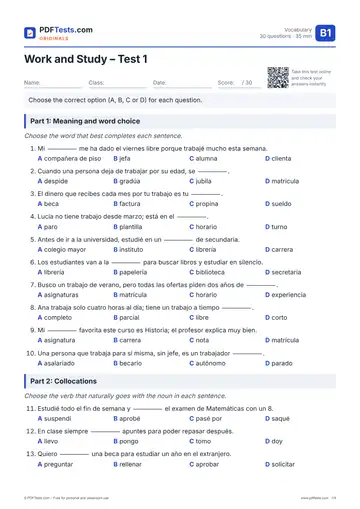
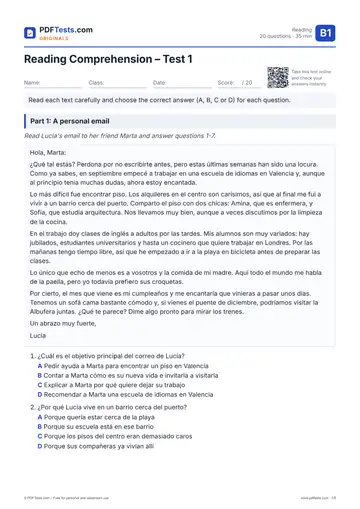
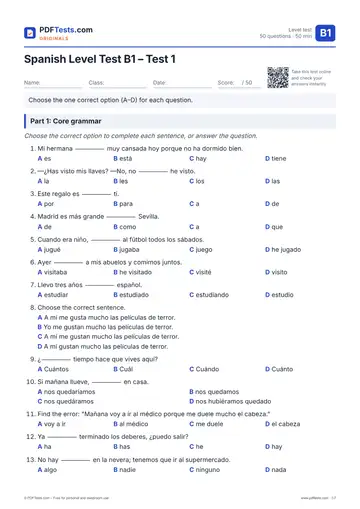
Preview of page 1 of Relative Pronouns – Test 1 Open PDF

Take the test online

Choose the one correct option for each question. Choose your answers, then press “Check my answers”.

Part 1: Basic relative pronouns

Choose the word that correctly completes each sentence.

  1. El libro _____ estoy leyendo es muy interesante.

  2. La chica _____ vive en el tercer piso es enfermera.

  3. Este es el pueblo _____ nació mi abuela.

  4. No entiendo _____ dices.

  5. Mis amigos, _____ viven en Madrid, vienen a visitarme este verano.

  6. Recuerdo el día _____ nos conocimos.

  7. ¿Es este el hombre _____ te robó la cartera?

  8. _____ más me gusta de mi trabajo es el horario flexible.

  9. No hay nadie _____ pueda ayudarte hoy.

  10. Perdí el autobús, _____ me hizo llegar tarde.

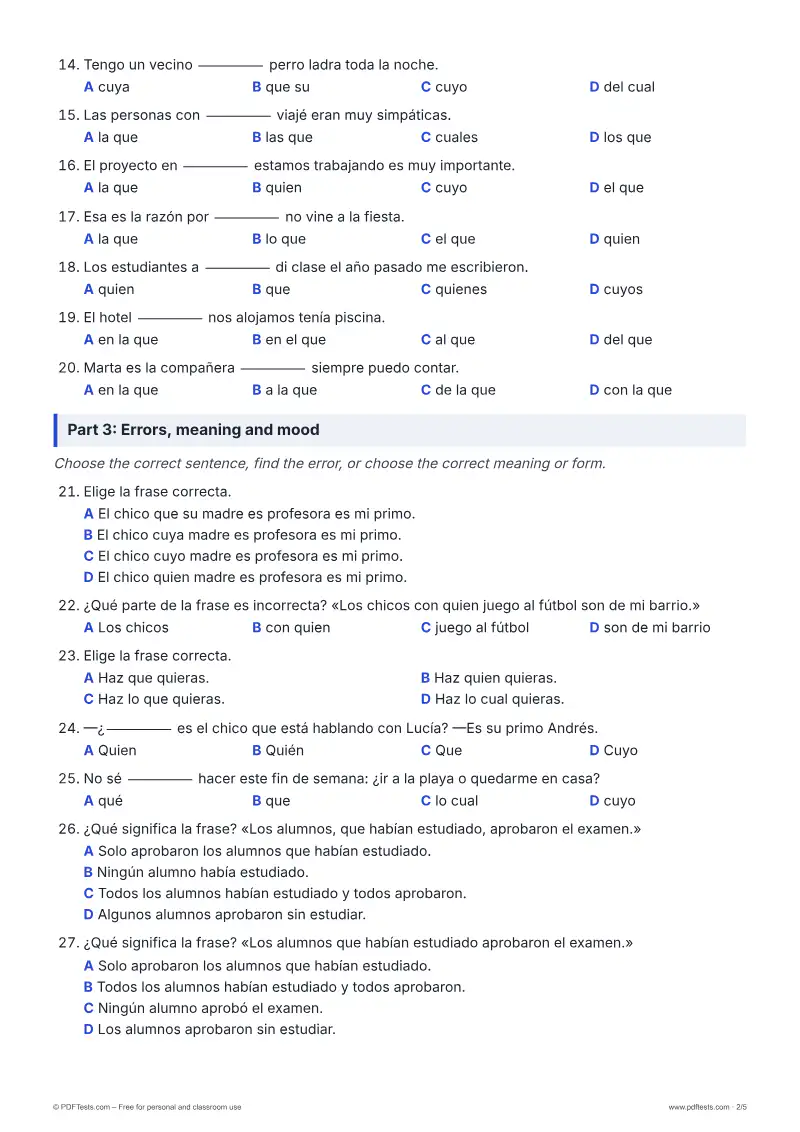
Part 2: Prepositions and cuyo

Choose the option that correctly completes each sentence. Pay attention to prepositions, gender and number.

  1. La empresa _____ trabajo está en el centro.

  2. El amigo _____ te hablé ayer se llama Tomás.

  3. La escritora, _____ novelas se han traducido a diez idiomas, dará una charla.

  4. Tengo un vecino _____ perro ladra toda la noche.

  5. Las personas con _____ viajé eran muy simpáticas.

  6. El proyecto en _____ estamos trabajando es muy importante.

  7. Esa es la razón por _____ no vine a la fiesta.

  8. Los estudiantes a _____ di clase el año pasado me escribieron.

  9. El hotel _____ nos alojamos tenía piscina.

  10. Marta es la compañera _____ siempre puedo contar.

Part 3: Errors, meaning and mood

Choose the correct sentence, find the error, or choose the correct meaning or form.

  1. Elige la frase correcta.

  2. ¿Qué parte de la frase es incorrecta? «Los chicos con quien juego al fútbol son de mi barrio.»

  3. Elige la frase correcta.

  4. —¿_____ es el chico que está hablando con Lucía? —Es su primo Andrés.

  5. No sé _____ hacer este fin de semana: ¿ir a la playa o quedarme en casa?

  6. ¿Qué significa la frase? «Los alumnos, que habían estudiado, aprobaron el examen.»

  7. ¿Qué significa la frase? «Los alumnos que habían estudiado aprobaron el examen.»

  8. ¿Qué parte de la frase es incorrecta? «Lo cual me preocupa es el examen de mañana.»

  9. No tengo ningún amigo que _____ cocinar bien.

  10. Tengo un amigo que _____ cocinar muy bien.

Preview

About this test

This B1 grammar test checks how well you use Spanish relative pronouns: que, quien/quienes, lo que, lo cual, el/la que after prepositions, cuyo, donde and en que. It also covers defining and non-defining clauses, interrogatives versus relatives, and indicative or subjunctive in relative clauses. It suits intermediate learners and teachers who need a quick, reliable check.

Topics covered

que vs. quien/quieneslo que and lo cualPreposition + el/la/los/las quecuyo, cuya, cuyos, cuyasdonde and en queDefining vs. non-defining clausesRelatives vs. interrogatives (que/qué, quien/quién)Indicative vs. subjunctive in relative clauses

How to use this test

  1. Download the PDF and print it, or take the test online below.
  2. Answer every question without a dictionary or time pressure.
  3. Check your answers and note the topics you need to review.

Notes for teachers

Use this test after teaching basic and prepositional relative clauses. It targets typical B1 errors: 'quien' in defining clauses without a comma, 'que su' instead of 'cuyo', dropping the preposition (*el amigo que te hablé), and wrong gender or number after a preposition (*la razón por lo que). It also targets 'lo cual' at the start of a sentence and confusion between que and qué. As follow-up, have students write sentences about their town or friends using cuyo and preposition + el que, and discuss the meaning difference in questions 26-27.