PDFTests Originals

Present Perfect (pretérito perfecto) – Test 1

B1 Intermediate GrammarSpanish

This B1 Spanish grammar test checks your control of the present perfect (pretérito perfecto): forming haber + participle, irregular participles, pronoun and negative word order, questions, and when to use it instead of the preterite. It is aimed at intermediate learners and their teachers who want a quick, printable check of this key tense.
Questions
30
Time
30 min
PDF
4 pages
Answer key
Included
  • 100% free
  • No sign-up or email
  • Print-ready A4 PDF
Preview of page 1 of Present Perfect (pretérito perfecto) – Test 1 Open PDF

Take the test online

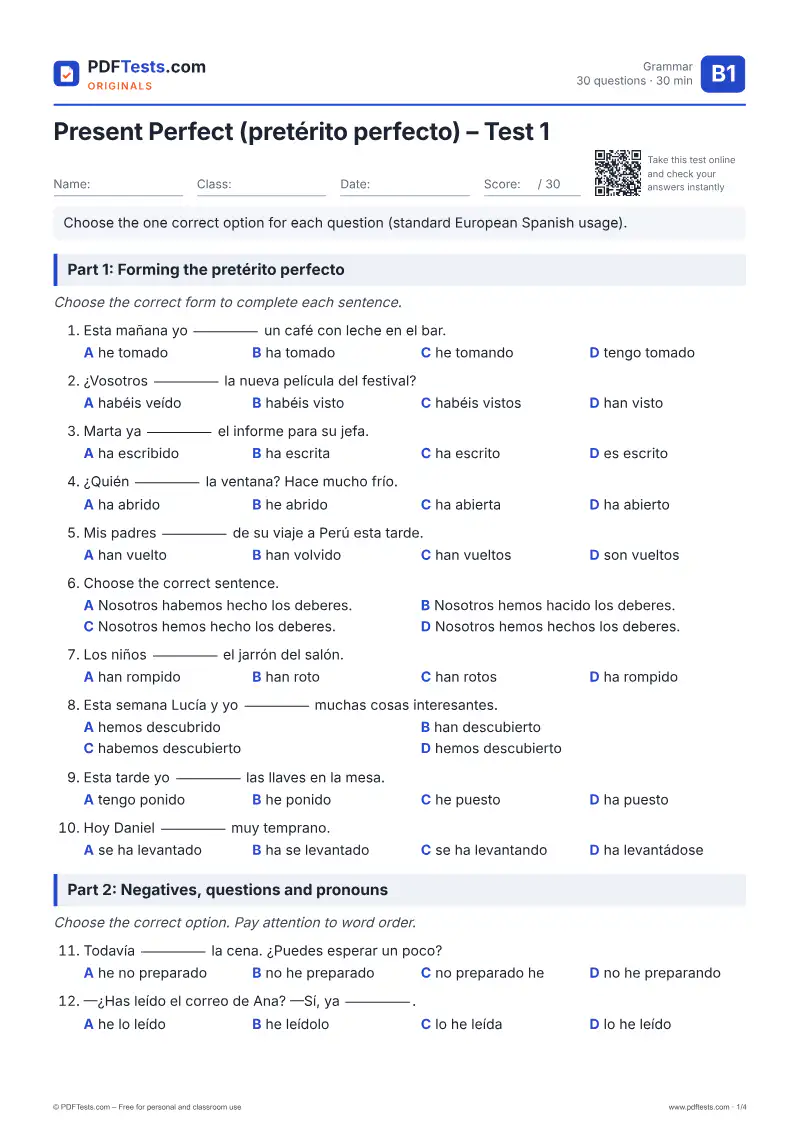
Choose the one correct option for each question (standard European Spanish usage). Choose your answers, then press “Check my answers”.

Part 1: Forming the pretérito perfecto

Choose the correct form to complete each sentence.

  1. Esta mañana yo _____ un café con leche en el bar.

  2. ¿Vosotros _____ la nueva película del festival?

  3. Marta ya _____ el informe para su jefa.

  4. ¿Quién _____ la ventana? Hace mucho frío.

  5. Mis padres _____ de su viaje a Perú esta tarde.

  6. Choose the correct sentence.

  7. Los niños _____ el jarrón del salón.

  8. Esta semana Lucía y yo _____ muchas cosas interesantes.

  9. Esta tarde yo _____ las llaves en la mesa.

  10. Hoy Daniel _____ muy temprano.

Part 2: Negatives, questions and pronouns

Choose the correct option. Pay attention to word order.

  1. Todavía _____ la cena. ¿Puedes esperar un poco?

  2. —¿Has leído el correo de Ana? —Sí, ya _____.

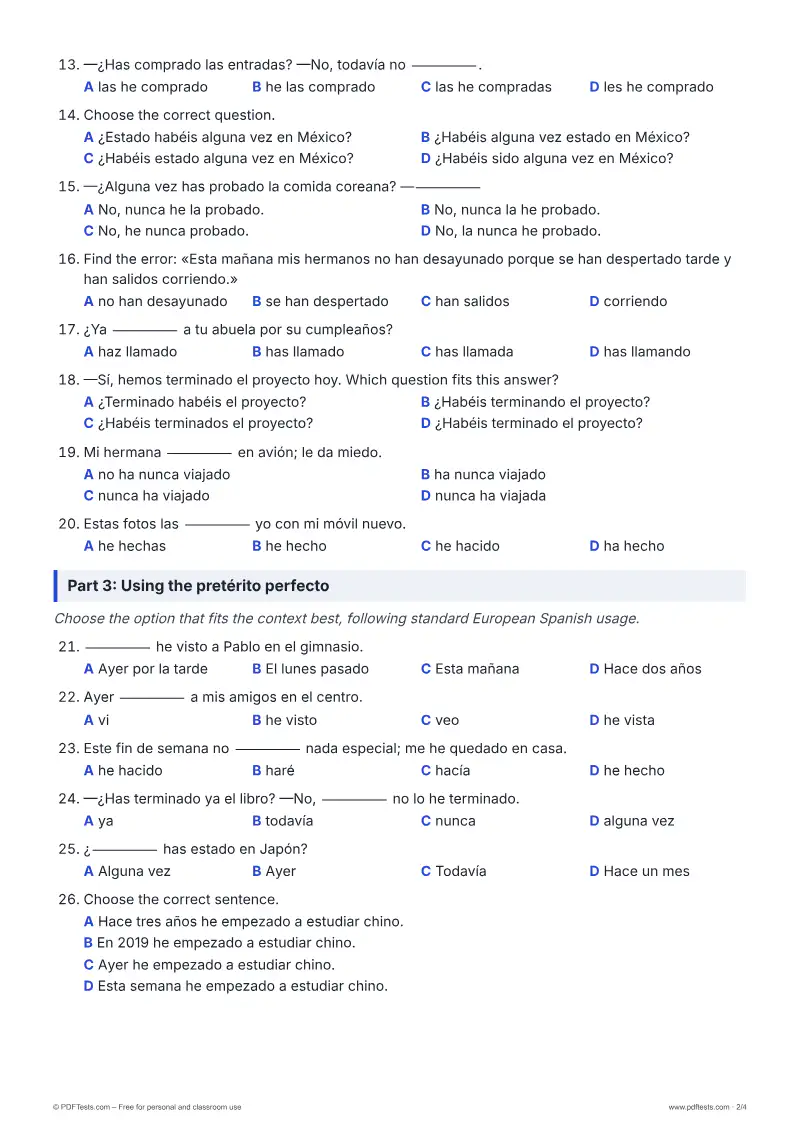
  3. —¿Has comprado las entradas? —No, todavía no _____.

  4. Choose the correct question.

  5. —¿Alguna vez has probado la comida coreana? —_____

  6. Find the error: «Esta mañana mis hermanos no han desayunado porque se han despertado tarde y han salidos corriendo.»

  7. ¿Ya _____ a tu abuela por su cumpleaños?

  8. —Sí, hemos terminado el proyecto hoy. Which question fits this answer?

  9. Mi hermana _____ en avión; le da miedo.

  10. Estas fotos las _____ yo con mi móvil nuevo.

Part 3: Using the pretérito perfecto

Choose the option that fits the context best, following standard European Spanish usage.

  1. _____ he visto a Pablo en el gimnasio.

  2. Ayer _____ a mis amigos en el centro.

  3. Este fin de semana no _____ nada especial; me he quedado en casa.

  4. —¿Has terminado ya el libro? —No, _____ no lo he terminado.

  5. ¿_____ has estado en Japón?

  6. Choose the correct sentence.

  7. «Hoy he trabajado ocho horas.» What does this sentence mean?

  8. Nunca _____ un libro tan interesante como este.

  9. Find the error: «Hoy he limpiado la casa, he hecho la compra y ayer he cocinado una paella.»

  10. —¿Por qué estás tan contenta? —Porque _____ el examen de conducir.

Preview

About this test

This B1 Spanish grammar test checks your control of the present perfect (pretérito perfecto): forming haber + participle, irregular participles, pronoun and negative word order, questions, and when to use it instead of the preterite. It is aimed at intermediate learners and their teachers who want a quick, printable check of this key tense.

Topics covered

Haber + past participleIrregular participlesReflexive and object pronounsNegatives and questionsYa, todavía, nunca, alguna vezPretérito perfecto vs. pretérito indefinido

How to use this test

  1. Download the PDF and print it, or take the test online below.
  2. Answer every question without a dictionary or time pressure.
  3. Check your answers and note the topics you need to review.

Notes for teachers

Part 1 targets form, especially irregular participles and haber vs. tener. Part 2 focuses on word order with pronouns and negatives. Part 3 contrasts the pretérito perfecto with the indefinido using time markers, following standard European Spanish usage. Note that many Latin American speakers prefer the indefinido for recent events, so discuss regional variation. Common errors targeted include *rompido/*abrido, adding -s to the participle, and splitting haber from the participle. As a follow-up, have students write five sentences about what they have and haven't done this week.