PDFTests Originals

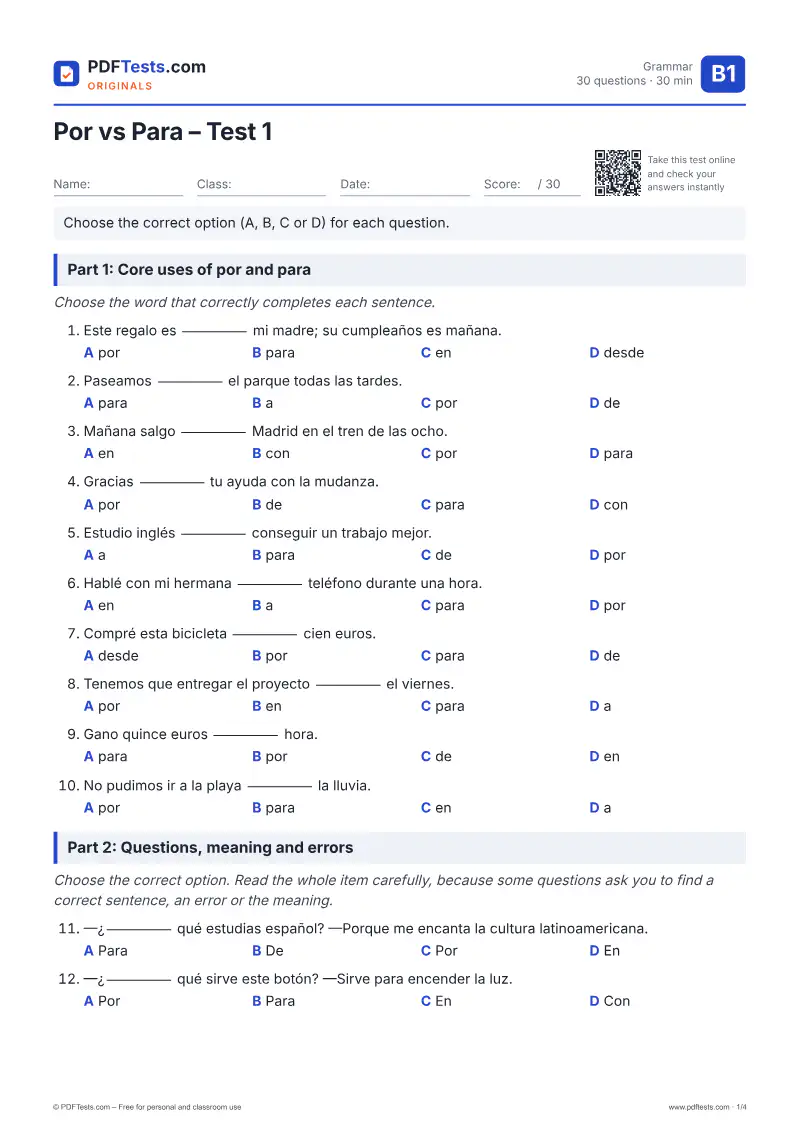
Por vs Para – Test 1

B1 Intermediate GrammarSpanish

This B1 test checks how well you can choose between por and para in everyday Spanish. It covers purpose, destination, deadlines, cause, price, exchange, means and movement through a place, and common fixed expressions such as por fin and por si acaso. It suits intermediate learners, and teachers who need a quick diagnostic or review activity.
Questions
30
Time
30 min
PDF
4 pages
Answer key
Included
  • 100% free
  • No sign-up or email
  • Print-ready A4 PDF
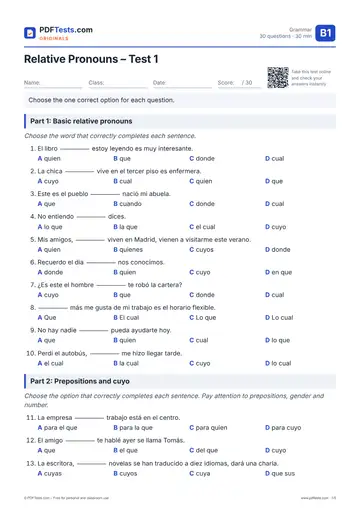
Preview of page 1 of Por vs Para – Test 1 Open PDF

Take the test online

Choose the correct option (A, B, C or D) for each question. Choose your answers, then press “Check my answers”.

Part 1: Core uses of por and para

Choose the word that correctly completes each sentence.

  1. Este regalo es _____ mi madre; su cumpleaños es mañana.

  2. Paseamos _____ el parque todas las tardes.

  3. Mañana salgo _____ Madrid en el tren de las ocho.

  4. Gracias _____ tu ayuda con la mudanza.

  5. Estudio inglés _____ conseguir un trabajo mejor.

  6. Hablé con mi hermana _____ teléfono durante una hora.

  7. Compré esta bicicleta _____ cien euros.

  8. Tenemos que entregar el proyecto _____ el viernes.

  9. Gano quince euros _____ hora.

  10. No pudimos ir a la playa _____ la lluvia.

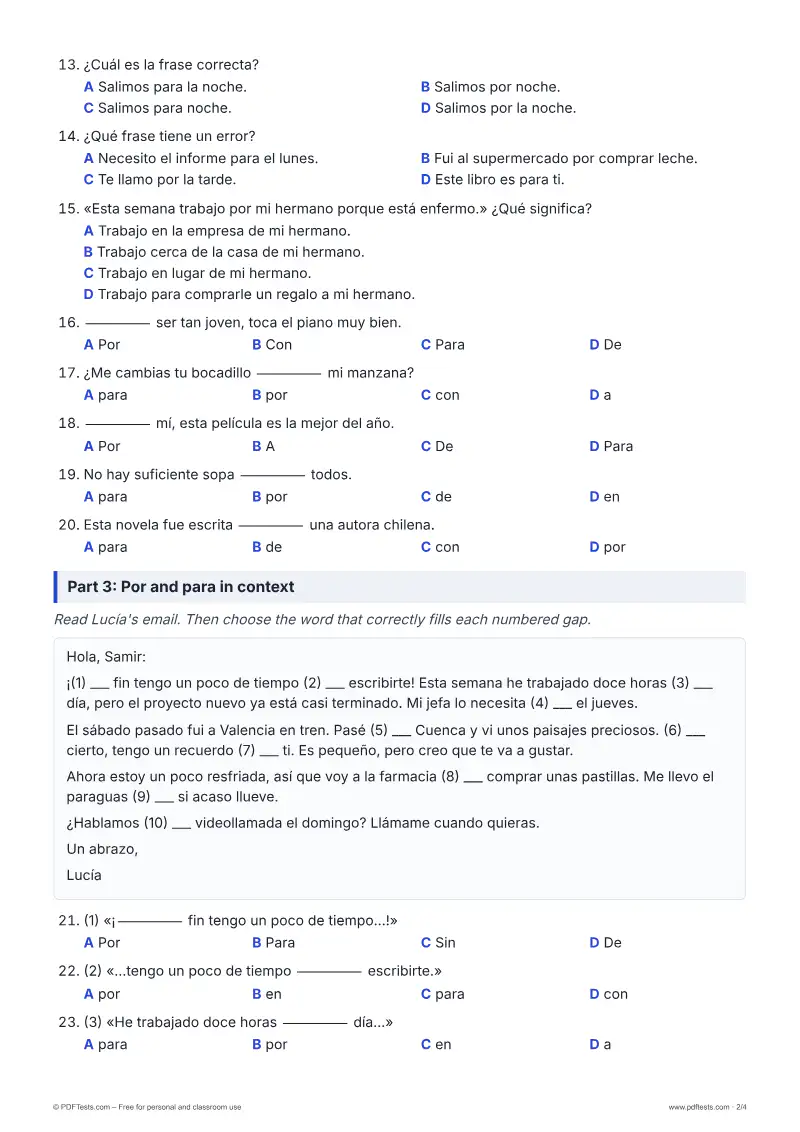
Part 2: Questions, meaning and errors

Choose the correct option. Read the whole item carefully, because some questions ask you to find a correct sentence, an error or the meaning.

  1. —¿_____ qué estudias español? —Porque me encanta la cultura latinoamericana.

  2. —¿_____ qué sirve este botón? —Sirve para encender la luz.

  3. ¿Cuál es la frase correcta?

  4. ¿Qué frase tiene un error?

  5. «Esta semana trabajo por mi hermano porque está enfermo.» ¿Qué significa?

  6. _____ ser tan joven, toca el piano muy bien.

  7. ¿Me cambias tu bocadillo _____ mi manzana?

  8. _____ mí, esta película es la mejor del año.

  9. No hay suficiente sopa _____ todos.

  10. Esta novela fue escrita _____ una autora chilena.

Part 3: Por and para in context

Read Lucía's email. Then choose the word that correctly fills each numbered gap.

Hola, Samir:

¡(1) ___ fin tengo un poco de tiempo (2) ___ escribirte! Esta semana he trabajado doce horas (3) ___ día, pero el proyecto nuevo ya está casi terminado. Mi jefa lo necesita (4) ___ el jueves.

El sábado pasado fui a Valencia en tren. Pasé (5) ___ Cuenca y vi unos paisajes preciosos. (6) ___ cierto, tengo un recuerdo (7) ___ ti. Es pequeño, pero creo que te va a gustar.

Ahora estoy un poco resfriada, así que voy a la farmacia (8) ___ comprar unas pastillas. Me llevo el paraguas (9) ___ si acaso llueve.

¿Hablamos (10) ___ videollamada el domingo? Llámame cuando quieras.

Un abrazo,

Lucía

  1. (1) «¡_____ fin tengo un poco de tiempo…!»

  2. (2) «…tengo un poco de tiempo _____ escribirte.»

  3. (3) «He trabajado doce horas _____ día…»

  4. (4) «Mi jefa lo necesita _____ el jueves.»

  5. (5) «Pasé _____ Cuenca y vi unos paisajes preciosos.»

  6. (6) «_____ cierto, tengo un recuerdo…»

  7. (7) «…tengo un recuerdo _____ ti.»

  8. (8) «…voy a la farmacia _____ comprar unas pastillas.»

  9. (9) «Me llevo el paraguas _____ si acaso llueve.»

  10. (10) «¿Hablamos _____ videollamada el domingo?»

Preview

About this test

This B1 test checks how well you can choose between por and para in everyday Spanish. It covers purpose, destination, deadlines, cause, price, exchange, means and movement through a place, and common fixed expressions such as por fin and por si acaso. It suits intermediate learners, and teachers who need a quick diagnostic or review activity.

Topics covered

Purpose and recipient (para)Cause and reason (por)Destination vs movement through a placeDeadlines and parts of the dayPrice, exchange and rateMeans of communication and passive agentQuestions: ¿por qué? vs ¿para qué?Fixed expressions with por

How to use this test

  1. Download the PDF and print it, or take the test online below.
  2. Answer every question without a dictionary or time pressure.
  3. Check your answers and note the topics you need to review.

Notes for teachers

Use Part 1 to check the core uses, and Part 2 for questions, meaning in context and error spotting. Part 3 tests both prepositions inside a connected text. The test targets typical B1 errors, such as using por + infinitive for purpose, para with parts of the day, and confusing ¿por qué? with ¿para qué?. As a follow-up, ask students to write a short email using at least five uses of por and five of para.