PDFTests Originals

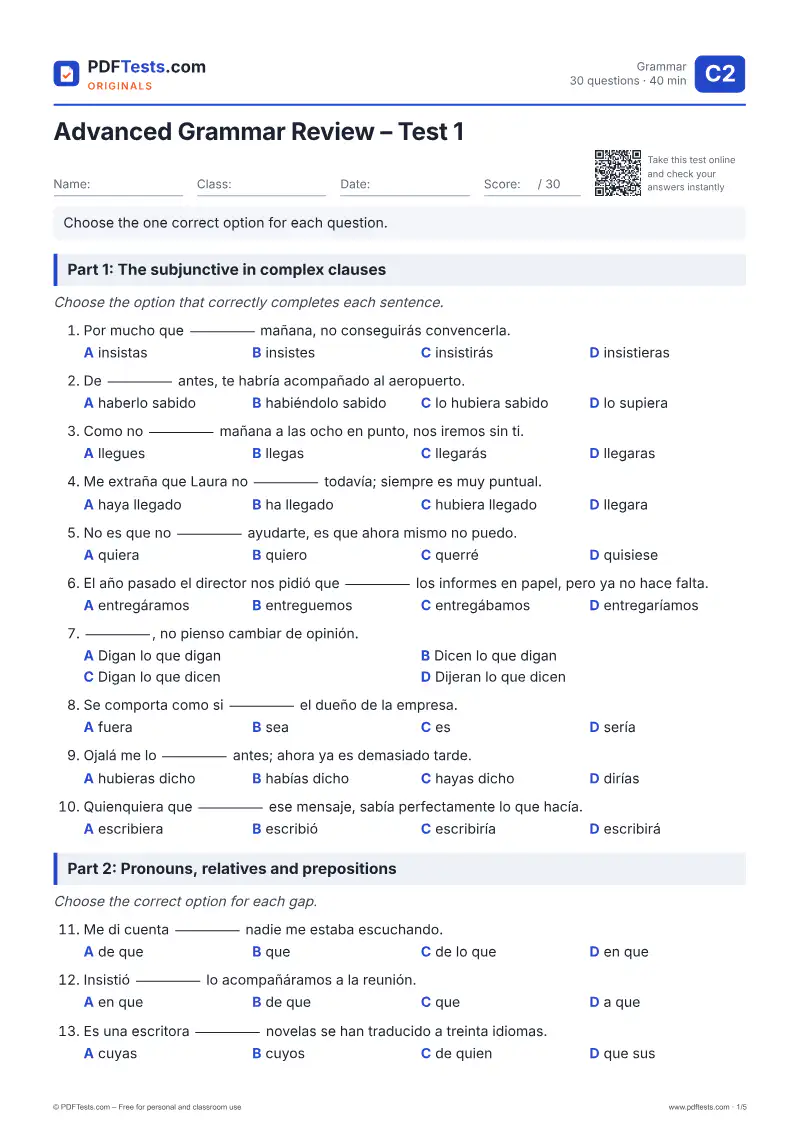
Advanced Grammar Review – Test 1

C2 Proficiency GrammarSpanish

This C2 Spanish grammar review tests the structures that set mastery apart from advanced proficiency. Topics include concessive and conditional subjunctive clauses, relative pronouns, clitic combinations, prepositional verbs, impersonal se, and tense and aspect. It suits learners preparing for top-level exams such as DELE C2 and teachers who need a quick diagnostic.
Questions
30
Time
40 min
PDF
5 pages
Answer key
Included
  • 100% free
  • No sign-up or email
  • Print-ready A4 PDF
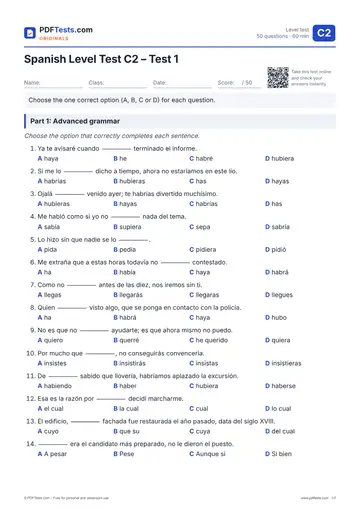
Preview of page 1 of Advanced Grammar Review – Test 1 Open PDF

Take the test online

Choose the one correct option for each question. Choose your answers, then press “Check my answers”.

Part 1: The subjunctive in complex clauses

Choose the option that correctly completes each sentence.

  1. Por mucho que _____ mañana, no conseguirás convencerla.

  2. De _____ antes, te habría acompañado al aeropuerto.

  3. Como no _____ mañana a las ocho en punto, nos iremos sin ti.

  4. Me extraña que Laura no _____ todavía; siempre es muy puntual.

  5. No es que no _____ ayudarte, es que ahora mismo no puedo.

  6. El año pasado el director nos pidió que _____ los informes en papel, pero ya no hace falta.

  7. _____, no pienso cambiar de opinión.

  8. Se comporta como si _____ el dueño de la empresa.

  9. Ojalá me lo _____ antes; ahora ya es demasiado tarde.

  10. Quienquiera que _____ ese mensaje, sabía perfectamente lo que hacía.

Part 2: Pronouns, relatives and prepositions

Choose the correct option for each gap.

  1. Me di cuenta _____ nadie me estaba escuchando.

  2. Insistió _____ lo acompañáramos a la reunión.

  3. Es una escritora _____ novelas se han traducido a treinta idiomas.

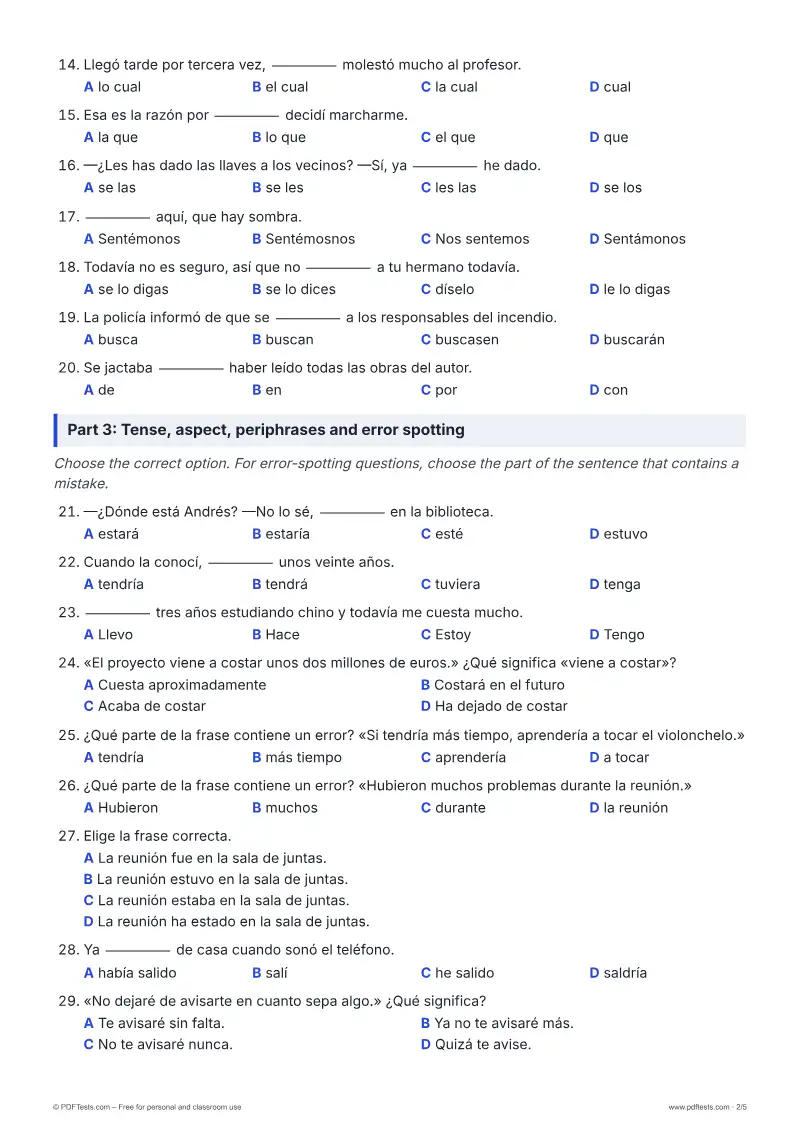
  4. Llegó tarde por tercera vez, _____ molestó mucho al profesor.

  5. Esa es la razón por _____ decidí marcharme.

  6. —¿Les has dado las llaves a los vecinos? —Sí, ya _____ he dado.

  7. _____ aquí, que hay sombra.

  8. Todavía no es seguro, así que no _____ a tu hermano todavía.

  9. La policía informó de que se _____ a los responsables del incendio.

  10. Se jactaba _____ haber leído todas las obras del autor.

Part 3: Tense, aspect, periphrases and error spotting

Choose the correct option. For error-spotting questions, choose the part of the sentence that contains a mistake.

  1. —¿Dónde está Andrés? —No lo sé, _____ en la biblioteca.

  2. Cuando la conocí, _____ unos veinte años.

  3. _____ tres años estudiando chino y todavía me cuesta mucho.

  4. «El proyecto viene a costar unos dos millones de euros.» ¿Qué significa «viene a costar»?

  5. ¿Qué parte de la frase contiene un error? «Si tendría más tiempo, aprendería a tocar el violonchelo.»

  6. ¿Qué parte de la frase contiene un error? «Hubieron muchos problemas durante la reunión.»

  7. Elige la frase correcta.

  8. Ya _____ de casa cuando sonó el teléfono.

  9. «No dejaré de avisarte en cuanto sepa algo.» ¿Qué significa?

  10. ¿Qué parte de la frase contiene un error? «Es importante de que todos participen en el debate.»

Preview

About this test

This C2 Spanish grammar review tests the structures that set mastery apart from advanced proficiency. Topics include concessive and conditional subjunctive clauses, relative pronouns, clitic combinations, prepositional verbs, impersonal se, and tense and aspect. It suits learners preparing for top-level exams such as DELE C2 and teachers who need a quick diagnostic.

Topics covered

Subjunctive in concessive and conditional clausesSequence of tensesRelative pronouns (cuyo, lo cual, el que)Clitic pronouns and imperativesDequeísmo and prepositional verbsImpersonal and passive seFuture and conditional of probabilityVerbal periphrases

How to use this test

  1. Download the PDF and print it, or take the test online below.
  2. Answer every question without a dictionary or time pressure.
  3. Check your answers and note the topics you need to review.

Notes for teachers

Use the test as a diagnostic before DELE C2 preparation or as a review after a unit on complex sentences. Several items target fossilised errors that persist even in very proficient speakers: dequeísmo, the conditional after 'si', 'hubieron', 'se venden' versus 'se busca a', and 'sentémosnos'. As follow-up, have learners correct the error-spotting sentences aloud and explain the rule behind each one. They can then write their own examples with 'por mucho que', 'como + subjunctive' and 'de + compound infinitive'.