PDFTests Originals

Modalverben für Fortgeschrittene – Arbeitsblatt 1

C1 Fortgeschritten ArbeitsblattEnglisch

Dieses Arbeitsblatt übt fortgeschrittene Modalverben auf C1-Niveau. Behandelt werden das Modal Perfect für Schlussfolgerungen und Kritik, needn't have im Vergleich zu don't have to sowie Ausdrücke wie be bound to, be supposed to, might as well, would rather und had better. Die Lernenden üben bejahte Sätze, verneinte Sätze und Fragen – zunächst mit gelenkten Übungen, dann mit Umformungen und Fehlerkorrektur.
Aufgaben
40
Zeit
40 Min.
PDF
5 Seiten
Lösungen
Enthalten
  • 100 % kostenlos
  • Ohne Anmeldung
  • Druckfertiges A4-PDF
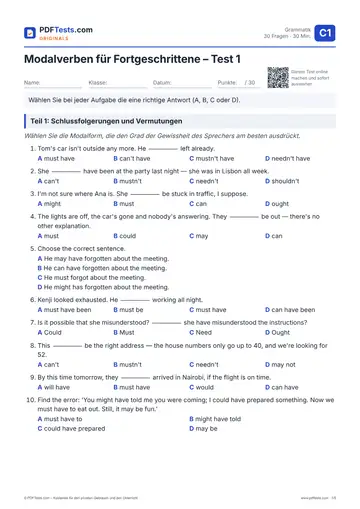
Vorschau von Seite 1: Modalverben für Fortgeschrittene – Arbeitsblatt 1 PDF öffnen

Arbeitsblatt online bearbeiten

Tippen Sie Ihre Antworten ein und klicken Sie auf „Antworten prüfen“. Alternative richtige Antworten werden akzeptiert.

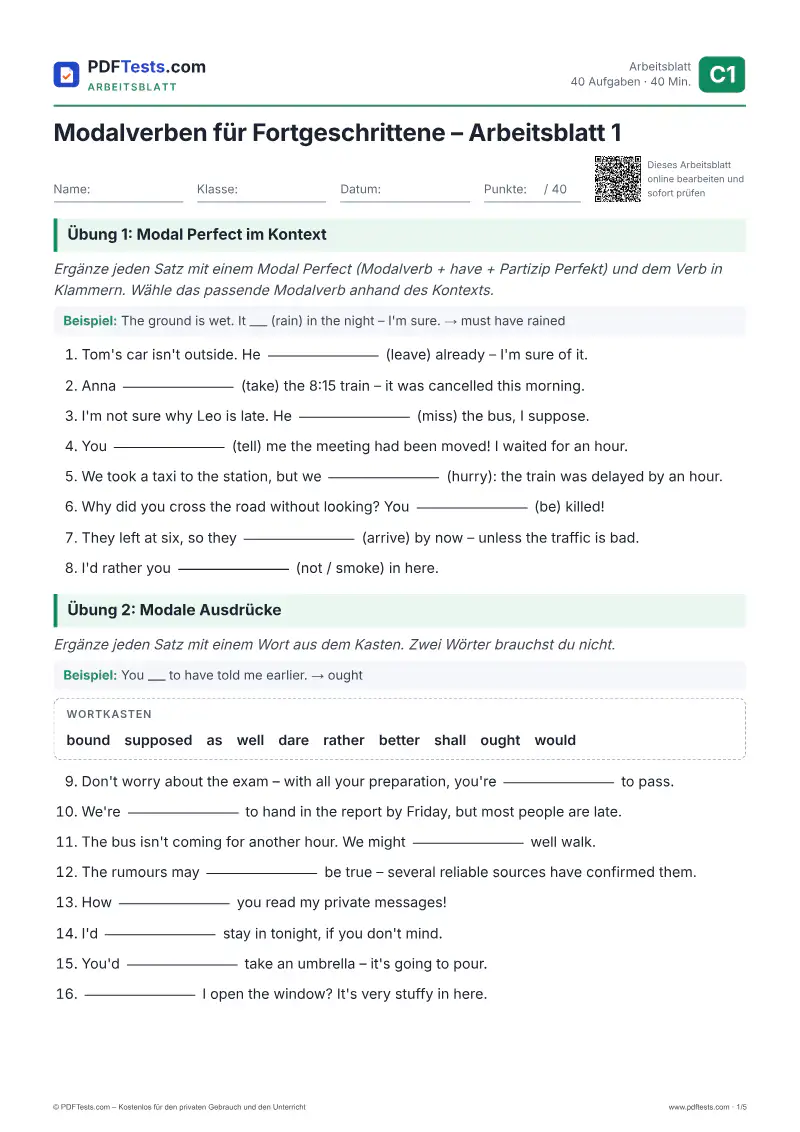
Übung 1: Modal Perfect im Kontext

Ergänze jeden Satz mit einem Modal Perfect (Modalverb + have + Partizip Perfekt) und dem Verb in Klammern. Wähle das passende Modalverb anhand des Kontexts.

Beispiel: The ground is wet. It ___ (rain) in the night – I'm sure. → must have rained

  1. Tom's car isn't outside. He (leave) already – I'm sure of it.

  2. Anna (take) the 8:15 train – it was cancelled this morning.

  3. I'm not sure why Leo is late. He (miss) the bus, I suppose.

  4. You (tell) me the meeting had been moved! I waited for an hour.

  5. We took a taxi to the station, but we (hurry): the train was delayed by an hour.

  6. Why did you cross the road without looking? You (be) killed!

  7. They left at six, so they (arrive) by now – unless the traffic is bad.

  8. I'd rather you (not / smoke) in here.

Übung 2: Modale Ausdrücke

Ergänze jeden Satz mit einem Wort aus dem Kasten. Zwei Wörter brauchst du nicht.

Beispiel: You ___ to have told me earlier. → ought

Wortkasten boundsupposedaswelldareratherbettershalloughtwould

  1. Don't worry about the exam – with all your preparation, you're to pass.

  2. We're to hand in the report by Friday, but most people are late.

  3. The bus isn't coming for another hour. We might well walk.

  4. The rumours may be true – several reliable sources have confirmed them.

  5. How you read my private messages!

  6. I'd stay in tonight, if you don't mind.

  7. You'd take an umbrella – it's going to pour.

  8. I open the window? It's very stuffy in here.

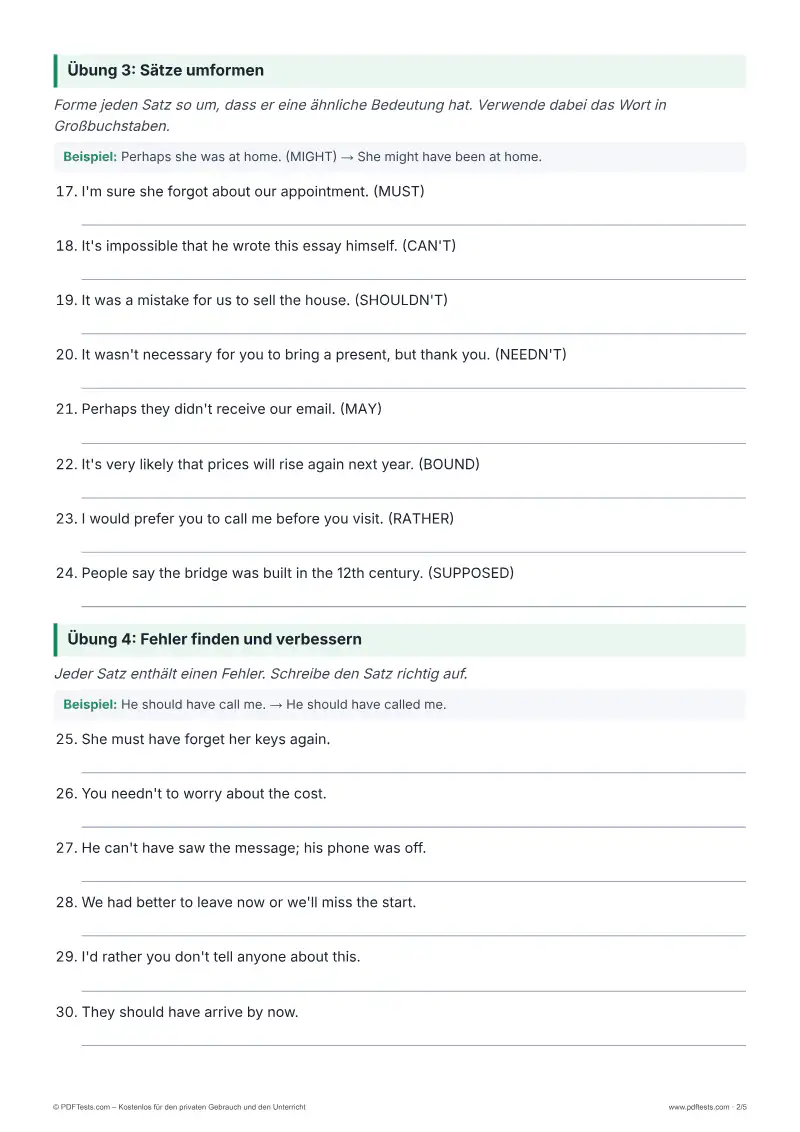
Übung 3: Sätze umformen

Forme jeden Satz so um, dass er eine ähnliche Bedeutung hat. Verwende dabei das Wort in Großbuchstaben.

Beispiel: Perhaps she was at home. (MIGHT) → She might have been at home.

  1. I'm sure she forgot about our appointment. (MUST)

  2. It's impossible that he wrote this essay himself. (CAN'T)

  3. It was a mistake for us to sell the house. (SHOULDN'T)

  4. It wasn't necessary for you to bring a present, but thank you. (NEEDN'T)

  5. Perhaps they didn't receive our email. (MAY)

  6. It's very likely that prices will rise again next year. (BOUND)

  7. I would prefer you to call me before you visit. (RATHER)

  8. People say the bridge was built in the 12th century. (SUPPOSED)

Übung 4: Fehler finden und verbessern

Jeder Satz enthält einen Fehler. Schreibe den Satz richtig auf.

Beispiel: He should have call me. → He should have called me.

  1. She must have forget her keys again.

  2. You needn't to worry about the cost.

  3. He can't have saw the message; his phone was off.

  4. We had better to leave now or we'll miss the start.

  5. I'd rather you don't tell anyone about this.

  6. They should have arrive by now.

  7. Did you must wear a uniform at your old school?

  8. You mustn't pay now; you can pay at the end.

Übung 5: Wörter ordnen

Bringe die Wörter in die richtige Reihenfolge, sodass Aussagesätze oder Fragen entstehen.

Beispiel: have / might / she / lost / it → She might have lost it.

  1. have / must / they / been / waiting / for / hours

  2. I / have / should / told / you / earlier / ?

  3. can't / she / meant / have / it / seriously

  4. might / well / as / we / home / go

  5. could / where / have / gone / they / ?

  6. needn't / you / have / waited / me / for

  7. would / you / rather / we / stayed / ?

  8. is / bound / there / to / be / a / delay

War diese Seite hilfreich?

Fehler melden

Falsche Lösung, Tippfehler oder unklare Erklärung? Schreiben Sie uns, wir korrigieren es.

Vorschau

Über diesen Test

Arbeitsblatt Englisch C1 zu Modalverben: Modal Perfect, Vermutungen, Kritik, needn't have, be bound to, had better. PDF mit Lösungen.

Themen

Modal Perfect (Modalverb + have + Partizip Perfekt)Schlussfolgerungen und VermutungenKritik und BedauernNotwendigkeit und VerpflichtungSemi-Modalverben und modale Ausdrücke

Hinweise für Lehrkräfte

Beginnen Sie mit Übung 1, um die Form Modalverb + have + Partizip Perfekt zu überprüfen, und lassen Sie die Lernenden dann erklären, was das jeweilige Modalverb ausdrückt (Gewissheit, Möglichkeit, Kritik, unnötige Handlung). Typische Fehler sind die Grundform nach „have“ (must have forget), ein zusätzliches „to“ nach needn't oder had better sowie ein Verb im Präsens nach „would rather + Subjekt“. Achten Sie außerdem darauf, dass der Unterschied zwischen mustn't und don't have to verstanden wird. Als Anschlussaktivität können Sie ein Foto einer rätselhaften Szene zeigen und die Lernenden mit must have, might have und can't have Vermutungen darüber anstellen lassen, was passiert ist.

Alle Englisch-Tests C1 →