PDFTests Originals

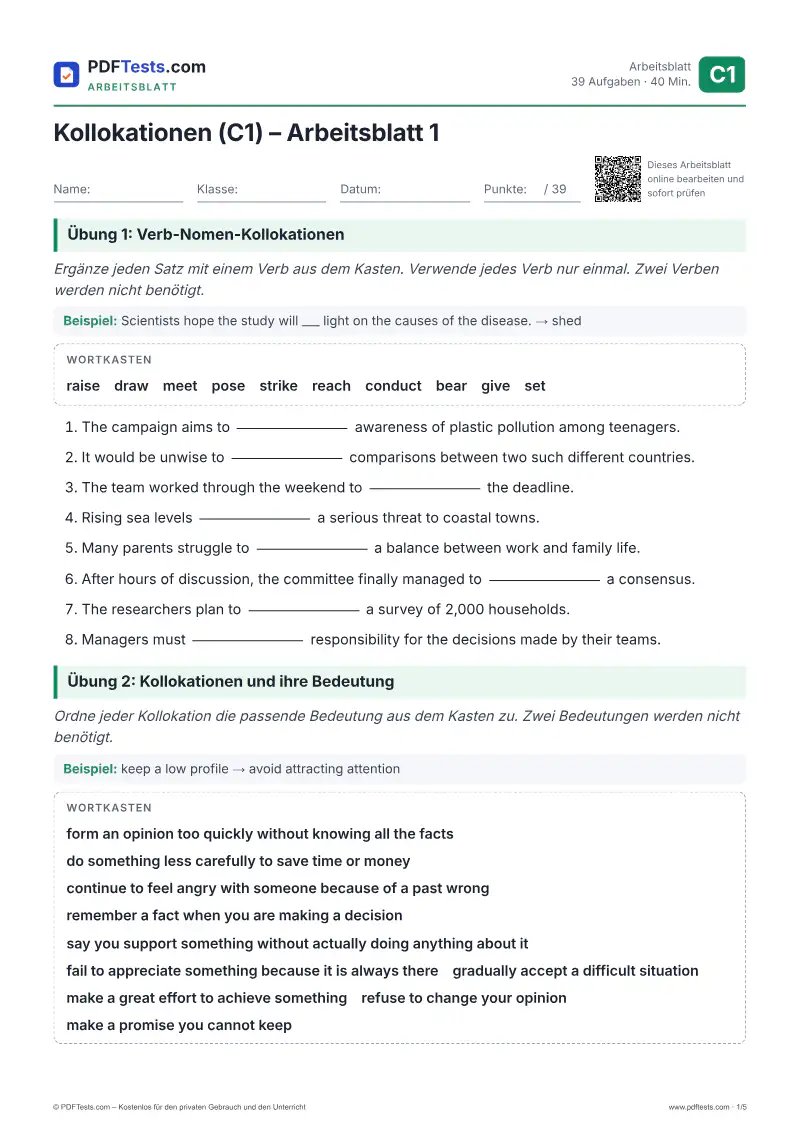
Kollokationen (C1) – Arbeitsblatt 1

C1 Fortgeschritten ArbeitsblattEnglisch

Dieses C1-Arbeitsblatt übt gängige englische Kollokationen im Kontext, etwa 'strike a balance', 'jump to conclusions' und 'an overwhelming majority'. In fünf Übungen, die von gelenkten zu freieren Aufgaben führen, arbeiten die Lernenden an Bedeutung, natürlichen Wortverbindungen und Wortformen. Es eignet sich für fortgeschrittene Lernende, die sich auf Prüfungen vorbereiten oder ihr Englisch natürlicher und präziser gestalten möchten.
Aufgaben
39
Zeit
40 Min.
PDF
5 Seiten
Lösungen
Enthalten
  • 100 % kostenlos
  • Ohne Anmeldung
  • Druckfertiges A4-PDF
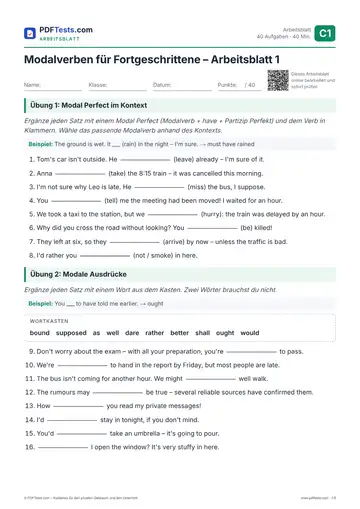
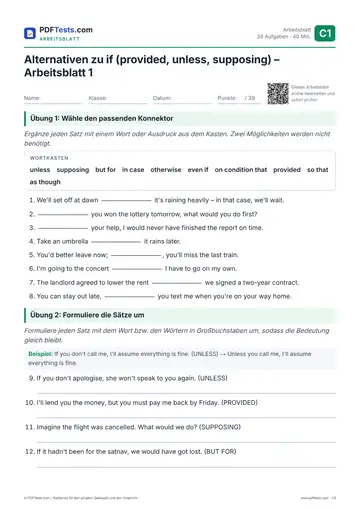
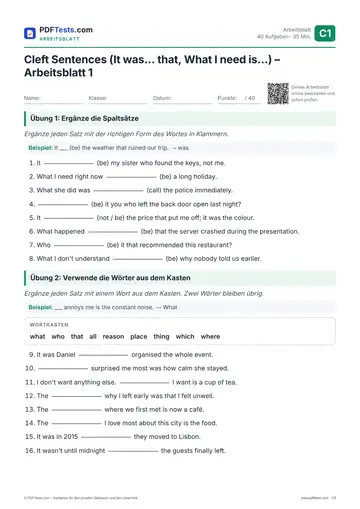
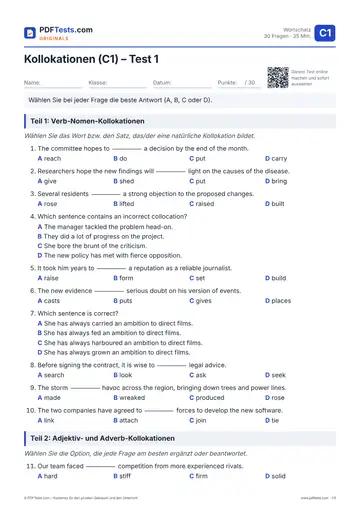
Vorschau von Seite 1: Kollokationen (C1) – Arbeitsblatt 1 PDF öffnen

Arbeitsblatt online bearbeiten

Tippen Sie Ihre Antworten ein und klicken Sie auf „Antworten prüfen“. Alternative richtige Antworten werden akzeptiert.

Übung 1: Verb-Nomen-Kollokationen

Ergänze jeden Satz mit einem Verb aus dem Kasten. Verwende jedes Verb nur einmal. Zwei Verben werden nicht benötigt.

Beispiel: Scientists hope the study will ___ light on the causes of the disease. → shed

Wortkasten raisedrawmeetposestrikereachconductbeargiveset

  1. The campaign aims to awareness of plastic pollution among teenagers.

  2. It would be unwise to comparisons between two such different countries.

  3. The team worked through the weekend to the deadline.

  4. Rising sea levels a serious threat to coastal towns.

  5. Many parents struggle to a balance between work and family life.

  6. After hours of discussion, the committee finally managed to a consensus.

  7. The researchers plan to a survey of 2,000 households.

  8. Managers must responsibility for the decisions made by their teams.

Übung 2: Kollokationen und ihre Bedeutung

Ordne jeder Kollokation die passende Bedeutung aus dem Kasten zu. Zwei Bedeutungen werden nicht benötigt.

Beispiel: keep a low profile → avoid attracting attention

Wortkasten form an opinion too quickly without knowing all the factsdo something less carefully to save time or moneycontinue to feel angry with someone because of a past wrongremember a fact when you are making a decisionsay you support something without actually doing anything about itfail to appreciate something because it is always theregradually accept a difficult situationmake a great effort to achieve somethingrefuse to change your opinionmake a promise you cannot keep

  1. jump to conclusions

  2. cut corners

  3. hold a grudge

  4. bear something in mind

  5. pay lip service to something

  6. take something for granted

  7. come to terms with something

  8. go to great lengths

Übung 3: Korrigiere die Kollokation

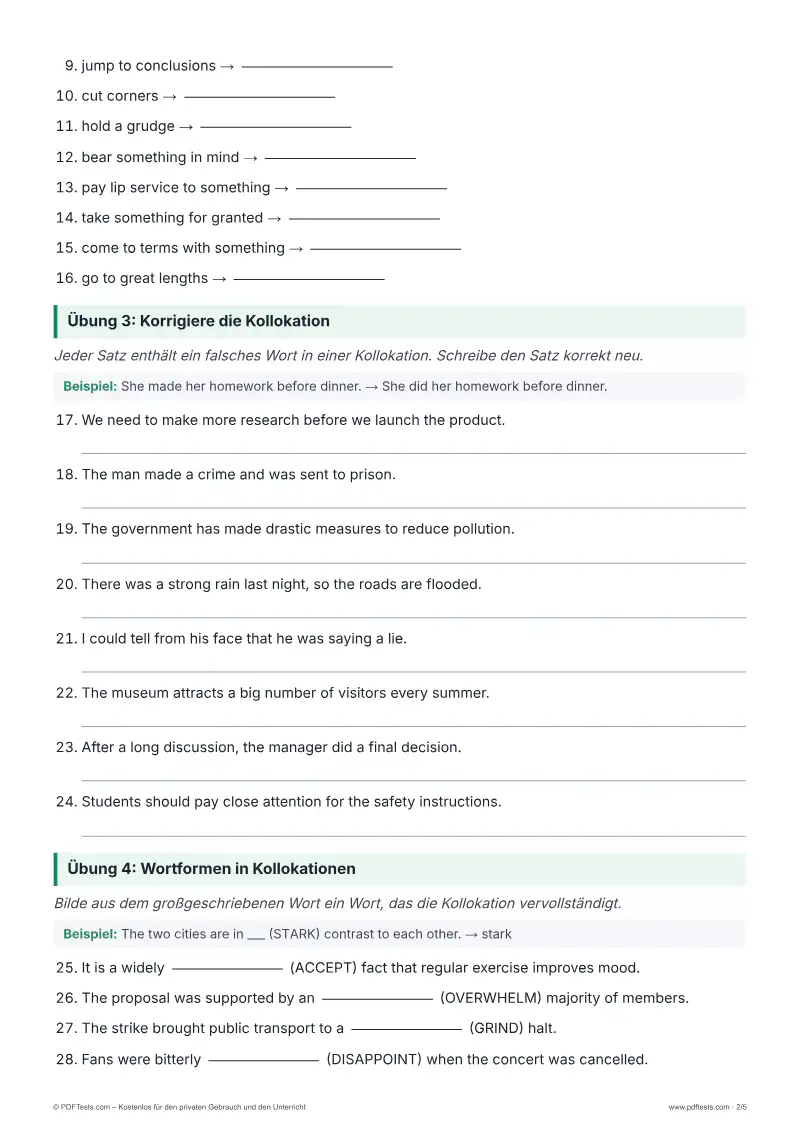
Jeder Satz enthält ein falsches Wort in einer Kollokation. Schreibe den Satz korrekt neu.

Beispiel: She made her homework before dinner. → She did her homework before dinner.

  1. We need to make more research before we launch the product.

  2. The man made a crime and was sent to prison.

  3. The government has made drastic measures to reduce pollution.

  4. There was a strong rain last night, so the roads are flooded.

  5. I could tell from his face that he was saying a lie.

  6. The museum attracts a big number of visitors every summer.

  7. After a long discussion, the manager did a final decision.

  8. Students should pay close attention for the safety instructions.

Übung 4: Wortformen in Kollokationen

Bilde aus dem großgeschriebenen Wort ein Wort, das die Kollokation vervollständigt.

Beispiel: The two cities are in ___ (STARK) contrast to each other. → stark

  1. It is a widely (ACCEPT) fact that regular exercise improves mood.

  2. The proposal was supported by an (OVERWHELM) majority of members.

  3. The strike brought public transport to a (GRIND) halt.

  4. Fans were bitterly (DISAPPOINT) when the concert was cancelled.

  5. Her research has made a (SIGNIFY) contribution to the field.

  6. In this storm, it is highly (LIKE) that the match will go ahead.

  7. After years of neglect, the old castle has fallen into (REPAIR).

  8. It is important to draw a clear (DISTINGUISH) between facts and opinions.

Übung 5: Umformulieren mit einer Kollokation

Formuliere jeden Satz mit dem Wort in Klammern so um, dass die Bedeutung gleich bleibt.

Beispiel: He wants to avoid attracting attention. (PROFILE) → He wants to keep a low profile.

  1. Remember that the shop closes early on Sundays. (MIND)

  2. The new rules will start to apply in January. (FORCE)

  3. I think you are forming an opinion too quickly. (CONCLUSIONS)

  4. She eventually accepted that she had lost her job. (TERMS)

  5. He made a huge effort to keep the project a secret. (LENGTHS)

  6. Many people don't appreciate clean water because it is always available. (GRANTED)

  7. The two sides finally agreed. (CONSENSUS)

War diese Seite hilfreich?

Fehler melden

Falsche Lösung, Tippfehler oder unklare Erklärung? Schreiben Sie uns, wir korrigieren es.

Vorschau

Über diesen Test

Kollokationen Englisch C1 Arbeitsblatt PDF: Verb-Nomen-Verbindungen, Bedeutungen, Wortbildung, Fehlerkorrektur und Umformungen. Mit Lösungen.

Themen

Verb-Nomen-KollokationenAdverb-Adjektiv-KollokationenKollokationen und ihre BedeutungWortbildungTypische Fehler bei Kollokationen

Hinweise für Lehrkräfte

Beginnen Sie mit Übung 1 als Einstieg und lassen Sie die Lernenden ihre Antworten zu Übung 2 zunächst in Partnerarbeit vergleichen, bevor Sie im Plenum kontrollieren. Ein typischer Fehler ist die wörtliche Übersetzung von Kollokationen aus der Muttersprache, was zu Fehlern wie 'make research' oder 'say a lie' führt – lenken Sie die Aufmerksamkeit daher gezielt auf das Verb in jeder Wortverbindung. Als Anschlussaufgabe können die Lernenden einen kurzen Meinungsabsatz zu einem selbst gewählten Thema schreiben und dabei mindestens sechs Kollokationen aus dem Arbeitsblatt verwenden.

Alle Englisch-Tests C1 →