PDFTests Originals

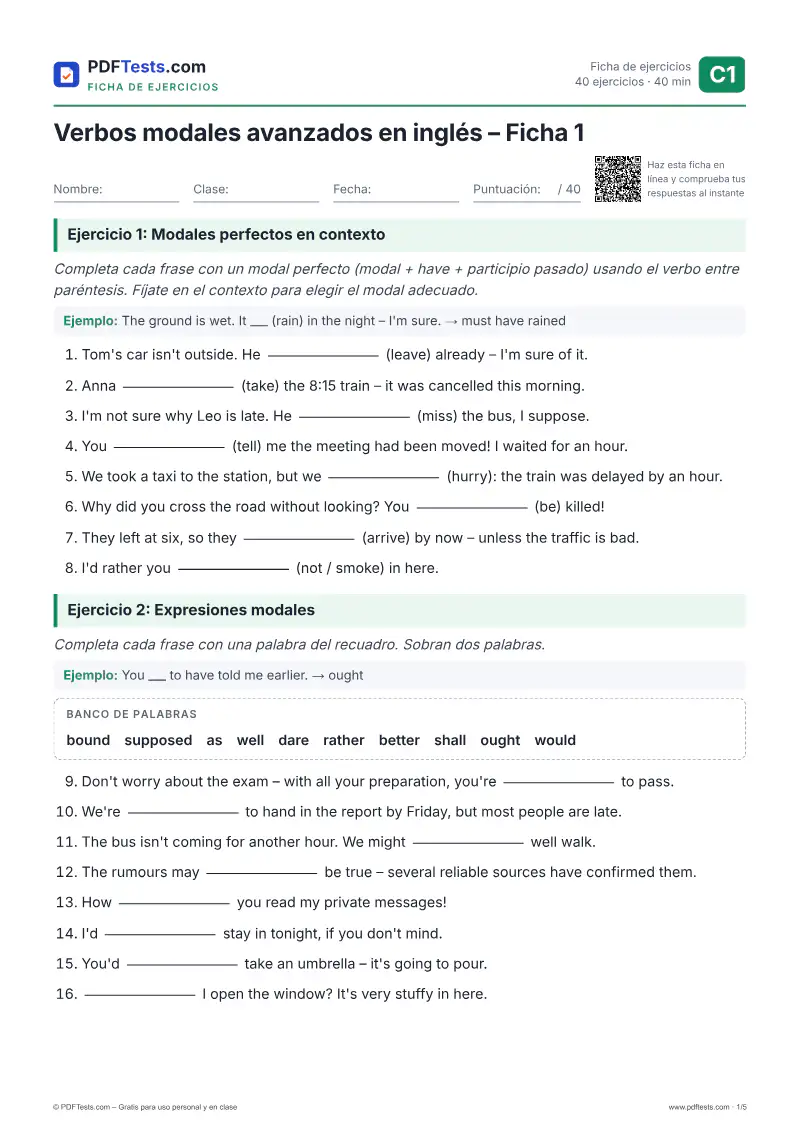
Verbos modales avanzados en inglés – Ficha 1

C1 Avanzado FichaInglés

Esta ficha sirve para practicar los verbos modales avanzados de nivel C1. Trabaja los modales perfectos para expresar deducción y crítica, la diferencia entre needn't have y don't have to, y expresiones como be bound to, be supposed to, might as well, would rather y had better. El alumnado practica las formas afirmativa, negativa e interrogativa, empezando con ejercicios controlados y pasando después a la reformulación de frases y la corrección de errores.
ejercicios
40
Tiempo
40 min
PDF
5 páginas
Soluciones
Incluidas
  • 100 % gratis
  • Sin registro
  • PDF A4 listo para imprimir
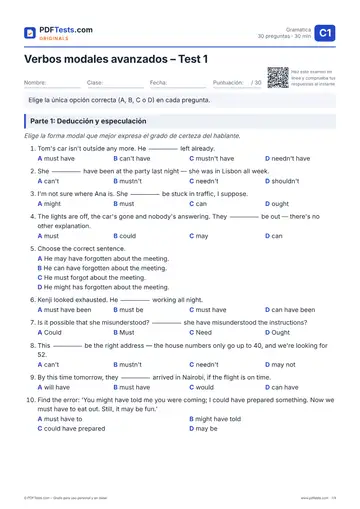
Vista previa de la página 1: Verbos modales avanzados en inglés – Ficha 1 Abrir PDF

Haz la ficha en línea

Escribe tus respuestas y pulsa «Comprobar respuestas». Se aceptan otras respuestas correctas.

Ejercicio 1: Modales perfectos en contexto

Completa cada frase con un modal perfecto (modal + have + participio pasado) usando el verbo entre paréntesis. Fíjate en el contexto para elegir el modal adecuado.

Ejemplo: The ground is wet. It ___ (rain) in the night – I'm sure. → must have rained

  1. Tom's car isn't outside. He (leave) already – I'm sure of it.

  2. Anna (take) the 8:15 train – it was cancelled this morning.

  3. I'm not sure why Leo is late. He (miss) the bus, I suppose.

  4. You (tell) me the meeting had been moved! I waited for an hour.

  5. We took a taxi to the station, but we (hurry): the train was delayed by an hour.

  6. Why did you cross the road without looking? You (be) killed!

  7. They left at six, so they (arrive) by now – unless the traffic is bad.

  8. I'd rather you (not / smoke) in here.

Ejercicio 2: Expresiones modales

Completa cada frase con una palabra del recuadro. Sobran dos palabras.

Ejemplo: You ___ to have told me earlier. → ought

Banco de palabras boundsupposedaswelldareratherbettershalloughtwould

  1. Don't worry about the exam – with all your preparation, you're to pass.

  2. We're to hand in the report by Friday, but most people are late.

  3. The bus isn't coming for another hour. We might well walk.

  4. The rumours may be true – several reliable sources have confirmed them.

  5. How you read my private messages!

  6. I'd stay in tonight, if you don't mind.

  7. You'd take an umbrella – it's going to pour.

  8. I open the window? It's very stuffy in here.

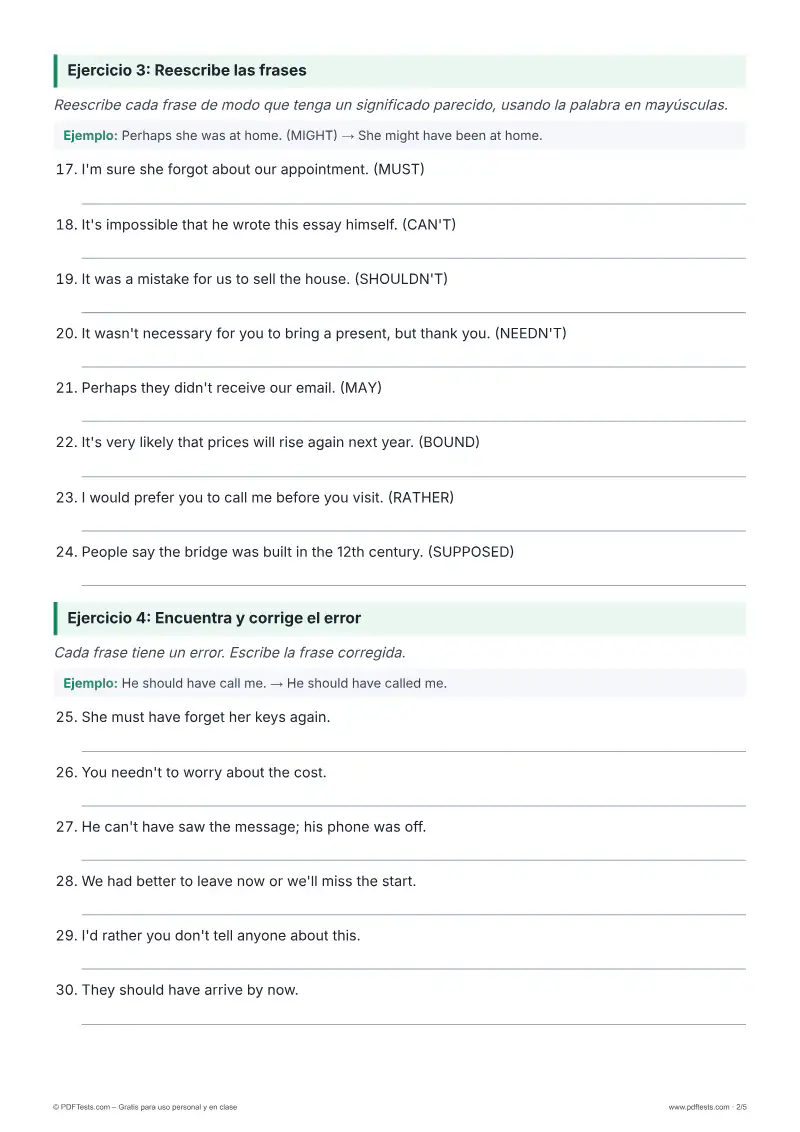
Ejercicio 3: Reescribe las frases

Reescribe cada frase de modo que tenga un significado parecido, usando la palabra en mayúsculas.

Ejemplo: Perhaps she was at home. (MIGHT) → She might have been at home.

  1. I'm sure she forgot about our appointment. (MUST)

  2. It's impossible that he wrote this essay himself. (CAN'T)

  3. It was a mistake for us to sell the house. (SHOULDN'T)

  4. It wasn't necessary for you to bring a present, but thank you. (NEEDN'T)

  5. Perhaps they didn't receive our email. (MAY)

  6. It's very likely that prices will rise again next year. (BOUND)

  7. I would prefer you to call me before you visit. (RATHER)

  8. People say the bridge was built in the 12th century. (SUPPOSED)

Ejercicio 4: Encuentra y corrige el error

Cada frase tiene un error. Escribe la frase corregida.

Ejemplo: He should have call me. → He should have called me.

  1. She must have forget her keys again.

  2. You needn't to worry about the cost.

  3. He can't have saw the message; his phone was off.

  4. We had better to leave now or we'll miss the start.

  5. I'd rather you don't tell anyone about this.

  6. They should have arrive by now.

  7. Did you must wear a uniform at your old school?

  8. You mustn't pay now; you can pay at the end.

Ejercicio 5: Ordena las palabras

Ordena las palabras para formar frases o preguntas.

Ejemplo: have / might / she / lost / it → She might have lost it.

  1. have / must / they / been / waiting / for / hours

  2. I / have / should / told / you / earlier / ?

  3. can't / she / meant / have / it / seriously

  4. might / well / as / we / home / go

  5. could / where / have / gone / they / ?

  6. needn't / you / have / waited / me / for

  7. would / you / rather / we / stayed / ?

  8. is / bound / there / to / be / a / delay

¿Te ha resultado útil esta página?

Informar de un error

¿Has visto una respuesta incorrecta, una errata o una explicación poco clara? Avísanos y lo corregiremos.

Vista previa

Sobre este examen

Ficha de inglés C1 en PDF sobre verbos modales avanzados: modales perfectos, deducción, crítica, needn't have, be bound to, had better. Con soluciones.

Temas

Modales perfectosDeducción y especulaciónCrítica y arrepentimientoNecesidad y obligaciónSemimodales y expresiones modales

Notas para el profesor

Empiece por el ejercicio 1 para comprobar la estructura modal + have + participio pasado y pida después al alumnado que explique qué expresa cada modal (certeza, posibilidad, crítica, acción innecesaria). Los errores más habituales son usar la forma base después de «have» (must have forget), añadir «to» después de needn't o had better, y usar un verbo en presente después de «would rather + sujeto». Asegúrese también de que se entiende bien la diferencia entre mustn't y don't have to. Como actividad de ampliación, muestre la foto de una escena misteriosa y pida que hagan hipótesis sobre lo que ocurrió usando must have, might have y can't have.

Todos los exámenes de Inglés C1 →