PDFTests Originals

Akademischer Wortschatz – Arbeitsblatt 1

C1 Fortgeschritten ArbeitsblattEnglisch

Dieses C1-Arbeitsblatt trainiert zentralen akademischen Wortschatz wie hypothesis, empirical, implications und robust. Die Lernenden erarbeiten Bedeutungen, typische Kollokationen und Wortbildung anhand von Sätzen im Stil wissenschaftlicher Texte. Ideal zur Vorbereitung auf ein Studium, auf IELTS, Cambridge C1 Advanced oder für Kurse im akademischen Schreiben.
Aufgaben
39
Zeit
45 Min.
PDF
5 Seiten
Lösungen
Enthalten
  • 100 % kostenlos
  • Ohne Anmeldung
  • Druckfertiges A4-PDF
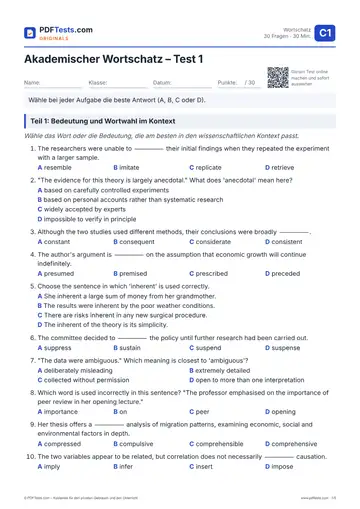
Vorschau von Seite 1: Akademischer Wortschatz – Arbeitsblatt 1 PDF öffnen

Arbeitsblatt online bearbeiten

Tippen Sie Ihre Antworten ein und klicken Sie auf „Antworten prüfen“. Alternative richtige Antworten werden akzeptiert.

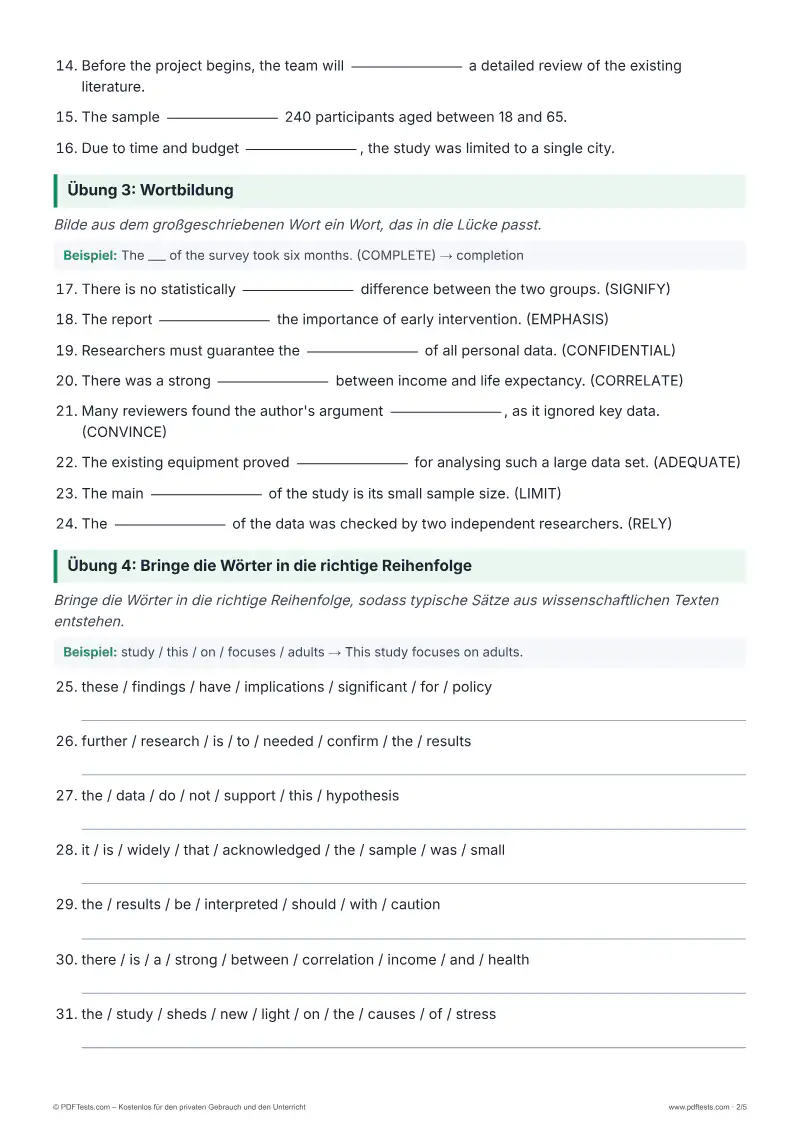
Übung 1: Ordne die Wörter ihren Bedeutungen zu

Ordne jeder Definition ein Wort aus dem Kasten zu. Zwei Wörter bleiben übrig.

Wortkasten hypothesisambiguoussubstantiateempiricalcoherentinherentmitigatediscrepancyarbitrarycomprehensive

  1. a proposed explanation that can be tested through research

  2. open to more than one interpretation

  3. to provide evidence that supports a claim

  4. based on observation or experiment rather than theory

  5. logical and consistent, so that it is easy to follow

  6. existing as a natural, permanent part of something

  7. to make something less severe or harmful

  8. a difference between two things that should be the same

Übung 2: Vervollständige die Sätze

Ergänze jeden Satz mit einem Wort aus dem Kasten. Zwei Wörter bleiben übrig.

Beispiel: The study ___ the link between diet and sleep. (box: investigates) → investigates

Wortkasten frameworkimplicationscriteriaprevalentrobustundertakecomprisedconstraintsnotionalbeit

  1. The researchers developed a theoretical to explain how students acquire new vocabulary.

  2. The findings have important for how schools design their reading programmes.

  3. Applicants are assessed against a set of clear , including experience and academic record.

  4. Short-sightedness is becoming increasingly among children who spend long hours indoors.

  5. The results were enough to be replicated in three independent studies.

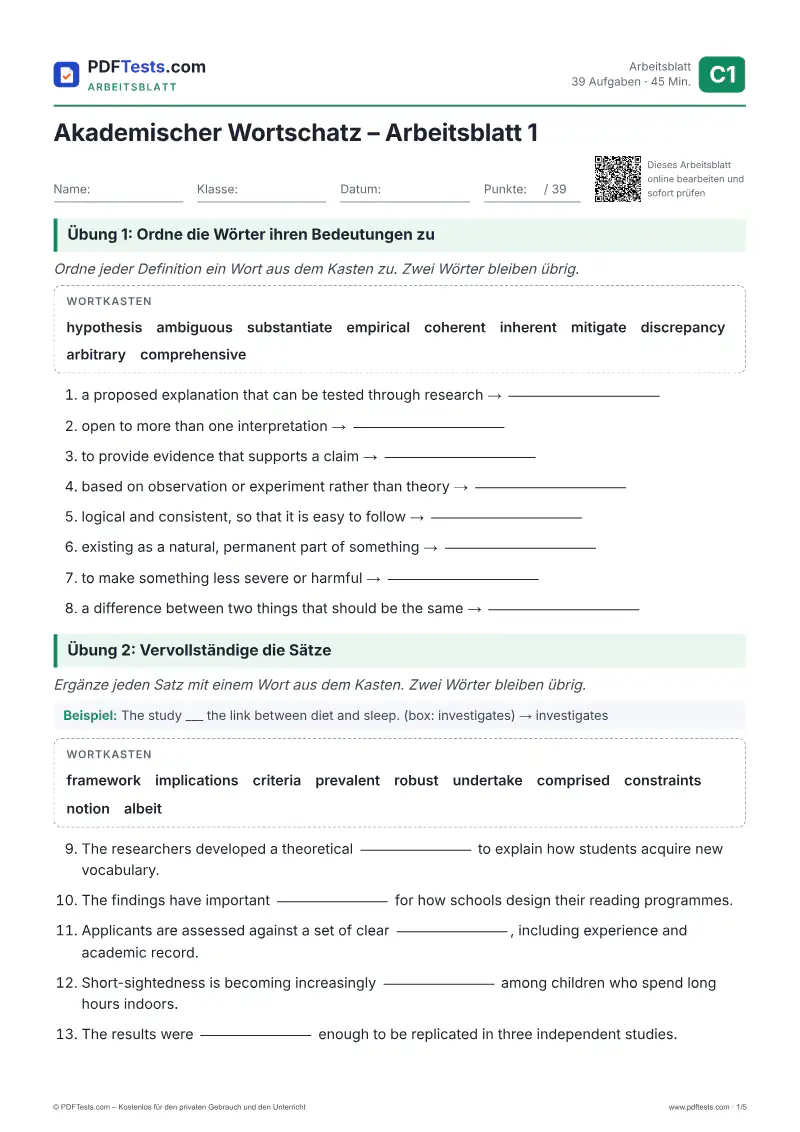
  6. Before the project begins, the team will a detailed review of the existing literature.

  7. The sample 240 participants aged between 18 and 65.

  8. Due to time and budget , the study was limited to a single city.

Übung 3: Wortbildung

Bilde aus dem großgeschriebenen Wort ein Wort, das in die Lücke passt.

Beispiel: The ___ of the survey took six months. (COMPLETE) → completion

  1. There is no statistically difference between the two groups. (SIGNIFY)

  2. The report the importance of early intervention. (EMPHASIS)

  3. Researchers must guarantee the of all personal data. (CONFIDENTIAL)

  4. There was a strong between income and life expectancy. (CORRELATE)

  5. Many reviewers found the author's argument , as it ignored key data. (CONVINCE)

  6. The existing equipment proved for analysing such a large data set. (ADEQUATE)

  7. The main of the study is its small sample size. (LIMIT)

  8. The of the data was checked by two independent researchers. (RELY)

Übung 4: Bringe die Wörter in die richtige Reihenfolge

Bringe die Wörter in die richtige Reihenfolge, sodass typische Sätze aus wissenschaftlichen Texten entstehen.

Beispiel: study / this / on / focuses / adults → This study focuses on adults.

  1. these / findings / have / implications / significant / for / policy

  2. further / research / is / to / needed / confirm / the / results

  3. the / data / do / not / support / this / hypothesis

  4. it / is / widely / that / acknowledged / the / sample / was / small

  5. the / results / be / interpreted / should / with / caution

  6. there / is / a / strong / between / correlation / income / and / health

  7. the / study / sheds / new / light / on / the / causes / of / stress

Übung 5: Korrigiere die Kollokationsfehler

Jeder Satz enthält einen Fehler in einer Kollokation. Schreibe den Satz korrekt auf.

Beispiel: The study gives a contribution to the field. → The study makes a contribution to the field.

  1. The researchers made an experiment to test their hypothesis.

  2. These results raise serious doubts on the reliability of earlier studies.

  3. The study draws attention on the role of social media in learning.

  4. Several factors play a key part to students' academic success.

  5. The author does a convincing case for reform.

  6. The new data lend strong support at the hypothesis.

  7. Further research is needed to address with this issue.

  8. The findings should be interpreted in caution.

War diese Seite hilfreich?

Fehler melden

Falsche Lösung, Tippfehler oder unklare Erklärung? Schreiben Sie uns, wir korrigieren es.

Vorschau

Über diesen Test

Arbeitsblatt Englisch C1 PDF: akademischer Wortschatz, Kollokationen und Wortbildung im Kontext üben. Zum Ausdrucken, mit Lösungen.

Themen

Akademischer WortschatzKollokationenWortbildungWissenschaftsspracheAkademisches Schreiben

Hinweise für Lehrkräfte

Beginnen Sie mit der Zuordnungsübung, um die Bedeutungen zu sichern. Anschließend folgen Lückentext und Wortbildung, danach die Übungen zu Kollokationen und zur Fehlerkorrektur. Typische Fehler sind falsche Präpositionen in festen Wendungen (draw attention on, raise doubts on) sowie die Verwechslung von Wortarten, etwa signify und significant oder rely und reliability. Als Anschlussaufgabe können die Lernenden ein kurzes Abstract für eine fiktive Studie verfassen und dabei mindestens acht Wörter aus dem Arbeitsblatt verwenden.

Alle Englisch-Tests C1 →