PDFTests Originals

Advanced Modal Verbs – Worksheet 1

C1 Advanced WorksheetEnglish

This worksheet practises advanced modal verbs at C1 level. It covers modal perfects for deduction and criticism, needn't have vs. don't have to, and expressions such as be bound to, be supposed to, might as well, would rather and had better. Learners work through affirmative, negative and question forms, starting with controlled practice and moving on to rewriting and error correction.
items
40
Time
40 min
PDF
5 pages
Answer key
Included
  • 100% free
  • No sign-up or email
  • Print-ready A4 PDF
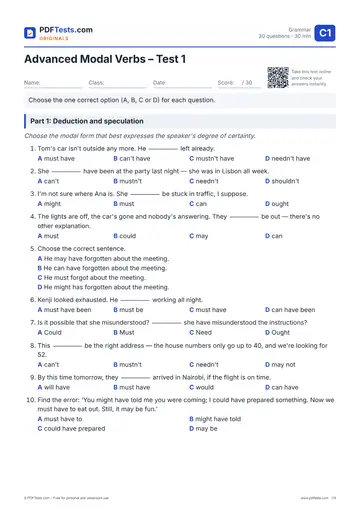
Preview of page 1 of Advanced Modal Verbs – Worksheet 1 Open PDF
New to this topic? Read the guide first: Advanced Modal Verbs: Uses, Forms and Common Mistakes (C1)

Do the worksheet online

Type your answers, then press “Check my answers”. Alternative correct answers are accepted.

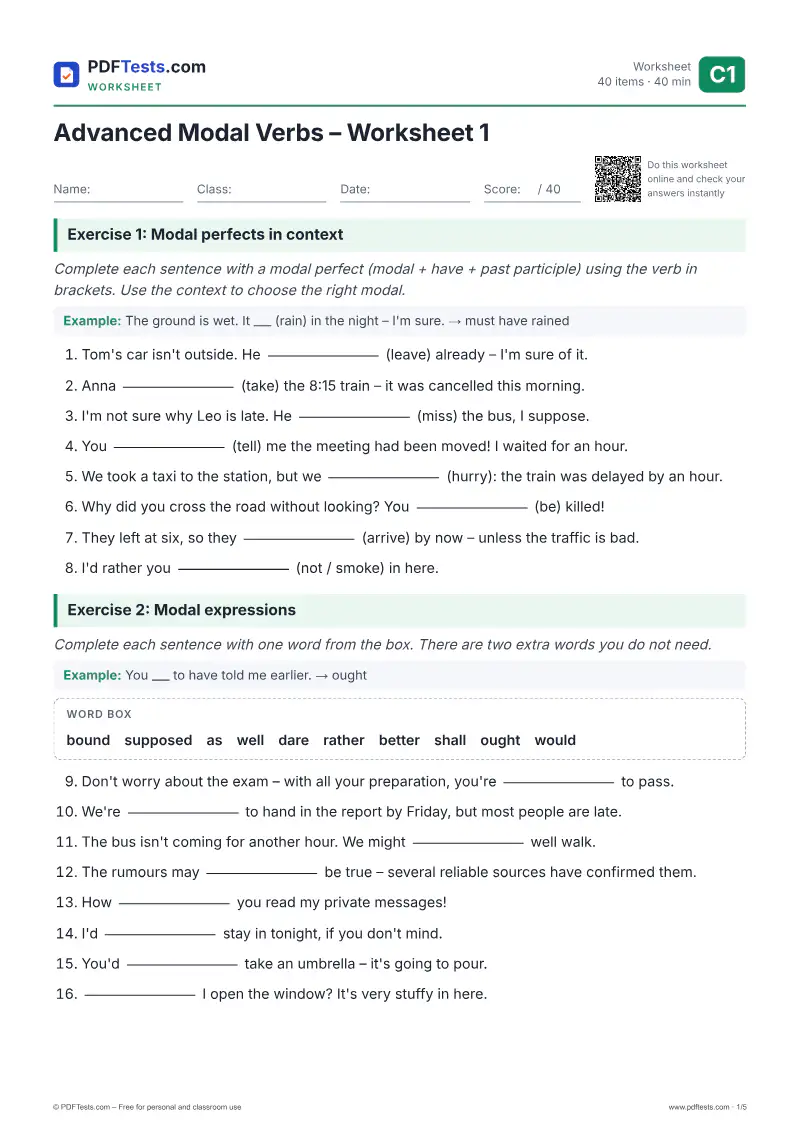
Exercise 1: Modal perfects in context

Complete each sentence with a modal perfect (modal + have + past participle) using the verb in brackets. Use the context to choose the right modal.

Example: The ground is wet. It ___ (rain) in the night – I'm sure. → must have rained

  1. Tom's car isn't outside. He (leave) already – I'm sure of it.

  2. Anna (take) the 8:15 train – it was cancelled this morning.

  3. I'm not sure why Leo is late. He (miss) the bus, I suppose.

  4. You (tell) me the meeting had been moved! I waited for an hour.

  5. We took a taxi to the station, but we (hurry): the train was delayed by an hour.

  6. Why did you cross the road without looking? You (be) killed!

  7. They left at six, so they (arrive) by now – unless the traffic is bad.

  8. I'd rather you (not / smoke) in here.

Exercise 2: Modal expressions

Complete each sentence with one word from the box. There are two extra words you do not need.

Example: You ___ to have told me earlier. → ought

Word box boundsupposedaswelldareratherbettershalloughtwould

  1. Don't worry about the exam – with all your preparation, you're to pass.

  2. We're to hand in the report by Friday, but most people are late.

  3. The bus isn't coming for another hour. We might well walk.

  4. The rumours may be true – several reliable sources have confirmed them.

  5. How you read my private messages!

  6. I'd stay in tonight, if you don't mind.

  7. You'd take an umbrella – it's going to pour.

  8. I open the window? It's very stuffy in here.

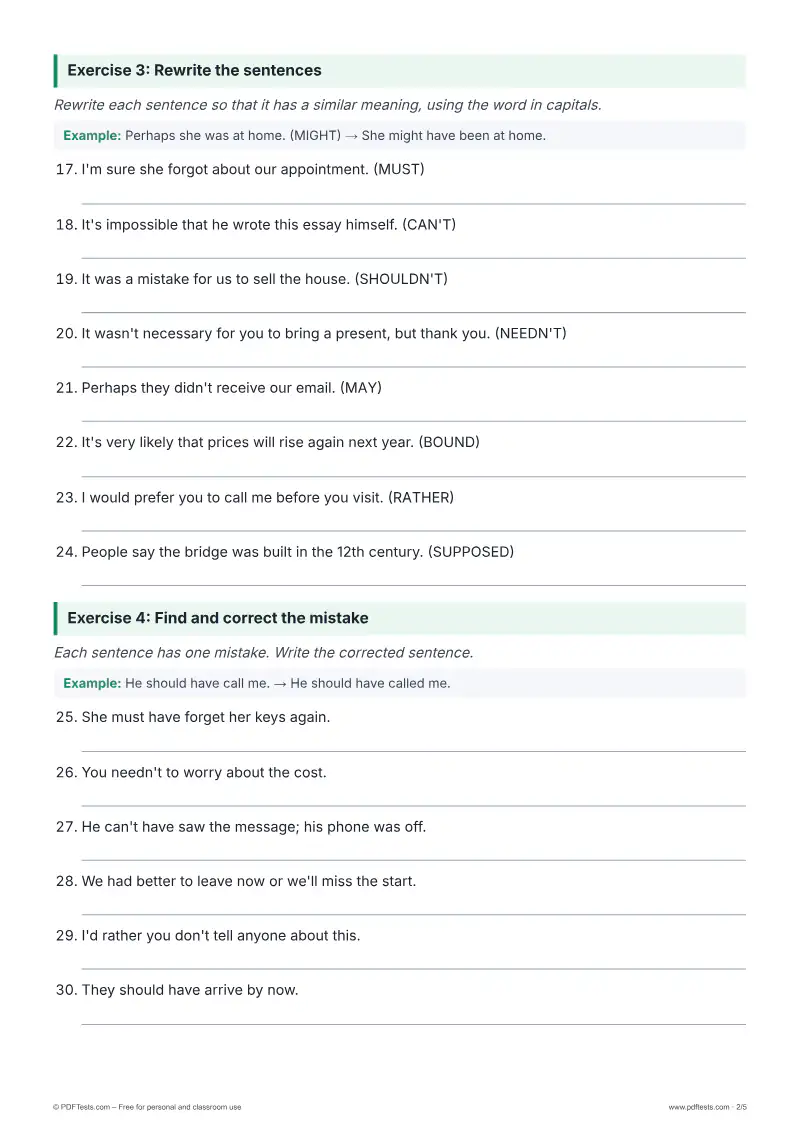
Exercise 3: Rewrite the sentences

Rewrite each sentence so that it has a similar meaning, using the word in capitals.

Example: Perhaps she was at home. (MIGHT) → She might have been at home.

  1. I'm sure she forgot about our appointment. (MUST)

  2. It's impossible that he wrote this essay himself. (CAN'T)

  3. It was a mistake for us to sell the house. (SHOULDN'T)

  4. It wasn't necessary for you to bring a present, but thank you. (NEEDN'T)

  5. Perhaps they didn't receive our email. (MAY)

  6. It's very likely that prices will rise again next year. (BOUND)

  7. I would prefer you to call me before you visit. (RATHER)

  8. People say the bridge was built in the 12th century. (SUPPOSED)

Exercise 4: Find and correct the mistake

Each sentence has one mistake. Write the corrected sentence.

Example: He should have call me. → He should have called me.

  1. She must have forget her keys again.

  2. You needn't to worry about the cost.

  3. He can't have saw the message; his phone was off.

  4. We had better to leave now or we'll miss the start.

  5. I'd rather you don't tell anyone about this.

  6. They should have arrive by now.

  7. Did you must wear a uniform at your old school?

  8. You mustn't pay now; you can pay at the end.

Exercise 5: Put the words in order

Put the words in the correct order to make sentences or questions.

Example: have / might / she / lost / it → She might have lost it.

  1. have / must / they / been / waiting / for / hours

  2. I / have / should / told / you / earlier / ?

  3. can't / she / meant / have / it / seriously

  4. might / well / as / we / home / go

  5. could / where / have / gone / they / ?

  6. needn't / you / have / waited / me / for

  7. would / you / rather / we / stayed / ?

  8. is / bound / there / to / be / a / delay

Was this page helpful?

Report a mistake

Spotted a wrong answer, a typo or an unclear explanation? Tell us and we will fix it.

Preview

About this test

C1 worksheet on advanced modal verbs: modal perfects, deduction, criticism, needn't have, be bound to, would rather, had better. Answers included.

Topics covered

Modal perfectsDeduction and speculationCriticism and regretNecessity and obligationSemi-modals and modal expressions

Notes for teachers

Start with Exercise 1 to check the form modal + have + past participle, then ask learners to say what each modal means (certainty, possibility, criticism, unnecessary action). Typical mistakes are using the base form after 'have' (must have forget), adding 'to' after needn't or had better, and using a present verb after 'would rather + subject'. Also make sure learners understand the difference between mustn't and don't have to. As a follow-up, show learners a photo of a mysterious scene and ask them to speculate about what happened using must have, might have and can't have.

All English C1 tests →