PDFTests Originals

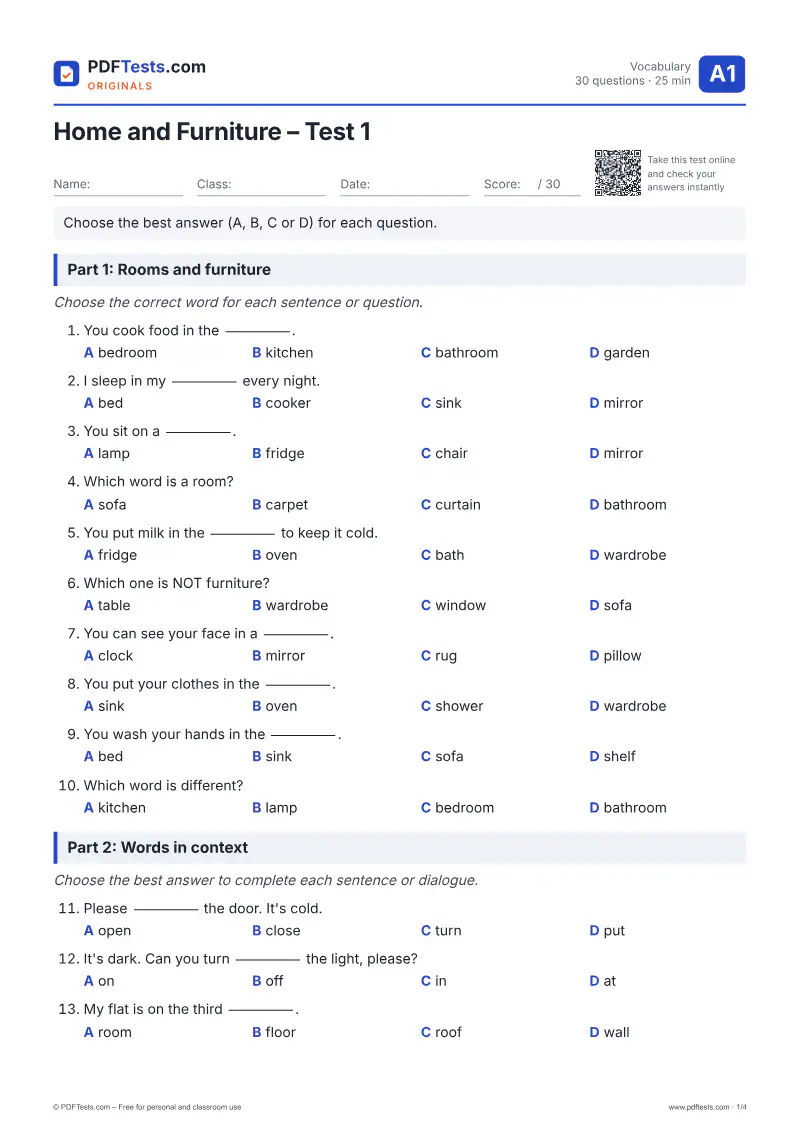
Home and Furniture – Test 1

A1 Beginner VocabularyEnglish

This A1 vocabulary test checks basic words for rooms, furniture and things in the home, plus common phrases like 'turn on the light' and 'close the door'. It finishes with a short reading about a family house. It suits beginner learners and teachers who need a quick, printable check of everyday home vocabulary.
Questions
30
Time
25 min
PDF
4 pages
Answer key
Included
  • 100% free
  • No sign-up or email
  • Print-ready A4 PDF
Preview of page 1 of Home and Furniture – Test 1 Open PDF

Take the test online

Choose the best answer (A, B, C or D) for each question. Choose your answers, then press “Check my answers”.

Part 1: Rooms and furniture

Choose the correct word for each sentence or question.

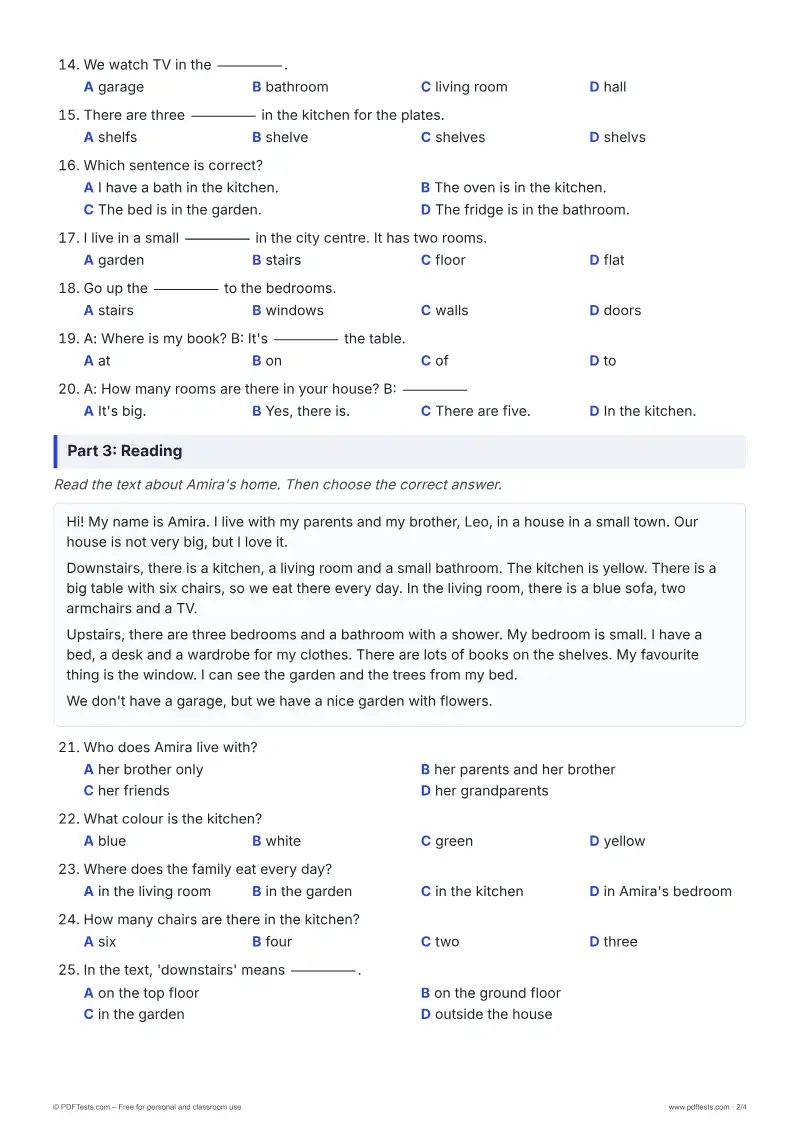
  1. You cook food in the _____.

  2. I sleep in my _____ every night.

  3. You sit on a _____.

  4. Which word is a room?

  5. You put milk in the _____ to keep it cold.

  6. Which one is NOT furniture?

  7. You can see your face in a _____.

  8. You put your clothes in the _____.

  9. You wash your hands in the _____.

  10. Which word is different?

Part 2: Words in context

Choose the best answer to complete each sentence or dialogue.

  1. Please _____ the door. It's cold.

  2. It's dark. Can you turn _____ the light, please?

  3. My flat is on the third _____.

  4. We watch TV in the _____.

  5. There are three _____ in the kitchen for the plates.

  6. Which sentence is correct?

  7. I live in a small _____ in the city centre. It has two rooms.

  8. Go up the _____ to the bedrooms.

  9. A: Where is my book? B: It's _____ the table.

  10. A: How many rooms are there in your house? B: _____

Part 3: Reading

Read the text about Amira's home. Then choose the correct answer.

Hi! My name is Amira. I live with my parents and my brother, Leo, in a house in a small town. Our house is not very big, but I love it.

Downstairs, there is a kitchen, a living room and a small bathroom. The kitchen is yellow. There is a big table with six chairs, so we eat there every day. In the living room, there is a blue sofa, two armchairs and a TV.

Upstairs, there are three bedrooms and a bathroom with a shower. My bedroom is small. I have a bed, a desk and a wardrobe for my clothes. There are lots of books on the shelves. My favourite thing is the window. I can see the garden and the trees from my bed.

We don't have a garage, but we have a nice garden with flowers.

  1. Who does Amira live with?

  2. What colour is the kitchen?

  3. Where does the family eat every day?

  4. How many chairs are there in the kitchen?

  5. In the text, 'downstairs' means _____.

  6. How many bathrooms are there in the house?

  7. Where are Amira's books?

  8. What does Amira put in her wardrobe?

  9. What can Amira see from her bed?

  10. Which sentence is true?

Was this page helpful?

Report a mistake

Spotted a wrong answer, a typo or an unclear explanation? Tell us and we will fix it.

Practise with a worksheet: Home and Furniture – Worksheet 1

Preview

About this test

This A1 vocabulary test checks basic words for rooms, furniture and things in the home, plus common phrases like 'turn on the light' and 'close the door'. It finishes with a short reading about a family house. It suits beginner learners and teachers who need a quick, printable check of everyday home vocabulary.

Topics covered

Rooms in a houseFurnitureKitchen and bathroom itemsEveryday home phrasesPlural nounsReading about a home

How to use this test

  1. Download the PDF and print it, or take the test online below.
  2. Answer every question without a dictionary or time pressure.
  3. Check your answers and note the topics you need to review.

Notes for teachers

Use this test after teaching basic home and furniture vocabulary, either as a review or as a short quiz. It targets common beginner mistakes such as mixing up rooms and furniture, confusing 'room' and 'floor', irregular plurals like 'shelves', and phrases such as 'turn on'. As a follow-up, ask students to draw a plan of their own home and describe it using 'There is / There are'.