PDFTests Originals

Present Simple – Test 3

A1 Beginner GrammarEnglish

This 30-question A1 test practises the Present Simple in everyday contexts. It covers third-person -s spelling, negatives with don't/doesn't, questions with do/does, short answers, adverbs of frequency and a short reading text. It suits beginner learners and teachers who need a quick, printable check of this key tense.
Questions
30
Time
30 min
PDF
4 pages
Answer key
Included
  • 100% free
  • No sign-up or email
  • Print-ready A4 PDF
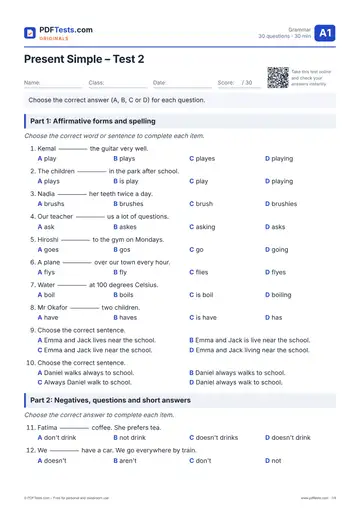
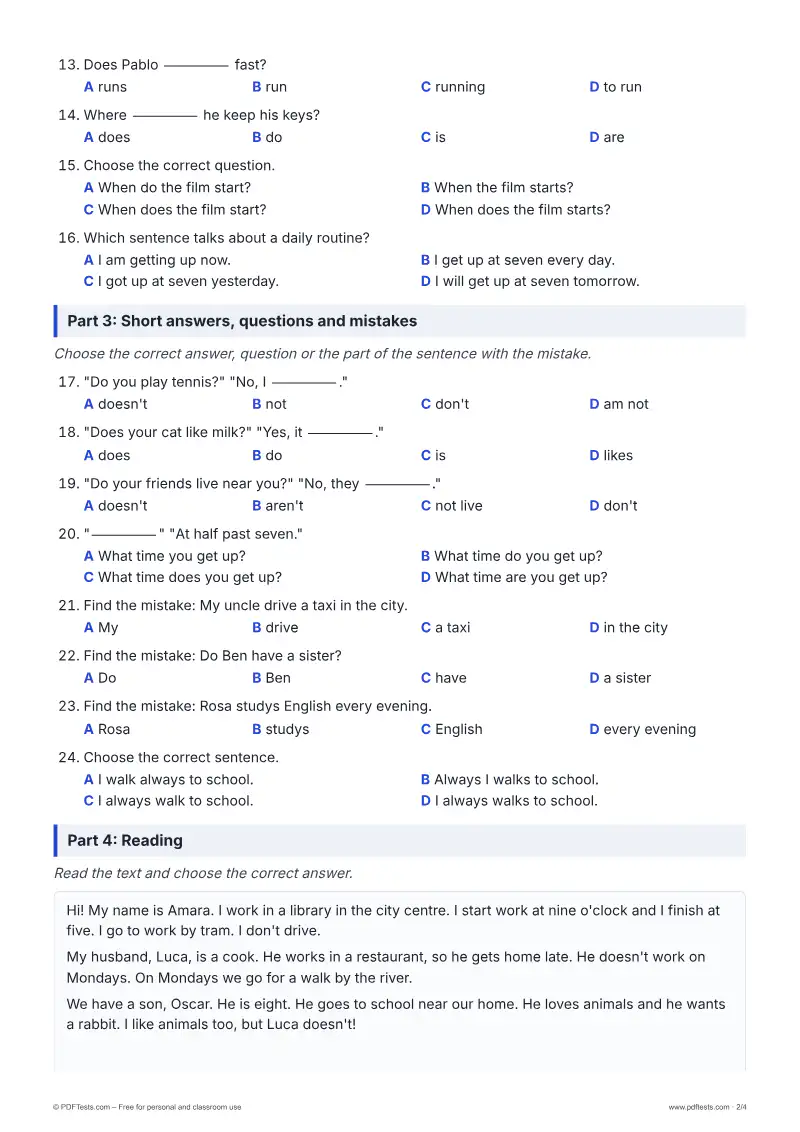
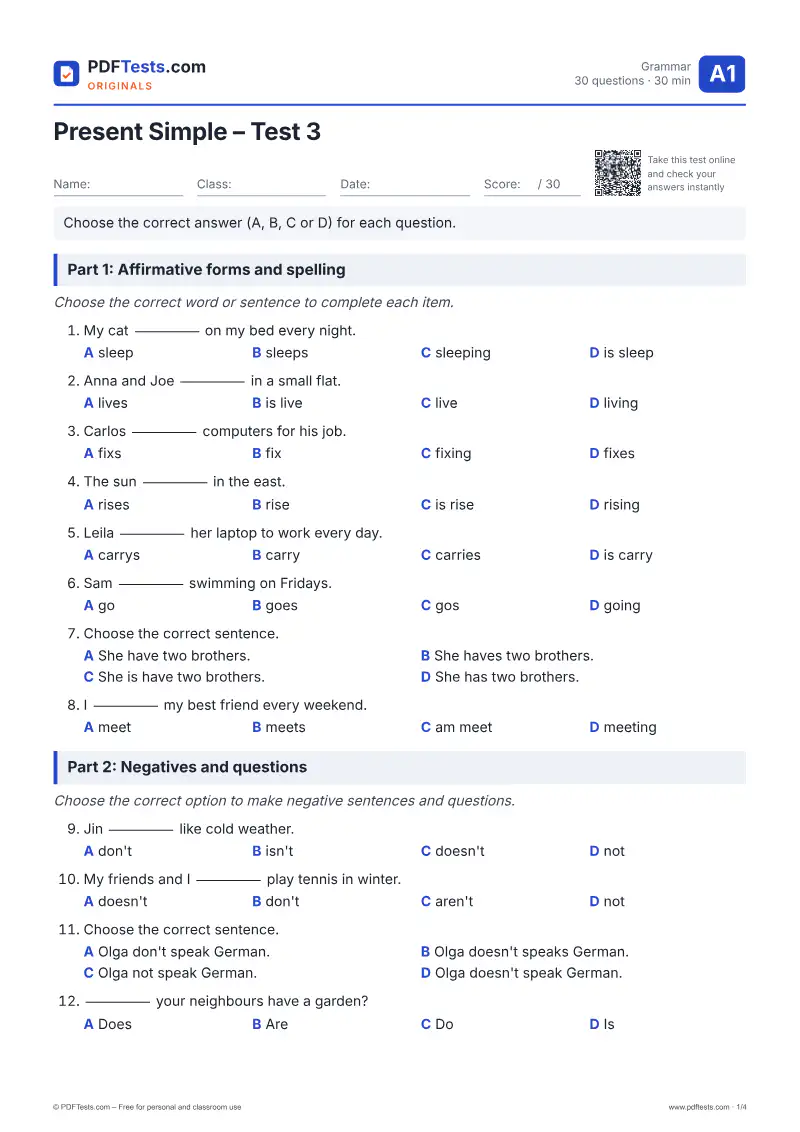
Preview of page 1 of Present Simple – Test 3 Open PDF
New to this topic? Read the guide first: Present Simple: Rules, Examples and Common Mistakes

Take the test online

Choose the correct answer (A, B, C or D) for each question. Choose your answers, then press “Check my answers”.

Part 1: Affirmative forms and spelling

Choose the correct word or sentence to complete each item.

  1. My cat _____ on my bed every night.

  2. Anna and Joe _____ in a small flat.

  3. Carlos _____ computers for his job.

  4. The sun _____ in the east.

  5. Leila _____ her laptop to work every day.

  6. Sam _____ swimming on Fridays.

  7. Choose the correct sentence.

  8. I _____ my best friend every weekend.

Part 2: Negatives and questions

Choose the correct option to make negative sentences and questions.

  1. Jin _____ like cold weather.

  2. My friends and I _____ play tennis in winter.

  3. Choose the correct sentence.

  4. _____ your neighbours have a garden?

  5. Does Pablo _____ fast?

  6. Where _____ he keep his keys?

  7. Choose the correct question.

  8. Which sentence talks about a daily routine?

Part 3: Short answers, questions and mistakes

Choose the correct answer, question or the part of the sentence with the mistake.

  1. "Do you play tennis?" "No, I _____."

  2. "Does your cat like milk?" "Yes, it _____."

  3. "Do your friends live near you?" "No, they _____."

  4. "_____" "At half past seven."

  5. Find the mistake: My uncle drive a taxi in the city.

  6. Find the mistake: Do Ben have a sister?

  7. Find the mistake: Rosa studys English every evening.

  8. Choose the correct sentence.

Part 4: Reading

Read the text and choose the correct answer.

Hi! My name is Amara. I work in a library in the city centre. I start work at nine o'clock and I finish at five. I go to work by tram. I don't drive.

My husband, Luca, is a cook. He works in a restaurant, so he gets home late. He doesn't work on Mondays. On Mondays we go for a walk by the river.

We have a son, Oscar. He is eight. He goes to school near our home. He loves animals and he wants a rabbit. I like animals too, but Luca doesn't!

At the weekend, I read and Oscar plays with his friends. Luca sleeps a lot on Sunday mornings.

  1. Where does Amara work?

  2. How does Amara go to work?

  3. Which day doesn't Luca work?

  4. Which sentence is true?

  5. "Does Luca like animals?"

  6. Oscar _____ a rabbit.

Was this page helpful?

Report a mistake

Spotted a wrong answer, a typo or an unclear explanation? Tell us and we will fix it.

Practise with a worksheet: Present Simple – Worksheet 1

Preview

About this test

This 30-question A1 test practises the Present Simple in everyday contexts. It covers third-person -s spelling, negatives with don't/doesn't, questions with do/does, short answers, adverbs of frequency and a short reading text. It suits beginner learners and teachers who need a quick, printable check of this key tense.

Topics covered

Present Simple affirmativeThird-person -s spellingNegatives with don't/doesn'tQuestions with do/doesShort answersAdverbs of frequencyError correctionReading comprehension

How to use this test

  1. Download the PDF and print it, or take the test online below.
  2. Answer every question without a dictionary or time pressure.
  3. Check your answers and note the topics you need to review.

Notes for teachers

Use this test after teaching the Present Simple, or as a review before moving on to the Present Continuous. It targets common A1 errors: missing third-person -s, spelling forms like 'studys' or 'fixs', 'doesn't' + verb with -s, wrong auxiliary in questions, and adverb position. For follow-up, ask students to write five sentences about a family member's routine and swap them for peer correction.