The present simple is the basic present tense in English. We use it for habits and routines, facts, and situations that are true for a long time: I drink coffee every morning, Water boils at 100°C, She lives in Madrid. The main thing to remember is the -s ending with he, she and it.
When do we use the present simple?
1. Habits and routines
Use the present simple for things you do regularly: every day, every week, on Saturdays.
- I get up at seven o’clock.
- My brother plays football on Sundays.
- We don’t watch TV in the morning.
2. Facts and things that are always true
Use it for general truths and scientific facts.
- The sun rises in the east.
- Cats like fish.
- It doesn’t snow in the desert.
3. Permanent situations
Use it for situations that are true now and for a long time, like where you live or what your job is.
- I live in a small flat.
- My mum works in a hospital.
- They speak Spanish and English.
4. Likes, dislikes and opinions
Verbs like like, love, hate, want, know and think are usually in the present simple.
- I love pizza.
- She doesn’t like cold weather.
- Do you know the answer?
5. Timetables
Use it for fixed times of trains, buses, films and classes.
- The bus leaves at 8.15.
- The film starts at nine.
How to form the present simple
Positive sentences
Use the base form of the verb (work, play, eat). With he, she, it (and one person or thing, like my dad or the shop), add -s.
| Subject | Verb | Example |
|---|---|---|
| I | work | I work in an office. |
| You | work | You work very hard. |
| He / She / It | works | She works at home. |
| We | work | We work together. |
| They | work | They work at night. |
Negative sentences
Use don’t (do not) or doesn’t (does not) + the base form. After doesn’t, the verb has no -s.
| Subject | Negative | Example |
|---|---|---|
| I / You / We / They | don’t + verb | I don’t eat meat. |
| He / She / It | doesn’t + verb | He doesn’t eat meat. |
In speaking and informal writing, we normally use the short forms don’t and doesn’t.
Questions
Put Do or Does at the start, then the subject, then the base form. Again, no -s on the main verb.
| Question | Short answer (yes) | Short answer (no) |
|---|---|---|
| Do you like tea? | Yes, I do. | No, I don’t. |
| Do they live here? | Yes, they do. | No, they don’t. |
| Does she work on Fridays? | Yes, she does. | No, she doesn’t. |
| Does it rain a lot? | Yes, it does. | No, it doesn’t. |
Questions with question words
Put the question word (what, where, when, what time, how often) before do or does.
- Where do you live?
- What time does the shop open?
- How often do they go swimming?
- What does your sister do? (= What is her job?)
Spelling: adding -s with he, she, it
Most verbs just take -s, but some need -es or change their spelling.
| Rule | Examples |
|---|---|
| Most verbs: add -s | work → works, play → plays, read → reads |
| Verbs ending in -s, -ss, -sh, -ch, -x: add -es | kiss → kisses, wash → washes, watch → watches, fix → fixes |
| Verbs ending in -o: add -es | go → goes, do → does |
| Consonant + -y: change y to -ies | study → studies, fly → flies, carry → carries |
| Vowel + -y: just add -s | play → plays, buy → buys, enjoy → enjoys |
| Irregular | have → has |
Pronunciation of the -s ending
The -s ending has three sounds:
- /s/ after sounds like p, t, k, f: works, stops, likes, laughs
- /z/ after most other sounds: plays, lives, reads, goes
- /ɪz/ (an extra syllable) after s, z, sh, ch, x sounds: watches, washes, kisses, uses
Also note: does is pronounced /dʌz/ and says is pronounced /sez/.
Signal words
These words often appear with the present simple:
- Adverbs of frequency: always, usually, often, sometimes, rarely, never
- Time expressions: every day, every week, every summer, on Mondays, at weekends, in the morning, once a week, twice a month
Word order matters. Adverbs of frequency go before the main verb but after the verb be:
- She usually walks to school.
- I never drink coffee at night.
- He is always late. (after be)
Longer time expressions usually go at the end: We go to the cinema once a month. For more practice with word order, read our guide to adverbs of frequency like always, usually and never.
Present simple and the verb be
The verb be (am, is, are) is special. It does not use do or does in negatives and questions.
| Verb be | Other verbs | |
|---|---|---|
| Positive | She is a teacher. | She teaches English. |
| Negative | She isn’t at home. | She doesn’t live here. |
| Question | Is she happy? | Does she like her job? |
Also, don’t use am/is/are together with another present simple verb: say I work, not I am work. If you need to review am, is, are, see our guide to the verb to be.
Present simple or present continuous?
Learners often mix the present simple with the present continuous (am/is/are + -ing).
| Present simple | Present continuous |
|---|---|
| Habits, routines, facts | Actions happening now, at this moment |
| I play tennis on Saturdays. | I**’m playing** tennis now. |
| She works in a bank. | She**’s working** from home today. |
| Signal words: every day, usually, never | Signal words: now, right now, at the moment, today |
Ask yourself: is this a regular or permanent thing, or is it happening right now? Our guide to present simple vs present continuous explains the difference in more detail.
Common mistakes
-
✗ She work in a bank. → ✓ She works in a bank.
With he, she and it, the verb needs -s. -
✗ He doesn’t works on Sundays. → ✓ He doesn’t work on Sundays.
Doesn’t already shows he/she/it, so the main verb has no -s. -
✗ Does she likes music? → ✓ Does she like music?
After does in questions, use the base form. -
✗ I am work in a shop. → ✓ I work in a shop.
Don’t add am/is/are before a present simple verb. -
✗ Do you are tired? → ✓ Are you tired?
The verb be makes questions without do. -
✗ I not like fish. → ✓ I don’t like fish.
Negatives need don’t or doesn’t. -
✗ Where you live? → ✓ Where do you live?
Questions need do or does after the question word. -
✗ He haves two cats. → ✓ He has two cats.
Have is irregular: he/she/it has. -
✗ She watchs TV. / He studys a lot. → ✓ She watches TV. / He studies a lot.
Follow the -es and -ies spelling rules. -
✗ I go always to the gym. → ✓ I always go to the gym.
Adverbs of frequency go before the main verb.
Quick check
Choose or write the correct form.
- My dad ___ (cook) dinner every evening.
- They ___ (not / like) horror films.
- ___ your sister speak French?
- Tom ___ (watch) football on Saturdays.
- Correct the mistake: She don’t have a car.
Answers
- cooks
- don’t like
- Does
- watches
- She doesn’t have a car.
Next step
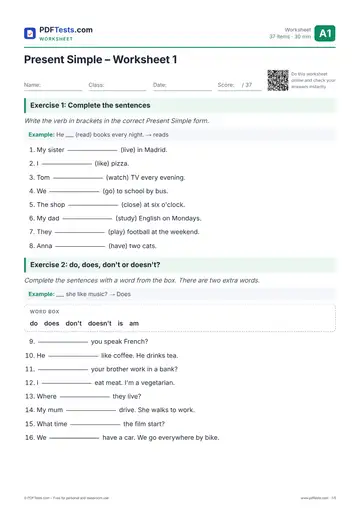
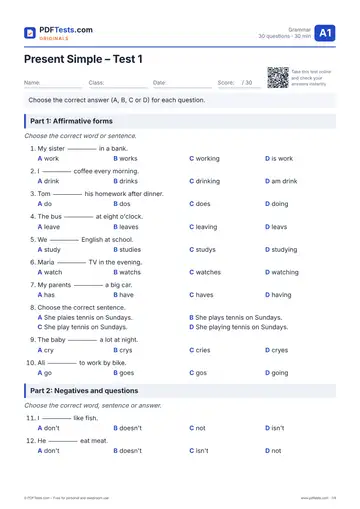
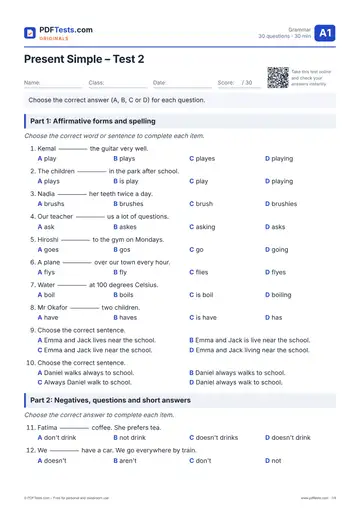
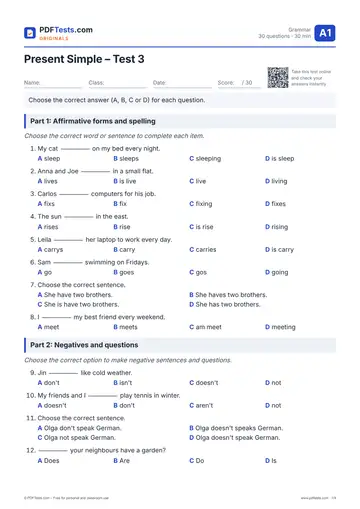
Now put the rules into practice. Start with our A1 Present Simple Test 1 to check positive sentences, negatives and questions, then try A1 Present Simple Test 2 for more practice with spelling and word order. If you make mistakes with don’t/doesn’t or the -s ending, come back to the tables above, read the examples aloud, and write five sentences about your own daily routine using I and five about a friend using he or she.
Was this page helpful?
What was the problem?
Thank you for your feedback!