PDFTests Originals

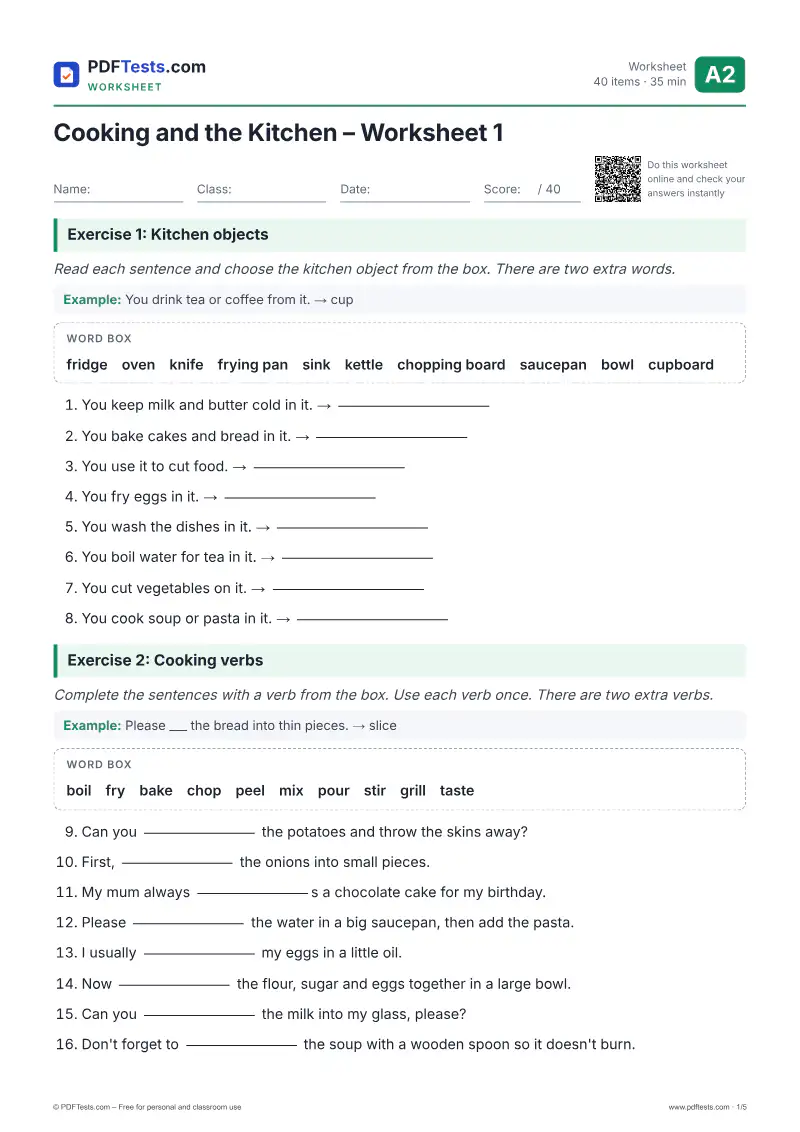
Cooking and the Kitchen – Worksheet 1

A2 Elementary WorksheetEnglish

This A2 worksheet practises everyday cooking and kitchen vocabulary in context. Learners match kitchen objects to their uses, choose the right cooking verbs, build word forms such as salty, fried and bakery, and fix common collocation mistakes like 'make the washing-up'. It suits teenage and adult learners at elementary level.
items
40
Time
35 min
PDF
5 pages
Answer key
Included
  • 100% free
  • No sign-up or email
  • Print-ready A4 PDF
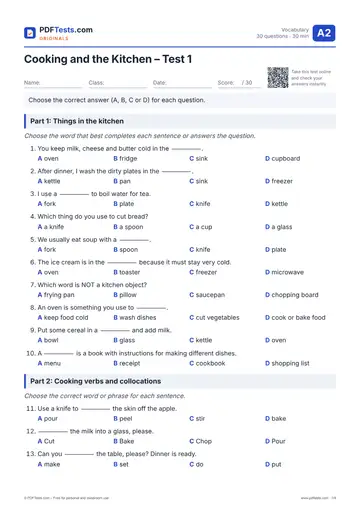
Preview of page 1 of Cooking and the Kitchen – Worksheet 1 Open PDF

Do the worksheet online

Type your answers, then press “Check my answers”. Alternative correct answers are accepted.

Exercise 1: Kitchen objects

Read each sentence and choose the kitchen object from the box. There are two extra words.

Example: You drink tea or coffee from it. → cup

Word box fridgeovenknifefrying pansinkkettlechopping boardsaucepanbowlcupboard

  1. You keep milk and butter cold in it.

  2. You bake cakes and bread in it.

  3. You use it to cut food.

  4. You fry eggs in it.

  5. You wash the dishes in it.

  6. You boil water for tea in it.

  7. You cut vegetables on it.

  8. You cook soup or pasta in it.

Exercise 2: Cooking verbs

Complete the sentences with a verb from the box. Use each verb once. There are two extra verbs.

Example: Please ___ the bread into thin pieces. → slice

Word box boilfrybakechoppeelmixpourstirgrilltaste

  1. Can you the potatoes and throw the skins away?

  2. First, the onions into small pieces.

  3. My mum always s a chocolate cake for my birthday.

  4. Please the water in a big saucepan, then add the pasta.

  5. I usually my eggs in a little oil.

  6. Now the flour, sugar and eggs together in a large bowl.

  7. Can you the milk into my glass, please?

  8. Don't forget to the soup with a wooden spoon so it doesn't burn.

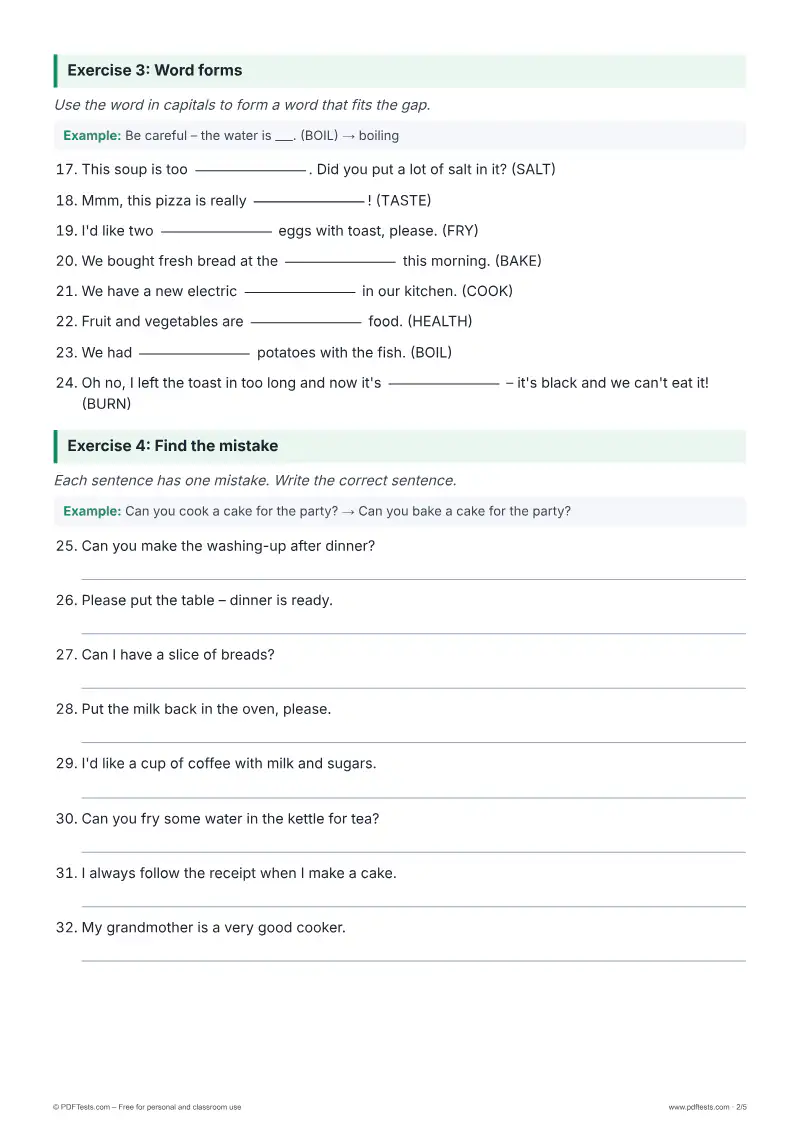
Exercise 3: Word forms

Use the word in capitals to form a word that fits the gap.

Example: Be careful – the water is ___. (BOIL) → boiling

  1. This soup is too . Did you put a lot of salt in it? (SALT)

  2. Mmm, this pizza is really ! (TASTE)

  3. I'd like two eggs with toast, please. (FRY)

  4. We bought fresh bread at the this morning. (BAKE)

  5. We have a new electric in our kitchen. (COOK)

  6. Fruit and vegetables are food. (HEALTH)

  7. We had potatoes with the fish. (BOIL)

  8. Oh no, I left the toast in too long and now it's – it's black and we can't eat it! (BURN)

Exercise 4: Find the mistake

Each sentence has one mistake. Write the correct sentence.

Example: Can you cook a cake for the party? → Can you bake a cake for the party?

  1. Can you make the washing-up after dinner?

  2. Please put the table – dinner is ready.

  3. Can I have a slice of breads?

  4. Put the milk back in the oven, please.

  5. I'd like a cup of coffee with milk and sugars.

  6. Can you fry some water in the kettle for tea?

  7. I always follow the receipt when I make a cake.

  8. My grandmother is a very good cooker.

Exercise 5: Make sentences

Put the words in the correct order to make sentences.

Example: a / of / glass / water → a glass of water

  1. the / in / put / fridge / milk / the

  2. you / table / can / the / set / ?

  3. a / of / I'd / cup / like / tea

  4. the / boil / pasta / for / ten / minutes

  5. dad / the / does / my / washing-up / every evening

  6. oven / is / cake / the / in / the

  7. onions / small / chop / into / pieces / the

  8. recipe / this / easy / very / is

Was this page helpful?

Report a mistake

Spotted a wrong answer, a typo or an unclear explanation? Tell us and we will fix it.

Preview

About this test

Printable A2 English worksheet on cooking and the kitchen: kitchen objects, cooking verbs, collocations and word forms, with answers.

Topics covered

Kitchen objectsCooking verbsFood collocationsWord formation: adjectives and nounsHousehold tasks in the kitchen

Notes for teachers

Start by showing pictures or real kitchen objects and eliciting the words before Exercise 1. Learners often confuse cook (a person) and cooker (a machine), receipt and recipe, and say 'make the washing-up' instead of 'do the washing-up', so highlight these after Exercises 3 and 4. As a follow-up, ask pairs to write a simple recipe for their favourite dish using at least five verbs from Exercise 2.

All English A2 tests →