PDFTests Originals

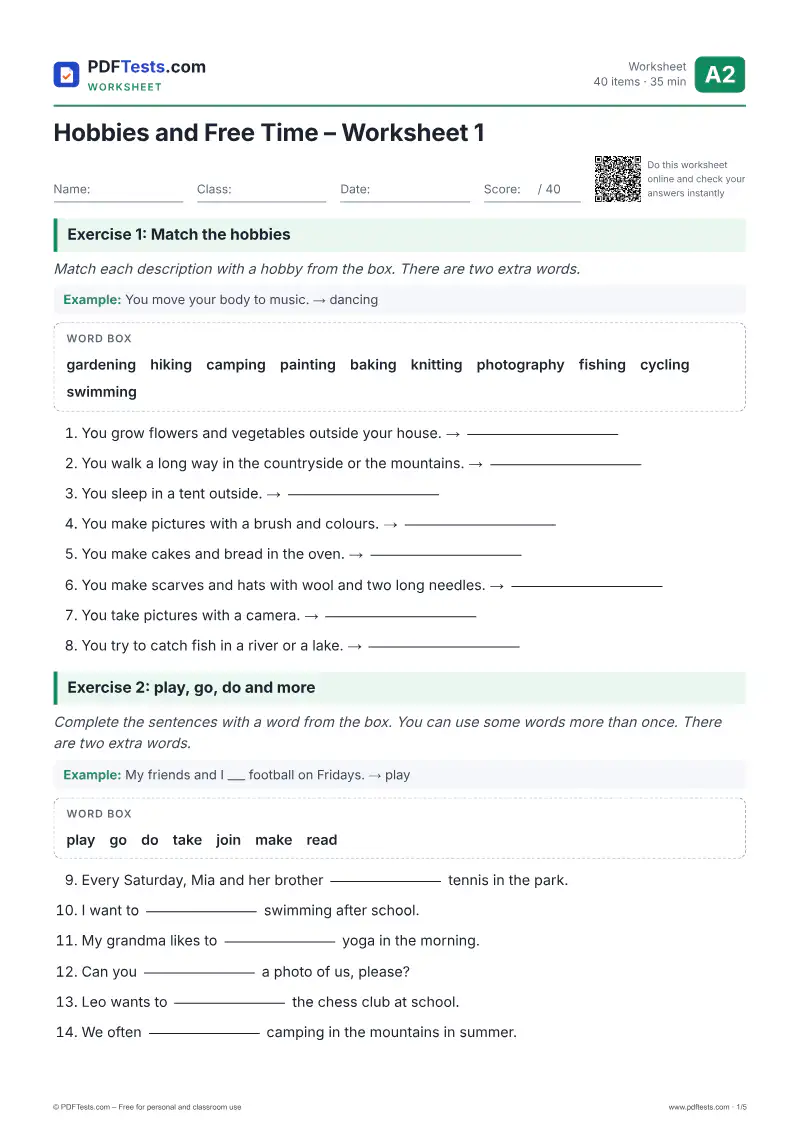
Hobbies and Free Time – Worksheet 1

A2 Elementary WorksheetEnglish

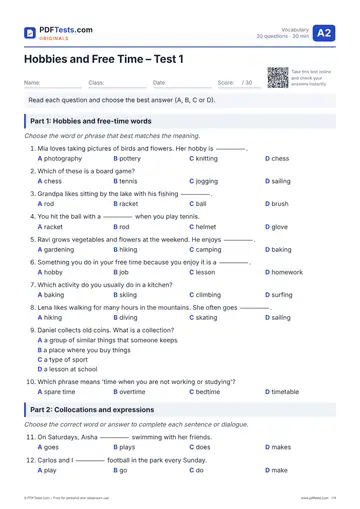
This worksheet helps A2 learners practise everyday vocabulary for hobbies and free-time activities. They match activities to their meanings, use collocations such as play, go and do, build word forms like singer and relaxing, and correct common mistakes. It works well in class or for homework.
items
40
Time
35 min
PDF
5 pages
Answer key
Included
  • 100% free
  • No sign-up or email
  • Print-ready A4 PDF
Preview of page 1 of Hobbies and Free Time – Worksheet 1 Open PDF

Do the worksheet online

Type your answers, then press “Check my answers”. Alternative correct answers are accepted.

Exercise 1: Match the hobbies

Match each description with a hobby from the box. There are two extra words.

Example: You move your body to music. → dancing

Word box gardeninghikingcampingpaintingbakingknittingphotographyfishingcyclingswimming

  1. You grow flowers and vegetables outside your house.

  2. You walk a long way in the countryside or the mountains.

  3. You sleep in a tent outside.

  4. You make pictures with a brush and colours.

  5. You make cakes and bread in the oven.

  6. You make scarves and hats with wool and two long needles.

  7. You take pictures with a camera.

  8. You try to catch fish in a river or a lake.

Exercise 2: play, go, do and more

Complete the sentences with a word from the box. You can use some words more than once. There are two extra words.

Example: My friends and I ___ football on Fridays. → play

Word box playgodotakejoinmakeread

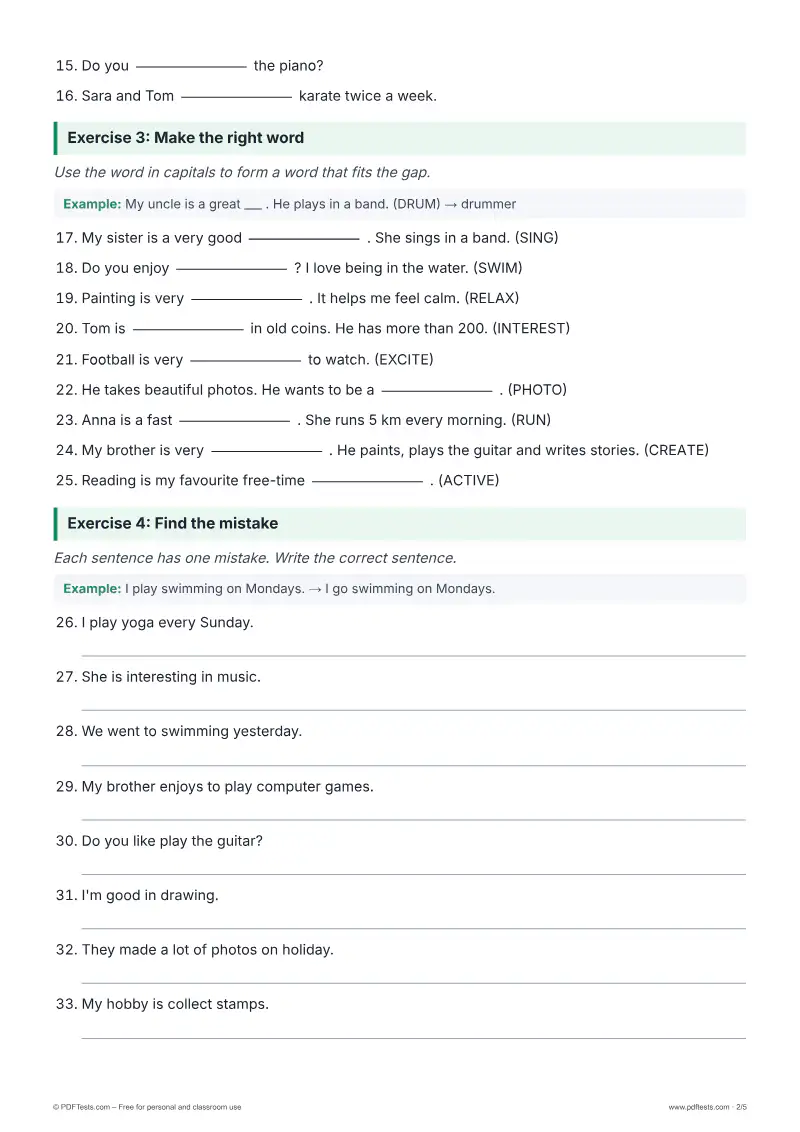
  1. Every Saturday, Mia and her brother tennis in the park.

  2. I want to swimming after school.

  3. My grandma likes to yoga in the morning.

  4. Can you a photo of us, please?

  5. Leo wants to the chess club at school.

  6. We often camping in the mountains in summer.

  7. Do you the piano?

  8. Sara and Tom karate twice a week.

Exercise 3: Make the right word

Use the word in capitals to form a word that fits the gap.

Example: My uncle is a great ___ . He plays in a band. (DRUM) → drummer

  1. My sister is a very good . She sings in a band. (SING)

  2. Do you enjoy ? I love being in the water. (SWIM)

  3. Painting is very . It helps me feel calm. (RELAX)

  4. Tom is in old coins. He has more than 200. (INTEREST)

  5. Football is very to watch. (EXCITE)

  6. He takes beautiful photos. He wants to be a . (PHOTO)

  7. Anna is a fast . She runs 5 km every morning. (RUN)

  8. My brother is very . He paints, plays the guitar and writes stories. (CREATE)

  9. Reading is my favourite free-time . (ACTIVE)

Exercise 4: Find the mistake

Each sentence has one mistake. Write the correct sentence.

Example: I play swimming on Mondays. → I go swimming on Mondays.

  1. I play yoga every Sunday.

  2. She is interesting in music.

  3. We went to swimming yesterday.

  4. My brother enjoys to play computer games.

  5. Do you like play the guitar?

  6. I'm good in drawing.

  7. They made a lot of photos on holiday.

  8. My hobby is collect stamps.

Exercise 5: Put the words in order

Put the words in the correct order to make sentences.

Example: like / I / reading / comics → I like reading comics.

  1. you / free time / do / your / what / in / do / ?

  2. loves / my / board games / playing / family

  3. twice / go / a week / I / cycling

  4. never / she / dancing / goes

  5. interested / are / in / you / photography / ?

  6. good / at / is / Ben / very / chess

  7. often / we / at / the weekend / go / hiking

Was this page helpful?

Report a mistake

Spotted a wrong answer, a typo or an unclear explanation? Tell us and we will fix it.

Preview

About this test

Printable A2 English worksheet on hobbies and free time: activity words, play/go/do collocations, word forms and common mistakes, with answers.

Topics covered

Hobbies and free timeCollocations with play, go and doWord formationAdjectives with -ed and -ingVerb + -ing after enjoy and love

Notes for teachers

Start with the matching exercise to check meaning, then move to the collocation and word-form tasks. Learners often say 'play yoga' or 'make photos', and they mix up interested and interesting, so point out these patterns before Exercise 4. As a follow-up, learners can interview a partner with the question 'What do you do in your free time?' and report back using go/play/do + activity.

All English A2 tests →