PDFTests Originals

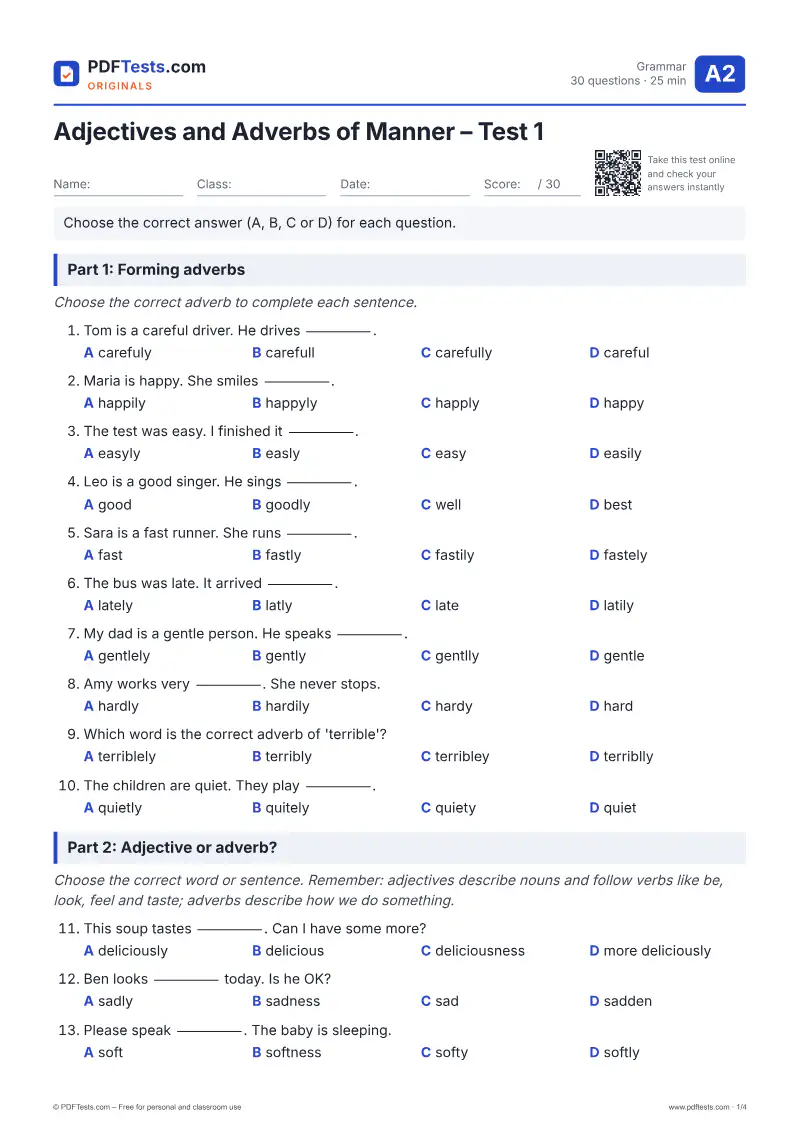
Adjectives and Adverbs of Manner – Test 1

A2 Elementary GrammarEnglish

This 30-question A2 grammar test practises adjectives and adverbs of manner. It covers how to form adverbs, when to use an adjective or an adverb, irregular forms like well, fast and hard, and use in questions, negatives and a short text. It suits learners in their second year of English and teachers who need a quick, printable check.
Questions
30
Time
25 min
PDF
4 pages
Answer key
Included
  • 100% free
  • No sign-up or email
  • Print-ready A4 PDF
Preview of page 1 of Adjectives and Adverbs of Manner – Test 1 Open PDF

Take the test online

Choose the correct answer (A, B, C or D) for each question. Choose your answers, then press “Check my answers”.

Part 1: Forming adverbs

Choose the correct adverb to complete each sentence.

  1. Tom is a careful driver. He drives _____.

  2. Maria is happy. She smiles _____.

  3. The test was easy. I finished it _____.

  4. Leo is a good singer. He sings _____.

  5. Sara is a fast runner. She runs _____.

  6. The bus was late. It arrived _____.

  7. My dad is a gentle person. He speaks _____.

  8. Amy works very _____. She never stops.

  9. Which word is the correct adverb of 'terrible'?

  10. The children are quiet. They play _____.

Part 2: Adjective or adverb?

Choose the correct word or sentence. Remember: adjectives describe nouns and follow verbs like be, look, feel and taste; adverbs describe how we do something.

  1. This soup tastes _____. Can I have some more?

  2. Ben looks _____ today. Is he OK?

  3. Please speak _____. The baby is sleeping.

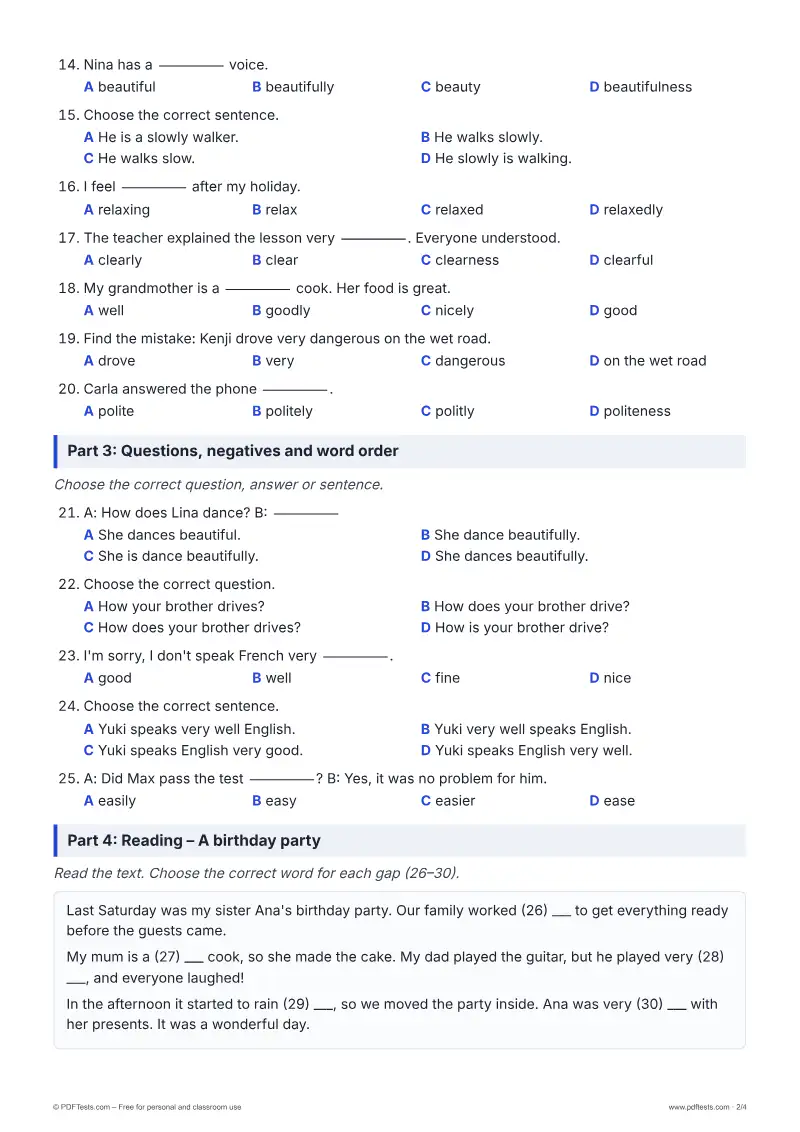
  4. Nina has a _____ voice.

  5. Choose the correct sentence.

  6. I feel _____ after my holiday.

  7. The teacher explained the lesson very _____. Everyone understood.

  8. My grandmother is a _____ cook. Her food is great.

  9. Find the mistake: Kenji drove very dangerous on the wet road.

  10. Carla answered the phone _____.

Part 3: Questions, negatives and word order

Choose the correct question, answer or sentence.

  1. A: How does Lina dance? B: _____

  2. Choose the correct question.

  3. I'm sorry, I don't speak French very _____.

  4. Choose the correct sentence.

  5. A: Did Max pass the test _____? B: Yes, it was no problem for him.

Part 4: Reading – A birthday party

Read the text. Choose the correct word for each gap (26–30).

Last Saturday was my sister Ana's birthday party. Our family worked (26) ___ to get everything ready before the guests came.

My mum is a (27) ___ cook, so she made the cake. My dad played the guitar, but he played very (28) ___, and everyone laughed!

In the afternoon it started to rain (29) ___, so we moved the party inside. Ana was very (30) ___ with her presents. It was a wonderful day.

  1. Gap (26): Our family worked _____ to get everything ready.

  2. Gap (27): My mum is a _____ cook.

  3. Gap (28): He played very _____, and everyone laughed!

  4. Gap (29): It started to rain _____.

  5. Gap (30): Ana was very _____ with her presents.

Preview

About this test

This 30-question A2 grammar test practises adjectives and adverbs of manner. It covers how to form adverbs, when to use an adjective or an adverb, irregular forms like well, fast and hard, and use in questions, negatives and a short text. It suits learners in their second year of English and teachers who need a quick, printable check.

Topics covered

Forming adverbs with -lySpelling changes (y → ily, le → ly)Irregular adverbs: well, fast, hard, lateAdjective or adverb?Linking verbs: look, feel, tasteWord order with adverbsQuestions with How

How to use this test

  1. Download the PDF and print it, or take the test online below.
  2. Answer every question without a dictionary or time pressure.
  3. Check your answers and note the topics you need to review.

Notes for teachers

Use this test after teaching how adverbs of manner are formed, or as a review before an A2 exam. It targets common errors such as 'fastly', 'lately' for 'late', 'hardly' for 'hard', 'good' instead of 'well', and adverbs after linking verbs (e.g. 'tastes deliciously'). As a follow-up, ask students to describe how family members do everyday activities, using one adjective and one adverb for each person.