PDFTests Originals

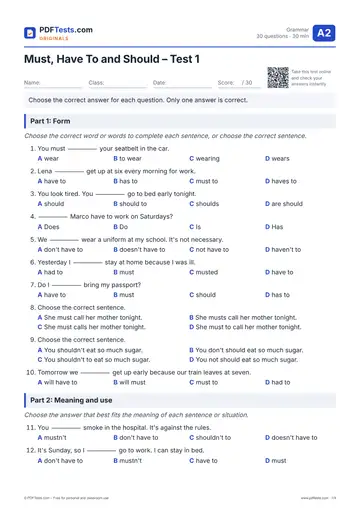
Must, Have To and Should – Worksheet 1

A2 Elementary WorksheetEnglish

This worksheet practises must, have to and should at A2 level. Learners use these verbs to talk about rules, obligation, no obligation and advice, and practise positive, negative and question forms. It suits classroom use or self-study for elementary learners.
items
39
Time
30 min
PDF
5 pages
Answer key
Included
  • 100% free
  • No sign-up or email
  • Print-ready A4 PDF
Preview of page 1 of Must, Have To and Should – Worksheet 1 Open PDF
New to this topic? Read the guide first: Must, Have To and Should: Rules, Examples and Common Mistakes

Do the worksheet online

Type your answers, then press “Check my answers”. Alternative correct answers are accepted.

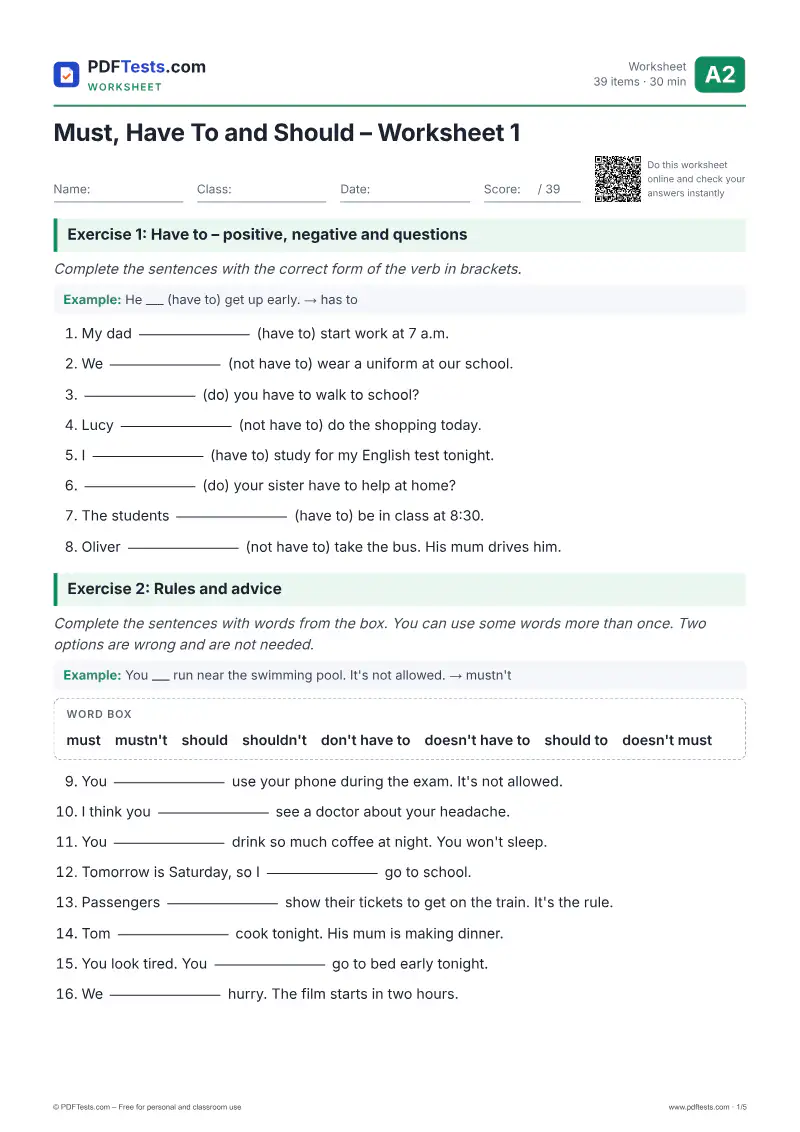
Exercise 1: Have to – positive, negative and questions

Complete the sentences with the correct form of the verb in brackets.

Example: He ___ (have to) get up early. → has to

  1. My dad (have to) start work at 7 a.m.

  2. We (not have to) wear a uniform at our school.

  3. (do) you have to walk to school?

  4. Lucy (not have to) do the shopping today.

  5. I (have to) study for my English test tonight.

  6. (do) your sister have to help at home?

  7. The students (have to) be in class at 8:30.

  8. Oliver (not have to) take the bus. His mum drives him.

Exercise 2: Rules and advice

Complete the sentences with words from the box. You can use some words more than once. Two options are wrong and are not needed.

Example: You ___ run near the swimming pool. It's not allowed. → mustn't

Word box mustmustn'tshouldshouldn'tdon't have todoesn't have toshould todoesn't must

  1. You use your phone during the exam. It's not allowed.

  2. I think you see a doctor about your headache.

  3. You drink so much coffee at night. You won't sleep.

  4. Tomorrow is Saturday, so I go to school.

  5. Passengers show their tickets to get on the train. It's the rule.

  6. Tom cook tonight. His mum is making dinner.

  7. You look tired. You go to bed early tonight.

  8. We hurry. The film starts in two hours.

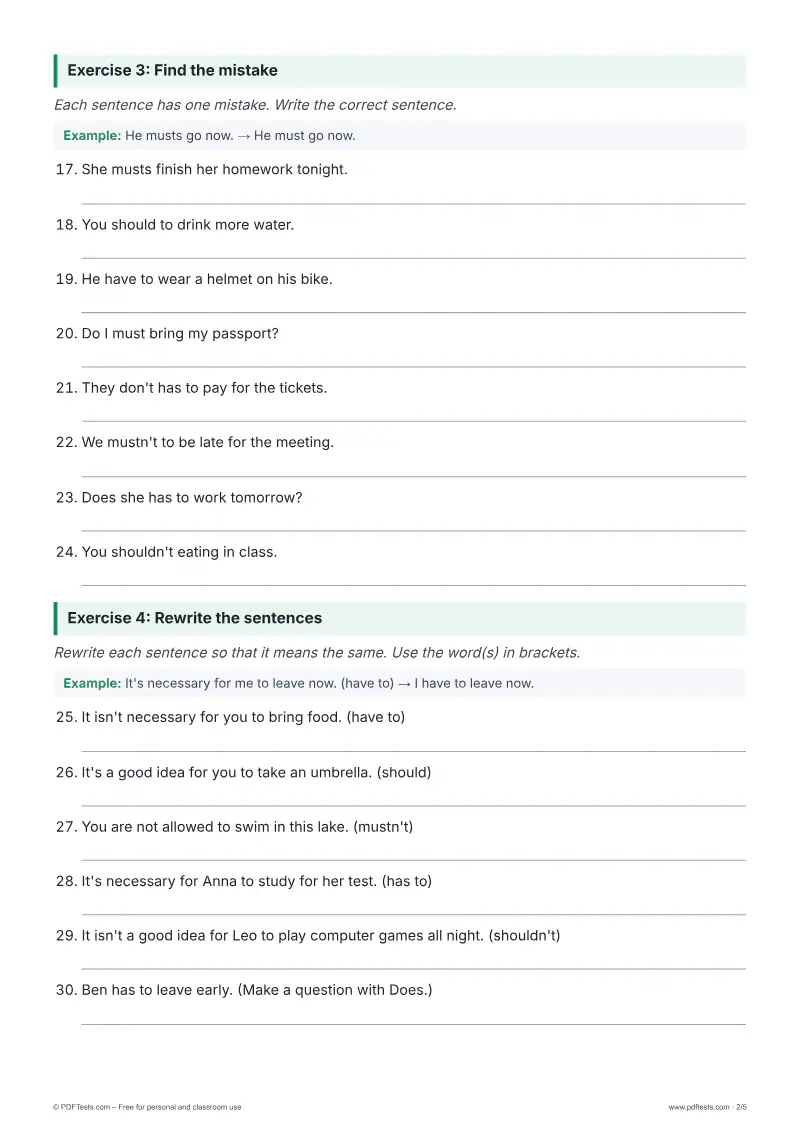
Exercise 3: Find the mistake

Each sentence has one mistake. Write the correct sentence.

Example: He musts go now. → He must go now.

  1. She musts finish her homework tonight.

  2. You should to drink more water.

  3. He have to wear a helmet on his bike.

  4. Do I must bring my passport?

  5. They don't has to pay for the tickets.

  6. We mustn't to be late for the meeting.

  7. Does she has to work tomorrow?

  8. You shouldn't eating in class.

Exercise 4: Rewrite the sentences

Rewrite each sentence so that it means the same. Use the word(s) in brackets.

Example: It's necessary for me to leave now. (have to) → I have to leave now.

  1. It isn't necessary for you to bring food. (have to)

  2. It's a good idea for you to take an umbrella. (should)

  3. You are not allowed to swim in this lake. (mustn't)

  4. It's necessary for Anna to study for her test. (has to)

  5. It isn't a good idea for Leo to play computer games all night. (shouldn't)

  6. Ben has to leave early. (Make a question with Does.)

  7. Sara has to wear glasses. (Make it negative.)

  8. We should buy a present. (Make a question.)

Exercise 5: Put the words in order

Put the words in the correct order to make sentences or questions.

Example: must / quiet / be / you → You must be quiet.

  1. you / have / to / do / work / on Saturdays / ?

  2. shouldn't / you / late / stay / up

  3. must / seatbelt / wear / a / you

  4. doesn't / my / have / brother / to / cook

  5. I / should / what / do / ?

  6. mustn't / in / the / library / talk / we

  7. have / to / does / uniform / wear / a / she / ?

Was this page helpful?

Report a mistake

Spotted a wrong answer, a typo or an unclear explanation? Tell us and we will fix it.

Preview

About this test

Printable A2 worksheet on must, have to and should: obligation, no obligation, prohibition and advice, with negatives and questions. Answers included.

Topics covered

must and mustn'thave to and don't have toshould and shouldn'trules and obligationgiving advicequestions and negatives

Notes for teachers

Start by eliciting school or home rules, then sort them into 'must/have to', 'mustn't' and 'don't have to' on the board before learners do the exercises. Typical mistakes are adding 'to' after must or should (should to go), adding -s to must (she musts), and using 'does she has to'. Point out that mustn't means 'it is not allowed', but don't have to means 'it is not necessary'. For follow-up, ask pairs to write five rules and three pieces of advice for a new student at their school.

All English A2 tests →