PDFTests Originals

Must, Have To and Should – Test 1

A2 Elementary GrammarEnglish

This A2 grammar test practises must, have to and should in everyday situations. It covers correct forms, the difference between mustn't and don't have to, giving advice, questions, past and future forms, and typical learner mistakes. It suits elementary learners, classroom revision and self-study.
Questions
30
Time
30 min
PDF
4 pages
Answer key
Included
  • 100% free
  • No sign-up or email
  • Print-ready A4 PDF
Preview of page 1 of Must, Have To and Should – Test 1 Open PDF

Take the test online

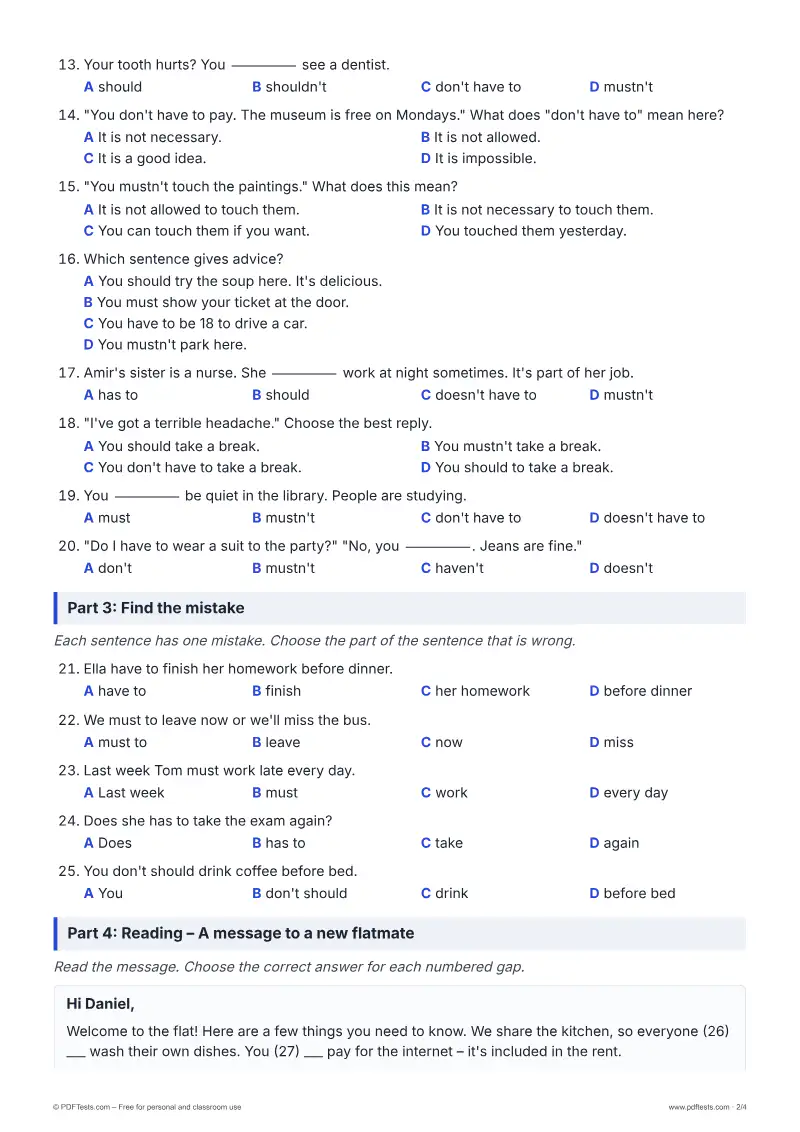
Choose the correct answer for each question. Only one answer is correct. Choose your answers, then press “Check my answers”.

Part 1: Form

Choose the correct word or words to complete each sentence, or choose the correct sentence.

  1. You must _____ your seatbelt in the car.

  2. Lena _____ get up at six every morning for work.

  3. You look tired. You _____ go to bed early tonight.

  4. _____ Marco have to work on Saturdays?

  5. We _____ wear a uniform at my school. It's not necessary.

  6. Yesterday I _____ stay at home because I was ill.

  7. Do I _____ bring my passport?

  8. Choose the correct sentence.

  9. Choose the correct sentence.

  10. Tomorrow we _____ get up early because our train leaves at seven.

Part 2: Meaning and use

Choose the answer that best fits the meaning of each sentence or situation.

  1. You _____ smoke in the hospital. It's against the rules.

  2. It's Sunday, so I _____ go to work. I can stay in bed.

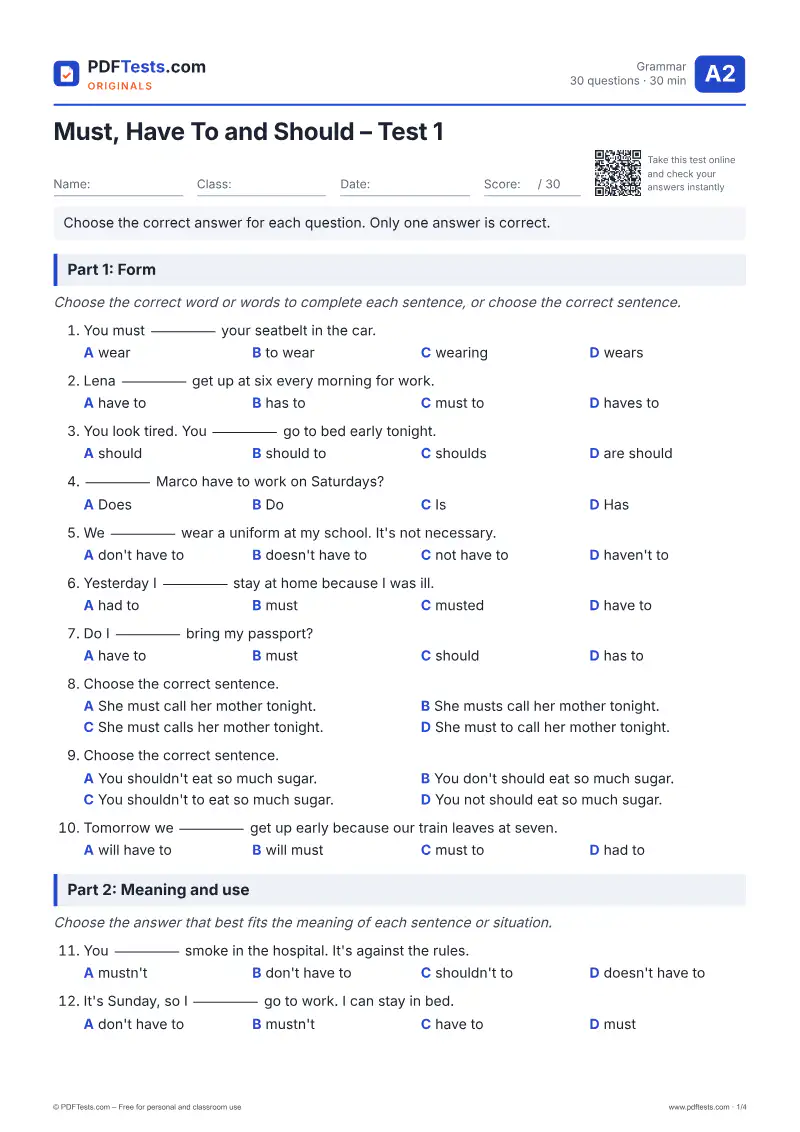
  3. Your tooth hurts? You _____ see a dentist.

  4. "You don't have to pay. The museum is free on Mondays." What does "don't have to" mean here?

  5. "You mustn't touch the paintings." What does this mean?

  6. Which sentence gives advice?

  7. Amir's sister is a nurse. She _____ work at night sometimes. It's part of her job.

  8. "I've got a terrible headache." Choose the best reply.

  9. You _____ be quiet in the library. People are studying.

  10. "Do I have to wear a suit to the party?" "No, you _____. Jeans are fine."

Part 3: Find the mistake

Each sentence has one mistake. Choose the part of the sentence that is wrong.

  1. Ella have to finish her homework before dinner.

  2. We must to leave now or we'll miss the bus.

  3. Last week Tom must work late every day.

  4. Does she has to take the exam again?

  5. You don't should drink coffee before bed.

Part 4: Reading – A message to a new flatmate

Read the message. Choose the correct answer for each numbered gap.

Hi Daniel,

Welcome to the flat! Here are a few things you need to know. We share the kitchen, so everyone (26) ___ wash their own dishes. You (27) ___ pay for the internet – it's included in the rent.

Please remember that you (28) ___ play loud music after 11 p.m., because our neighbours have small children. The supermarket on the corner is great, but you (29) ___ go on Saturday morning – it's very busy then! Try Friday evening instead.

Oh, and last month I (30) ___ call a plumber because the shower broke, so please tell me if anything stops working.

See you soon,

Priya

  1. (26) We share the kitchen, so everyone _____ wash their own dishes.

  2. (27) You _____ pay for the internet – it's included in the rent.

  3. (28) Please remember that you _____ play loud music after 11 p.m.

  4. (29) The supermarket is great, but you _____ go on Saturday morning – it's very busy then!

  5. (30) Last month I _____ call a plumber because the shower broke.

Preview

About this test

This A2 grammar test practises must, have to and should in everyday situations. It covers correct forms, the difference between mustn't and don't have to, giving advice, questions, past and future forms, and typical learner mistakes. It suits elementary learners, classroom revision and self-study.

Topics covered

musthave to / has toshould for advicemustn't vs don't have tohad to and will have toquestions with have tocommon errors

How to use this test

  1. Download the PDF and print it, or take the test online below.
  2. Answer every question without a dictionary or time pressure.
  3. Check your answers and note the topics you need to review.

Notes for teachers

Use this test after teaching obligation, prohibition and advice. It targets frequent A2 errors, including adding 'to' after must or should ('must to go'), using 'have to' instead of 'has to' in the third person, saying 'must' in the past, and confusing mustn't with don't have to. As follow-up, students can write five house rules and five pieces of advice for a new student at their school.