PDFTests Originals

Present Perfect (ever, never, just, already, yet) – Test 1

A2 Elementary GrammarEnglish

This A2 grammar test checks how well learners form and use the present perfect, including positive sentences, negatives, questions and short answers. It focuses on the time words ever, never, just, already and yet, their meaning and their position in the sentence. It suits elementary learners, classroom practice and self-study.

Questions
30
Time
30 min
PDF
5 pages
Answer key
Included
  • 100% free
  • No sign-up or email
  • Print-ready A4 PDF
Preview of page 1 of Present Perfect (ever, never, just, already, yet) – Test 1 Open PDF

Take the test online

Choose the best option (A, B, C or D) for each question. Choose your answers, then press “Check my answers”.

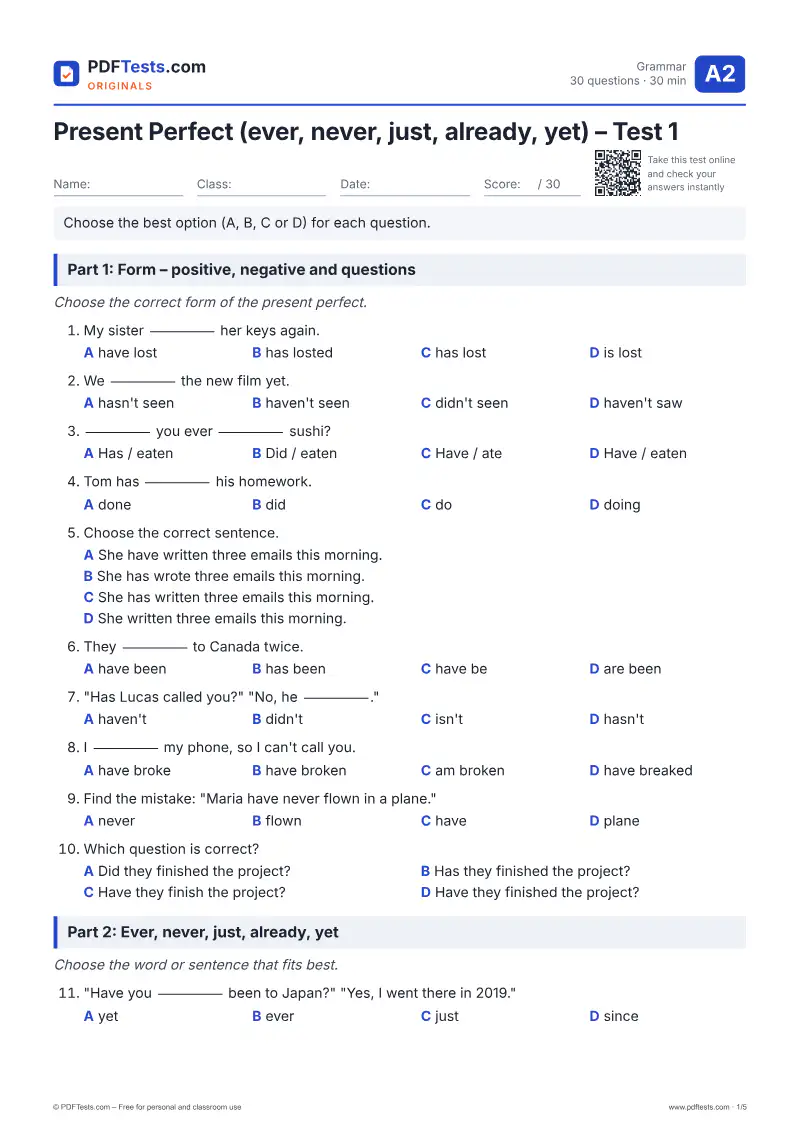
Part 1: Form – positive, negative and questions

Choose the correct form of the present perfect.

  1. My sister _____ her keys again.

  2. We _____ the new film yet.

  3. _____ you ever _____ sushi?

  4. Tom has _____ his homework.

  5. Choose the correct sentence.

  6. They _____ to Canada twice.

  7. "Has Lucas called you?" "No, he _____."

  8. I _____ my phone, so I can't call you.

  9. Find the mistake: "Maria have never flown in a plane."

  10. Which question is correct?

Part 2: Ever, never, just, already, yet

Choose the word or sentence that fits best.

  1. "Have you _____ been to Japan?" "Yes, I went there in 2019."

  2. I've _____ eaten snails. What do they taste like?

  3. "Is Ana here?" "No, she's _____ left. You missed her by one minute."

  4. The bus hasn't arrived _____. We're still waiting.

  5. Don't buy milk. I've _____ bought some.

  6. Choose the correct sentence.

  7. Choose the correct question.

  8. "Have you ever ridden a horse?" "No, _____."

  9. What is wrong with this sentence? "I haven't never seen snow."

  10. We've _____ moved house, so our new flat is still full of boxes.

Part 3: Present perfect in context

Read the email. Then choose the best answer for each question.

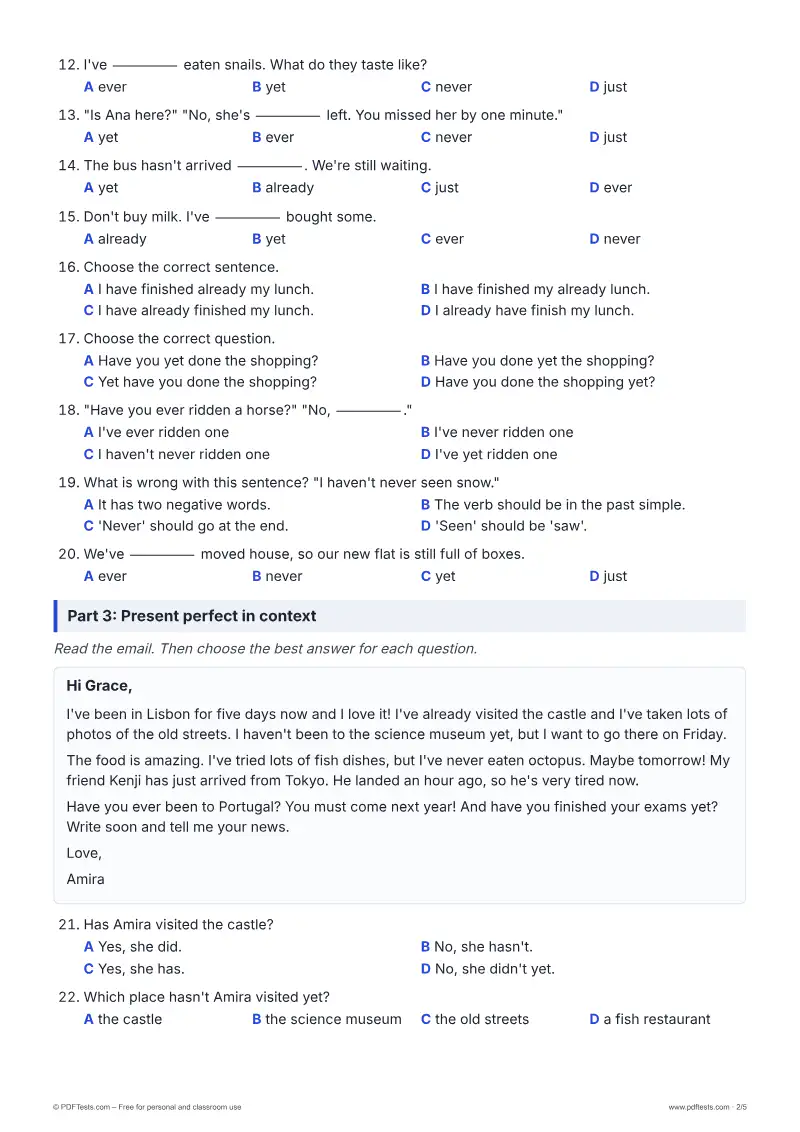
Hi Grace,

I've been in Lisbon for five days now and I love it! I've already visited the castle and I've taken lots of photos of the old streets. I haven't been to the science museum yet, but I want to go there on Friday.

The food is amazing. I've tried lots of fish dishes, but I've never eaten octopus. Maybe tomorrow! My friend Kenji has just arrived from Tokyo. He landed an hour ago, so he's very tired now.

Have you ever been to Portugal? You must come next year! And have you finished your exams yet? Write soon and tell me your news.

Love,

Amira

  1. Has Amira visited the castle?

  2. Which place hasn't Amira visited yet?

  3. Amira writes: "I've never eaten octopus." What does this mean?

  4. "Kenji has just arrived." When did he arrive?

  5. Why does Amira say "I haven't been to the science museum yet"?

  6. Grace has finished her exams. Which is the best reply to Amira's question?

  7. Grace has not visited Portugal at any time. What does she write?

  8. Complete Grace's question to Amira: "_____ you taken a boat trip on the river yet?"

  9. Kenji is very tired. He _____ unpacked his bag yet.

  10. Which sentence about the email is true?

Preview

About this test

This A2 grammar test checks how well learners form and use the present perfect, including positive sentences, negatives, questions and short answers. It focuses on the time words ever, never, just, already and yet, their meaning and their position in the sentence. It suits elementary learners, classroom practice and self-study.

Topics covered

Present perfect formPast participlesNegatives and questionsEver and neverJust and alreadyYet in questions and negativesShort answers

How to use this test

  1. Download the PDF and print it, or take the test online below.
  2. Answer every question without a dictionary or time pressure.
  3. Check your answers and note the topics you need to review.

Notes for teachers

Part 1 checks form (has/have, past participles), Part 2 focuses on the meaning and word order of ever, never, just, already and yet, and Part 3 uses a short email to test meaning in context. Typical errors targeted include wrong auxiliaries (she have), past simple forms after have (have saw), double negatives (haven't never) and mixing up already and yet. As a follow-up, ask students to write a short email about a trip using each time word at least once.