PDFTests Originals

Collocations – Worksheet 1

B2 Upper-intermediate WorksheetEnglish

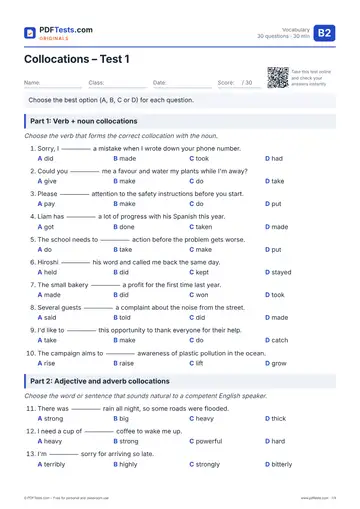
This B2 worksheet practises common English collocations in context, including verb + noun pairs, intensifying adverbs and the tricky make/do/take/have group. Learners also form the right word for each collocation and rewrite sentences more naturally. It suits upper-intermediate learners preparing for exams or wanting to sound more fluent.
items
39
Time
35 min
PDF
5 pages
Answer key
Included
  • 100% free
  • No sign-up or email
  • Print-ready A4 PDF
Preview of page 1 of Collocations – Worksheet 1 Open PDF

Do the worksheet online

Type your answers, then press “Check my answers”. Alternative correct answers are accepted.

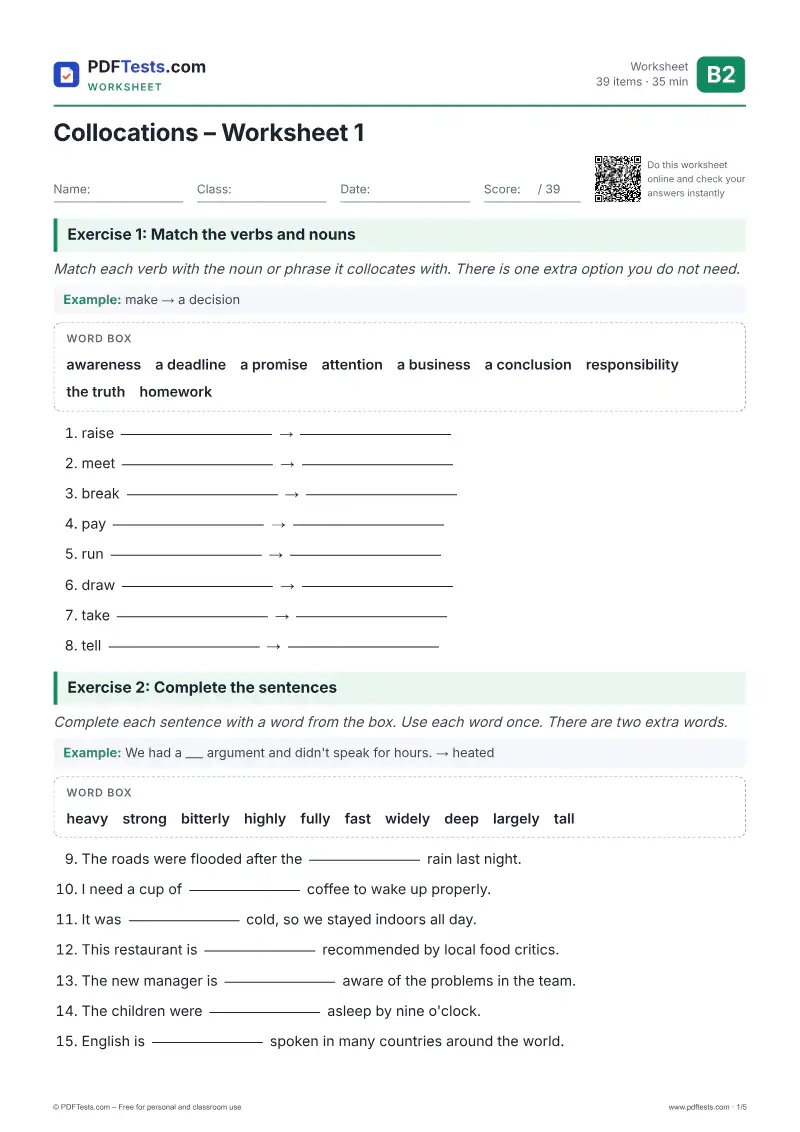
Exercise 1: Match the verbs and nouns

Match each verb with the noun or phrase it collocates with. There is one extra option you do not need.

Example: make → a decision

Word box awarenessa deadlinea promiseattentiona businessa conclusionresponsibilitythe truthhomework

  1. raise

  2. meet

  3. break

  4. pay

  5. run

  6. draw

  7. take

  8. tell

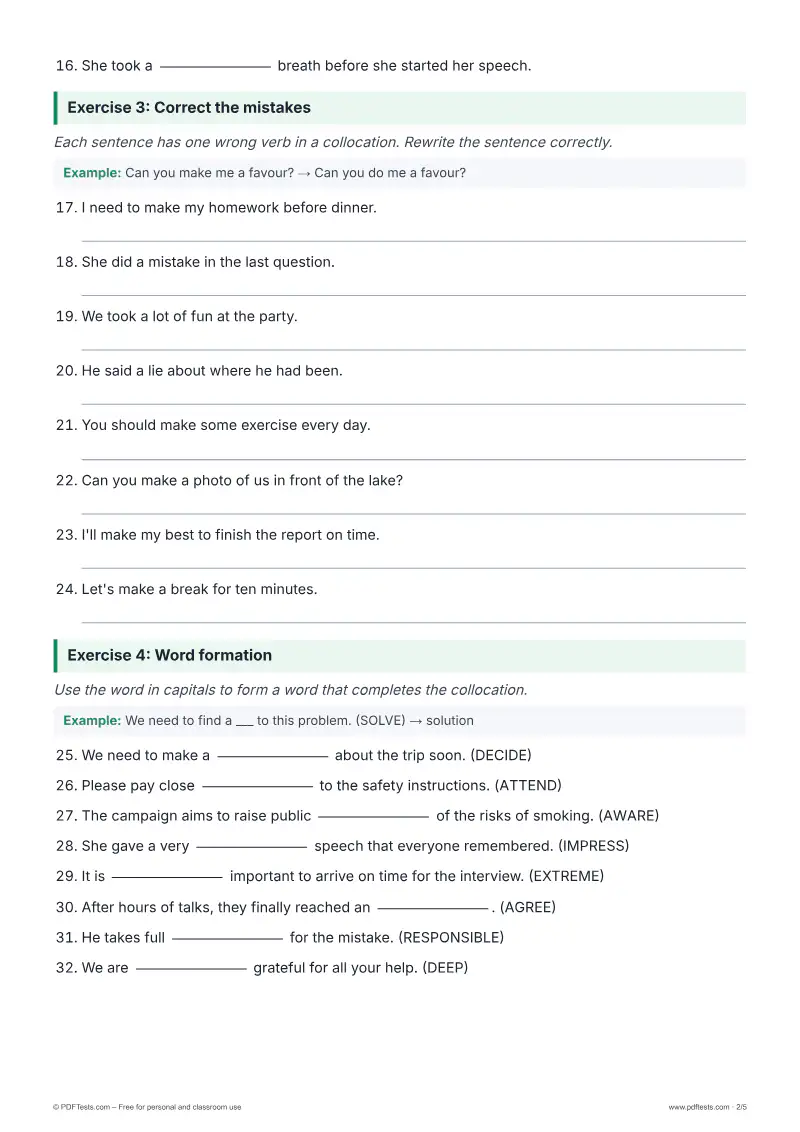
Exercise 2: Complete the sentences

Complete each sentence with a word from the box. Use each word once. There are two extra words.

Example: We had a ___ argument and didn't speak for hours. → heated

Word box heavystrongbitterlyhighlyfullyfastwidelydeeplargelytall

  1. The roads were flooded after the rain last night.

  2. I need a cup of coffee to wake up properly.

  3. It was cold, so we stayed indoors all day.

  4. This restaurant is recommended by local food critics.

  5. The new manager is aware of the problems in the team.

  6. The children were asleep by nine o'clock.

  7. English is spoken in many countries around the world.

  8. She took a breath before she started her speech.

Exercise 3: Correct the mistakes

Each sentence has one wrong verb in a collocation. Rewrite the sentence correctly.

Example: Can you make me a favour? → Can you do me a favour?

  1. I need to make my homework before dinner.

  2. She did a mistake in the last question.

  3. We took a lot of fun at the party.

  4. He said a lie about where he had been.

  5. You should make some exercise every day.

  6. Can you make a photo of us in front of the lake?

  7. I'll make my best to finish the report on time.

  8. Let's make a break for ten minutes.

Exercise 4: Word formation

Use the word in capitals to form a word that completes the collocation.

Example: We need to find a ___ to this problem. (SOLVE) → solution

  1. We need to make a about the trip soon. (DECIDE)

  2. Please pay close to the safety instructions. (ATTEND)

  3. The campaign aims to raise public of the risks of smoking. (AWARE)

  4. She gave a very speech that everyone remembered. (IMPRESS)

  5. It is important to arrive on time for the interview. (EXTREME)

  6. After hours of talks, they finally reached an . (AGREE)

  7. He takes full for the mistake. (RESPONSIBLE)

  8. We are grateful for all your help. (DEEP)

Exercise 5: Rewrite the sentences

Rewrite each sentence so that it means the same, using a collocation with the word in capitals.

Example: She decided quickly. (MADE) → She made a quick decision.

  1. I tried as hard as I could in the exam. (BEST)

  2. Let's stop working for a few minutes. (BREAK)

  3. He always does what he says he will do. (PROMISES)

  4. Tom never lies. (TRUTH)

  5. She photographed the sunset. (PHOTO)

  6. We enjoyed ourselves a lot at the festival. (FUN)

  7. The manager is responsible for the budget. (CHARGE)

Was this page helpful?

Report a mistake

Spotted a wrong answer, a typo or an unclear explanation? Tell us and we will fix it.

Preview

About this test

B2 English collocations worksheet: verb + noun, adverb + adjective, make/do/take/have and word forms. Printable, with answers.

Topics covered

Verb + noun collocationsAdverb + adjective collocationsMake, do, take and haveWord formationNatural phrasing

Notes for teachers

Start with the matching exercise as a warm-up and ask learners to note each collocation as a whole chunk, not as separate words. Typical mistakes include mixing up make and do ("make homework", "do a mistake") and translating directly from the first language ("say a lie"). As a follow-up, ask pairs to write a short story using at least eight collocations from the worksheet and then swap stories to underline them.

All English B2 tests →