PDFTests Originals

Modals of Deduction in the Past (must have, might have) – Worksheet 1

B2 Upper-intermediate WorksheetEnglish

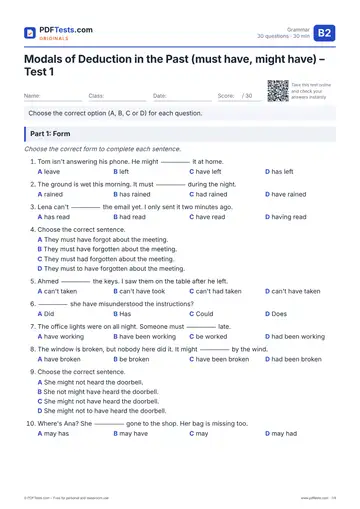
This worksheet practises past modals of deduction (must have, might/may/could have, can't/couldn't have + past participle) for talking about how certain we are about past events. It covers form, meaning, negatives and questions and is designed for B2 learners in class or at home.
items
39
Time
35 min
PDF
5 pages
Answer key
Included
  • 100% free
  • No sign-up or email
  • Print-ready A4 PDF
Preview of page 1 of Modals of Deduction in the Past (must have, might have) – Worksheet 1 Open PDF
New to this topic? Read the guide first: Modals of Deduction in the Past: Must Have, Might Have, Can't Have

Do the worksheet online

Type your answers, then press “Check my answers”. Alternative correct answers are accepted.

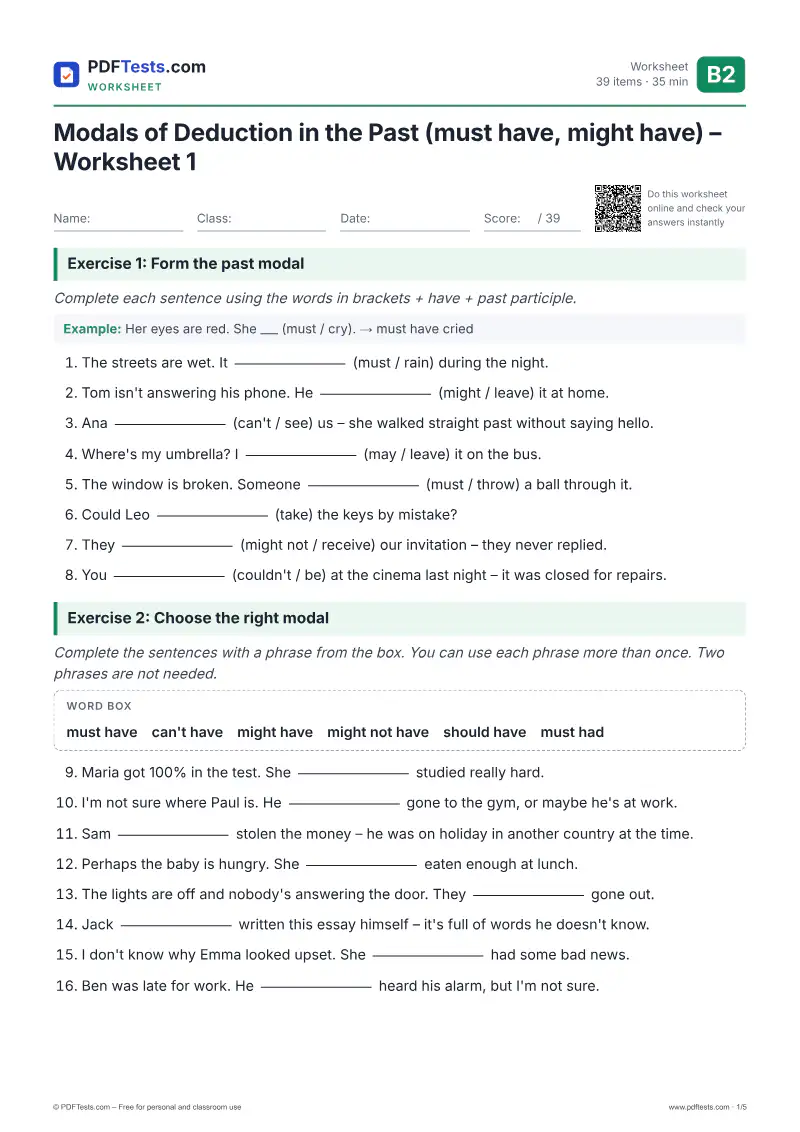
Exercise 1: Form the past modal

Complete each sentence using the words in brackets + have + past participle.

Example: Her eyes are red. She ___ (must / cry). → must have cried

  1. The streets are wet. It (must / rain) during the night.

  2. Tom isn't answering his phone. He (might / leave) it at home.

  3. Ana (can't / see) us – she walked straight past without saying hello.

  4. Where's my umbrella? I (may / leave) it on the bus.

  5. The window is broken. Someone (must / throw) a ball through it.

  6. Could Leo (take) the keys by mistake?

  7. They (might not / receive) our invitation – they never replied.

  8. You (couldn't / be) at the cinema last night – it was closed for repairs.

Exercise 2: Choose the right modal

Complete the sentences with a phrase from the box. You can use each phrase more than once. Two phrases are not needed.

Word box must havecan't havemight havemight not haveshould havemust had

  1. Maria got 100% in the test. She studied really hard.

  2. I'm not sure where Paul is. He gone to the gym, or maybe he's at work.

  3. Sam stolen the money – he was on holiday in another country at the time.

  4. Perhaps the baby is hungry. She eaten enough at lunch.

  5. The lights are off and nobody's answering the door. They gone out.

  6. Jack written this essay himself – it's full of words he doesn't know.

  7. I don't know why Emma looked upset. She had some bad news.

  8. Ben was late for work. He heard his alarm, but I'm not sure.

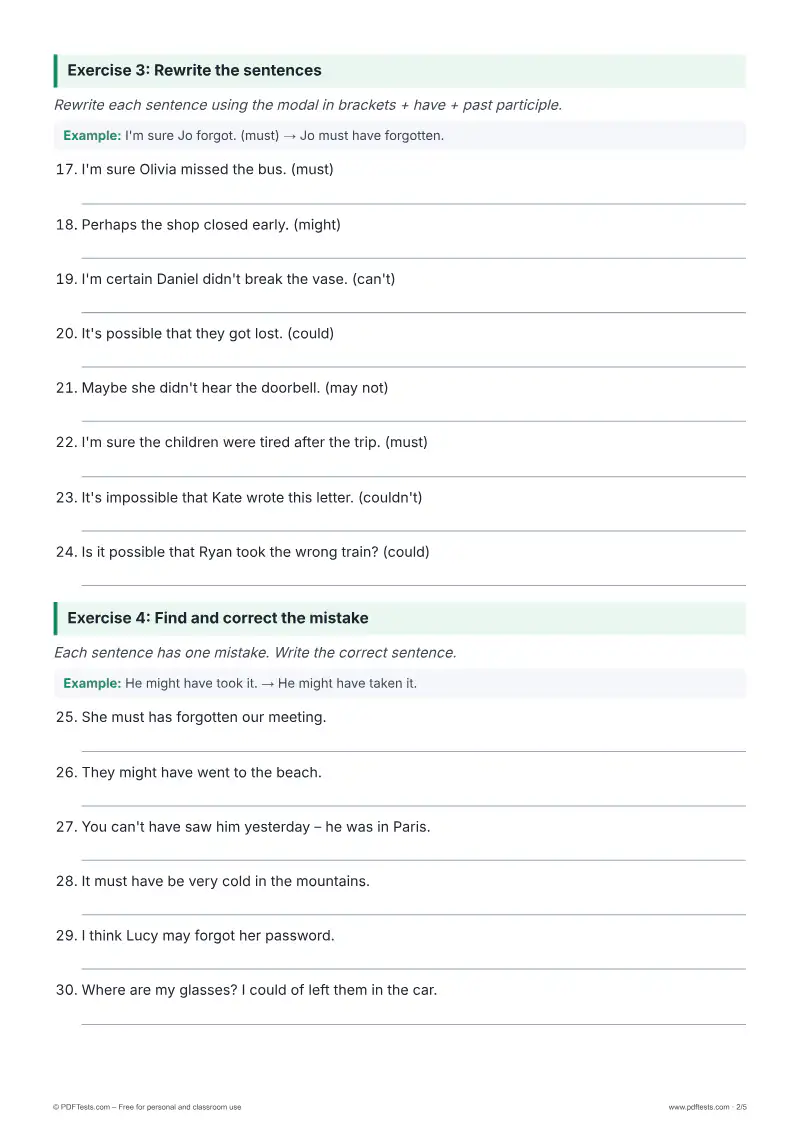
Exercise 3: Rewrite the sentences

Rewrite each sentence using the modal in brackets + have + past participle.

Example: I'm sure Jo forgot. (must) → Jo must have forgotten.

  1. I'm sure Olivia missed the bus. (must)

  2. Perhaps the shop closed early. (might)

  3. I'm certain Daniel didn't break the vase. (can't)

  4. It's possible that they got lost. (could)

  5. Maybe she didn't hear the doorbell. (may not)

  6. I'm sure the children were tired after the trip. (must)

  7. It's impossible that Kate wrote this letter. (couldn't)

  8. Is it possible that Ryan took the wrong train? (could)

Exercise 4: Find and correct the mistake

Each sentence has one mistake. Write the correct sentence.

Example: He might have took it. → He might have taken it.

  1. She must has forgotten our meeting.

  2. They might have went to the beach.

  3. You can't have saw him yesterday – he was in Paris.

  4. It must have be very cold in the mountains.

  5. I think Lucy may forgot her password.

  6. Where are my glasses? I could of left them in the car.

  7. Could he has taken my phone by mistake?

  8. The match must have finish late, because they didn't get home until midnight.

Exercise 5: Put the words in order

Put the words in the correct order to make sentences or questions.

Example: have / he / must / left → He must have left.

  1. have / tired / she / must / been

  2. key / have / might / he / the / lost

  3. can't / they / the / have / message / read

  4. have / the / could / door / someone / opened / ?

  5. not / may / understood / have / the / question / she

  6. left / have / earlier / must / the / train

  7. been / couldn't / him / it / have

Was this page helpful?

Report a mistake

Spotted a wrong answer, a typo or an unclear explanation? Tell us and we will fix it.

Preview

About this test

B2 worksheet on past modals of deduction: must have, might have, may have, could have, can't have. Five printable exercises with answers.

Topics covered

Modals of deductionmust have / can't havemight / may / could havePast participlesSpeculating about the past

Notes for teachers

Start by eliciting a mystery situation (e.g. an empty classroom) and have students speculate about what happened, sorting their ideas into 'certain', 'possible' and 'impossible'. Typical mistakes include using the past simple instead of the past participle (might have went), writing 'could of', and using mustn't have instead of can't have for negative certainty. As a follow-up, give pairs a set of picture clues and ask them to write a short explanation of the 'crime' using at least five past modals.

All English B2 tests →