PDFTests Originals

Futuro continuo y futuro perfecto (Future Continuous y Future Perfect) – Test 1

B2 Intermedio alto GramáticaInglés

Este test de gramática de nivel B2 comprueba si sabes formar y usar el futuro continuo (future continuous: will be doing) y el futuro perfecto (future perfect: will have done). Incluye las formas afirmativa, negativa e interrogativa, la diferencia de significado entre ambos tiempos, expresiones temporales como 'by' y 'this time tomorrow', y los errores más habituales de los alumnos. Es ideal para estudiantes de nivel intermedio alto, candidatos a exámenes oficiales y profesores que buscan una prueba lista para usar en clase.
Preguntas
30
Tiempo
30 min
PDF
5 páginas
Soluciones
Incluidas
  • 100 % gratis
  • Sin registro
  • PDF A4 listo para imprimir
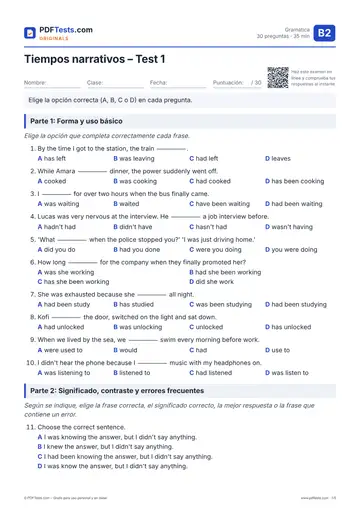
Vista previa de la página 1: Futuro continuo y futuro perfecto (Future Continuous y Future Perfect) – Test 1 Abrir PDF

Haz el examen en línea

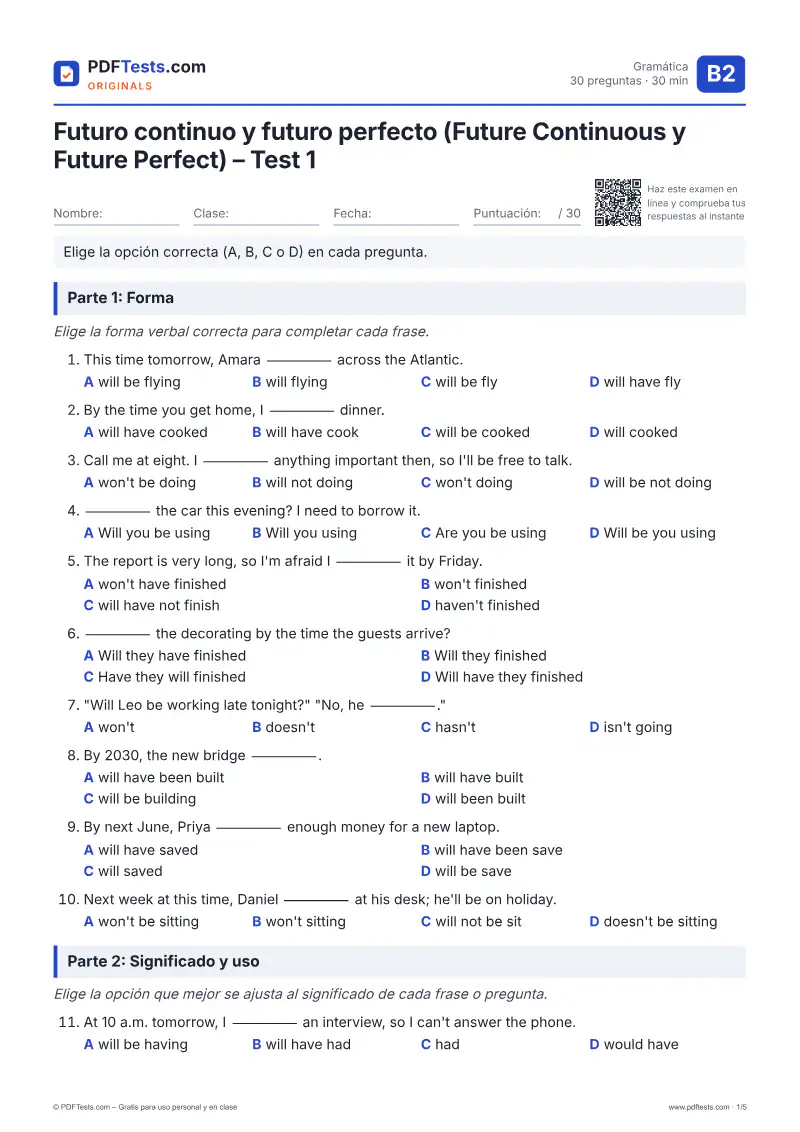
Elige la opción correcta (A, B, C o D) en cada pregunta. Elige tus respuestas y pulsa «Comprobar respuestas».

Parte 1: Forma

Elige la forma verbal correcta para completar cada frase.

  1. This time tomorrow, Amara _____ across the Atlantic.

  2. By the time you get home, I _____ dinner.

  3. Call me at eight. I _____ anything important then, so I'll be free to talk.

  4. _____ the car this evening? I need to borrow it.

  5. The report is very long, so I'm afraid I _____ it by Friday.

  6. _____ the decorating by the time the guests arrive?

  7. "Will Leo be working late tonight?" "No, he _____."

  8. By 2030, the new bridge _____.

  9. By next June, Priya _____ enough money for a new laptop.

  10. Next week at this time, Daniel _____ at his desk; he'll be on holiday.

Parte 2: Significado y uso

Elige la opción que mejor se ajusta al significado de cada frase o pregunta.

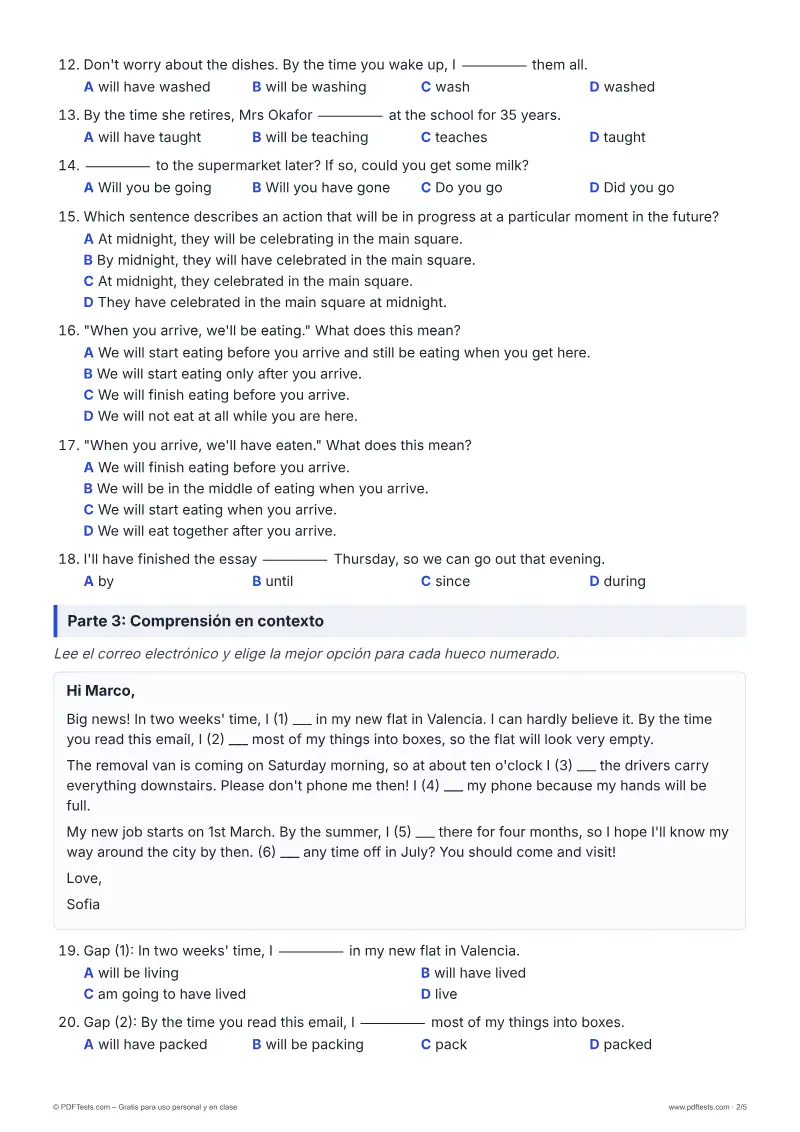
  1. At 10 a.m. tomorrow, I _____ an interview, so I can't answer the phone.

  2. Don't worry about the dishes. By the time you wake up, I _____ them all.

  3. By the time she retires, Mrs Okafor _____ at the school for 35 years.

  4. _____ to the supermarket later? If so, could you get some milk?

  5. Which sentence describes an action that will be in progress at a particular moment in the future?

  6. "When you arrive, we'll be eating." What does this mean?

  7. "When you arrive, we'll have eaten." What does this mean?

  8. I'll have finished the essay _____ Thursday, so we can go out that evening.

Parte 3: Comprensión en contexto

Lee el correo electrónico y elige la mejor opción para cada hueco numerado.

Hi Marco,

Big news! In two weeks' time, I (1) ___ in my new flat in Valencia. I can hardly believe it. By the time you read this email, I (2) ___ most of my things into boxes, so the flat will look very empty.

The removal van is coming on Saturday morning, so at about ten o'clock I (3) ___ the drivers carry everything downstairs. Please don't phone me then! I (4) ___ my phone because my hands will be full.

My new job starts on 1st March. By the summer, I (5) ___ there for four months, so I hope I'll know my way around the city by then. (6) ___ any time off in July? You should come and visit!

Love,

Sofia

  1. Gap (1): In two weeks' time, I _____ in my new flat in Valencia.

  2. Gap (2): By the time you read this email, I _____ most of my things into boxes.

  3. Gap (3): At about ten o'clock I _____ the drivers carry everything downstairs.

  4. Gap (4): I _____ my phone because my hands will be full.

  5. Gap (5): By the summer, I _____ there for four months.

  6. Gap (6): _____ any time off in July?

Parte 4: Encuentra el error

Elige la frase correcta o identifica la parte de la frase que contiene un error.

  1. Which sentence is correct?

  2. Which part contains the error? "When I will get home, my parents will probably be watching the news."

  3. Which part contains the error? "I will have know Ella for ten years next month."

  4. Which part contains the error? "This time next week, we will be knowing whether we passed the exam."

  5. Which sentence is correct?

  6. Which part contains the error? "Don't come at eight because I will be have dinner with my grandparents."

Vista previa

Sobre este examen

Este test de gramática de nivel B2 comprueba si sabes formar y usar el futuro continuo (future continuous: will be doing) y el futuro perfecto (future perfect: will have done). Incluye las formas afirmativa, negativa e interrogativa, la diferencia de significado entre ambos tiempos, expresiones temporales como 'by' y 'this time tomorrow', y los errores más habituales de los alumnos. Es ideal para estudiantes de nivel intermedio alto, candidatos a exámenes oficiales y profesores que buscan una prueba lista para usar en clase.

Temas

Futuro continuo (future continuous)Futuro perfecto (future perfect)Negativas y preguntasExpresiones temporales (by, this time tomorrow)Oraciones temporalesVerbos de estado (stative verbs)Corrección de errores

Cómo usar este examen

  1. Descarga el PDF e imprímelo, o haz el examen en línea más abajo.
  2. Responde todas las preguntas sin diccionario y sin prisas.
  3. Comprueba tus respuestas y apunta los temas que debes repasar.

Notas para el profesor

Use la Parte 1 para comprobar la forma y las Partes 2 y 3 para ver si los alumnos distinguen entre una acción en curso en un momento futuro y una acción terminada antes de un momento futuro. El test se centra en errores frecuentes como usar 'will' en oraciones temporales, 'until' en lugar de 'by', olvidar el participio pasado o poner verbos de estado en forma continua. Como actividad de seguimiento, pida a los alumnos que escriban sus propias frases con 'This time next year...' y 'By the time I'm 30...' y que las intercambien para corregirlas entre compañeros.