PDFTests Originals

Use of English C1 – Test 1

C1 Advanced GrammarEnglish

This C1 Use of English test checks advanced grammar and vocabulary in four exam-style parts: a multiple-choice cloze, an open cloze in multiple-choice format, word formation and key word transformations. It suits upper-advanced learners preparing for C1-level exams, and teachers who need a reliable diagnostic or revision test.

Questions
36
Time
45 min
PDF
6 pages
Answer key
Included
  • 100% free
  • No sign-up or email
  • Print-ready A4 PDF
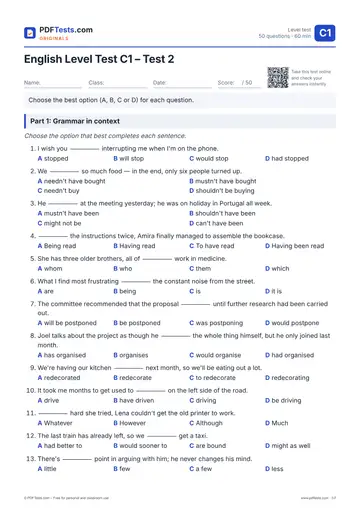
Preview of page 1 of Use of English C1 – Test 1 Open PDF
Use of English B1–C2 · all exam-style tests, task types and tips

Take the test online

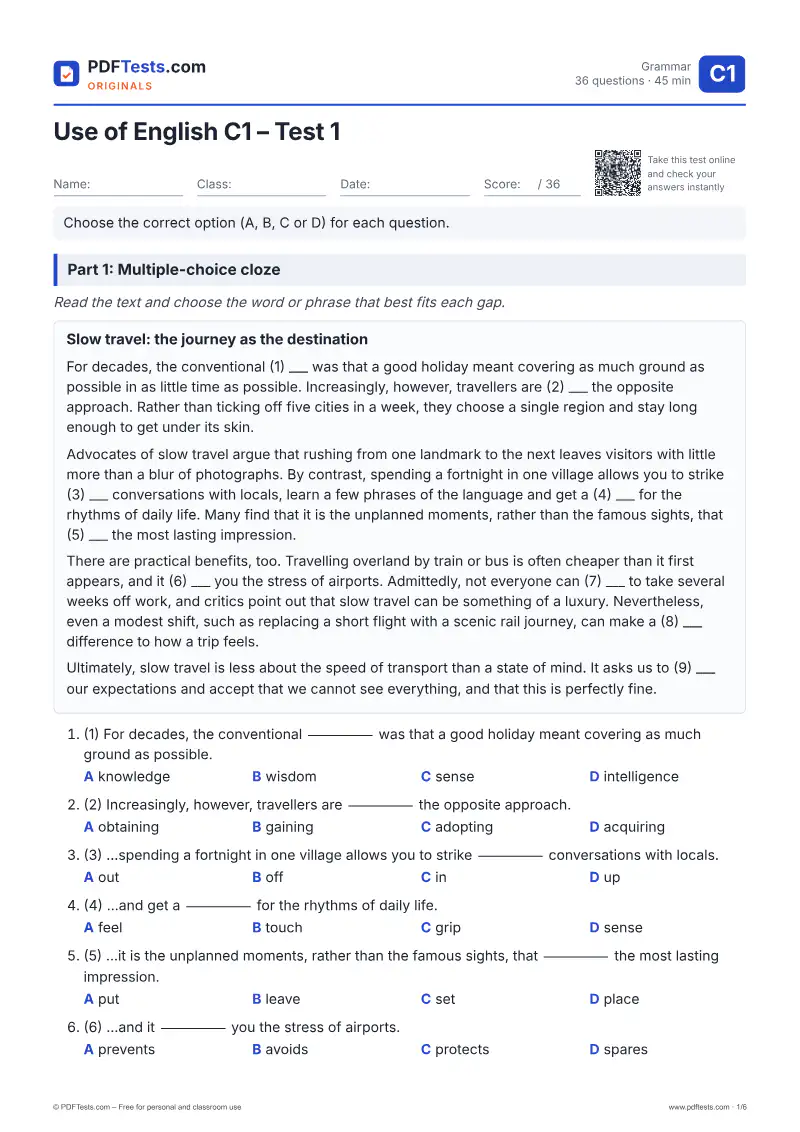
Choose the correct option (A, B, C or D) for each question. Choose your answers, then press “Check my answers”.

Part 1: Multiple-choice cloze

Read the text and choose the word or phrase that best fits each gap.

Slow travel: the journey as the destination

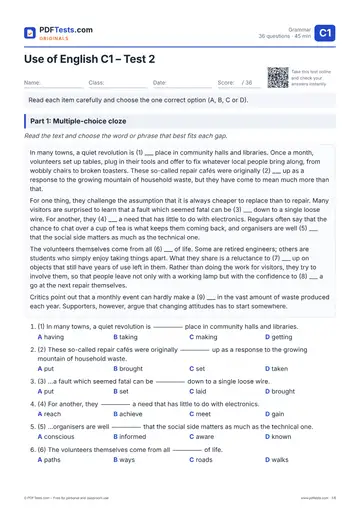
For decades, the conventional (1) ___ was that a good holiday meant covering as much ground as possible in as little time as possible. Increasingly, however, travellers are (2) ___ the opposite approach. Rather than ticking off five cities in a week, they choose a single region and stay long enough to get under its skin.

Advocates of slow travel argue that rushing from one landmark to the next leaves visitors with little more than a blur of photographs. By contrast, spending a fortnight in one village allows you to strike (3) ___ conversations with locals, learn a few phrases of the language and get a (4) ___ for the rhythms of daily life. Many find that it is the unplanned moments, rather than the famous sights, that (5) ___ the most lasting impression.

There are practical benefits, too. Travelling overland by train or bus is often cheaper than it first appears, and it (6) ___ you the stress of airports. Admittedly, not everyone can (7) ___ to take several weeks off work, and critics point out that slow travel can be something of a luxury. Nevertheless, even a modest shift, such as replacing a short flight with a scenic rail journey, can make a (8) ___ difference to how a trip feels.

Ultimately, slow travel is less about the speed of transport than a state of mind. It asks us to (9) ___ our expectations and accept that we cannot see everything, and that this is perfectly fine.

  1. (1) For decades, the conventional _____ was that a good holiday meant covering as much ground as possible.

  2. (2) Increasingly, however, travellers are _____ the opposite approach.

  3. (3) ...spending a fortnight in one village allows you to strike _____ conversations with locals.

  4. (4) ...and get a _____ for the rhythms of daily life.

  5. (5) ...it is the unplanned moments, rather than the famous sights, that _____ the most lasting impression.

  6. (6) ...and it _____ you the stress of airports.

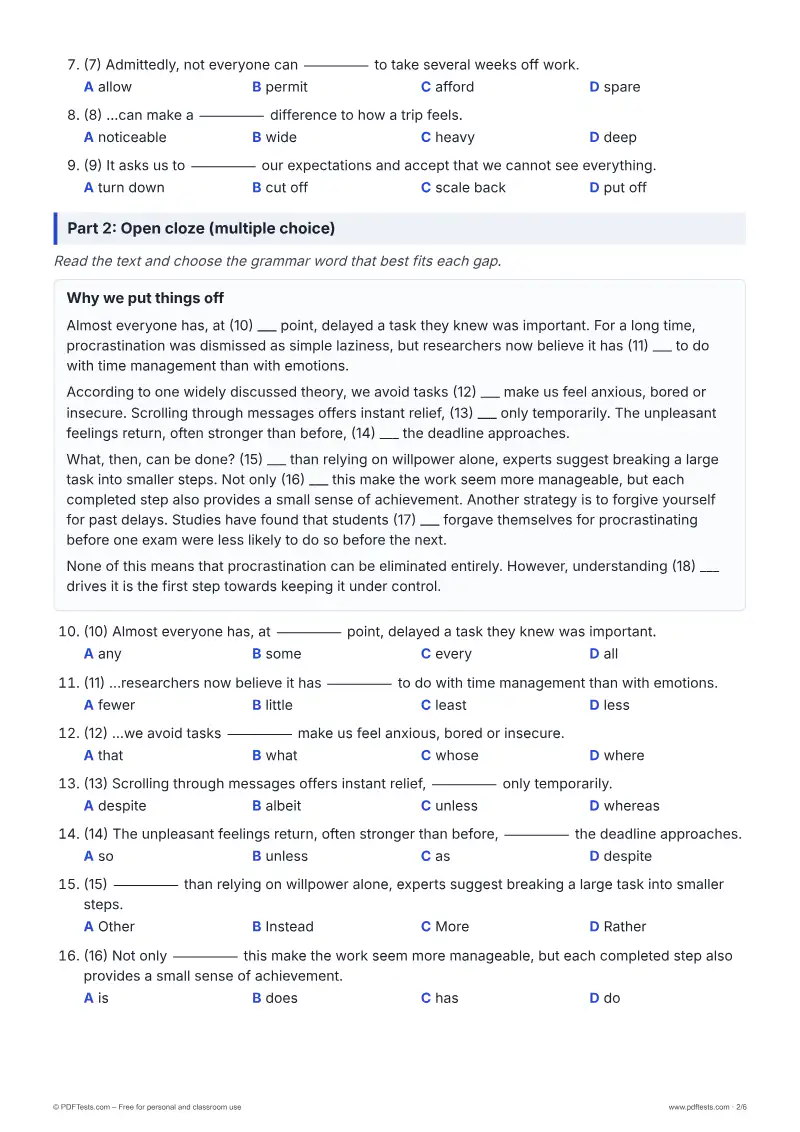
  7. (7) Admittedly, not everyone can _____ to take several weeks off work.

  8. (8) ...can make a _____ difference to how a trip feels.

  9. (9) It asks us to _____ our expectations and accept that we cannot see everything.

Part 2: Open cloze (multiple choice)

Read the text and choose the grammar word that best fits each gap.

Why we put things off

Almost everyone has, at (10) ___ point, delayed a task they knew was important. For a long time, procrastination was dismissed as simple laziness, but researchers now believe it has (11) ___ to do with time management than with emotions.

According to one widely discussed theory, we avoid tasks (12) ___ make us feel anxious, bored or insecure. Scrolling through messages offers instant relief, (13) ___ only temporarily. The unpleasant feelings return, often stronger than before, (14) ___ the deadline approaches.

What, then, can be done? (15) ___ than relying on willpower alone, experts suggest breaking a large task into smaller steps. Not only (16) ___ this make the work seem more manageable, but each completed step also provides a small sense of achievement. Another strategy is to forgive yourself for past delays. Studies have found that students (17) ___ forgave themselves for procrastinating before one exam were less likely to do so before the next.

None of this means that procrastination can be eliminated entirely. However, understanding (18) ___ drives it is the first step towards keeping it under control.

  1. (10) Almost everyone has, at _____ point, delayed a task they knew was important.

  2. (11) ...researchers now believe it has _____ to do with time management than with emotions.

  3. (12) ...we avoid tasks _____ make us feel anxious, bored or insecure.

  4. (13) Scrolling through messages offers instant relief, _____ only temporarily.

  5. (14) The unpleasant feelings return, often stronger than before, _____ the deadline approaches.

  6. (15) _____ than relying on willpower alone, experts suggest breaking a large task into smaller steps.

  7. (16) Not only _____ this make the work seem more manageable, but each completed step also provides a small sense of achievement.

  8. (17) Studies have found that students _____ forgave themselves for procrastinating before one exam were less likely to do so before the next.

  9. (18) However, understanding _____ drives it is the first step towards keeping it under control.

Part 3: Word formation

Choose the correct form of the word in capitals to complete each sentence.

  1. The committee's decision was met with widespread _____ from local residents. (APPROVE)

  2. The museum saw a sharp drop in _____ after ticket prices were raised. (ATTEND)

  3. It is _____ to expect a beginner to master the software in a single afternoon. (REAL)

  4. The new manager has a reputation for being highly _____, often changing plans at the last minute. (PREDICT)

  5. Despite repeated warnings, the company continued to _____ the risks involved. (ESTIMATE)

  6. The two reports were written _____ of each other, yet they reached the same conclusions. (DEPEND)

  7. The film's _____ ending left many viewers wanting a sequel. (RESOLVE)

  8. Recent _____ in battery technology have made electric bikes far more practical. (BREAK)

  9. The scheme was praised for its _____, allowing staff to choose when and where they work. (FLEX)

Part 4: Key word transformations

Choose the sentence that uses the word in capitals and has the same meaning as the first sentence.

  1. I'm sure Tom didn't take your keys on purpose. (CAN'T)

  2. It was only when she read the letter that she understood what had happened. (UNTIL)

  3. People say that the castle was built in the twelfth century. (SAID)

  4. I regret not accepting the job offer. (WISH)

  5. The meeting was cancelled because so few people could attend. (CALLED)

  6. You should have told me you were coming. (OUGHT)

  7. Although he had very little experience, he was given the job. (SPITE)

  8. I didn't recognise her at first because she had changed so much. (SUCH)

  9. There's no point in arguing with him; he never changes his mind. (WORTH)

Was this page helpful?

Report a mistake

Spotted a wrong answer, a typo or an unclear explanation? Tell us and we will fix it.

Practise with a worksheet: Use of English C1 – Worksheet 1

Preview

About this test

This C1 Use of English test checks advanced grammar and vocabulary in four exam-style parts: a multiple-choice cloze, an open cloze in multiple-choice format, word formation and key word transformations. It suits upper-advanced learners preparing for C1-level exams, and teachers who need a reliable diagnostic or revision test.

Topics covered

Collocations and fixed phrasesPhrasal verbsRelative pronouns and linkersInversionWord formation with prefixes and suffixesModal perfectsPassive reporting structuresKey word transformations

How to use this test

  1. Download the PDF and print it, or take the test online below.
  2. Answer every question without a dictionary or time pressure.
  3. Check your answers and note the topics you need to review.

Notes for teachers

Use the test as a timed practice paper (about 45 minutes) or set each part as a separate lesson warm-up. The distractors target typical C1 errors: wrong collocates, particle confusion, faulty inversion, wrong negative prefixes and transformations that change the meaning. After marking, ask students to explain why each distractor is wrong. Then ask them to write their own transformation items using the same key words.