PDFTests Originals

Use of English C1 – Test 1

C1 Avanzado GramáticaInglés

Este test de Use of English de nivel C1 evalúa gramática y vocabulario avanzados en cuatro partes con formato de examen: un cloze de opción múltiple, un cloze abierto en formato de opción múltiple, formación de palabras y transformaciones de frases con palabra clave (key word transformations). Es ideal para estudiantes de nivel avanzado que preparan exámenes de nivel C1 y para profesores que necesitan una prueba diagnóstica o de repaso fiable.
Preguntas
36
Tiempo
45 min
PDF
6 páginas
Soluciones
Incluidas
  • 100 % gratis
  • Sin registro
  • PDF A4 listo para imprimir
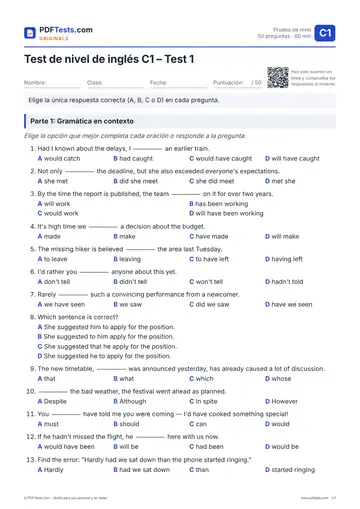
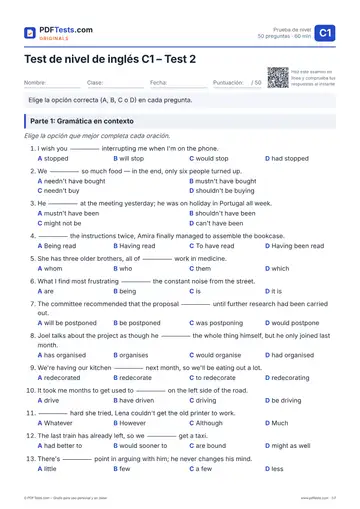
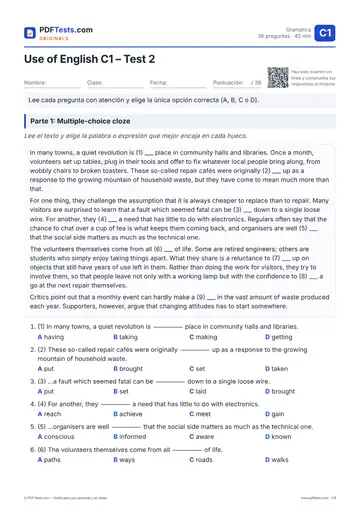
Vista previa de la página 1: Use of English C1 – Test 1 Abrir PDF
Use of English B1–C2 · todos los exámenes con formato de examen, tipos de tarea y consejos

Haz el examen en línea

Elige la opción correcta (A, B, C o D) en cada pregunta. Elige tus respuestas y pulsa «Comprobar respuestas».

Parte 1: Cloze de opción múltiple

Lee el texto y elige la palabra o expresión que mejor encaja en cada hueco.

Slow travel: the journey as the destination

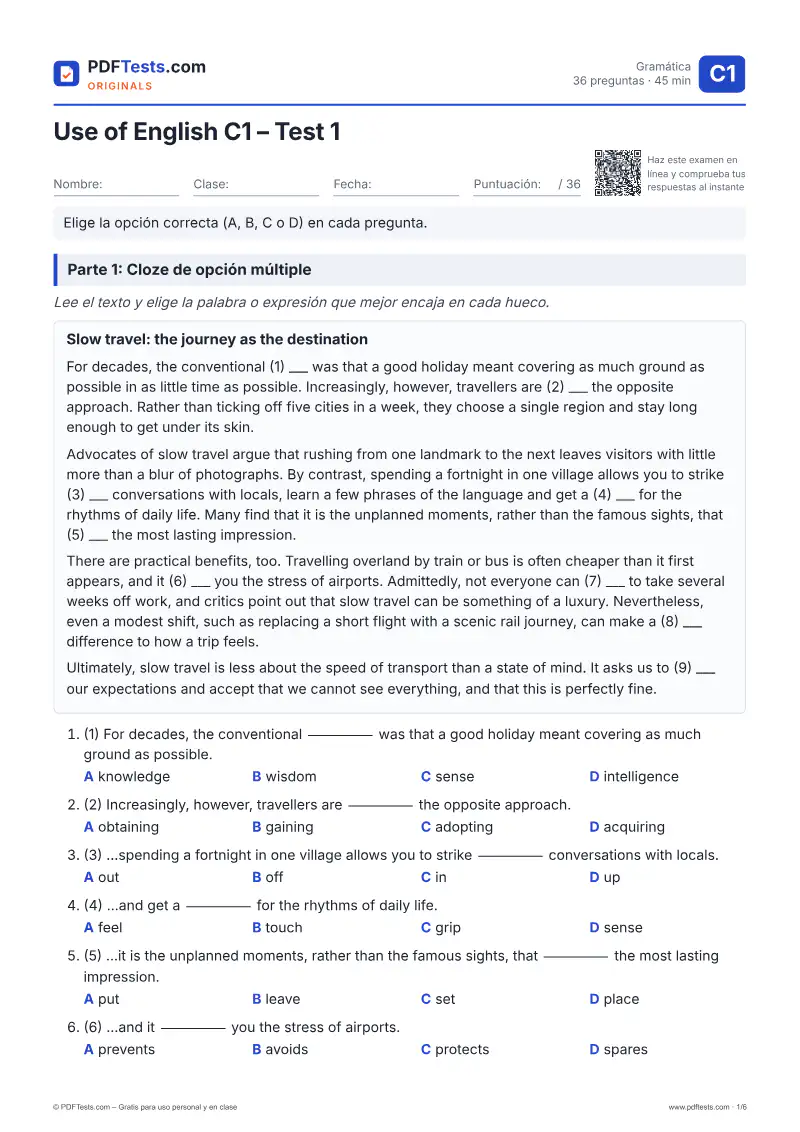
For decades, the conventional (1) ___ was that a good holiday meant covering as much ground as possible in as little time as possible. Increasingly, however, travellers are (2) ___ the opposite approach. Rather than ticking off five cities in a week, they choose a single region and stay long enough to get under its skin.

Advocates of slow travel argue that rushing from one landmark to the next leaves visitors with little more than a blur of photographs. By contrast, spending a fortnight in one village allows you to strike (3) ___ conversations with locals, learn a few phrases of the language and get a (4) ___ for the rhythms of daily life. Many find that it is the unplanned moments, rather than the famous sights, that (5) ___ the most lasting impression.

There are practical benefits, too. Travelling overland by train or bus is often cheaper than it first appears, and it (6) ___ you the stress of airports. Admittedly, not everyone can (7) ___ to take several weeks off work, and critics point out that slow travel can be something of a luxury. Nevertheless, even a modest shift, such as replacing a short flight with a scenic rail journey, can make a (8) ___ difference to how a trip feels.

Ultimately, slow travel is less about the speed of transport than a state of mind. It asks us to (9) ___ our expectations and accept that we cannot see everything, and that this is perfectly fine.

  1. (1) For decades, the conventional _____ was that a good holiday meant covering as much ground as possible.

  2. (2) Increasingly, however, travellers are _____ the opposite approach.

  3. (3) ...spending a fortnight in one village allows you to strike _____ conversations with locals.

  4. (4) ...and get a _____ for the rhythms of daily life.

  5. (5) ...it is the unplanned moments, rather than the famous sights, that _____ the most lasting impression.

  6. (6) ...and it _____ you the stress of airports.

  7. (7) Admittedly, not everyone can _____ to take several weeks off work.

  8. (8) ...can make a _____ difference to how a trip feels.

  9. (9) It asks us to _____ our expectations and accept that we cannot see everything.

Parte 2: Cloze abierto (opción múltiple)

Lee el texto y elige la palabra gramatical que mejor encaja en cada hueco.

Why we put things off

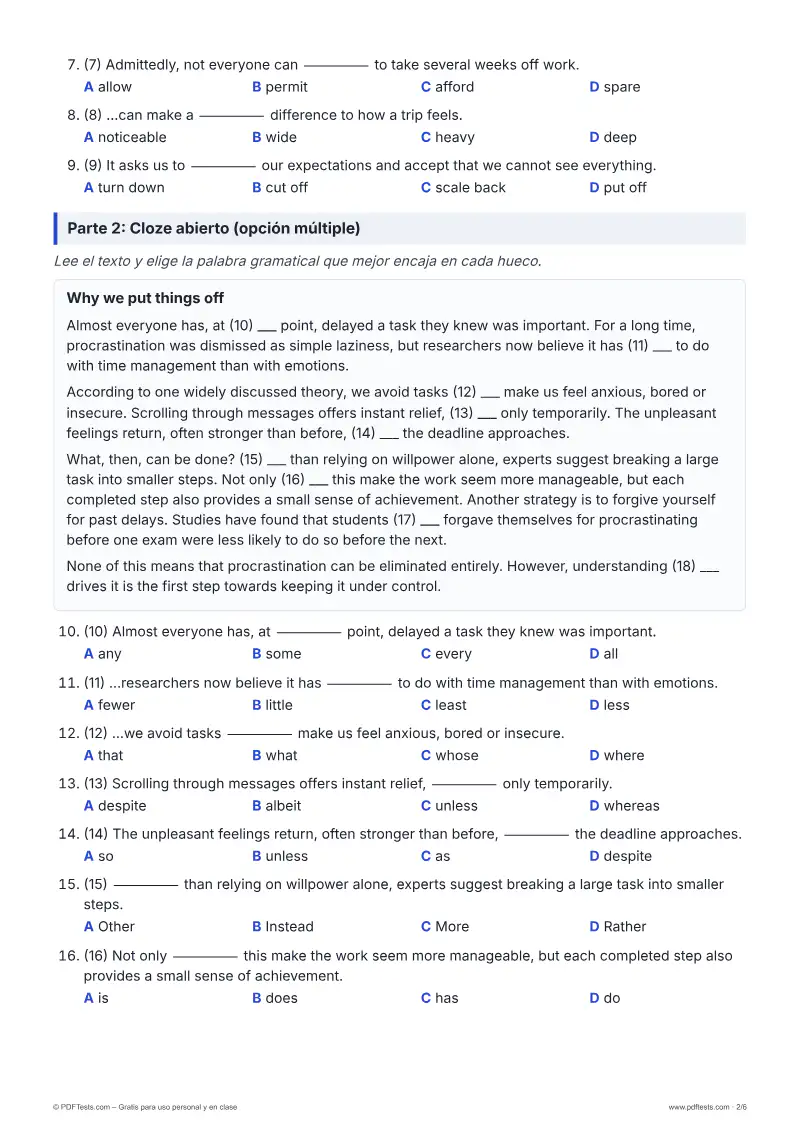
Almost everyone has, at (10) ___ point, delayed a task they knew was important. For a long time, procrastination was dismissed as simple laziness, but researchers now believe it has (11) ___ to do with time management than with emotions.

According to one widely discussed theory, we avoid tasks (12) ___ make us feel anxious, bored or insecure. Scrolling through messages offers instant relief, (13) ___ only temporarily. The unpleasant feelings return, often stronger than before, (14) ___ the deadline approaches.

What, then, can be done? (15) ___ than relying on willpower alone, experts suggest breaking a large task into smaller steps. Not only (16) ___ this make the work seem more manageable, but each completed step also provides a small sense of achievement. Another strategy is to forgive yourself for past delays. Studies have found that students (17) ___ forgave themselves for procrastinating before one exam were less likely to do so before the next.

None of this means that procrastination can be eliminated entirely. However, understanding (18) ___ drives it is the first step towards keeping it under control.

  1. (10) Almost everyone has, at _____ point, delayed a task they knew was important.

  2. (11) ...researchers now believe it has _____ to do with time management than with emotions.

  3. (12) ...we avoid tasks _____ make us feel anxious, bored or insecure.

  4. (13) Scrolling through messages offers instant relief, _____ only temporarily.

  5. (14) The unpleasant feelings return, often stronger than before, _____ the deadline approaches.

  6. (15) _____ than relying on willpower alone, experts suggest breaking a large task into smaller steps.

  7. (16) Not only _____ this make the work seem more manageable, but each completed step also provides a small sense of achievement.

  8. (17) Studies have found that students _____ forgave themselves for procrastinating before one exam were less likely to do so before the next.

  9. (18) However, understanding _____ drives it is the first step towards keeping it under control.

Parte 3: Formación de palabras

Elige la forma correcta de la palabra en mayúsculas para completar cada frase.

  1. The committee's decision was met with widespread _____ from local residents. (APPROVE)

  2. The museum saw a sharp drop in _____ after ticket prices were raised. (ATTEND)

  3. It is _____ to expect a beginner to master the software in a single afternoon. (REAL)

  4. The new manager has a reputation for being highly _____, often changing plans at the last minute. (PREDICT)

  5. Despite repeated warnings, the company continued to _____ the risks involved. (ESTIMATE)

  6. The two reports were written _____ of each other, yet they reached the same conclusions. (DEPEND)

  7. The film's _____ ending left many viewers wanting a sequel. (RESOLVE)

  8. Recent _____ in battery technology have made electric bikes far more practical. (BREAK)

  9. The scheme was praised for its _____, allowing staff to choose when and where they work. (FLEX)

Parte 4: Transformaciones con palabra clave

Elige la frase que contiene la palabra en mayúsculas y tiene el mismo significado que la primera frase.

  1. I'm sure Tom didn't take your keys on purpose. (CAN'T)

  2. It was only when she read the letter that she understood what had happened. (UNTIL)

  3. People say that the castle was built in the twelfth century. (SAID)

  4. I regret not accepting the job offer. (WISH)

  5. The meeting was cancelled because so few people could attend. (CALLED)

  6. You should have told me you were coming. (OUGHT)

  7. Although he had very little experience, he was given the job. (SPITE)

  8. I didn't recognise her at first because she had changed so much. (SUCH)

  9. There's no point in arguing with him; he never changes his mind. (WORTH)

¿Te ha resultado útil esta página?

Informar de un error

¿Has visto una respuesta incorrecta, una errata o una explicación poco clara? Avísanos y lo corregiremos.

Practica con una ficha: Use of English C1 – Ficha 1

Vista previa

Sobre este examen

Este test de Use of English de nivel C1 evalúa gramática y vocabulario avanzados en cuatro partes con formato de examen: un cloze de opción múltiple, un cloze abierto en formato de opción múltiple, formación de palabras y transformaciones de frases con palabra clave (key word transformations). Es ideal para estudiantes de nivel avanzado que preparan exámenes de nivel C1 y para profesores que necesitan una prueba diagnóstica o de repaso fiable.

Temas

Colocaciones y expresiones fijasPhrasal verbsPronombres relativos y conectoresInversiónFormación de palabras con prefijos y sufijosVerbos modales en perfecto (modal perfects)Estructuras pasivas impersonales (passive reporting structures)Transformaciones con palabra clave (key word transformations)

Cómo usar este examen

  1. Descarga el PDF e imprímelo, o haz el examen en línea más abajo.
  2. Responde todas las preguntas sin diccionario y sin prisas.
  3. Comprueba tus respuestas y apunta los temas que debes repasar.

Notas para el profesor

Puede usar el test como simulacro cronometrado (unos 45 minutos) o plantear cada parte como actividad de calentamiento en clases distintas. Los distractores se centran en errores típicos del nivel C1: colocaciones incorrectas, confusión de partículas, inversiones mal construidas, prefijos negativos equivocados y transformaciones que alteran el significado. Después de corregir, pida al alumnado que explique por qué cada distractor es incorrecto. A continuación, propóngales que redacten sus propias transformaciones con las mismas palabras clave.