PDFTests Originals

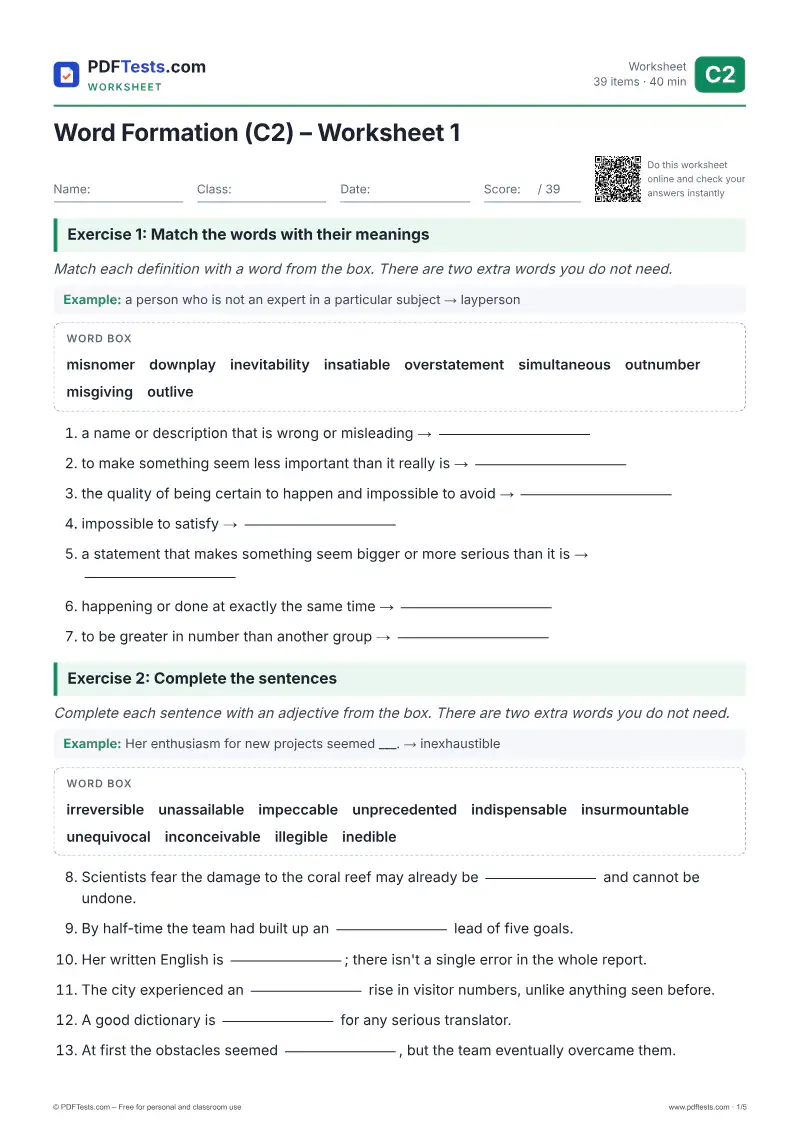
Word Formation (C2) – Worksheet 1

C2 Proficiency WorksheetEnglish

This worksheet practises advanced word formation in context: negative prefixes, verb-forming affixes, noun and adjective suffixes and common collocations. It is for C2 learners and Cambridge C2 Proficiency candidates who want to build precision and range in their vocabulary.
items
39
Time
40 min
PDF
5 pages
Answer key
Included
  • 100% free
  • No sign-up or email
  • Print-ready A4 PDF
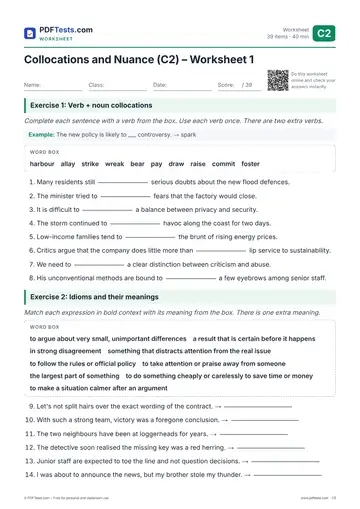
Preview of page 1 of Word Formation (C2) – Worksheet 1 Open PDF

Do the worksheet online

Type your answers, then press “Check my answers”. Alternative correct answers are accepted.

Exercise 1: Match the words with their meanings

Match each definition with a word from the box. There are two extra words you do not need.

Example: a person who is not an expert in a particular subject → layperson

Word box misnomerdownplayinevitabilityinsatiableoverstatementsimultaneousoutnumbermisgivingoutlive

  1. a name or description that is wrong or misleading

  2. to make something seem less important than it really is

  3. the quality of being certain to happen and impossible to avoid

  4. impossible to satisfy

  5. a statement that makes something seem bigger or more serious than it is

  6. happening or done at exactly the same time

  7. to be greater in number than another group

Exercise 2: Complete the sentences

Complete each sentence with an adjective from the box. There are two extra words you do not need.

Example: Her enthusiasm for new projects seemed ___. → inexhaustible

Word box irreversibleunassailableimpeccableunprecedentedindispensableinsurmountableunequivocalinconceivableillegibleinedible

  1. Scientists fear the damage to the coral reef may already be and cannot be undone.

  2. By half-time the team had built up an lead of five goals.

  3. Her written English is ; there isn't a single error in the whole report.

  4. The city experienced an rise in visitor numbers, unlike anything seen before.

  5. A good dictionary is for any serious translator.

  6. At first the obstacles seemed , but the team eventually overcame them.

  7. The director gave an answer: there would be no further delays.

  8. Thirty years ago it would have been that people would carry powerful computers in their pockets.

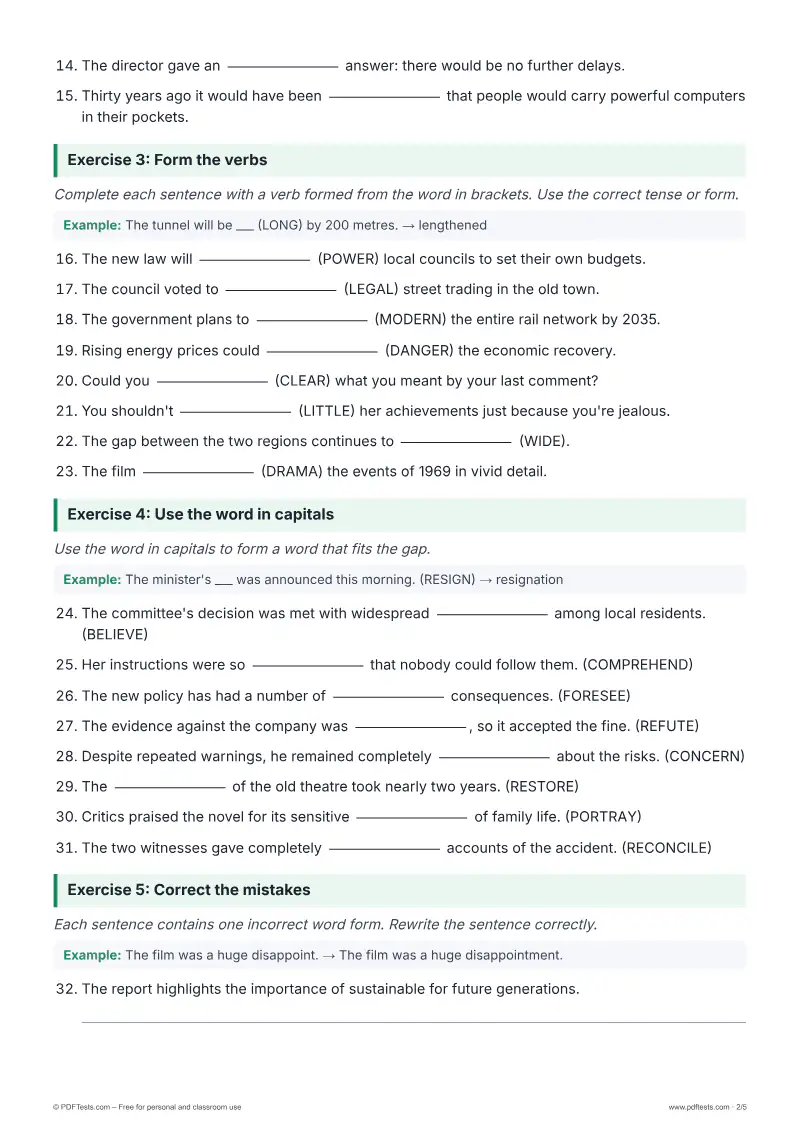
Exercise 3: Form the verbs

Complete each sentence with a verb formed from the word in brackets. Use the correct tense or form.

Example: The tunnel will be ___ (LONG) by 200 metres. → lengthened

  1. The new law will (POWER) local councils to set their own budgets.

  2. The council voted to (LEGAL) street trading in the old town.

  3. The government plans to (MODERN) the entire rail network by 2035.

  4. Rising energy prices could (DANGER) the economic recovery.

  5. Could you (CLEAR) what you meant by your last comment?

  6. You shouldn't (LITTLE) her achievements just because you're jealous.

  7. The gap between the two regions continues to (WIDE).

  8. The film (DRAMA) the events of 1969 in vivid detail.

Exercise 4: Use the word in capitals

Use the word in capitals to form a word that fits the gap.

Example: The minister's ___ was announced this morning. (RESIGN) → resignation

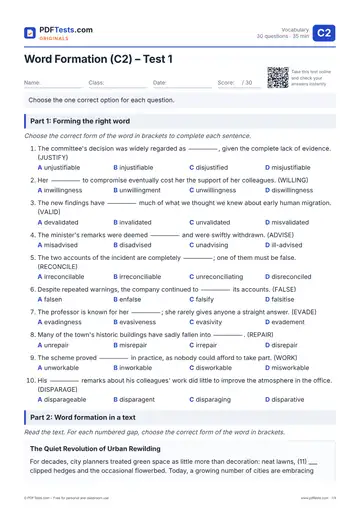
  1. The committee's decision was met with widespread among local residents. (BELIEVE)

  2. Her instructions were so that nobody could follow them. (COMPREHEND)

  3. The new policy has had a number of consequences. (FORESEE)

  4. The evidence against the company was , so it accepted the fine. (REFUTE)

  5. Despite repeated warnings, he remained completely about the risks. (CONCERN)

  6. The of the old theatre took nearly two years. (RESTORE)

  7. Critics praised the novel for its sensitive of family life. (PORTRAY)

  8. The two witnesses gave completely accounts of the accident. (RECONCILE)

Exercise 5: Correct the mistakes

Each sentence contains one incorrect word form. Rewrite the sentence correctly.

Example: The film was a huge disappoint. → The film was a huge disappointment.

  1. The report highlights the importance of sustainable for future generations.

  2. Most of the jury found his argument completely unconvinced.

  3. She spoke with remarkable eloquent at the ceremony.

  4. The company has been accused of negligent in its handling of customer data.

  5. Many viewers found the ending of the series deeply dissatisfied.

  6. There has been a noticeable deteriorate in air quality this year.

  7. The judge described the defendant's behaviour as reprehensive.

  8. The organisation's response was criticised for its lack of transparent.

Was this page helpful?

Report a mistake

Spotted a wrong answer, a typo or an unclear explanation? Tell us and we will fix it.

Preview

About this test

C2 word formation worksheet: prefixes, suffixes, word families and collocations in context. Printable with answers for advanced English learners.

Topics covered

Word formationPrefixes and suffixesNegative adjectivesVerb-forming affixesAbstract nounsCollocations

Notes for teachers

Start with the matching and word box tasks to activate vocabulary, then move to the open word-formation exercises, ideally under timed exam-style conditions. Typical mistakes include choosing the wrong negative prefix (unrefutable for irrefutable), confusing -ed and -ing adjectives (unconvinced vs unconvincing) and forgetting spelling changes (reconcile → irreconcilable). As a follow-up, ask learners to build full word families for five base words from the worksheet and write one sentence for each form.

All English C2 tests →