PDFTests Originals

Aficiones y tiempo libre – Test 1

A2 Elemental VocabularioInglés

Este test de vocabulario de nivel A2 comprueba si el alumnado domina las palabras cotidianas relacionadas con las aficiones y las actividades de tiempo libre. Trabaja el significado de las palabras, colocaciones frecuentes con play, go y do, el vocabulario en contexto a partir de un texto breve y familias de palabras sencillas. Está pensado para adolescentes y adultos de nivel elemental y sirve para practicar en clase, como deberes o para estudiar por libre.
Preguntas
30
Tiempo
30 min
PDF
4 páginas
Soluciones
Incluidas
  • 100 % gratis
  • Sin registro
  • PDF A4 listo para imprimir
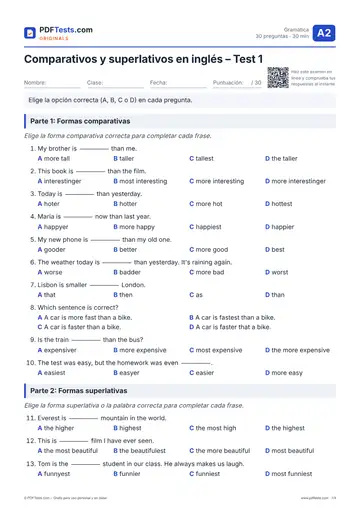
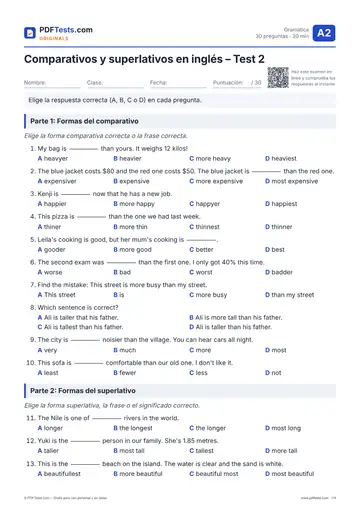
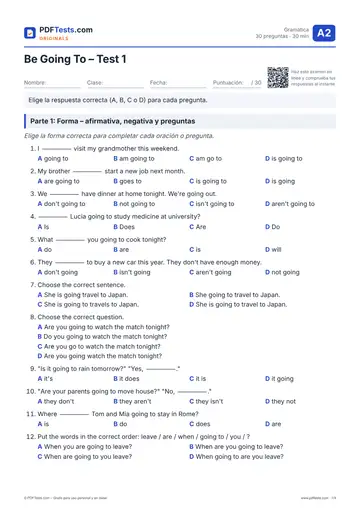
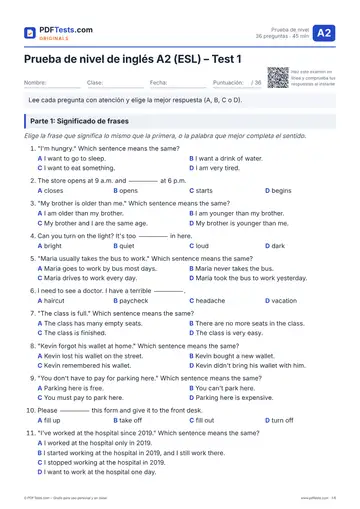
Vista previa de la página 1: Aficiones y tiempo libre – Test 1 Abrir PDF

Haz el examen en línea

Lee cada pregunta y elige la respuesta correcta (A, B, C o D). Elige tus respuestas y pulsa «Comprobar respuestas».

Parte 1: Vocabulario de aficiones y tiempo libre

Elige la palabra o expresión que mejor corresponde al significado.

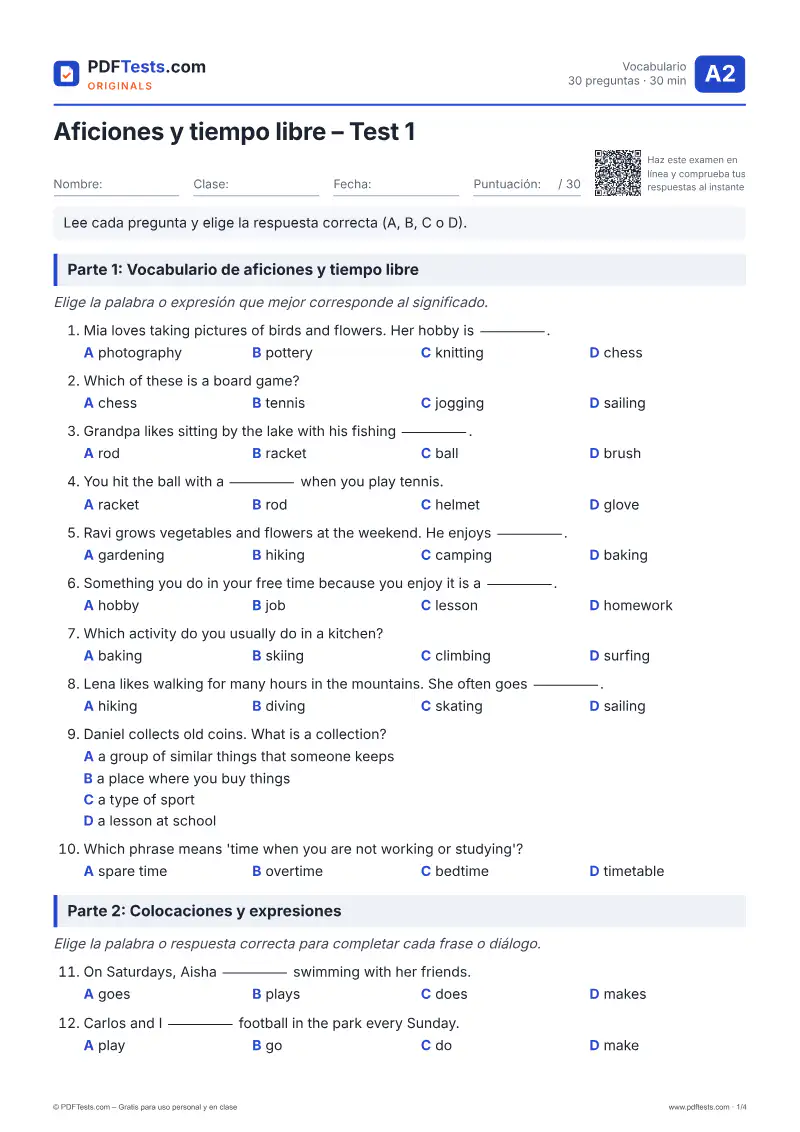
  1. Mia loves taking pictures of birds and flowers. Her hobby is _____.

  2. Which of these is a board game?

  3. Grandpa likes sitting by the lake with his fishing _____.

  4. You hit the ball with a _____ when you play tennis.

  5. Ravi grows vegetables and flowers at the weekend. He enjoys _____.

  6. Something you do in your free time because you enjoy it is a _____.

  7. Which activity do you usually do in a kitchen?

  8. Lena likes walking for many hours in the mountains. She often goes _____.

  9. Daniel collects old coins. What is a collection?

  10. Which phrase means 'time when you are not working or studying'?

Parte 2: Colocaciones y expresiones

Elige la palabra o respuesta correcta para completar cada frase o diálogo.

  1. On Saturdays, Aisha _____ swimming with her friends.

  2. Carlos and I _____ football in the park every Sunday.

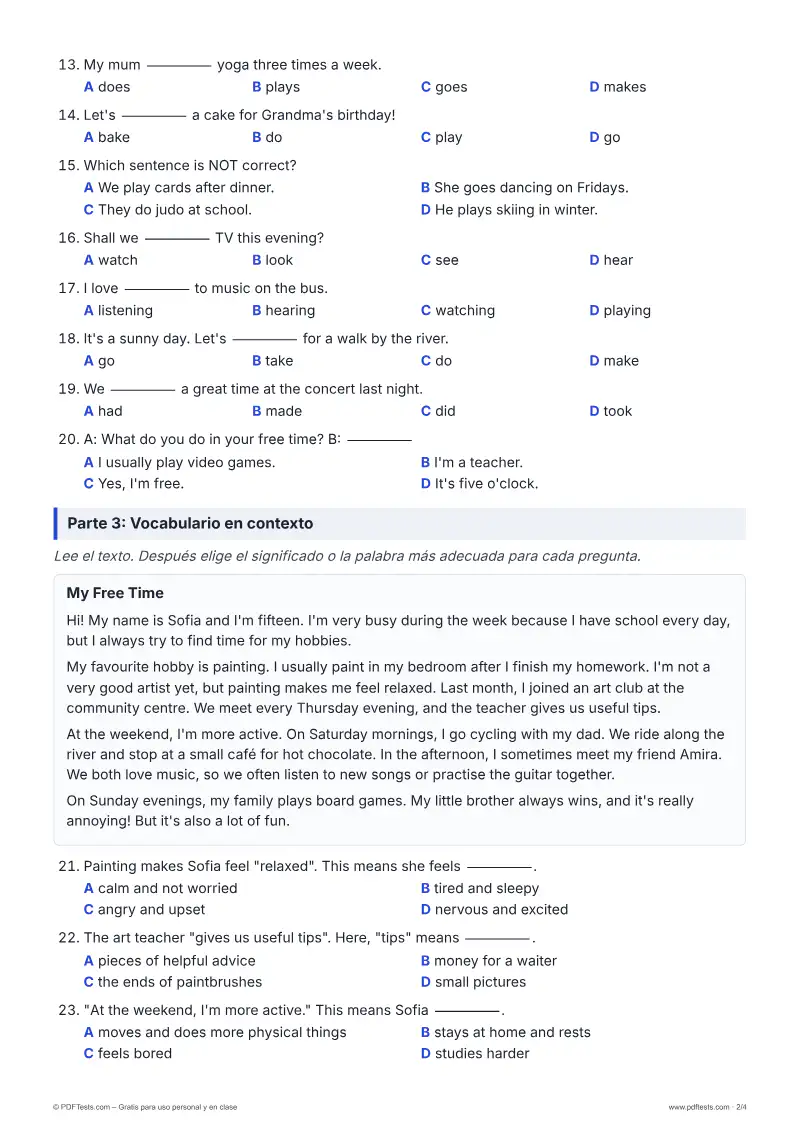
  3. My mum _____ yoga three times a week.

  4. Let's _____ a cake for Grandma's birthday!

  5. Which sentence is NOT correct?

  6. Shall we _____ TV this evening?

  7. I love _____ to music on the bus.

  8. It's a sunny day. Let's _____ for a walk by the river.

  9. We _____ a great time at the concert last night.

  10. A: What do you do in your free time? B: _____

Parte 3: Vocabulario en contexto

Lee el texto. Después elige el significado o la palabra más adecuada para cada pregunta.

My Free Time

Hi! My name is Sofia and I'm fifteen. I'm very busy during the week because I have school every day, but I always try to find time for my hobbies.

My favourite hobby is painting. I usually paint in my bedroom after I finish my homework. I'm not a very good artist yet, but painting makes me feel relaxed. Last month, I joined an art club at the community centre. We meet every Thursday evening, and the teacher gives us useful tips.

At the weekend, I'm more active. On Saturday mornings, I go cycling with my dad. We ride along the river and stop at a small café for hot chocolate. In the afternoon, I sometimes meet my friend Amira. We both love music, so we often listen to new songs or practise the guitar together.

On Sunday evenings, my family plays board games. My little brother always wins, and it's really annoying! But it's also a lot of fun.

  1. Painting makes Sofia feel "relaxed". This means she feels _____.

  2. The art teacher "gives us useful tips". Here, "tips" means _____.

  3. "At the weekend, I'm more active." This means Sofia _____.

  4. Her brother always wins and "it's really annoying". This means it makes Sofia feel _____.

  5. Sofia paints pictures. A person who paints pictures is an _____.

Parte 4: Familias de palabras

Elige la forma correcta de la palabra para completar cada frase.

  1. Kenji is very _____ in old films. He watches one every weekend.

  2. This book is really _____. I can't stop reading it!

  3. My uncle is a great _____. He makes delicious food.

  4. I'm so _____! There's nothing to do at home today.

  5. Ana is a very good _____. She wins every race in the pool.

¿Te ha resultado útil esta página?

Informar de un error

¿Has visto una respuesta incorrecta, una errata o una explicación poco clara? Avísanos y lo corregiremos.

Practica con una ficha: Aficiones y tiempo libre – Ficha 1

Vista previa

Sobre este examen

Este test de vocabulario de nivel A2 comprueba si el alumnado domina las palabras cotidianas relacionadas con las aficiones y las actividades de tiempo libre. Trabaja el significado de las palabras, colocaciones frecuentes con play, go y do, el vocabulario en contexto a partir de un texto breve y familias de palabras sencillas. Está pensado para adolescentes y adultos de nivel elemental y sirve para practicar en clase, como deberes o para estudiar por libre.

Temas

Aficiones y actividades de ocioMaterial deportivo y de juegosColocaciones con play, go y doExpresiones sobre el tiempo libreVocabulario en contextoFamilias de palabras (-ed/-ing, -er/-ist)

Cómo usar este examen

  1. Descarga el PDF e imprímelo, o haz el examen en línea más abajo.
  2. Responde todas las preguntas sin diccionario y sin prisas.
  3. Comprueba tus respuestas y apunta los temas que debes repasar.

Notas para el profesor

Utiliza el test después de una unidad sobre aficiones y tiempo libre, o como prueba diagnóstica rápida en el nivel A2. Se centra en errores típicos de los hispanohablantes, como decir 'play skiing' en lugar de 'go skiing', 'see TV' en lugar de 'watch TV', 'listen music' sin 'to', usar 'cooker' para referirse a una persona o confundir los adjetivos en -ed y en -ing. Como actividad de ampliación, pide a los alumnos que escriban un párrafo breve sobre su propio tiempo libre usando al menos cinco colocaciones de la Parte 2.