PDFTests Originals

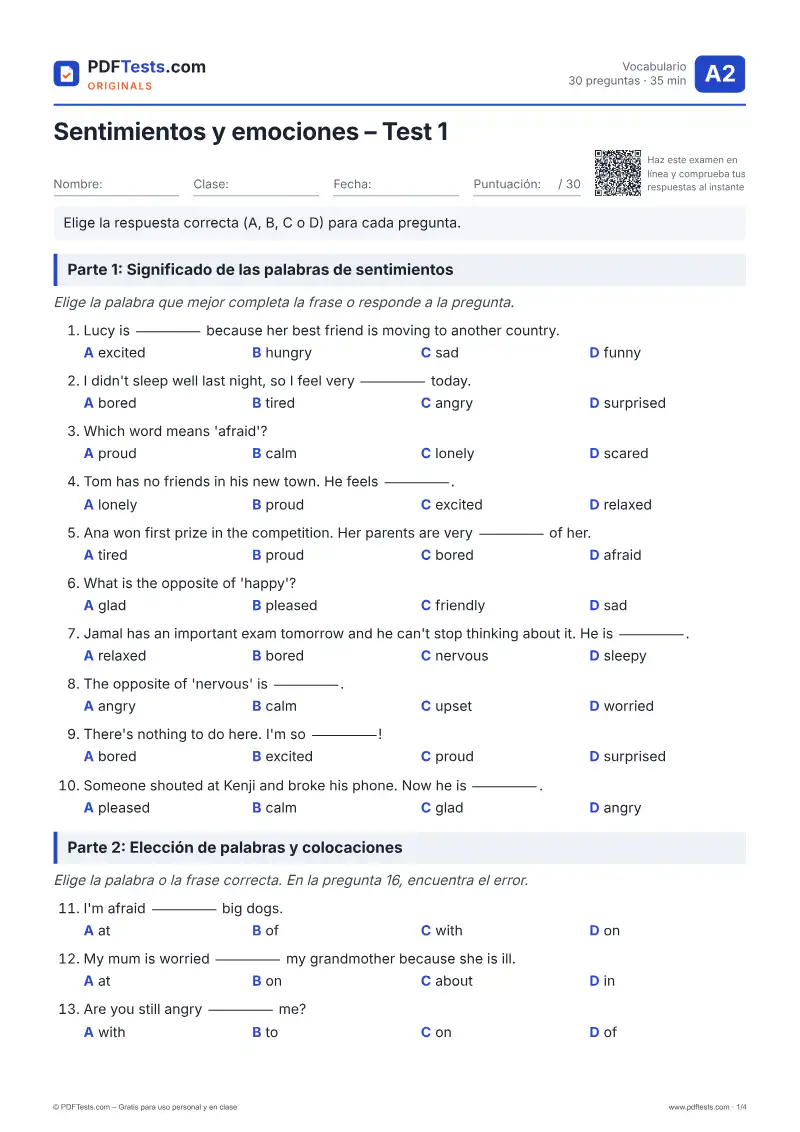
Sentimientos y emociones – Test 1

A2 Elemental VocabularioInglés

Este test de vocabulario de nivel A2 comprueba si los alumnos conocen las palabras más habituales en inglés para hablar de sentimientos y emociones. Trabaja el significado de las palabras, las preposiciones y los verbos que acompañan a estos adjetivos, los adjetivos terminados en -ed e -ing, las familias de palabras y la comprensión de un texto breve. Es adecuado para alumnos de nivel elemental, tanto adolescentes como adultos, y sirve para clase, deberes o estudio autónomo.
Preguntas
30
Tiempo
35 min
PDF
4 páginas
Soluciones
Incluidas
  • 100 % gratis
  • Sin registro
  • PDF A4 listo para imprimir
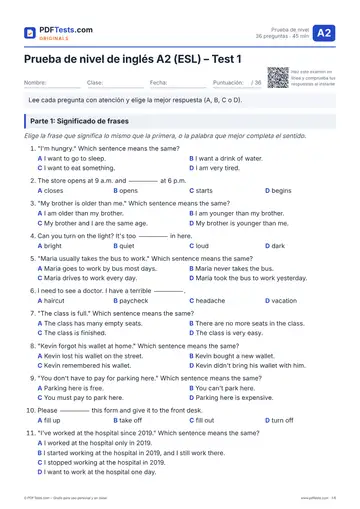
Vista previa de la página 1: Sentimientos y emociones – Test 1 Abrir PDF

Haz el examen en línea

Elige la respuesta correcta (A, B, C o D) para cada pregunta. Elige tus respuestas y pulsa «Comprobar respuestas».

Parte 1: Significado de las palabras de sentimientos

Elige la palabra que mejor completa la frase o responde a la pregunta.

  1. Lucy is _____ because her best friend is moving to another country.

  2. I didn't sleep well last night, so I feel very _____ today.

  3. Which word means 'afraid'?

  4. Tom has no friends in his new town. He feels _____.

  5. Ana won first prize in the competition. Her parents are very _____ of her.

  6. What is the opposite of 'happy'?

  7. Jamal has an important exam tomorrow and he can't stop thinking about it. He is _____.

  8. The opposite of 'nervous' is _____.

  9. There's nothing to do here. I'm so _____!

  10. Someone shouted at Kenji and broke his phone. Now he is _____.

Parte 2: Elección de palabras y colocaciones

Elige la palabra o la frase correcta. En la pregunta 16, encuentra el error.

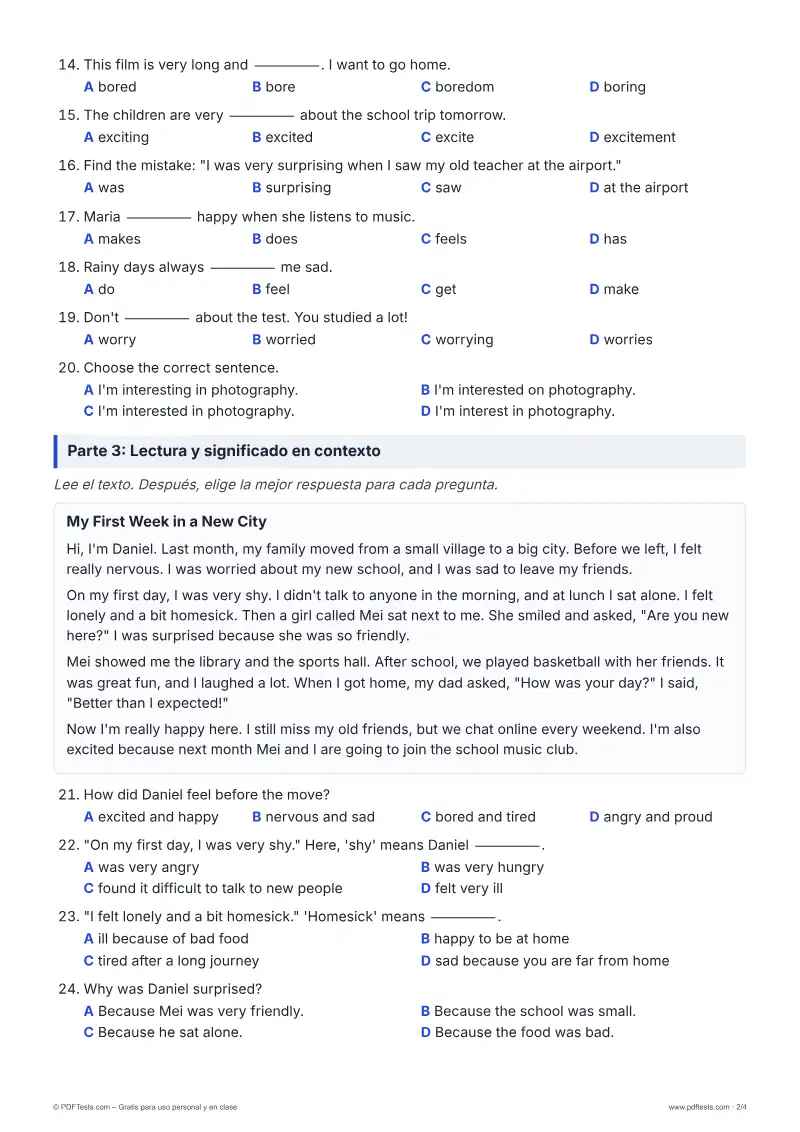
  1. I'm afraid _____ big dogs.

  2. My mum is worried _____ my grandmother because she is ill.

  3. Are you still angry _____ me?

  4. This film is very long and _____. I want to go home.

  5. The children are very _____ about the school trip tomorrow.

  6. Find the mistake: "I was very surprising when I saw my old teacher at the airport."

  7. Maria _____ happy when she listens to music.

  8. Rainy days always _____ me sad.

  9. Don't _____ about the test. You studied a lot!

  10. Choose the correct sentence.

Parte 3: Lectura y significado en contexto

Lee el texto. Después, elige la mejor respuesta para cada pregunta.

My First Week in a New City

Hi, I'm Daniel. Last month, my family moved from a small village to a big city. Before we left, I felt really nervous. I was worried about my new school, and I was sad to leave my friends.

On my first day, I was very shy. I didn't talk to anyone in the morning, and at lunch I sat alone. I felt lonely and a bit homesick. Then a girl called Mei sat next to me. She smiled and asked, "Are you new here?" I was surprised because she was so friendly.

Mei showed me the library and the sports hall. After school, we played basketball with her friends. It was great fun, and I laughed a lot. When I got home, my dad asked, "How was your day?" I said, "Better than I expected!"

Now I'm really happy here. I still miss my old friends, but we chat online every weekend. I'm also excited because next month Mei and I are going to join the school music club.

  1. How did Daniel feel before the move?

  2. "On my first day, I was very shy." Here, 'shy' means Daniel _____.

  3. "I felt lonely and a bit homesick." 'Homesick' means _____.

  4. Why was Daniel surprised?

  5. Which word from the text describes Mei?

  6. Mei brought a lot of _____ into Daniel's life.

  7. Daniel said his day was "better than I expected". This means _____.

  8. Which sentence about Daniel now is true?

  9. Mei asked, "Are you new here?" Which answer is best?

  10. Why is Daniel excited?

¿Te ha resultado útil esta página?

Informar de un error

¿Has visto una respuesta incorrecta, una errata o una explicación poco clara? Avísanos y lo corregiremos.

Practica con una ficha: Sentimientos y emociones – Ficha 1

Vista previa

Sobre este examen

Este test de vocabulario de nivel A2 comprueba si los alumnos conocen las palabras más habituales en inglés para hablar de sentimientos y emociones. Trabaja el significado de las palabras, las preposiciones y los verbos que acompañan a estos adjetivos, los adjetivos terminados en -ed e -ing, las familias de palabras y la comprensión de un texto breve. Es adecuado para alumnos de nivel elemental, tanto adolescentes como adultos, y sirve para clase, deberes o estudio autónomo.

Temas

Adjetivos para expresar sentimientosAntónimosPreposiciones después de adjetivosAdjetivos en -ed e -ingFeel y makeFamilias de palabrasComprensión lectora: significado en contexto

Cómo usar este examen

  1. Descarga el PDF e imprímelo, o haz el examen en línea más abajo.
  2. Responde todas las preguntas sin diccionario y sin prisas.
  3. Comprueba tus respuestas y apunta los temas que debes repasar.

Notas para el profesor

Puede usar la Parte 1 como actividad de calentamiento o repaso rápido del vocabulario básico de sentimientos y pasar después a las secciones de colocaciones y lectura. El test se centra en errores típicos del nivel A2, como confundir bored/boring y surprised/surprising, usar la preposición equivocada después de afraid, worried y angry, o mezclar feel y make. Como actividad de ampliación, pida a los alumnos que escriban cinco frases sobre momentos en los que se sintieron nervous, proud, bored, surprised o homesick.