PDFTests Originals

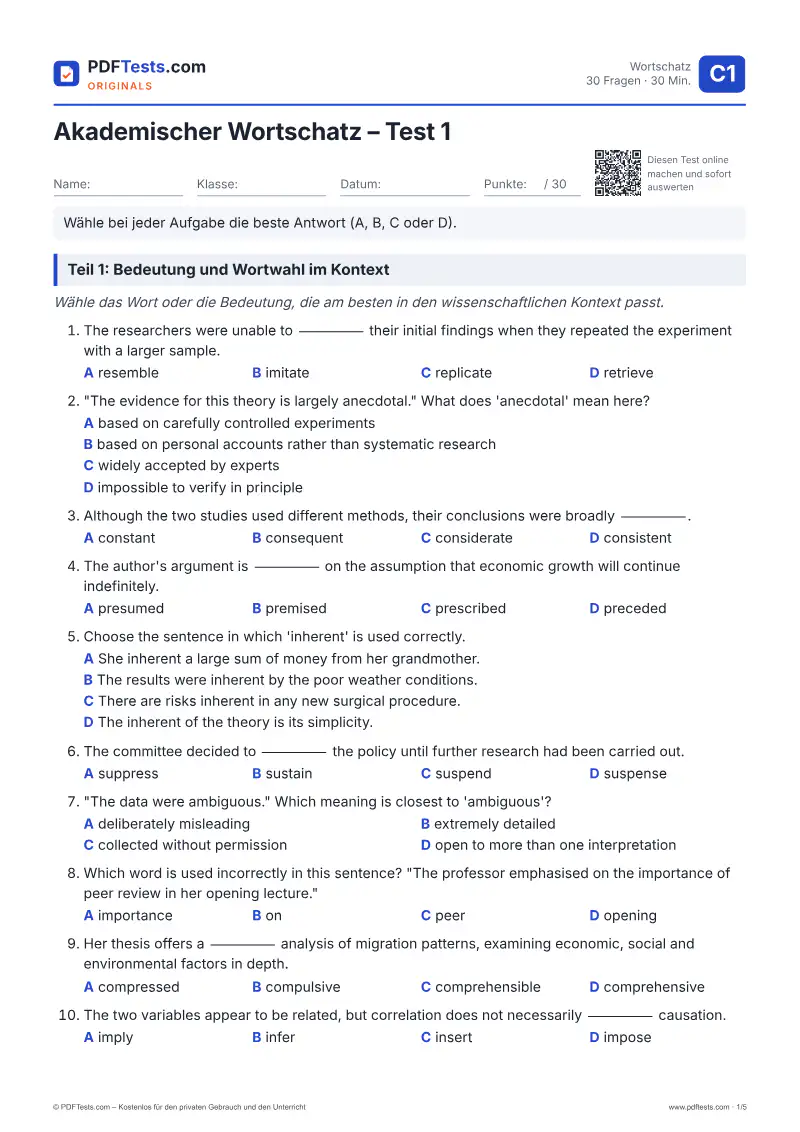
Akademischer Wortschatz – Test 1

C1 Fortgeschritten WortschatzEnglisch

Dieser C1-Test prüft den Wortschatz, den man zum Lesen und Schreiben wissenschaftlicher Texte braucht. Er behandelt Wortbedeutung im Kontext, typische akademische Kollokationen und Wortbildung innerhalb von Wortfamilien. Der Test eignet sich für fortgeschrittene Lernende, die sich auf ein Studium oder auf Prüfungen wie IELTS und C1 Advanced vorbereiten, sowie für Lehrkräfte in EAP-Kursen (English for Academic Purposes).
Fragen
30
Zeit
30 Min.
PDF
5 Seiten
Lösungen
Enthalten
  • 100 % kostenlos
  • Ohne Anmeldung
  • Druckfertiges A4-PDF
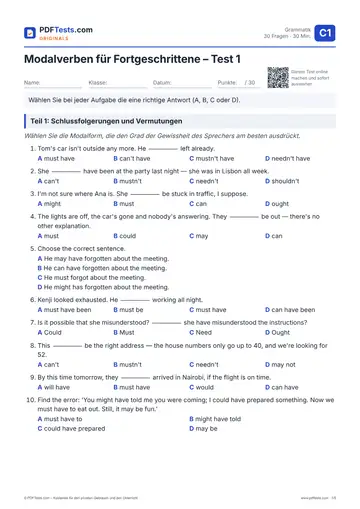
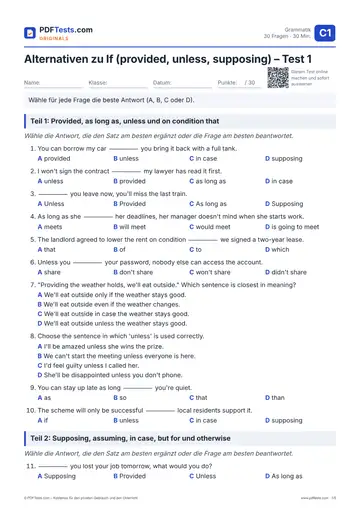
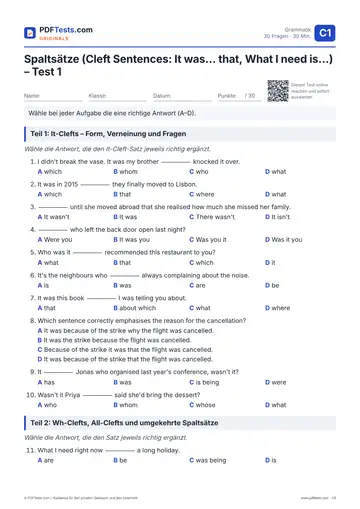
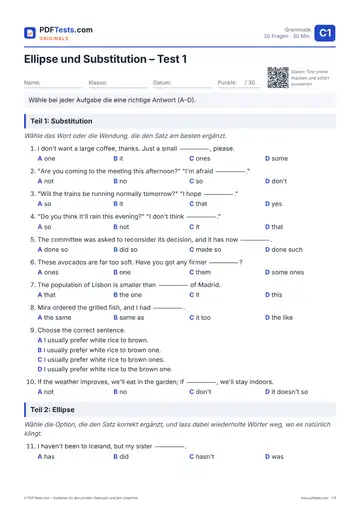
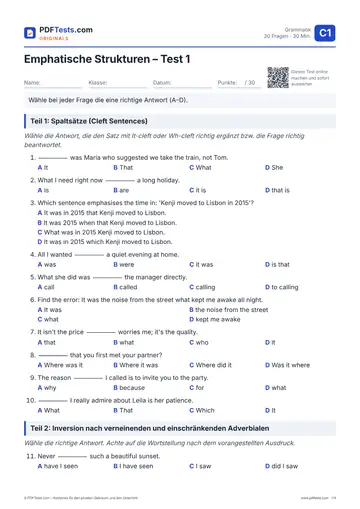
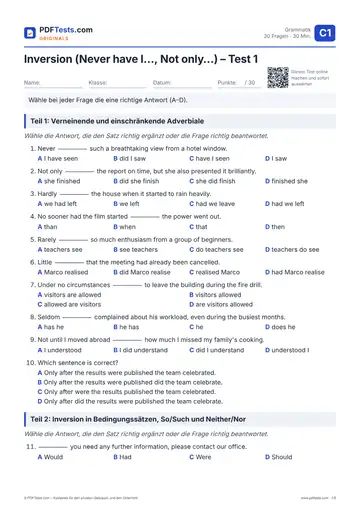
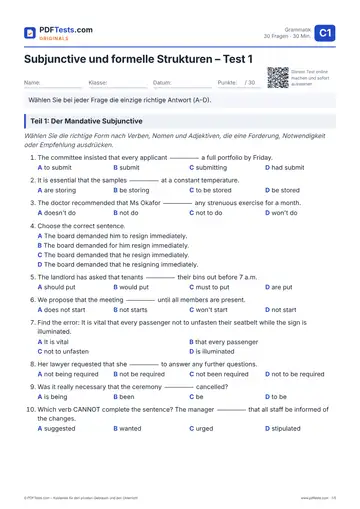
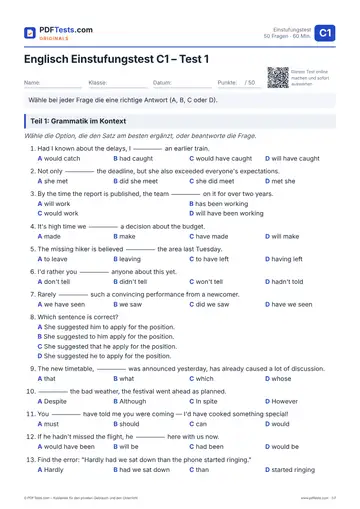
Vorschau von Seite 1: Akademischer Wortschatz – Test 1 PDF öffnen

Test online machen

Wähle bei jeder Aufgabe die beste Antwort (A, B, C oder D). Wählen Sie Ihre Antworten und klicken Sie auf „Antworten prüfen“.

Teil 1: Bedeutung und Wortwahl im Kontext

Wähle das Wort oder die Bedeutung, die am besten in den wissenschaftlichen Kontext passt.

  1. The researchers were unable to _____ their initial findings when they repeated the experiment with a larger sample.

  2. "The evidence for this theory is largely anecdotal." What does 'anecdotal' mean here?

  3. Although the two studies used different methods, their conclusions were broadly _____.

  4. The author's argument is _____ on the assumption that economic growth will continue indefinitely.

  5. Choose the sentence in which 'inherent' is used correctly.

  6. The committee decided to _____ the policy until further research had been carried out.

  7. "The data were ambiguous." Which meaning is closest to 'ambiguous'?

  8. Which word is used incorrectly in this sentence? "The professor emphasised on the importance of peer review in her opening lecture."

  9. Her thesis offers a _____ analysis of migration patterns, examining economic, social and environmental factors in depth.

  10. The two variables appear to be related, but correlation does not necessarily _____ causation.

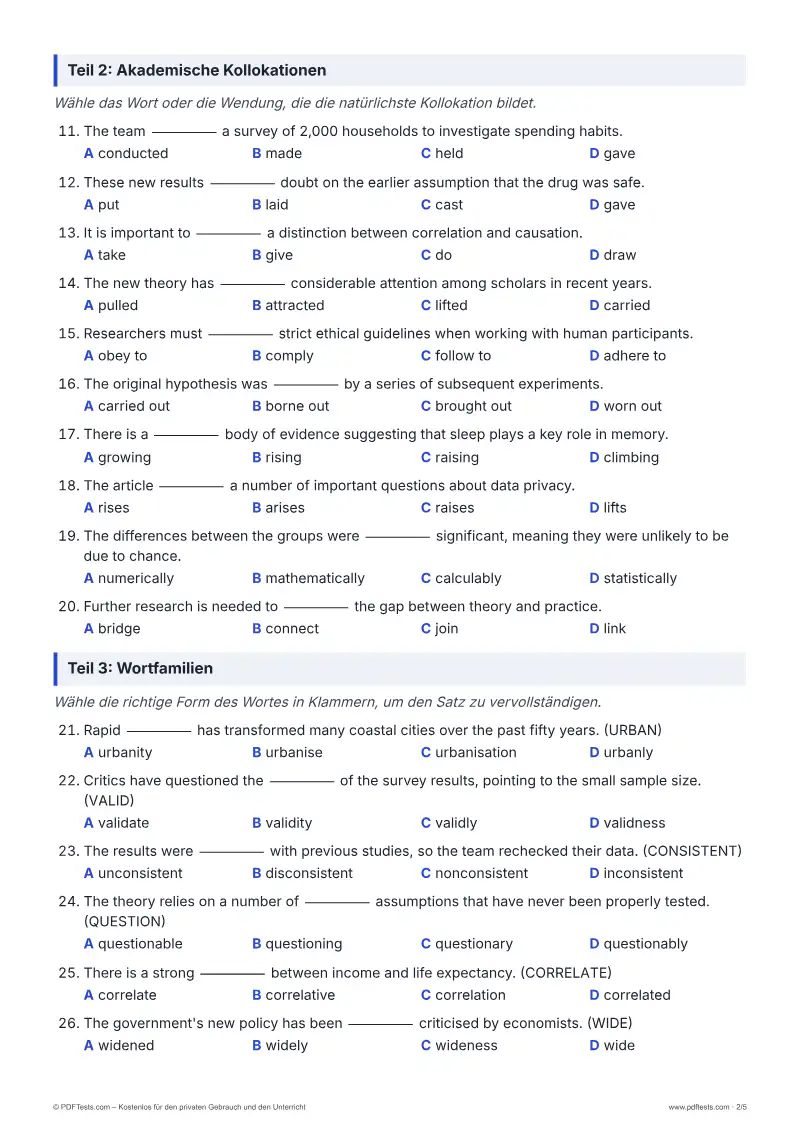
Teil 2: Akademische Kollokationen

Wähle das Wort oder die Wendung, die die natürlichste Kollokation bildet.

  1. The team _____ a survey of 2,000 households to investigate spending habits.

  2. These new results _____ doubt on the earlier assumption that the drug was safe.

  3. It is important to _____ a distinction between correlation and causation.

  4. The new theory has _____ considerable attention among scholars in recent years.

  5. Researchers must _____ strict ethical guidelines when working with human participants.

  6. The original hypothesis was _____ by a series of subsequent experiments.

  7. There is a _____ body of evidence suggesting that sleep plays a key role in memory.

  8. The article _____ a number of important questions about data privacy.

  9. The differences between the groups were _____ significant, meaning they were unlikely to be due to chance.

  10. Further research is needed to _____ the gap between theory and practice.

Teil 3: Wortfamilien

Wähle die richtige Form des Wortes in Klammern, um den Satz zu vervollständigen.

  1. Rapid _____ has transformed many coastal cities over the past fifty years. (URBAN)

  2. Critics have questioned the _____ of the survey results, pointing to the small sample size. (VALID)

  3. The results were _____ with previous studies, so the team rechecked their data. (CONSISTENT)

  4. The theory relies on a number of _____ assumptions that have never been properly tested. (QUESTION)

  5. There is a strong _____ between income and life expectancy. (CORRELATE)

  6. The government's new policy has been _____ criticised by economists. (WIDE)

  7. Researchers must ensure the _____ of participants' personal data. (CONFIDENTIAL)

  8. Her findings _____ the claim that bilingual children develop better problem-solving skills. (STRONG)

  9. The sample was not _____ of the wider population, so the conclusions cannot be generalised. (REPRESENT)

  10. The author's argument is rather _____ because it ignores several key factors. (SIMPLE)

Vorschau

Über diesen Test

Dieser C1-Test prüft den Wortschatz, den man zum Lesen und Schreiben wissenschaftlicher Texte braucht. Er behandelt Wortbedeutung im Kontext, typische akademische Kollokationen und Wortbildung innerhalb von Wortfamilien. Der Test eignet sich für fortgeschrittene Lernende, die sich auf ein Studium oder auf Prüfungen wie IELTS und C1 Advanced vorbereiten, sowie für Lehrkräfte in EAP-Kursen (English for Academic Purposes).

Themen

Akademischer WortschatzBedeutung im KontextKollokationenWortfamilienWortbildungLeicht verwechselbare Wörter

So nutzen Sie diesen Test

  1. Laden Sie das PDF herunter und drucken Sie es aus – oder machen Sie den Test unten online.
  2. Beantworten Sie alle Fragen ohne Wörterbuch und ohne Zeitdruck.
  3. Prüfen Sie Ihre Antworten und notieren Sie, was Sie wiederholen sollten.

Hinweise für Lehrkräfte

Setzen Sie den Test zu Beginn eines EAP-Kurses als Einstufung ein oder zur Wiederholung nach einer Einheit zum wissenschaftlichen Schreiben. Er zielt auf typische Fehler auf C1-Niveau: das Verwechseln ähnlich aussehender Wörter (imply/infer, comprehensive/comprehensible), überflüssige Präpositionen (emphasise on) und das falsche Verb in festen Kollokationen (cast doubt, draw a distinction). Zur Vertiefung können die Lernenden eigene wissenschaftliche Sätze mit den Kollokationen aus Teil 2 formulieren. Außerdem können sie für die Wörter aus Teil 3 vollständige Tabellen der Wortfamilien erstellen.