PDFTests Originals

Prueba de nivel de inglés C2 – Test 2

C2 Maestría Prueba de nivelInglés

Esta prueba de nivel C2 evalúa la gramática avanzada, el vocabulario idiomático y la precisión estilística que se esperan de un usuario de inglés muy competente, y termina con un texto de lectura exigente. Es ideal para quienes preparan exámenes de nivel C2 y para docentes que necesitan confirmar si un alumno domina con seguridad el nivel más alto del MCER.
Preguntas
50
Tiempo
60 min
PDF
7 páginas
Soluciones
Incluidas
  • 100 % gratis
  • Sin registro
  • PDF A4 listo para imprimir
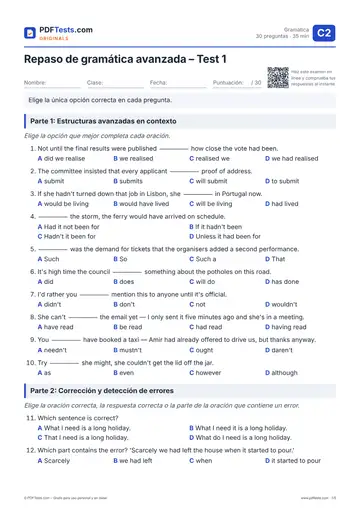
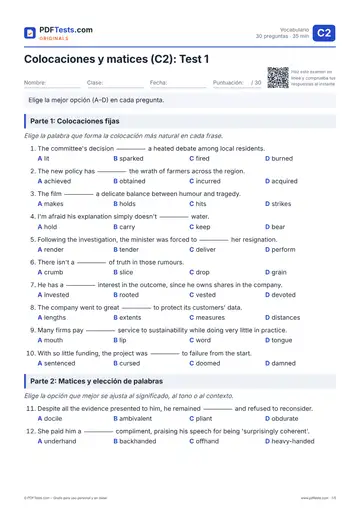
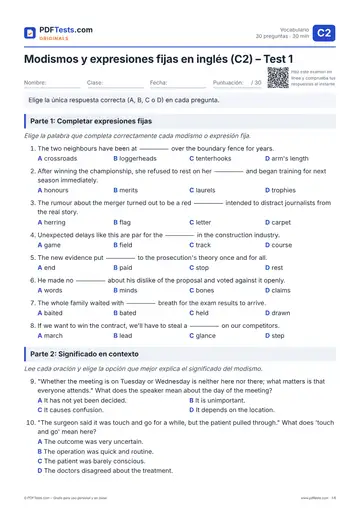
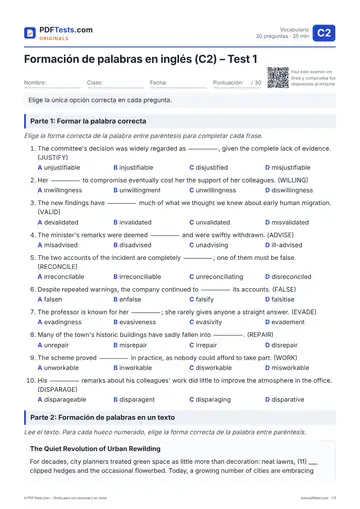
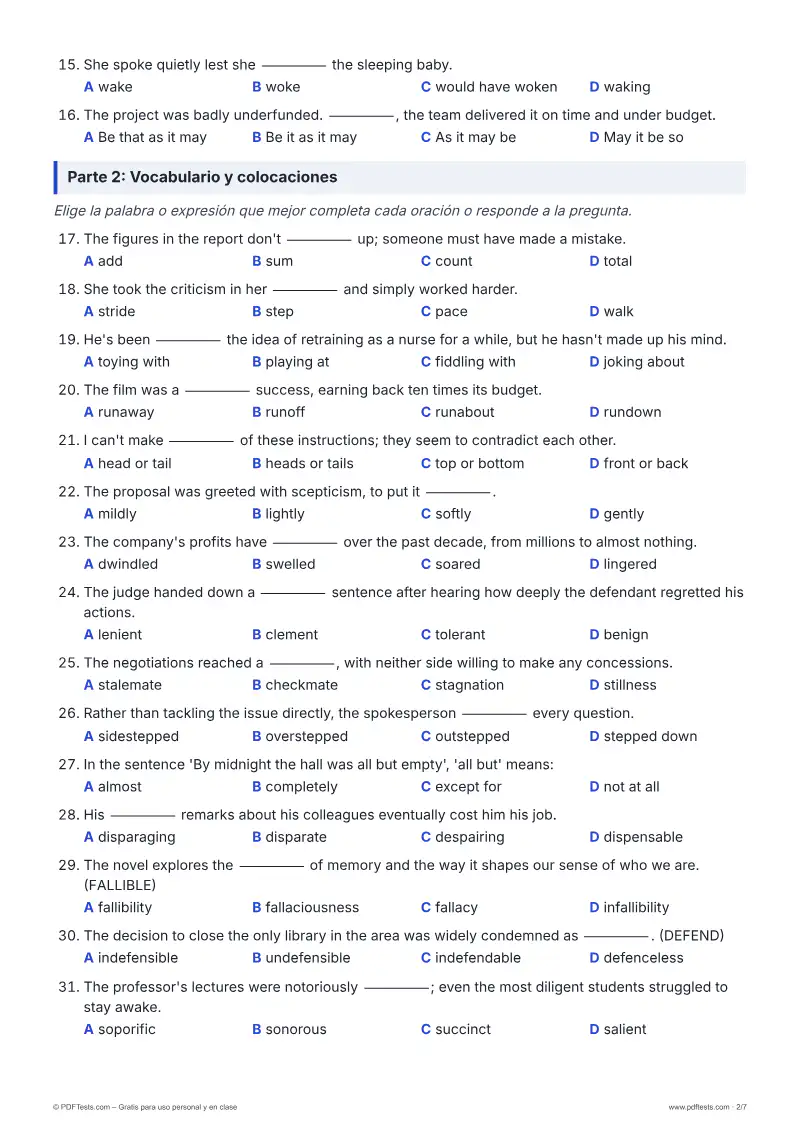
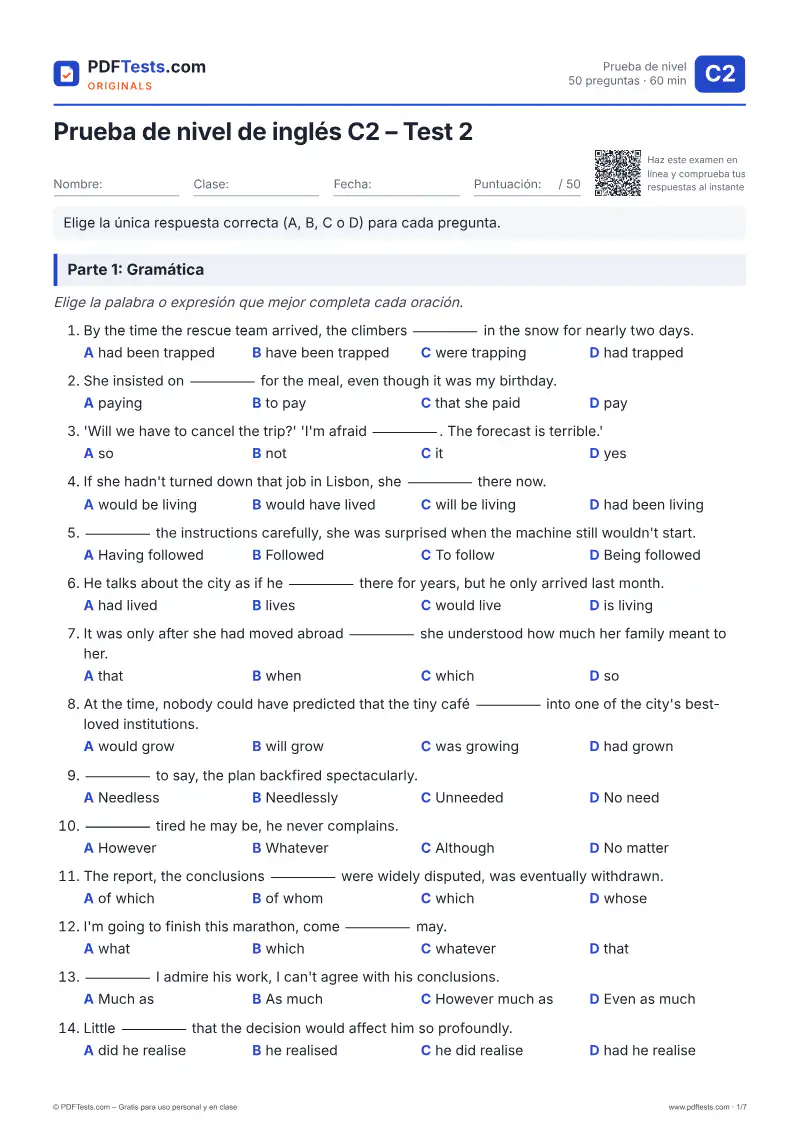
Vista previa de la página 1: Prueba de nivel de inglés C2 – Test 2 Abrir PDF

Haz el examen en línea

Elige la única respuesta correcta (A, B, C o D) para cada pregunta. Elige tus respuestas y pulsa «Comprobar respuestas».

Parte 1: Gramática

Elige la palabra o expresión que mejor completa cada oración.

  1. By the time the rescue team arrived, the climbers _____ in the snow for nearly two days.

  2. She insisted on _____ for the meal, even though it was my birthday.

  3. 'Will we have to cancel the trip?' 'I'm afraid _____. The forecast is terrible.'

  4. If she hadn't turned down that job in Lisbon, she _____ there now.

  5. _____ the instructions carefully, she was surprised when the machine still wouldn't start.

  6. He talks about the city as if he _____ there for years, but he only arrived last month.

  7. It was only after she had moved abroad _____ she understood how much her family meant to her.

  8. At the time, nobody could have predicted that the tiny café _____ into one of the city's best-loved institutions.

  9. _____ to say, the plan backfired spectacularly.

  10. _____ tired he may be, he never complains.

  11. The report, the conclusions _____ were widely disputed, was eventually withdrawn.

  12. I'm going to finish this marathon, come _____ may.

  13. _____ I admire his work, I can't agree with his conclusions.

  14. Little _____ that the decision would affect him so profoundly.

  15. She spoke quietly lest she _____ the sleeping baby.

  16. The project was badly underfunded. _____, the team delivered it on time and under budget.

Parte 2: Vocabulario y colocaciones

Elige la palabra o expresión que mejor completa cada oración o responde a la pregunta.

  1. The figures in the report don't _____ up; someone must have made a mistake.

  2. She took the criticism in her _____ and simply worked harder.

  3. He's been _____ the idea of retraining as a nurse for a while, but he hasn't made up his mind.

  4. The film was a _____ success, earning back ten times its budget.

  5. I can't make _____ of these instructions; they seem to contradict each other.

  6. The proposal was greeted with scepticism, to put it _____.

  7. The company's profits have _____ over the past decade, from millions to almost nothing.

  8. The judge handed down a _____ sentence after hearing how deeply the defendant regretted his actions.

  9. The negotiations reached a _____, with neither side willing to make any concessions.

  10. Rather than tackling the issue directly, the spokesperson _____ every question.

  11. In the sentence 'By midnight the hall was all but empty', 'all but' means:

  12. His _____ remarks about his colleagues eventually cost him his job.

  13. The novel explores the _____ of memory and the way it shapes our sense of who we are. (FALLIBLE)

  14. The decision to close the only library in the area was widely condemned as _____. (DEFEND)

  15. The professor's lectures were notoriously _____; even the most diligent students struggled to stay awake.

  16. She has a _____ wit that can leave even her sharpest opponents speechless.

Parte 3: Corrección, paráfrasis y registro

Elige la oración correcta, identifica el error o elige la mejor paráfrasis o respuesta.

  1. Which sentence is the most appropriate opening for a formal letter of complaint?

  2. Which sentence is correct?

  3. Which word is incorrect? 'The number of applicants have risen sharply since the fees were reduced.'

  4. Which sentence is closest in meaning to: 'She was on the verge of giving up when the offer arrived.'?

  5. Which sentence is correct?

  6. Which sentence is incorrect?

  7. Which sentence best rephrases: 'I wish I hadn't lent him my car.'?

  8. 'You must be exhausted after the journey.' Which reply is correct?

  9. Which sentence is closest in meaning to: 'There's no telling how long the repairs will take.'?

  10. Which sentence uses 'whereby' correctly?

  11. Which part is incorrect? 'The data suggests that the policy, while well-intentioned, has had little affect on unemployment.'

  12. What is wrong with this sentence? 'Having been told about the delay, the tickets were refunded by the airline.'

Parte 4: Comprensión lectora

Lee el texto y elige la mejor respuesta para cada pregunta.

Few debates in architectural conservation are as old, or as stubbornly unresolved, as the question of what should be done with a building that time has begun to undo. In the nineteenth century, one school of thought held that a damaged cathedral or castle ought to be returned to a state of completeness, even, on occasion, to a state it had never actually enjoyed. Restorers armed with sketches, guesswork and considerable confidence added towers, replaced carvings and smoothed away the irregularities of centuries. The results were often spectacular, and frequently fraudulent.

Their critics were scathing. To scrape a façade clean, they argued, was to erase the very evidence that gave it meaning: the weathering of stone, the patched repairs of medieval masons, the scars of fires and wars. A building, in this view, is less an object than a document, and to 'improve' a document is to falsify it. The proper response to decay was therefore not renewal but maintenance: modest, continuous care that would slow deterioration without disguising it.

Today, most professionals profess allegiance to the second position, at least in principle. Contemporary guidelines insist that any intervention be minimal, reversible and clearly distinguishable from the original fabric. Yet practice is rarely so tidy. A roof cannot be left to collapse out of respect for its authenticity; a crumbling wall must sometimes be rebuilt if the structure is to survive at all. Every repair, however discreet, involves a judgement about which layers of a building's history deserve to be kept and which can be quietly sacrificed.

What complicates matters further is that the public does not always share the experts' reverence for age. Visitors tend to admire buildings that look 'as they were', and many are disappointed to find a ruin left as a ruin. Conservationists are thus caught between a professional ethic that values honesty and an audience that frequently prefers illusion.

Perhaps the most persuasive recent argument is that this tension is not a problem to be solved but a condition to be managed. A building that has survived for eight hundred years has already been altered countless times by people with competing ideas of what it ought to be. Seen in this light, today's conservators are not the final guardians of a fixed original, but merely the latest contributors to an unfinished conversation, one that their successors will, in turn, reinterpret.

  1. According to the first paragraph, nineteenth-century restorers sometimes

  2. The word 'scathing' in the second paragraph most nearly means

  3. The critics compared a building to a document in order to suggest that

  4. What point does the writer make in the third paragraph?

  5. According to the fourth paragraph, conservationists face a dilemma because

  6. Which statement best reflects the writer's conclusion?

¿Te ha resultado útil esta página?

Informar de un error

¿Has visto una respuesta incorrecta, una errata o una explicación poco clara? Avísanos y lo corregiremos.

Vista previa

Sobre este examen

Esta prueba de nivel C2 evalúa la gramática avanzada, el vocabulario idiomático y la precisión estilística que se esperan de un usuario de inglés muy competente, y termina con un texto de lectura exigente. Es ideal para quienes preparan exámenes de nivel C2 y para docentes que necesitan confirmar si un alumno domina con seguridad el nivel más alto del MCER.

Temas

Inversión avanzada y oraciones concesivasCondicionales y pasado irrealOraciones de relativo y de participioExpresiones idiomáticas y colocacionesFormación de palabrasCorrección de erroresParáfrasis y registroComprensión lectora

Cómo usar este examen

  1. Descarga el PDF e imprímelo, o haz el examen en línea más abajo.
  2. Responde todas las preguntas sin diccionario y sin prisas.
  3. Comprueba tus respuestas y apunta los temas que debes repasar.

Notas para el profesor

Calcule unos 60 minutos. Los alumnos que obtengan 40/50 o más pueden considerarse consolidados en C2; una puntuación de 30-39 indica un C1 alto que necesita trabajo específico en precisión y expresiones idiomáticas. La prueba se centra en errores típicos de nivel avanzado, como los participios sueltos (dangling participles), la concordancia tras 'neither... nor' y 'the number of', las colocaciones con casi sinónimos y los tiempos irreales tras 'as if'. Como actividad de seguimiento, pida a los alumnos que reescriban las opciones incorrectas de la Parte 3 y que resuman el texto de lectura en unas 80 palabras.