PDFTests Originals

Plus-que-parfait – Test 1

B1 Intermediate GrammarFrench

This B1 French grammar test covers the plus-que-parfait (pluperfect): forming it with avoir and être, past participle agreement, and using it to show that one past action happened before another. It also includes negatives, questions, reported speech, regrets with si seulement, error spotting and a short reading text. It suits intermediate learners and teachers who need a ready-made class or homework test.
Questions
30
Time
35 min
PDF
5 pages
Answer key
Included
  • 100% free
  • No sign-up or email
  • Print-ready A4 PDF
Preview of page 1 of Plus-que-parfait – Test 1 Open PDF

Take the test online

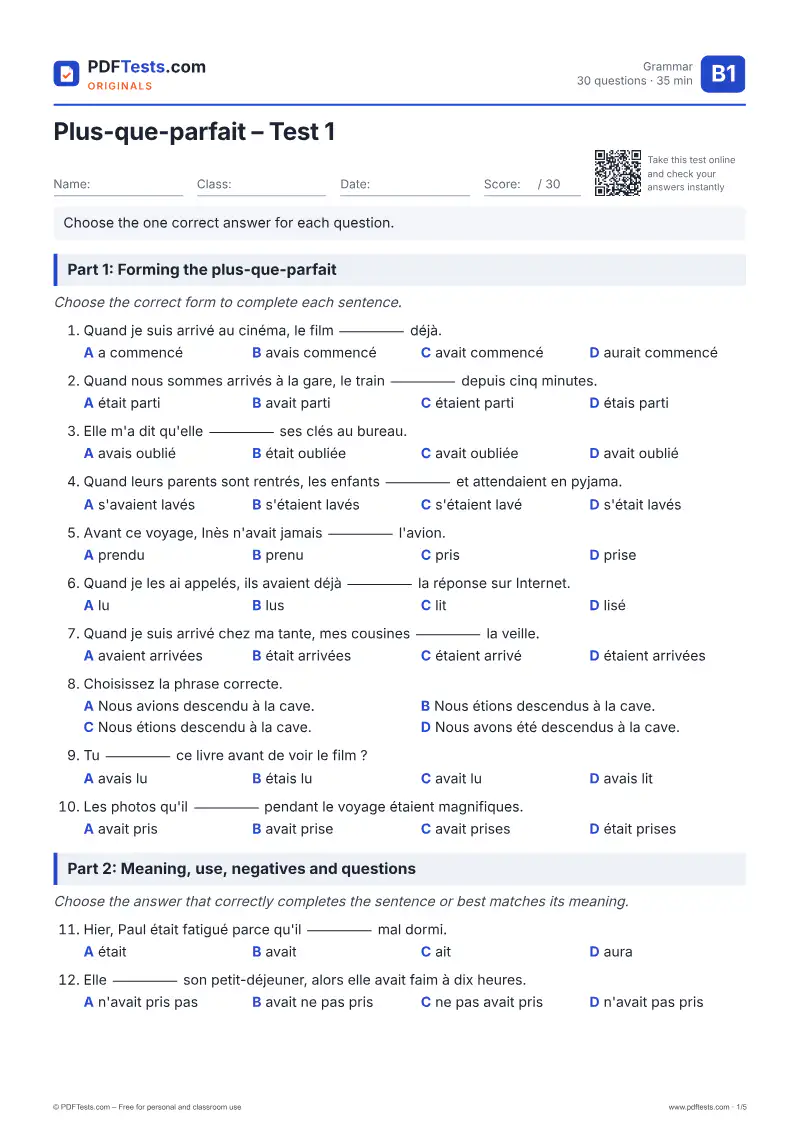
Choose the one correct answer for each question. Choose your answers, then press “Check my answers”.

Part 1: Forming the plus-que-parfait

Choose the correct form to complete each sentence.

  1. Quand je suis arrivé au cinéma, le film _____ déjà.

  2. Quand nous sommes arrivés à la gare, le train _____ depuis cinq minutes.

  3. Elle m'a dit qu'elle _____ ses clés au bureau.

  4. Quand leurs parents sont rentrés, les enfants _____ et attendaient en pyjama.

  5. Avant ce voyage, Inès n'avait jamais _____ l'avion.

  6. Quand je les ai appelés, ils avaient déjà _____ la réponse sur Internet.

  7. Quand je suis arrivé chez ma tante, mes cousines _____ la veille.

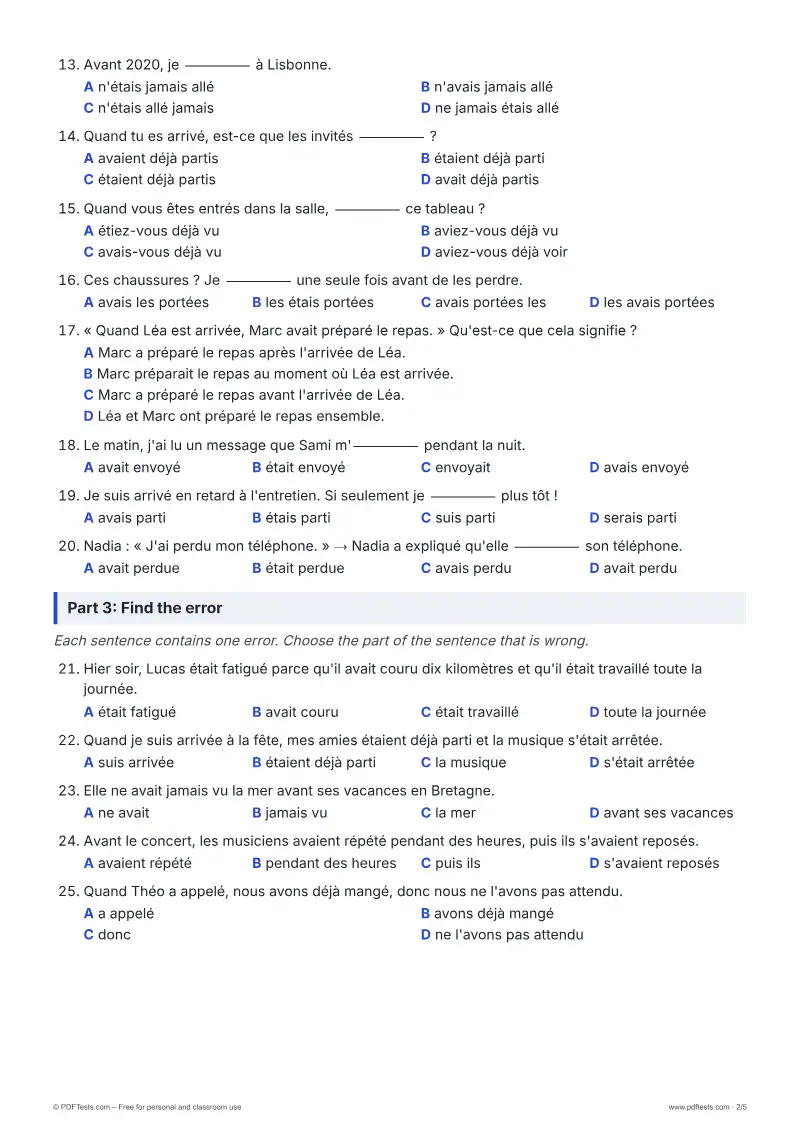
  8. Choisissez la phrase correcte.

  9. Tu _____ ce livre avant de voir le film ?

  10. Les photos qu'il _____ pendant le voyage étaient magnifiques.

Part 2: Meaning, use, negatives and questions

Choose the answer that correctly completes the sentence or best matches its meaning.

  1. Hier, Paul était fatigué parce qu'il _____ mal dormi.

  2. Elle _____ son petit-déjeuner, alors elle avait faim à dix heures.

  3. Avant 2020, je _____ à Lisbonne.

  4. Quand tu es arrivé, est-ce que les invités _____ ?

  5. Quand vous êtes entrés dans la salle, _____ ce tableau ?

  6. Ces chaussures ? Je _____ une seule fois avant de les perdre.

  7. « Quand Léa est arrivée, Marc avait préparé le repas. » Qu'est-ce que cela signifie ?

  8. Le matin, j'ai lu un message que Sami m'_____ pendant la nuit.

  9. Je suis arrivé en retard à l'entretien. Si seulement je _____ plus tôt !

  10. Nadia : « J'ai perdu mon téléphone. » → Nadia a expliqué qu'elle _____ son téléphone.

Part 3: Find the error

Each sentence contains one error. Choose the part of the sentence that is wrong.

  1. Hier soir, Lucas était fatigué parce qu'il avait couru dix kilomètres et qu'il était travaillé toute la journée.

  2. Quand je suis arrivée à la fête, mes amies étaient déjà parti et la musique s'était arrêtée.

  3. Elle ne avait jamais vu la mer avant ses vacances en Bretagne.

  4. Avant le concert, les musiciens avaient répété pendant des heures, puis ils s'avaient reposés.

  5. Quand Théo a appelé, nous avons déjà mangé, donc nous ne l'avons pas attendu.

Part 4: Reading

Read the text and choose the correct answer to each question.

Le jour où Amina a commencé son nouveau travail, rien ne s'est passé comme prévu. La veille, elle avait préparé ses vêtements, elle avait vérifié l'horaire du bus et elle s'était couchée tôt. Pourtant, le matin, son téléphone, qui lui servait de réveil, n'avait pas sonné : elle avait oublié de le recharger.

Quand elle est sortie de chez elle, le bus était déjà passé. Heureusement, sa voisine Clara, qui avait entendu la porte, lui a proposé de l'emmener en voiture. Clara avait travaillé dans la même entreprise quelques années plus tôt, alors elle connaissait bien le chemin.

Amina est arrivée au bureau à neuf heures dix. Elle avait peur, mais sa responsable a souri : elle-même était arrivée en retard le premier jour, dix ans auparavant ! Le soir, Amina a raconté sa journée à son frère. Il a ri et lui a demandé si elle avait pensé à recharger son téléphone cette fois.

  1. Pourquoi le téléphone d'Amina n'a-t-il pas sonné ?

  2. Qu'est-ce qu'Amina avait fait la veille ?

  3. Pourquoi Clara connaissait-elle bien le chemin ?

  4. Dans la phrase « le bus était déjà passé », pourquoi l'auteur utilise-t-il le plus-que-parfait ?

  5. Quelle phrase est vraie selon le texte ?

Preview

About this test

This B1 French grammar test covers the plus-que-parfait (pluperfect): forming it with avoir and être, past participle agreement, and using it to show that one past action happened before another. It also includes negatives, questions, reported speech, regrets with si seulement, error spotting and a short reading text. It suits intermediate learners and teachers who need a ready-made class or homework test.

Topics covered

Plus-que-parfaitAuxiliary choice: avoir or êtrePast participle agreementReflexive verbsNegatives and questionsReported speechSequence of past events

How to use this test

  1. Download the PDF and print it, or take the test online below.
  2. Answer every question without a dictionary or time pressure.
  3. Check your answers and note the topics you need to review.

Notes for teachers

Use this test after introducing the plus-que-parfait alongside the passé composé and imparfait. It targets typical B1 errors: the wrong auxiliary with movement and reflexive verbs, missing agreement, wrong placement of ne…pas and jamais, and the passé composé used where an earlier past action needs the pluperfect. As a follow-up, ask learners to write a short story about a day when nothing went as planned, using at least five verbs in the plus-que-parfait.