PDFTests Originals

Leseverstehen – Test 4

B1 Mittelstufe LeseverstehenEnglisch

Dieser Test zum Leseverstehen auf Niveau B1 enthält drei Originaltexte: eine Anzeige, in der Freiwillige für den Sommer gesucht werden, einen persönlichen Blogbeitrag über ein Leben ohne Smartphone und eine Kurzgeschichte über einen Laufwettkampf. Die 20 Multiple-Choice-Fragen prüfen globales Verstehen, Detailverstehen, Schlussfolgerungen und Wortschatz im Kontext. Der Test eignet sich für Lernende auf mittlerem Niveau, die sich auf B1-Prüfungen vorbereiten, und für Lehrkräfte, die eine fertige Leseüberprüfung suchen.
Fragen
20
Zeit
35 Min.
PDF
5 Seiten
Lösungen
Enthalten
  • 100 % kostenlos
  • Ohne Anmeldung
  • Druckfertiges A4-PDF
Vorschau von Seite 1: Leseverstehen – Test 4 PDF öffnen

Test online machen

Lies jeden Text aufmerksam durch und wähle bei jeder Frage die beste Antwort (A, B, C oder D). Wählen Sie Ihre Antworten und klicken Sie auf „Antworten prüfen“.

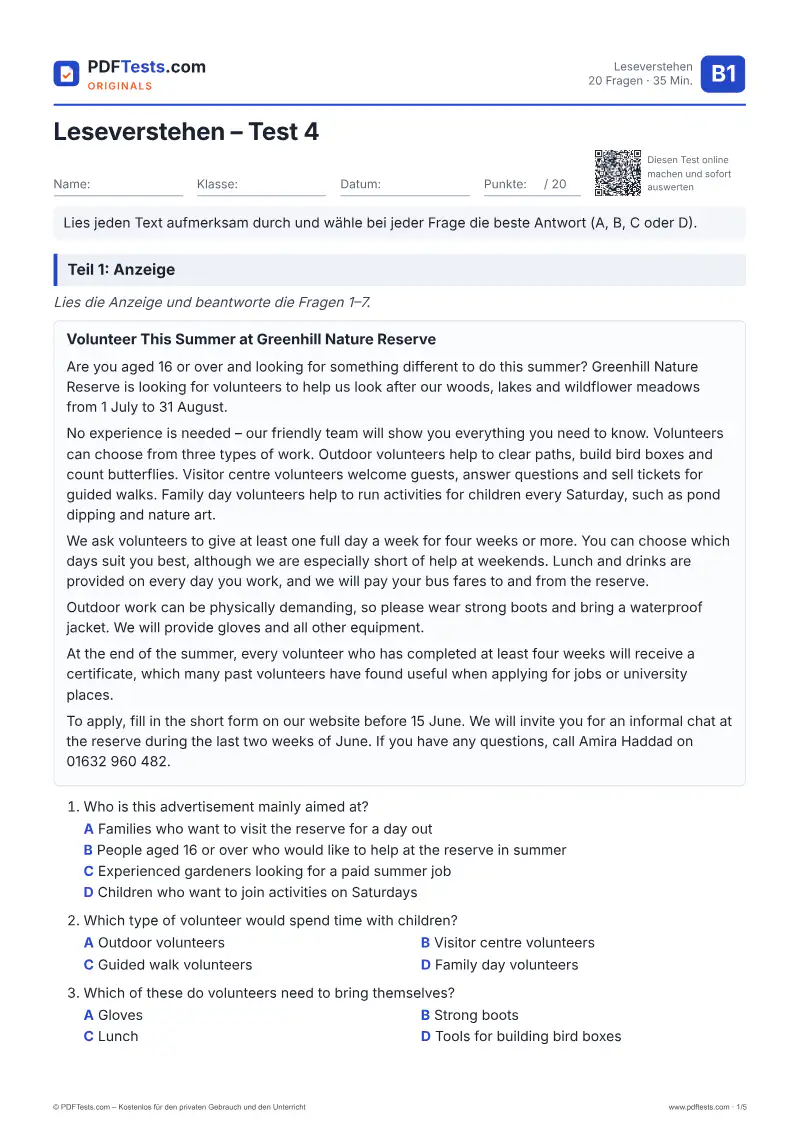
Teil 1: Anzeige

Lies die Anzeige und beantworte die Fragen 1–7.

Volunteer This Summer at Greenhill Nature Reserve

Are you aged 16 or over and looking for something different to do this summer? Greenhill Nature Reserve is looking for volunteers to help us look after our woods, lakes and wildflower meadows from 1 July to 31 August.

No experience is needed – our friendly team will show you everything you need to know. Volunteers can choose from three types of work. Outdoor volunteers help to clear paths, build bird boxes and count butterflies. Visitor centre volunteers welcome guests, answer questions and sell tickets for guided walks. Family day volunteers help to run activities for children every Saturday, such as pond dipping and nature art.

We ask volunteers to give at least one full day a week for four weeks or more. You can choose which days suit you best, although we are especially short of help at weekends. Lunch and drinks are provided on every day you work, and we will pay your bus fares to and from the reserve.

Outdoor work can be physically demanding, so please wear strong boots and bring a waterproof jacket. We will provide gloves and all other equipment.

At the end of the summer, every volunteer who has completed at least four weeks will receive a certificate, which many past volunteers have found useful when applying for jobs or university places.

To apply, fill in the short form on our website before 15 June. We will invite you for an informal chat at the reserve during the last two weeks of June. If you have any questions, call Amira Haddad on 01632 960 482.

  1. Who is this advertisement mainly aimed at?

  2. Which type of volunteer would spend time with children?

  3. Which of these do volunteers need to bring themselves?

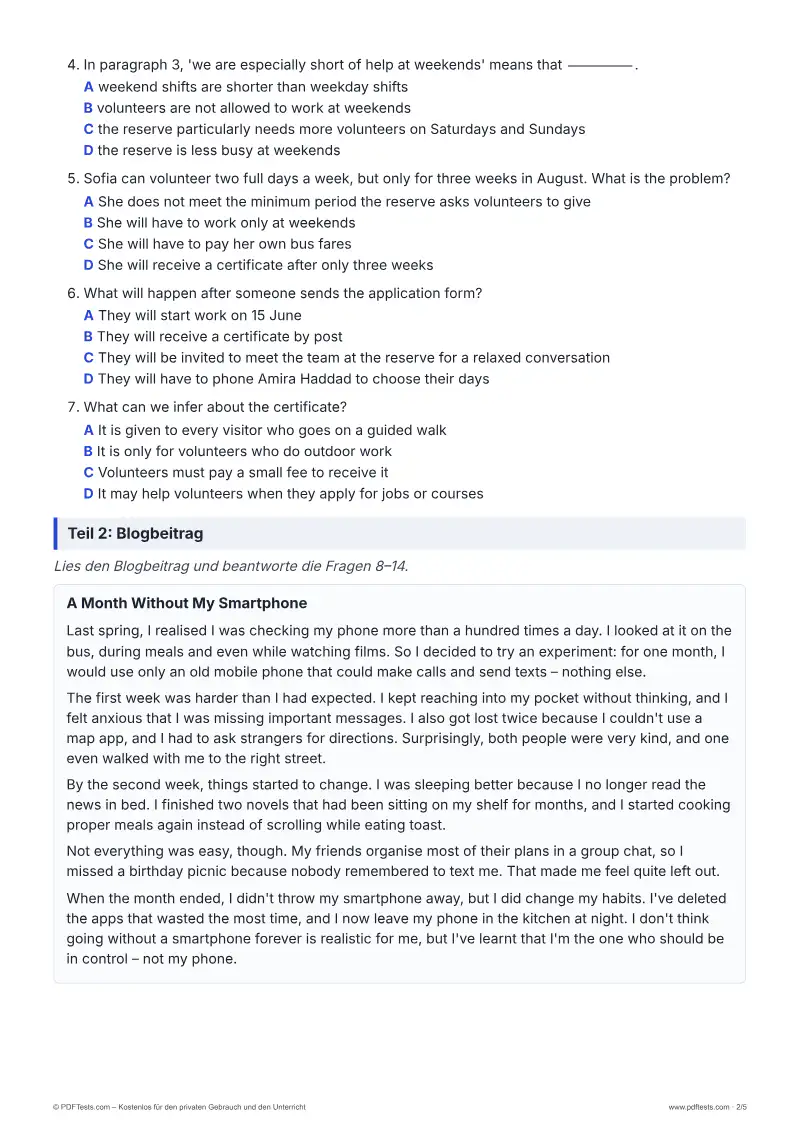
  4. In paragraph 3, 'we are especially short of help at weekends' means that _____.

  5. Sofia can volunteer two full days a week, but only for three weeks in August. What is the problem?

  6. What will happen after someone sends the application form?

  7. What can we infer about the certificate?

Teil 2: Blogbeitrag

Lies den Blogbeitrag und beantworte die Fragen 8–14.

A Month Without My Smartphone

Last spring, I realised I was checking my phone more than a hundred times a day. I looked at it on the bus, during meals and even while watching films. So I decided to try an experiment: for one month, I would use only an old mobile phone that could make calls and send texts – nothing else.

The first week was harder than I had expected. I kept reaching into my pocket without thinking, and I felt anxious that I was missing important messages. I also got lost twice because I couldn't use a map app, and I had to ask strangers for directions. Surprisingly, both people were very kind, and one even walked with me to the right street.

By the second week, things started to change. I was sleeping better because I no longer read the news in bed. I finished two novels that had been sitting on my shelf for months, and I started cooking proper meals again instead of scrolling while eating toast.

Not everything was easy, though. My friends organise most of their plans in a group chat, so I missed a birthday picnic because nobody remembered to text me. That made me feel quite left out.

When the month ended, I didn't throw my smartphone away, but I did change my habits. I've deleted the apps that wasted the most time, and I now leave my phone in the kitchen at night. I don't think going without a smartphone forever is realistic for me, but I've learnt that I'm the one who should be in control – not my phone.

  1. Why did the writer decide to try the experiment?

  2. What happened during the first week?

  3. According to paragraph 3, why was the writer sleeping better?

  4. Why did the writer miss her friend's birthday picnic?

  5. In paragraph 4, 'feel quite left out' is closest in meaning to _____.

  6. What has the writer done since the experiment ended?

  7. What is the writer's main conclusion?

Teil 3: Kurzgeschichte

Lies die Geschichte und beantworte die Fragen 15–20.

The Last Kilometre

Mateo had been training for his first ten-kilometre race for three months. He ran before work three mornings a week, even when it was cold and dark. His goal was simple: to finish in under fifty minutes.

On the day of the race, the weather was perfect. Mateo started carefully, just as his running club had advised, and by the eighth kilometre he was well ahead of his planned time. He began to imagine telling his friends about his result.

Then, as he turned a corner, he saw a runner sitting at the side of the road, holding her ankle. Dozens of people ran past her without stopping. Mateo hesitated for a moment. If he stopped now, he would almost certainly miss his goal. But he couldn't just leave her there.

'Are you all right?' he asked. The woman, whose name was Grace, explained that she had twisted her ankle on a stone. There were no race officials nearby, so Mateo offered his arm, and together they walked slowly towards the finish line.

It took them almost twenty minutes. When they finally crossed the line, the crowd gave them the loudest cheer of the day. Mateo's time was just over an hour.

That evening, his phone wouldn't stop buzzing. Someone had filmed them, and the video had been shared by the race organisers with the words: 'This is what running is really about.' Mateo smiled. He would try for fifty minutes again next year, but he knew this was a race he would remember for much longer.

  1. How was the race going for Mateo before he saw Grace?

  2. Why did Mateo hesitate for a moment?

  3. Why did Mateo help Grace walk to the finish line himself?

  4. In the last paragraph, 'his phone wouldn't stop buzzing' means that Mateo _____.

  5. What does the race organisers' comment suggest?

  6. How does Mateo feel about the race at the end of the story?

War diese Seite hilfreich?

Fehler melden

Falsche Lösung, Tippfehler oder unklare Erklärung? Schreiben Sie uns, wir korrigieren es.

Vorschau

Über diesen Test

Dieser Test zum Leseverstehen auf Niveau B1 enthält drei Originaltexte: eine Anzeige, in der Freiwillige für den Sommer gesucht werden, einen persönlichen Blogbeitrag über ein Leben ohne Smartphone und eine Kurzgeschichte über einen Laufwettkampf. Die 20 Multiple-Choice-Fragen prüfen globales Verstehen, Detailverstehen, Schlussfolgerungen und Wortschatz im Kontext. Der Test eignet sich für Lernende auf mittlerem Niveau, die sich auf B1-Prüfungen vorbereiten, und für Lehrkräfte, die eine fertige Leseüberprüfung suchen.

Themen

GlobalverstehenDetailverstehenSchlussfolgerungen ziehenWortschatz im KontextAnzeigenBlogbeiträgeKurzgeschichten

So nutzen Sie diesen Test

  1. Laden Sie das PDF herunter und drucken Sie es aus – oder machen Sie den Test unten online.
  2. Beantworten Sie alle Fragen ohne Wörterbuch und ohne Zeitdruck.
  3. Prüfen Sie Ihre Antworten und notieren Sie, was Sie wiederholen sollten.

Hinweise für Lehrkräfte

Planen Sie etwa 35 Minuten ein oder setzen Sie pro Stunde einen Text als Einstieg ein. Viele Fragen zielen auf typische Fehler auf B1-Niveau ab: Lernende wählen eine Option, die Wörter aus dem Text wiederholt, aber die Bedeutung verändert, oder sie verwechseln, was der Autor ausdrücklich sagt, mit dem, was sich daraus ableiten lässt. Lassen Sie die Lernenden nach dem Test im Text genau die Wörter unterstreichen, die jede Antwort belegen. Als Anschlussaufgabe können sie einen eigenen kurzen Blogbeitrag darüber schreiben, wie sie eine Alltagsgewohnheit verändert haben.