PDFTests Originals

Leseverstehen – Test 1

B1 Mittelstufe LeseverstehenEnglisch

Dieser Test zum Leseverstehen auf Niveau B1 enthält drei Originaltexte unterschiedlicher Textsorten: eine persönliche E-Mail, einen Zeitschriftenartikel und eine Kurzgeschichte. Die 20 Multiple-Choice-Fragen prüfen, ob die Hauptaussage, wichtige Einzelheiten, Schlussfolgerungen und Wortbedeutungen im Kontext verstanden werden. Der Test eignet sich für Lernende auf mittlerem Niveau, die sich auf B1-Prüfungen vorbereiten, und für Lehrkräfte, die eine druckfertige Lernzielkontrolle zum Leseverstehen suchen.
Fragen
20
Zeit
35 Min.
PDF
5 Seiten
Lösungen
Enthalten
  • 100 % kostenlos
  • Ohne Anmeldung
  • Druckfertiges A4-PDF
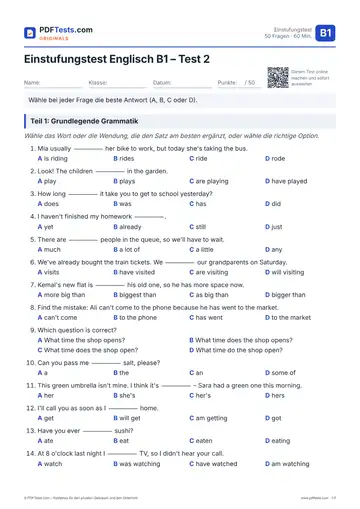
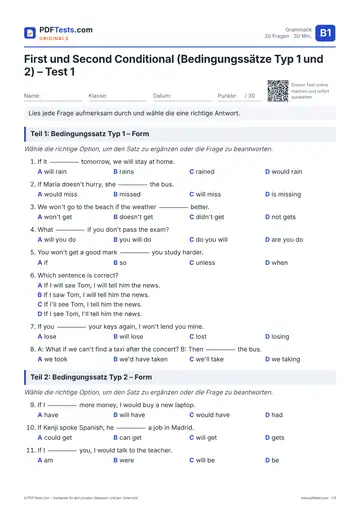
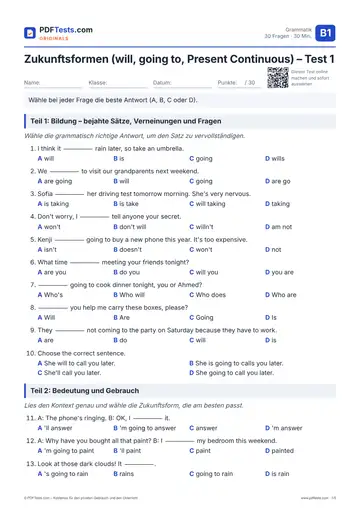
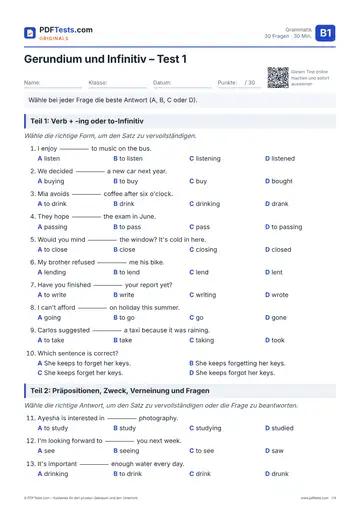
Vorschau von Seite 1: Leseverstehen – Test 1 PDF öffnen

Test online machen

Lies jeden Text aufmerksam durch und wähle für jede Frage die beste Antwort (A, B, C oder D). Wählen Sie Ihre Antworten und klicken Sie auf „Antworten prüfen“.

Teil 1: Eine E-Mail

Lies die E-Mail von Lucia an ihren Freund Tom und beantworte die Fragen 1–7.

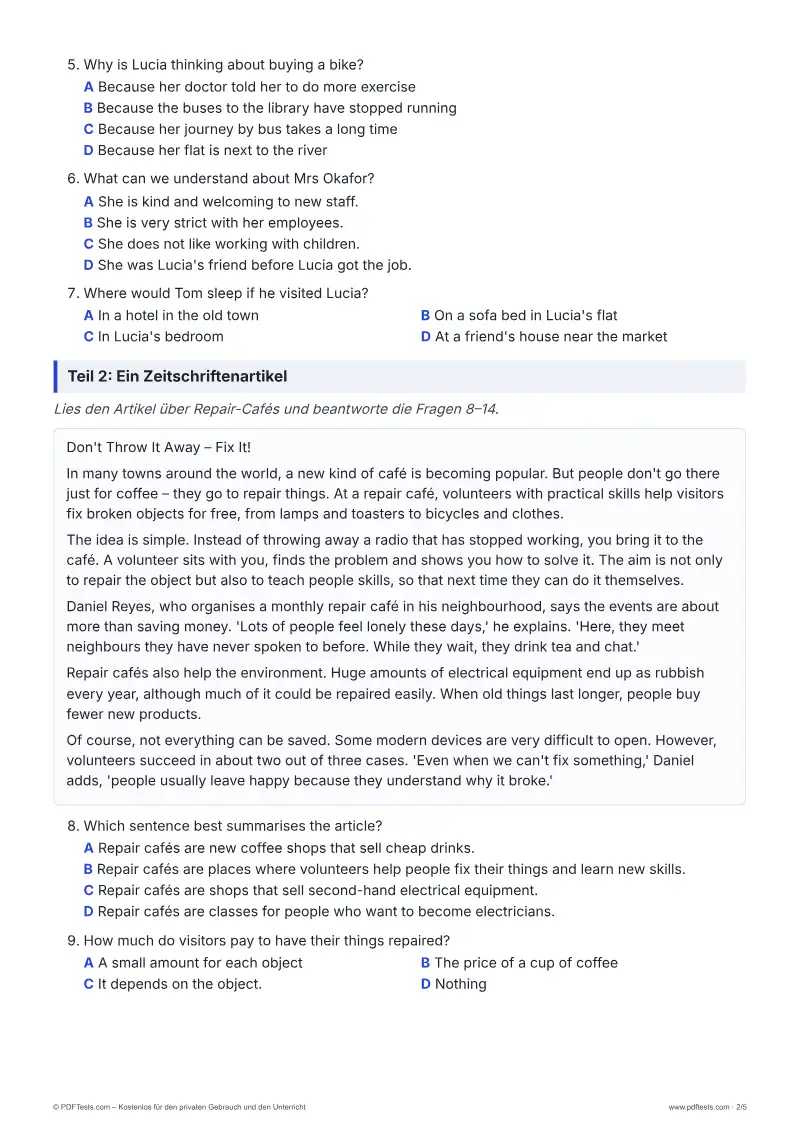
Hi Tom,

I'm sorry I haven't written for so long, but the last few weeks have been really busy. As you know, I started my new job at the city library at the beginning of March. I was quite nervous on my first day because I didn't know anyone, but my colleagues have been very friendly and patient with me. My manager, Mrs Okafor, even took me out for lunch at the end of my first week.

The work is more varied than I expected. In the mornings I usually help visitors find books or use the computers, and in the afternoons I organise activities for children. Last Saturday we had a storytelling event, and nearly forty kids came! It was noisy, but I loved it.

The only real problem is the journey. The library is on the other side of the city, so I have to take two buses, and it often takes more than an hour. I'm thinking about buying a bike when the weather gets warmer, because there's a cycle path along the river that goes almost all the way there.

Anyway, I'd love to see you soon. Are you free on the weekend of the 20th? My new flat is small, but there's a sofa bed, so you could stay with me. We could visit the old town and try the market I told you about.

Write back when you can!

Love,

Lucia

  1. What is the main purpose of Lucia's email?

  2. How did Lucia feel on her first day at work?

  3. What does Lucia usually do in the afternoons?

  4. In paragraph 2, the word 'varied' is closest in meaning to _____.

  5. Why is Lucia thinking about buying a bike?

  6. What can we understand about Mrs Okafor?

  7. Where would Tom sleep if he visited Lucia?

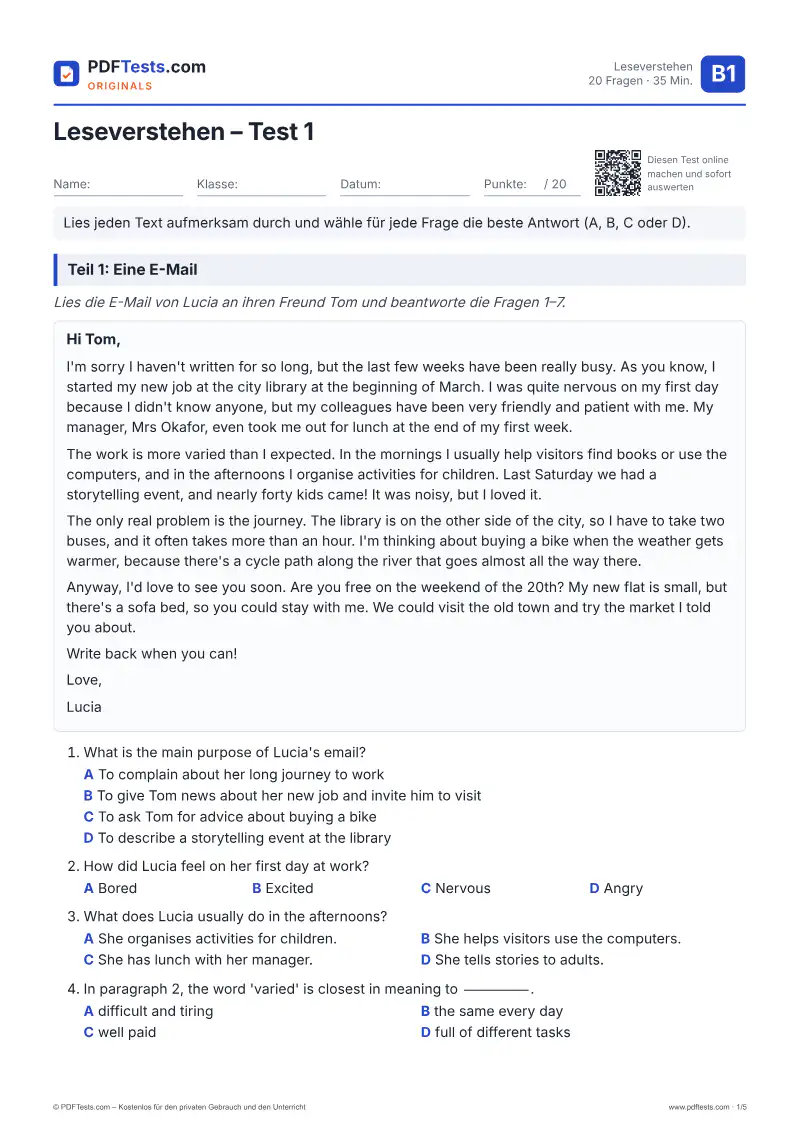
Teil 2: Ein Zeitschriftenartikel

Lies den Artikel über Repair-Cafés und beantworte die Fragen 8–14.

Don't Throw It Away – Fix It!

In many towns around the world, a new kind of café is becoming popular. But people don't go there just for coffee – they go to repair things. At a repair café, volunteers with practical skills help visitors fix broken objects for free, from lamps and toasters to bicycles and clothes.

The idea is simple. Instead of throwing away a radio that has stopped working, you bring it to the café. A volunteer sits with you, finds the problem and shows you how to solve it. The aim is not only to repair the object but also to teach people skills, so that next time they can do it themselves.

Daniel Reyes, who organises a monthly repair café in his neighbourhood, says the events are about more than saving money. 'Lots of people feel lonely these days,' he explains. 'Here, they meet neighbours they have never spoken to before. While they wait, they drink tea and chat.'

Repair cafés also help the environment. Huge amounts of electrical equipment end up as rubbish every year, although much of it could be repaired easily. When old things last longer, people buy fewer new products.

Of course, not everything can be saved. Some modern devices are very difficult to open. However, volunteers succeed in about two out of three cases. 'Even when we can't fix something,' Daniel adds, 'people usually leave happy because they understand why it broke.'

  1. Which sentence best summarises the article?

  2. How much do visitors pay to have their things repaired?

  3. Apart from repairing objects, what is the other aim of repair cafés?

  4. According to Daniel Reyes, what is one social benefit of repair cafés?

  5. In paragraph 4, 'end up as rubbish' means that the equipment _____.

  6. What can we infer about the objects that people bring to repair cafés?

  7. Why are visitors usually happy even when their object cannot be fixed?

Teil 3: Eine Kurzgeschichte

Lies die Geschichte und beantworte die Fragen 15–20.

The Wrong Song

Priya had practised for weeks. Every evening after dinner, she sat on her bed with her guitar and played the same two songs until her fingers hurt. Tonight was the open-mic night at the little café on Green Street, and she had finally agreed to perform.

When she arrived, the café was fuller than she had imagined. Her best friend, Sam, waved from a table near the front and gave her a thumbs-up. Priya tried to smile, but her hands were shaking.

'Next, please welcome Priya!' the host announced.

She walked to the small stage, sat down and began to play. After a few notes, her heart sank. In her panic she had started the slow song, not the cheerful one she had planned to open with. For a moment she thought about stopping and starting again. Then she remembered what her music teacher always said: 'If you make a mistake, keep going. The audience doesn't know your plan.'

So she kept going. Slowly, the room became quiet. People put down their cups and listened. When she finished, there was a short silence, and then everyone began to clap loudly.

Afterwards, Sam hugged her. 'That was beautiful,' he said. 'Why were you so worried?'

Priya laughed. 'Because that wasn't the song I meant to play first!'

An older woman at the next table leaned over. 'Well, I'm glad you did,' she said. 'It was perfect for tonight.'

  1. How did Priya prepare for the open-mic night?

  2. How did Priya feel when she arrived at the café?

  3. What mistake did Priya make?

  4. In paragraph 4, 'her heart sank' means that Priya _____.

  5. Why did Priya continue playing instead of starting again?

  6. What does the story suggest about the audience's reaction to Priya's song?

Vorschau

Über diesen Test

Dieser Test zum Leseverstehen auf Niveau B1 enthält drei Originaltexte unterschiedlicher Textsorten: eine persönliche E-Mail, einen Zeitschriftenartikel und eine Kurzgeschichte. Die 20 Multiple-Choice-Fragen prüfen, ob die Hauptaussage, wichtige Einzelheiten, Schlussfolgerungen und Wortbedeutungen im Kontext verstanden werden. Der Test eignet sich für Lernende auf mittlerem Niveau, die sich auf B1-Prüfungen vorbereiten, und für Lehrkräfte, die eine druckfertige Lernzielkontrolle zum Leseverstehen suchen.

Themen

GlobalverstehenDetailverstehenSchlussfolgerungen ziehen (Inference)Wortschatz im KontextPersönliche E-MailZeitschriftenartikelKurzgeschichte

So nutzen Sie diesen Test

  1. Laden Sie das PDF herunter und drucken Sie es aus – oder machen Sie den Test unten online.
  2. Beantworten Sie alle Fragen ohne Wörterbuch und ohne Zeitdruck.
  3. Prüfen Sie Ihre Antworten und notieren Sie, was Sie wiederholen sollten.

Hinweise für Lehrkräfte

Planen Sie etwa 35 Minuten ein und ermutigen Sie die Lernenden, jeden Text zunächst einmal global zu lesen, bevor sie die Fragen beantworten. Die Distraktoren zielen auf typische Schwierigkeiten auf B1-Niveau: eine Antwort zu wählen, nur weil sie Wörter aus dem Text wiederholt, Einzelheiten aus verschiedenen Absätzen zu verwechseln und Redewendungen wie 'her heart sank' wörtlich zu verstehen. Als Anschlussaufgabe können die Lernenden eine Antwort auf Lucias E-Mail schreiben oder Priyas Geschichte aus Sams Sicht nacherzählen.