PDFTests Originals

Einstufungstest Englisch B1 (ESL Placement) – Test 2

B1 Mittelstufe EinstufungstestEnglisch

Mit diesem Übungstest zur Einstufung auf Niveau B1 lässt sich prüfen, ob erwachsene Lernende und Studierende das mittlere Niveau sicher beherrschen. Er umfasst Satzbedeutung, zentrale B1-Grammatik und zwei kurze Lesetexte über den Alltag in den USA. Der Test eignet sich zur Vorbereitung auf einen ESL-Einstufungstest an einem College oder in der Erwachsenenbildung und für Lehrkräfte, die schnell das Niveau ihrer Gruppe einschätzen möchten.
Fragen
36
Zeit
45 Min.
PDF
7 Seiten
Lösungen
Enthalten
  • 100 % kostenlos
  • Ohne Anmeldung
  • Druckfertiges A4-PDF
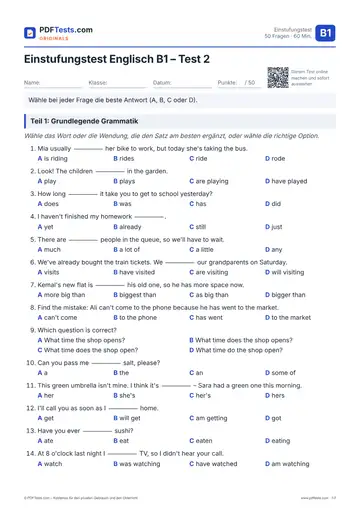
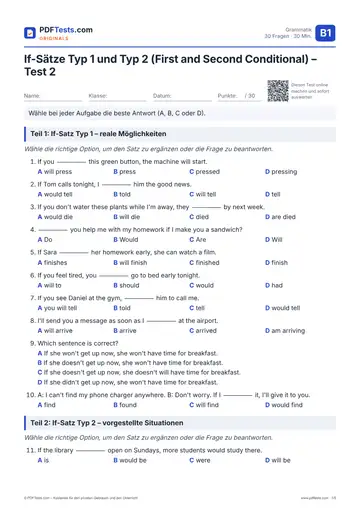
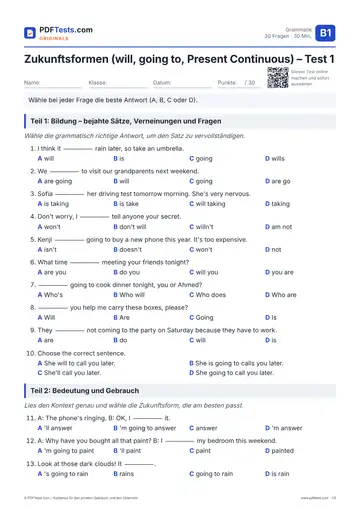
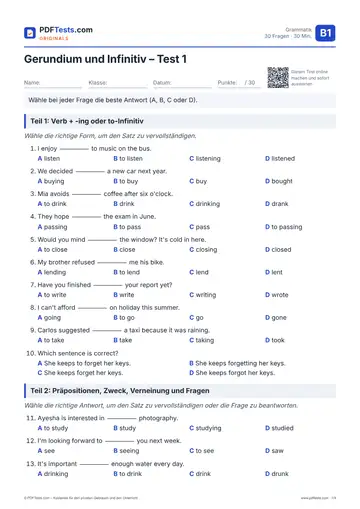
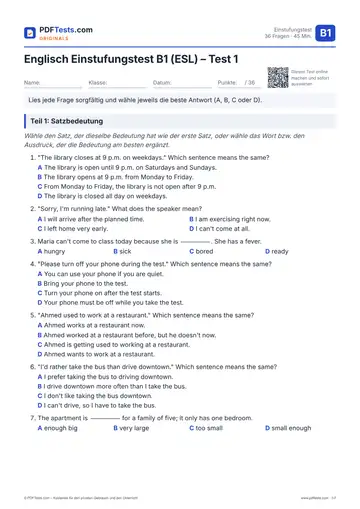
Vorschau von Seite 1: Einstufungstest Englisch B1 (ESL Placement) – Test 2 PDF öffnen
ESL-Einstufungstest · alle Übungstests, Niveaus und Tipps

Test online machen

Lies jede Frage sorgfältig und wähle die beste Antwort (A, B, C oder D). Wählen Sie Ihre Antworten und klicken Sie auf „Antworten prüfen“.

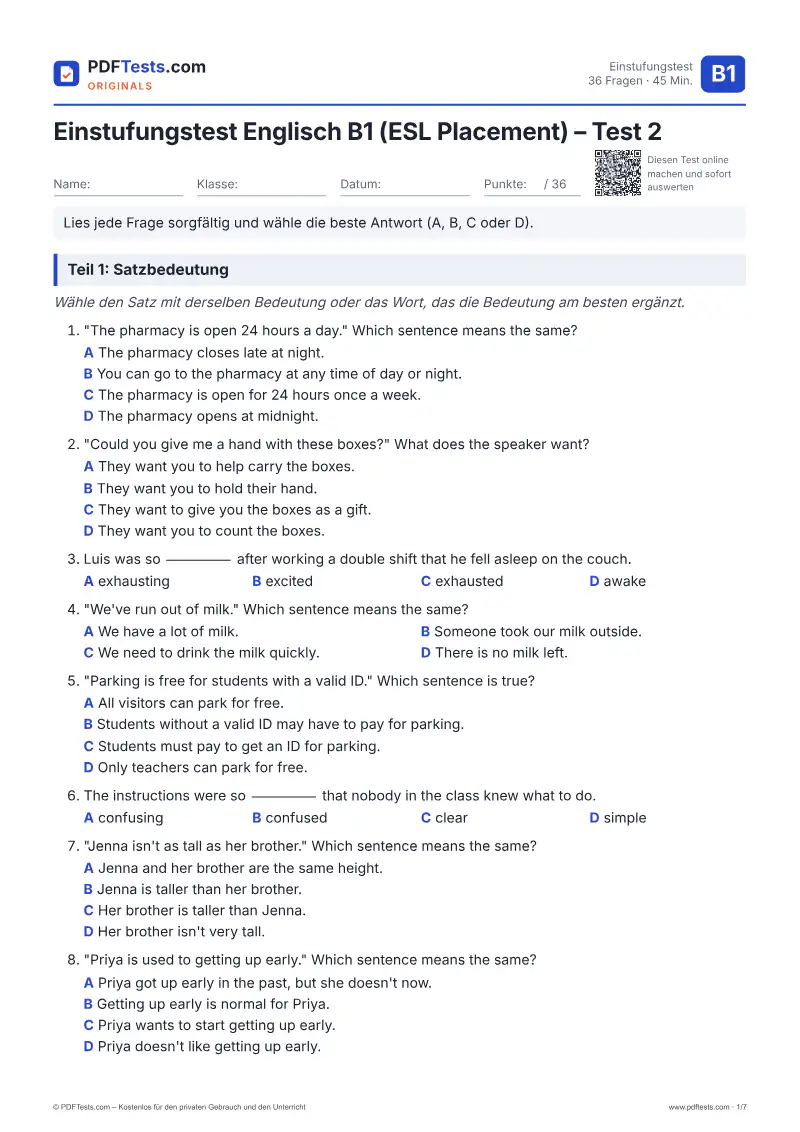
Teil 1: Satzbedeutung

Wähle den Satz mit derselben Bedeutung oder das Wort, das die Bedeutung am besten ergänzt.

  1. "The pharmacy is open 24 hours a day." Which sentence means the same?

  2. "Could you give me a hand with these boxes?" What does the speaker want?

  3. Luis was so _____ after working a double shift that he fell asleep on the couch.

  4. "We've run out of milk." Which sentence means the same?

  5. "Parking is free for students with a valid ID." Which sentence is true?

  6. The instructions were so _____ that nobody in the class knew what to do.

  7. "Jenna isn't as tall as her brother." Which sentence means the same?

  8. "Priya is used to getting up early." Which sentence means the same?

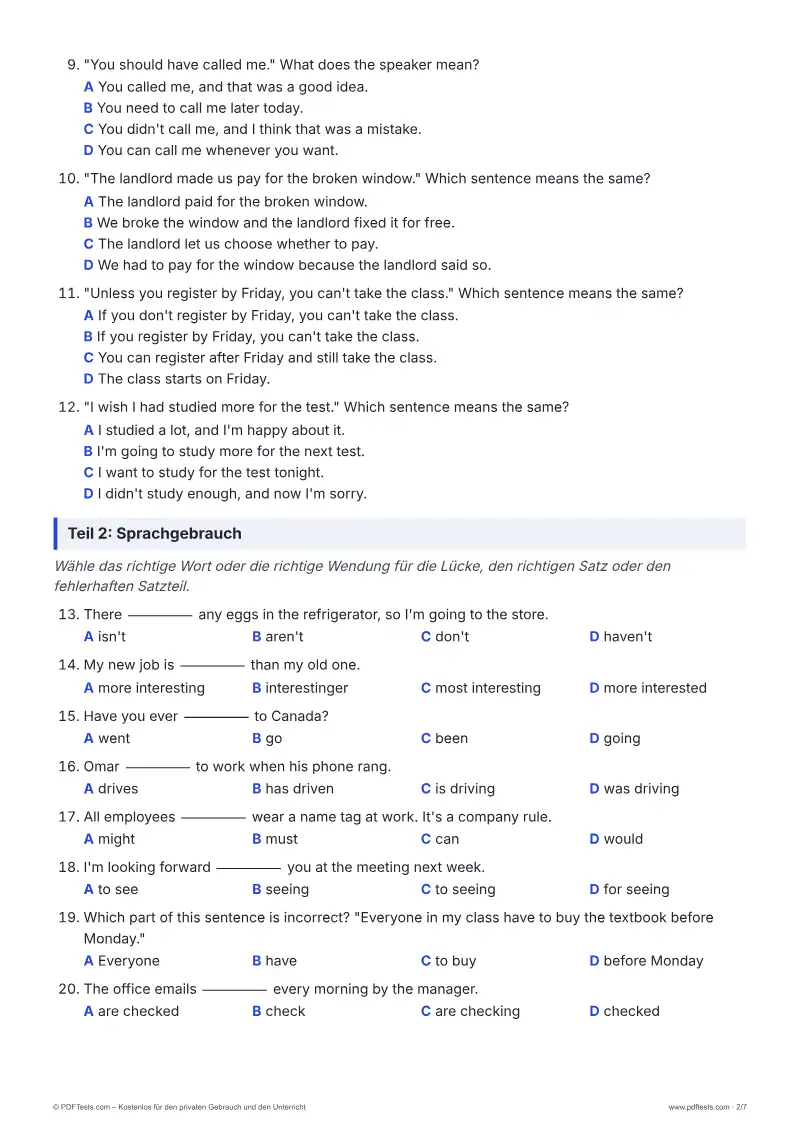
  9. "You should have called me." What does the speaker mean?

  10. "The landlord made us pay for the broken window." Which sentence means the same?

  11. "Unless you register by Friday, you can't take the class." Which sentence means the same?

  12. "I wish I had studied more for the test." Which sentence means the same?

Teil 2: Sprachgebrauch

Wähle das richtige Wort oder die richtige Wendung für die Lücke, den richtigen Satz oder den fehlerhaften Satzteil.

  1. There _____ any eggs in the refrigerator, so I'm going to the store.

  2. My new job is _____ than my old one.

  3. Have you ever _____ to Canada?

  4. Omar _____ to work when his phone rang.

  5. All employees _____ wear a name tag at work. It's a company rule.

  6. I'm looking forward _____ you at the meeting next week.

  7. Which part of this sentence is incorrect? "Everyone in my class have to buy the textbook before Monday."

  8. The office emails _____ every morning by the manager.

  9. If I _____ you, I would talk to your manager about the schedule.

  10. This is the restaurant _____ we had our first date.

  11. Sam told me that he _____ his new job the day before.

  12. Which sentence is correct?

Teil 3: Lesen – Aushang im Wohnhaus

Lies den Aushang und beantworte die Fragen.

NOTICE TO ALL RESIDENTS – MAPLE COURT APARTMENTS

Dear Residents,

On Wednesday, October 16, the city will repair a water pipe under Elm Street. Because of this work, there will be no water in the building from 9:00 a.m. to 3:00 p.m. Please fill some bottles with water the night before, and do not use dishwashers or washing machines during this time.

The laundry room will also be closed all day on Wednesday so that our maintenance team can clean the machines. It will open again on Thursday at 7:00 a.m. We are sorry for any inconvenience.

We would also like to remind you that the parking lot will be repainted on Saturday, October 19. All cars must be moved to the street by 8:00 a.m. Cars that are still in the lot will be towed at the owner's expense.

If you have any questions, please call the management office at (555) 014-2290, Monday through Friday, 8:30 a.m. to 5:00 p.m., or leave a note in the box next to the mailboxes.

Thank you,

Gloria Mendez, Building Manager

  1. Why will there be no water in the building on Wednesday?

  2. What does the manager ask residents to do the night before the water is turned off?

  3. When can residents use the laundry room again?

  4. A car is still in the parking lot at 9:00 a.m. on Saturday. What will probably happen?

  5. In the sentence "Cars that are still in the lot will be towed at the owner's expense," the phrase "at the owner's expense" means:

  6. A resident has a question on Sunday. What can they do?

Teil 4: Lesen – Eine neue Autofahrerin

Lies den Text und beantworte die Fragen.

When Rosa Delgado moved to Phoenix with her two children, she quickly learned that life without a car was difficult. The bus stop was a twenty-minute walk from her apartment, and in summer the temperature often reached 110 degrees. Getting to her job at a medical office and taking the kids to school took hours every day.

Rosa had driven a little in her home country, but she had never had a license. In Arizona, she first needed to pass a written test about traffic laws. The test was available in Spanish, but Rosa decided to take it in English. "I wanted to understand the road signs, and the police if they ever stopped me," she explains. Every night after the children went to bed, she studied the driver's manual with a dictionary next to her. She failed the written test the first time by just two questions, but she passed easily three weeks later.

The driving test was harder. A coworker, Mei, offered to let Rosa practice in her car on Sunday mornings, when the streets were quiet. Mei was patient, but she also told Rosa honestly when she made mistakes, especially with parking. After two months of practice, Rosa passed the road test on her first try.

Today Rosa drives to work in fifteen minutes. She has also started giving rides to two neighbors who don't have cars. "Someone helped me, so now I help other people," she says. "And my English got better, too. I never expected that from a driving test."

  1. Why was life difficult for Rosa when she first arrived in Phoenix?

  2. Why did Rosa decide to take the written test in English?

  3. What happened the first time Rosa took the written test?

  4. Why did Rosa and Mei practice on Sunday mornings?

  5. What can we infer about Mei?

  6. Which title best fits the text?

War diese Seite hilfreich?

Fehler melden

Falsche Lösung, Tippfehler oder unklare Erklärung? Schreiben Sie uns, wir korrigieren es.

Vorschau

Über diesen Test

Mit diesem Übungstest zur Einstufung auf Niveau B1 lässt sich prüfen, ob erwachsene Lernende und Studierende das mittlere Niveau sicher beherrschen. Er umfasst Satzbedeutung, zentrale B1-Grammatik und zwei kurze Lesetexte über den Alltag in den USA. Der Test eignet sich zur Vorbereitung auf einen ESL-Einstufungstest an einem College oder in der Erwachsenenbildung und für Lehrkräfte, die schnell das Niveau ihrer Gruppe einschätzen möchten.

Themen

SatzbedeutungWortschatz im KontextZeitformenModalverben und Bedingungssätze (Conditionals)Passiv und indirekte Rede (Reported Speech)Gerundium und Infinitiv (Gerunds and Infinitives)Leseverstehen

So nutzen Sie diesen Test

  1. Laden Sie das PDF herunter und drucken Sie es aus – oder machen Sie den Test unten online.
  2. Beantworten Sie alle Fragen ohne Wörterbuch und ohne Zeitdruck.
  3. Prüfen Sie Ihre Antworten und notieren Sie, was Sie wiederholen sollten.

Hinweise für Lehrkräfte

Planen Sie etwa 45 Minuten ohne Wörterbuch ein. Ab 29 von 36 Punkten beherrschen die Lernenden B1 sicher; bei 20–28 Punkten arbeiten sie auf B1-Niveau, brauchen aber noch Übung; unter 20 Punkten ist eine Einstufung auf A2 sinnvoll. Die Aufgaben zielen auf typische Fehler, etwa die Verwechslung von „used to“ und „be used to“, die Kongruenz von Subjekt und Verb bei „everyone“, „look forward to + -ing“ sowie das Past Perfect in der indirekten Rede. Als Anschlussaufgabe können die Lernenden die falschen Antwortoptionen in Teil 2 korrigieren und begründen, warum sie falsch sind.