PDFTests Originals

Leseverstehen – Test 4

B2 Gute Mittelstufe LeseverstehenEnglisch

Dieser Test zum Leseverstehen auf Niveau B2 enthält drei Originaltexte: einen Zeitschriftenartikel über das Mitschreiben, eine formelle Beschwerde-E-Mail und eine kurze literarische Erzählung. Die 20 Multiple-Choice-Fragen prüfen globales Verstehen, Detailverstehen, das Erschließen impliziter Informationen und Wortschatz im Kontext. Der Test eignet sich für Lernende der oberen Mittelstufe, die sich auf B2-Prüfungen vorbereiten, und für Lehrkräfte, die eine fertige Lernzielkontrolle zum Ausdrucken suchen.
Fragen
20
Zeit
40 Min.
PDF
7 Seiten
Lösungen
Enthalten
  • 100 % kostenlos
  • Ohne Anmeldung
  • Druckfertiges A4-PDF
Vorschau von Seite 1: Leseverstehen – Test 4 PDF öffnen

Test online machen

Lies jeden Text aufmerksam und wähle für jede Frage die beste Antwort (A, B, C oder D). Wählen Sie Ihre Antworten und klicken Sie auf „Antworten prüfen“.

Teil 1: Zeitschriftenartikel

Lies den Artikel über das Mitschreiben und beantworte die Fragen 1–7.

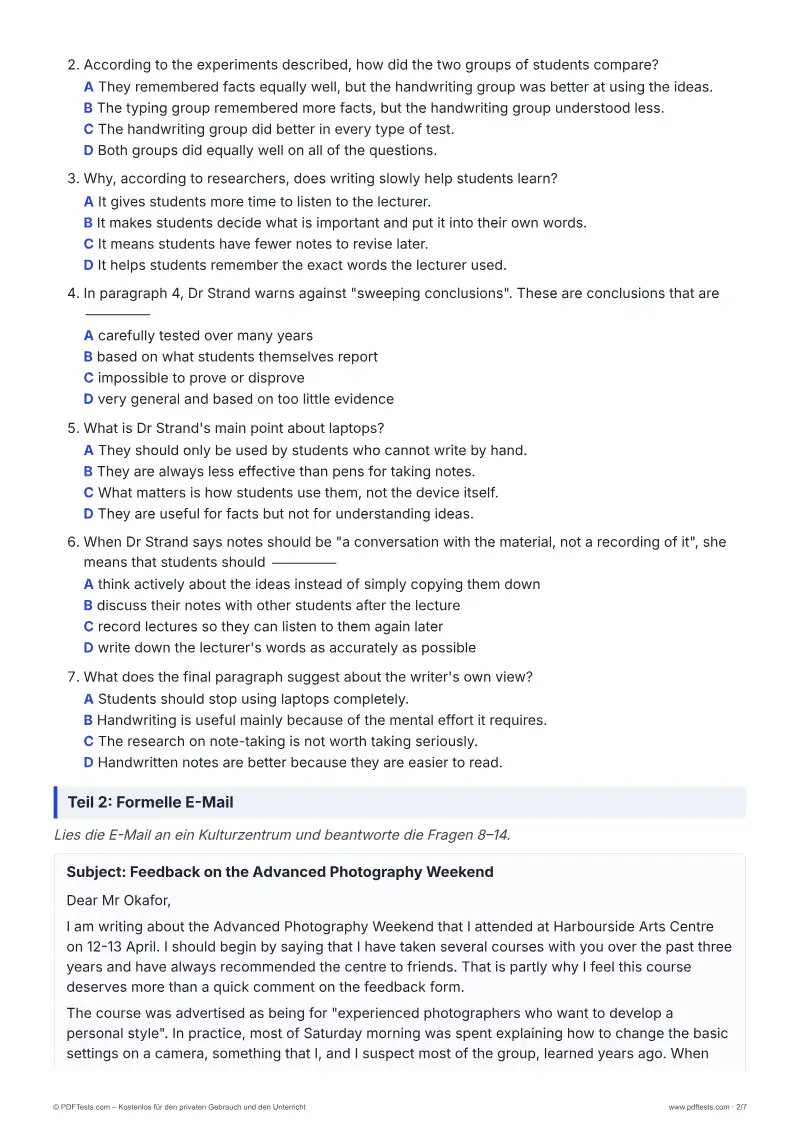
Pen versus Keyboard: Why Your Notes Might Be Holding You Back

Walk into any university lecture hall and you will see rows of glowing screens. Most students now type their notes, and it is easy to see why. Typing is faster, the notes are neat and searchable, and nothing gets lost in a pile of paper. Yet a growing body of research suggests that this speed may come at a price.

In a series of experiments, psychologists asked two groups of students to watch the same recorded talks. One group took notes on laptops and the other by hand. Shortly afterwards, both groups were tested on simple facts, and they performed similarly. But when they were asked questions that required them to apply ideas or compare concepts, the handwriting group did noticeably better.

The explanation, researchers believe, lies in what happens when we cannot keep up. Most people write far more slowly than a lecturer speaks, so a student with a pen is forced to make choices. What is essential? What can be left out? How can a long explanation be squeezed into a few words? This constant filtering means the material is processed as it is recorded. Typists, by contrast, tend to capture lectures almost word for word, acting more like transcription machines than active listeners.

Not everyone is convinced. Dr Helena Strand, who studies learning technology, argues that the problem may be the habit rather than the tool. "Students who type can be trained to summarise rather than copy," she says. "And for learners with conditions that make handwriting painful or slow, a keyboard is not a luxury but a necessity." She also warns against drawing sweeping conclusions from studies that often last only a single afternoon.

What, then, should students do? Strand's advice is practical. Whatever the method, notes should be a conversation with the material, not a recording of it. That might mean pausing to write a question in the margin, sketching a quick diagram, or closing the laptop for the last five minutes of a lecture to jot down the three main points from memory. The pen, it seems, is not magic. But the thinking it forces upon us might be.

  1. Which question is the article mainly trying to answer?

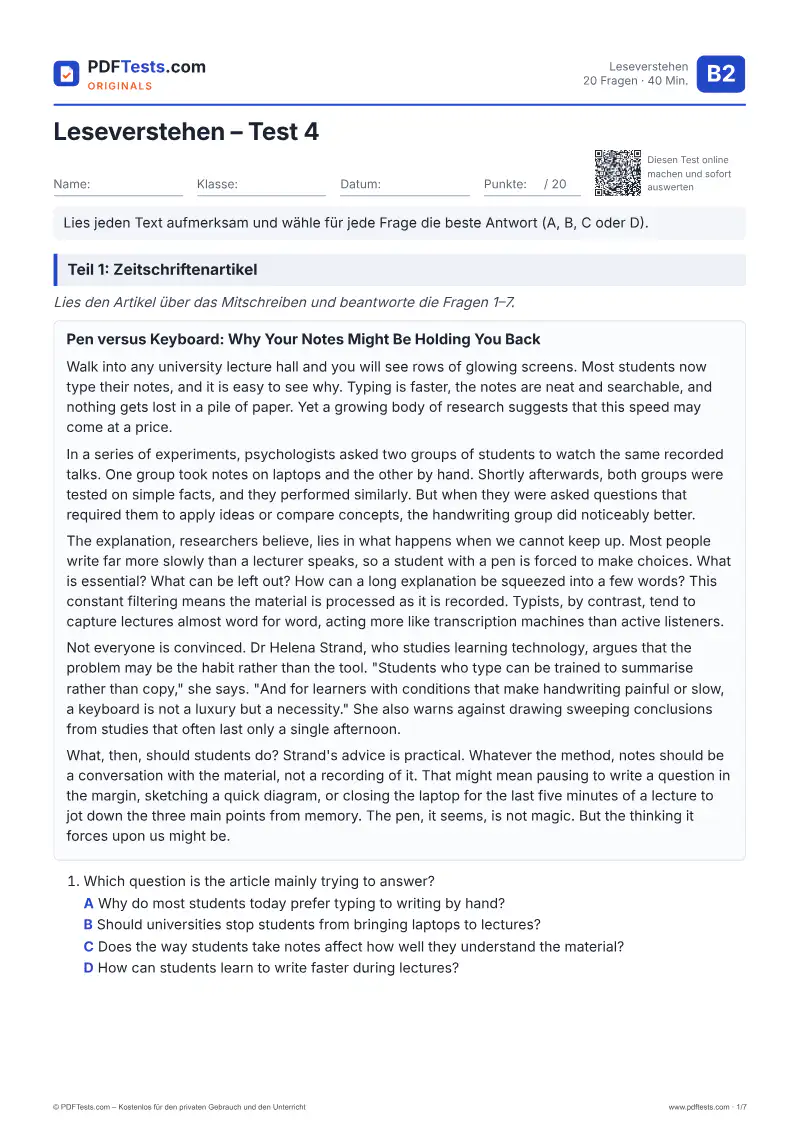
  2. According to the experiments described, how did the two groups of students compare?

  3. Why, according to researchers, does writing slowly help students learn?

  4. In paragraph 4, Dr Strand warns against "sweeping conclusions". These are conclusions that are _____

  5. What is Dr Strand's main point about laptops?

  6. When Dr Strand says notes should be "a conversation with the material, not a recording of it", she means that students should _____

  7. What does the final paragraph suggest about the writer's own view?

Teil 2: Formelle E-Mail

Lies die E-Mail an ein Kulturzentrum und beantworte die Fragen 8–14.

Subject: Feedback on the Advanced Photography Weekend

Dear Mr Okafor,

I am writing about the Advanced Photography Weekend that I attended at Harbourside Arts Centre on 12-13 April. I should begin by saying that I have taken several courses with you over the past three years and have always recommended the centre to friends. That is partly why I feel this course deserves more than a quick comment on the feedback form.

The course was advertised as being for "experienced photographers who want to develop a personal style". In practice, most of Saturday morning was spent explaining how to change the basic settings on a camera, something that I, and I suspect most of the group, learned years ago. When two participants politely asked whether we could move on, the tutor agreed, but then returned to the same basics after lunch. I understand that groups are rarely perfectly matched, but the course description set clear expectations which were not met.

Sunday was a different story. The outdoor session at the old docks was genuinely inspiring, and the individual feedback on our portfolios was thoughtful and honest. Had the whole weekend been like this, I would be writing to thank you.

I would also like to mention a practical issue. The joining instructions stated that lunch would be provided, so many of us brought nothing with us. On Saturday, the sandwiches ran out before the second half of the group had been served, and several people had to leave the building to find food, missing the start of the afternoon session.

I am not asking for a full refund, as I did gain something from the course. However, I would appreciate either a partial refund or a credit towards a future course. More importantly, I would suggest that participants complete a short questionnaire about their experience before a course begins, so that tutors can plan accordingly.

I look forward to hearing from you.

Yours sincerely,

Farida Haddad

  1. Why does Farida mention that she has taken several courses at the centre before?

  2. What was Farida's main problem with Saturday morning?

  3. What can be inferred about the tutor on Saturday?

  4. In paragraph 3, "Sunday was a different story" means that Sunday _____

  5. What happened at lunchtime on Saturday?

  6. Which outcome would Farida be satisfied with?

  7. Why does Farida suggest a questionnaire before courses begin?

Teil 3: Kurzgeschichte

Lies die Geschichte und beantworte die Fragen 15–20.

Tomasz had tuned pianos in schools, concert halls and, once, on a ferry, but he had never been asked to tune one that nobody played.

"It was my husband's," Mrs Adeyemi explained, leading him into a front room where the curtains were half drawn. "He died in the spring. I don't play a note myself."

The piano stood against the far wall, its lid covered in framed photographs. Tomasz lifted them off one by one and laid them carefully on the sofa. When he pressed middle C, the sound came out flat and slightly sour, like a voice after a long illness.

He worked in silence for nearly two hours. Mrs Adeyemi brought him tea that he forgot to drink, then hovered in the doorway as if she wanted to say something but could not decide what. Tomasz had learned long ago not to fill other people's silences. In his experience, they usually filled themselves.

Eventually she spoke. "He used to play every evening after dinner. Nothing difficult. The same six or seven songs, over and over. I used to complain about it." She gave a small, embarrassed laugh. "Now the house is so quiet I can hear the fridge."

Tomasz tested the final octave, then sat back. "May I ask," he said, "why you wanted it tuned, if no one will play it?"

She considered the question for a long moment. "Because he would have hated to see it neglected," she said. "And because my granddaughter starts lessons in September. I thought perhaps the songs could come back. Different hands, but the same songs."

Before he left, Tomasz played a short scale to check his work. The notes rose clean and bright through the room. Mrs Adeyemi closed her eyes. When he turned around, he saw that she had already begun putting the photographs back, but not on the lid. She was arranging them on the shelf above the fireplace, leaving the piano clear.

  1. What made this job unusual for Tomasz?

  2. The comparison "like a voice after a long illness" suggests that the piano sounded _____

  3. Why didn't Tomasz speak while Mrs Adeyemi stood in the doorway?

  4. What does Mrs Adeyemi's comment about hearing the fridge show?

  5. Why did Mrs Adeyemi want the piano tuned?

  6. What does Mrs Adeyemi's decision to move the photographs to the shelf suggest?

War diese Seite hilfreich?

Fehler melden

Falsche Lösung, Tippfehler oder unklare Erklärung? Schreiben Sie uns, wir korrigieren es.

Vorschau

Über diesen Test

Dieser Test zum Leseverstehen auf Niveau B2 enthält drei Originaltexte: einen Zeitschriftenartikel über das Mitschreiben, eine formelle Beschwerde-E-Mail und eine kurze literarische Erzählung. Die 20 Multiple-Choice-Fragen prüfen globales Verstehen, Detailverstehen, das Erschließen impliziter Informationen und Wortschatz im Kontext. Der Test eignet sich für Lernende der oberen Mittelstufe, die sich auf B2-Prüfungen vorbereiten, und für Lehrkräfte, die eine fertige Lernzielkontrolle zum Ausdrucken suchen.

Themen

LeseverstehenGlobalverstehen und KernaussageDetailverstehenSchlussfolgerungen ziehen (Inference)Wortschatz im KontextHaltung und Absicht des Autors

So nutzen Sie diesen Test

  1. Laden Sie das PDF herunter und drucken Sie es aus – oder machen Sie den Test unten online.
  2. Beantworten Sie alle Fragen ohne Wörterbuch und ohne Zeitdruck.
  3. Prüfen Sie Ihre Antworten und notieren Sie, was Sie wiederholen sollten.

Hinweise für Lehrkräfte

Setzen Sie den Test als Prüfungssimulation mit Zeitvorgabe ein oder verteilen Sie ihn auf eine Unterrichtsstunde in drei Abschnitten, einen pro Text. Viele Fragen zielen auf typische Fehler auf B2-Niveau: Die Lernenden wählen eine Option, die Wörter aus dem Text wiederholt, deren Sinn aber verfälscht, sie verwechseln die Meinung einer zitierten Person mit der des Autors oder verstehen bildliche Sprache wörtlich. Als Anschlussaufgabe können die Lernenden die Belegstellen für jede Antwort unterstreichen oder eine eigene Antwort auf die E-Mail von Farida Haddad verfassen.