PDFTests Originals

Leseverstehen – Test 5

B2 Gute Mittelstufe LeseverstehenEnglisch

Dieser Test zum Leseverstehen auf Niveau B2 enthält drei Originaltexte aus unterschiedlichen Textsorten: einen populärwissenschaftlichen Artikel über die Psychologie des Wartens, ein Bewerbungsschreiben und eine Kurzgeschichte, die in einer Restaurantküche spielt. Die 20 Fragen prüfen globales Verstehen, Detailverstehen, Schlussfolgerungen, Einstellungen und Wortschatz im Kontext. Er eignet sich für Lernende der oberen Mittelstufe, die sich auf B2-Prüfungen vorbereiten, sowie für Lehrkräfte, die eine fertige Leseverstehensaufgabe suchen.

Fragen
20
Zeit
40 Min.
PDF
6 Seiten
Lösungen
Enthalten
  • 100 % kostenlos
  • Ohne Anmeldung
  • Druckfertiges A4-PDF
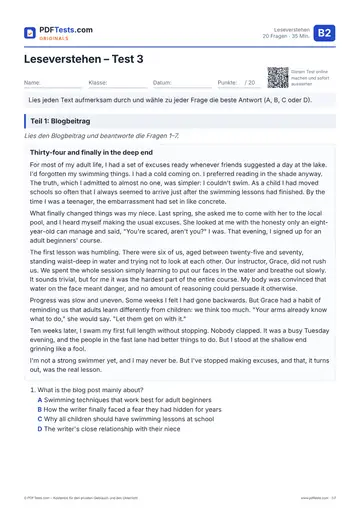
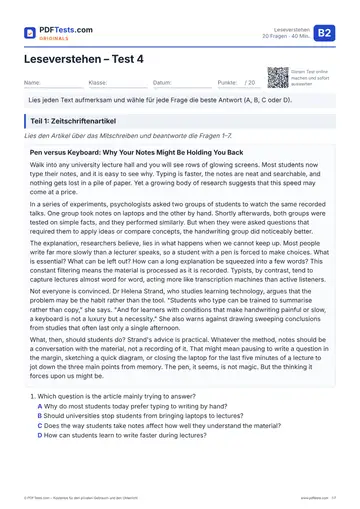
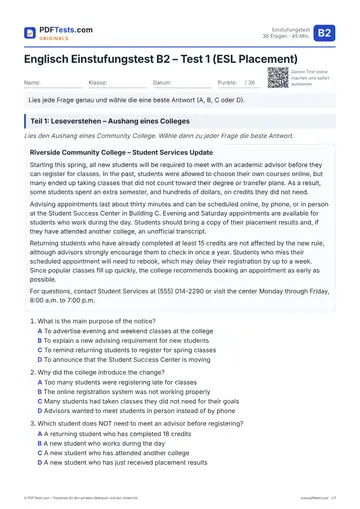
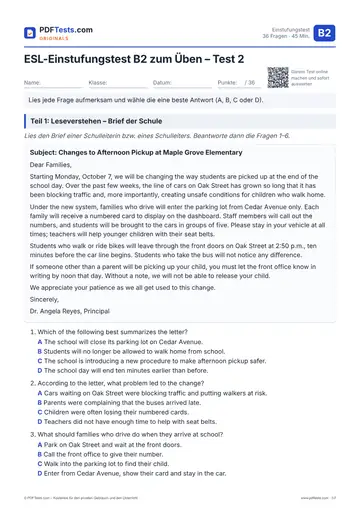
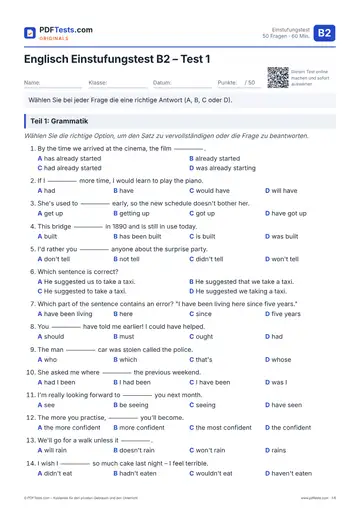
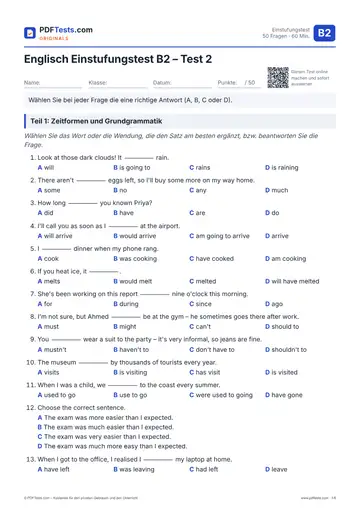
Vorschau von Seite 1: Leseverstehen – Test 5 PDF öffnen

Test online machen

Lies jeden Text aufmerksam durch und wähle für jede Frage die beste Antwort (A, B, C oder D). Wählen Sie Ihre Antworten und klicken Sie auf „Antworten prüfen“.

Teil 1: Zeitschriftenartikel

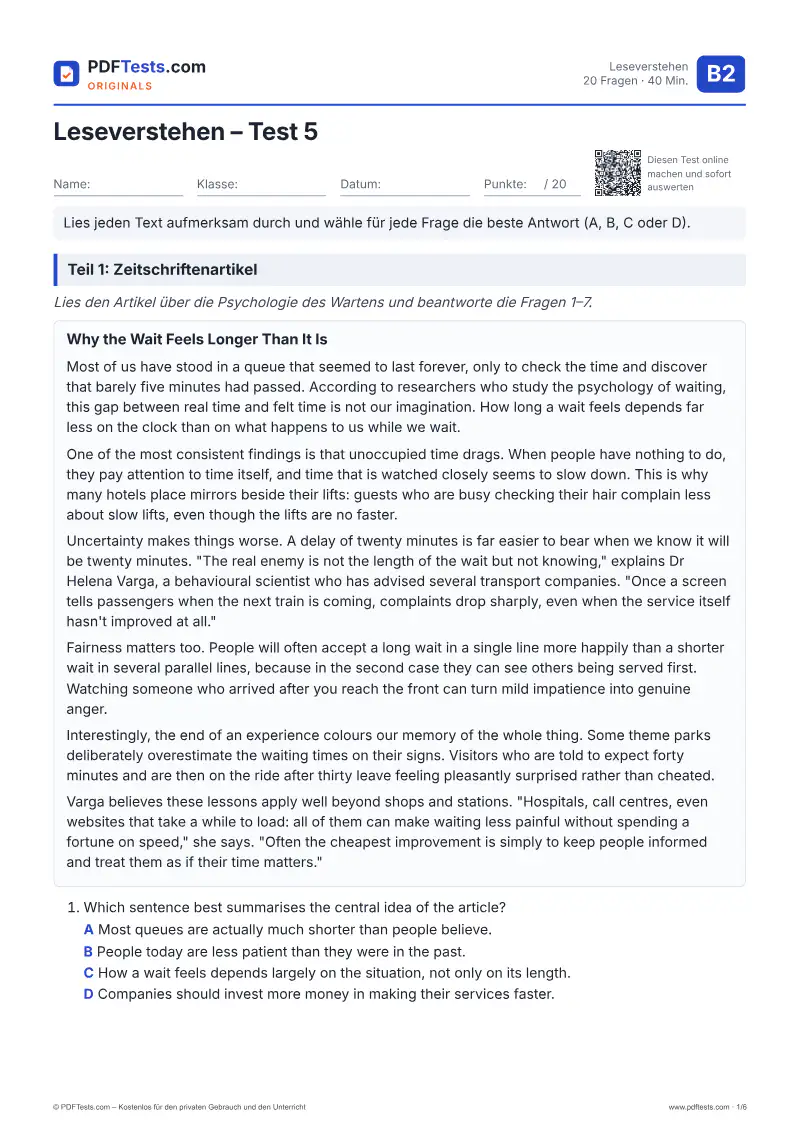
Lies den Artikel über die Psychologie des Wartens und beantworte die Fragen 1–7.

Why the Wait Feels Longer Than It Is

Most of us have stood in a queue that seemed to last forever, only to check the time and discover that barely five minutes had passed. According to researchers who study the psychology of waiting, this gap between real time and felt time is not our imagination. How long a wait feels depends far less on the clock than on what happens to us while we wait.

One of the most consistent findings is that unoccupied time drags. When people have nothing to do, they pay attention to time itself, and time that is watched closely seems to slow down. This is why many hotels place mirrors beside their lifts: guests who are busy checking their hair complain less about slow lifts, even though the lifts are no faster.

Uncertainty makes things worse. A delay of twenty minutes is far easier to bear when we know it will be twenty minutes. "The real enemy is not the length of the wait but not knowing," explains Dr Helena Varga, a behavioural scientist who has advised several transport companies. "Once a screen tells passengers when the next train is coming, complaints drop sharply, even when the service itself hasn't improved at all."

Fairness matters too. People will often accept a long wait in a single line more happily than a shorter wait in several parallel lines, because in the second case they can see others being served first. Watching someone who arrived after you reach the front can turn mild impatience into genuine anger.

Interestingly, the end of an experience colours our memory of the whole thing. Some theme parks deliberately overestimate the waiting times on their signs. Visitors who are told to expect forty minutes and are then on the ride after thirty leave feeling pleasantly surprised rather than cheated.

Varga believes these lessons apply well beyond shops and stations. "Hospitals, call centres, even websites that take a while to load: all of them can make waiting less painful without spending a fortune on speed," she says. "Often the cheapest improvement is simply to keep people informed and treat them as if their time matters."

  1. Which sentence best summarises the central idea of the article?

  2. According to the article, why do some hotels put mirrors next to their lifts?

  3. According to Dr Varga, what upsets people most while they are waiting?

  4. In paragraph 2, the phrase "unoccupied time drags" means that time with nothing to do _____.

  5. What can be inferred about why people often prefer one long queue to several shorter ones?

  6. Why do some theme parks show waiting times that are longer than the real ones?

  7. In the final paragraph, what does Dr Varga suggest?

Teil 2: Bewerbungsschreiben

Lies das Schreiben und beantworte die Fragen 8–13.

Dear Ms Lindqvist,

I am writing to apply for the position of Weekend Learning Assistant at the Harbourside Science Centre, as advertised on your website. Having visited the centre many times with my younger cousins, I know how much effort goes into making science feel exciting rather than intimidating, and I would very much like to be part of that.

I am currently in the second year of a degree in environmental science, so I have a solid grounding in the subjects covered by many of your exhibits. However, I appreciate that knowing the facts is only half the job. What matters just as much is being able to explain an idea to a curious eight-year-old and to their grandparent in the same conversation. For the past eighteen months, I have worked part-time as a swimming instructor for children aged five to eleven, a role that has taught me patience and the importance of adapting my explanations to each child. I have also learnt to stay calm when a session doesn't go according to plan, which I imagine happens fairly often on a busy Saturday at the centre.

Last summer, I volunteered at a coastal nature festival, where I ran a rock-pool activity for families. At first, I relied heavily on a prepared script, but I quickly realised that children engaged far more when I let their questions lead the discussion. By the end of the week, I had abandoned the script almost entirely. That experience convinced me that hands-on learning is the most effective way to spark an interest in science.

I should mention that I am not available on the first weekend of each month during term time, when I attend compulsory field trips for my course. I would, however, be happy to make up these hours during the school holidays, when I understand the centre is at its busiest.

I have attached my CV and the contact details of two referees. I would welcome the opportunity to discuss my application further and could attend an interview on any weekday afternoon.

Yours sincerely,

Joaquin Ferreira

  1. Why does Joaquin mention visiting the centre with his younger cousins?

  2. When Joaquin writes that "knowing the facts is only half the job", he means that _____.

  3. According to the letter, what has Joaquin's work as a swimming instructor taught him?

  4. What did Joaquin learn from running the rock-pool activity?

  5. In paragraph 3, the word "spark" in "spark an interest" is closest in meaning to _____.

  6. Which statement about Joaquin's availability is true?

Teil 3: Kurzgeschichte

Lies die Geschichte und beantworte die Fragen 14–20.

The Night the Kitchen Found Its Rhythm

By half past six, every table at Corvo was booked, and Ibrahim had been a junior cook there for exactly three weeks. He was slicing onions when Chef Delphine came out of her office, pale and holding her phone.

"My daughter's been taken to hospital," she said quietly. "It's nothing serious, they think, but I have to go." She looked around the kitchen. Marco, her deputy, was on holiday. The two other cooks avoided her eyes. Then she looked at Ibrahim. "You know the menu. You've watched me run the pass every night. You'll call the orders."

Before he could object, she had gone.

For the first hour, it was chaos. Ibrahim's voice, which he had always thought of as reasonably loud, seemed to vanish under the hiss of the grills. Orders piled up. A plate of fish went out without its sauce and came straight back. Finally, Sana, who had worked at Corvo for six years, tapped him on the shoulder.

"Stop asking," she said. "You keep saying, 'Could someone maybe do the lamb?' Nobody moves for 'maybe'. Tell us."

He swallowed hard. "Lamb, two minutes. Sana, risotto now, please." To his astonishment, she nodded and turned back to the stove without a word.

Something shifted after that. He stopped apologising for every request and started watching the whole kitchen instead of the single ticket in front of him. He noticed when the dishwasher was falling behind and sent someone to help before the clean plates ran out. By nine o'clock, the tickets were arriving faster than ever, yet the kitchen had settled into a strange, steady rhythm, like a song everyone suddenly knew the words to.

When the last dessert went out, nobody cheered. Sana simply handed him a glass of water and said, "Not bad, for someone who says 'maybe'."

The next morning, Delphine called to say her daughter was fine. Then she asked how service had gone.

Ibrahim thought about the returned fish, the shaking in his hands, and the moment the kitchen had finally started listening.

"We got through it," he said. He decided the rest could wait until he was sure he could tell it without sounding proud.

  1. Why did Delphine choose Ibrahim to call the orders?

  2. "Ibrahim's voice... seemed to vanish under the hiss of the grills." This means that _____.

  3. What was Sana's advice to Ibrahim?

  4. What does the phrase "To his astonishment" show about Ibrahim?

  5. Which change in Ibrahim's approach helped the service improve?

  6. The comparison "like a song everyone suddenly knew the words to" suggests that the kitchen was _____.

  7. Why does Ibrahim give Delphine such a short answer about the evening?

War diese Seite hilfreich?

Fehler melden

Falsche Lösung, Tippfehler oder unklare Erklärung? Schreiben Sie uns, wir korrigieren es.

Vorschau

Über diesen Test

Dieser Test zum Leseverstehen auf Niveau B2 enthält drei Originaltexte aus unterschiedlichen Textsorten: einen populärwissenschaftlichen Artikel über die Psychologie des Wartens, ein Bewerbungsschreiben und eine Kurzgeschichte, die in einer Restaurantküche spielt. Die 20 Fragen prüfen globales Verstehen, Detailverstehen, Schlussfolgerungen, Einstellungen und Wortschatz im Kontext. Er eignet sich für Lernende der oberen Mittelstufe, die sich auf B2-Prüfungen vorbereiten, sowie für Lehrkräfte, die eine fertige Leseverstehensaufgabe suchen.

Themen

LeseverstehenGlobalverstehen und HauptaussageDetailverstehenSchlussfolgerungen ziehenWortschatz im KontextBildhafte SpracheAbsicht des Autors

So nutzen Sie diesen Test

  1. Laden Sie das PDF herunter und drucken Sie es aus – oder machen Sie den Test unten online.
  2. Beantworten Sie alle Fragen ohne Wörterbuch und ohne Zeitdruck.
  3. Prüfen Sie Ihre Antworten und notieren Sie, was Sie wiederholen sollten.

Hinweise für Lehrkräfte

Planen Sie etwa 40 Minuten ein oder bearbeiten Sie für kürzere Übungsphasen einen Teil pro Unterrichtsstunde. Viele Distraktoren greifen Wörter aus dem Text auf, verfälschen aber deren Bedeutung – so lernen die Schülerinnen und Schüler, den gesamten Kontext zu prüfen, statt nur nach gleichen Wörtern zu suchen. Fragen zu Schlussfolgerungen und bildhafter Sprache (Vergleiche sowie Ausdrücke wie „drags“ oder „spark“) bereiten erfahrungsgemäß die meisten Schwierigkeiten; es lohnt sich, sie anschließend gemeinsam zu besprechen. Als Anschlussaufgabe können die Lernenden ein eigenes Bewerbungsschreiben verfassen oder die Geschichte aus Sanas Perspektive nacherzählen.