PDFTests Originals

Leseverstehen – Test 3

B2 Gute Mittelstufe LeseverstehenEnglisch

Dieser Test zum Leseverstehen auf Niveau B2 enthält drei Originaltexte aus unterschiedlichen Textsorten: einen persönlichen Blogbeitrag, ein Zeitschrifteninterview und eine Buchrezension. Die 20 Multiple-Choice-Fragen prüfen, ob die Hauptaussage, wichtige Einzelheiten, indirekt Gemeintes und Wortschatz im Kontext verstanden werden. Der Test eignet sich für Lernende auf der oberen Mittelstufe, die sich auf Prüfungen der Stufe B2 vorbereiten, und für Lehrkräfte, die eine fertige Lernzielkontrolle zum Leseverstehen suchen.

Fragen
20
Zeit
35 Min.
PDF
7 Seiten
Lösungen
Enthalten
  • 100 % kostenlos
  • Ohne Anmeldung
  • Druckfertiges A4-PDF
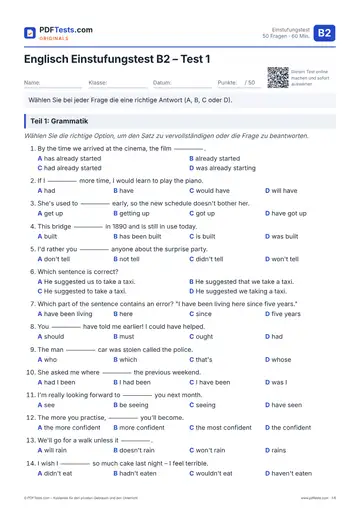
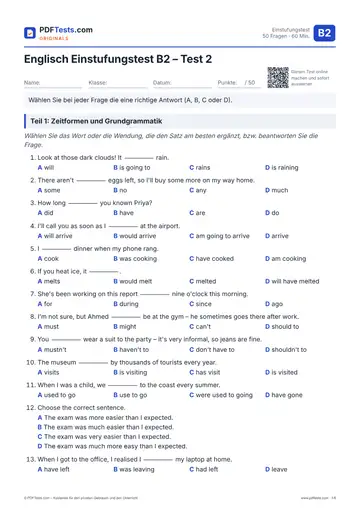
Vorschau von Seite 1: Leseverstehen – Test 3 PDF öffnen

Test online machen

Lies jeden Text aufmerksam durch und wähle zu jeder Frage die beste Antwort (A, B, C oder D). Wählen Sie Ihre Antworten und klicken Sie auf „Antworten prüfen“.

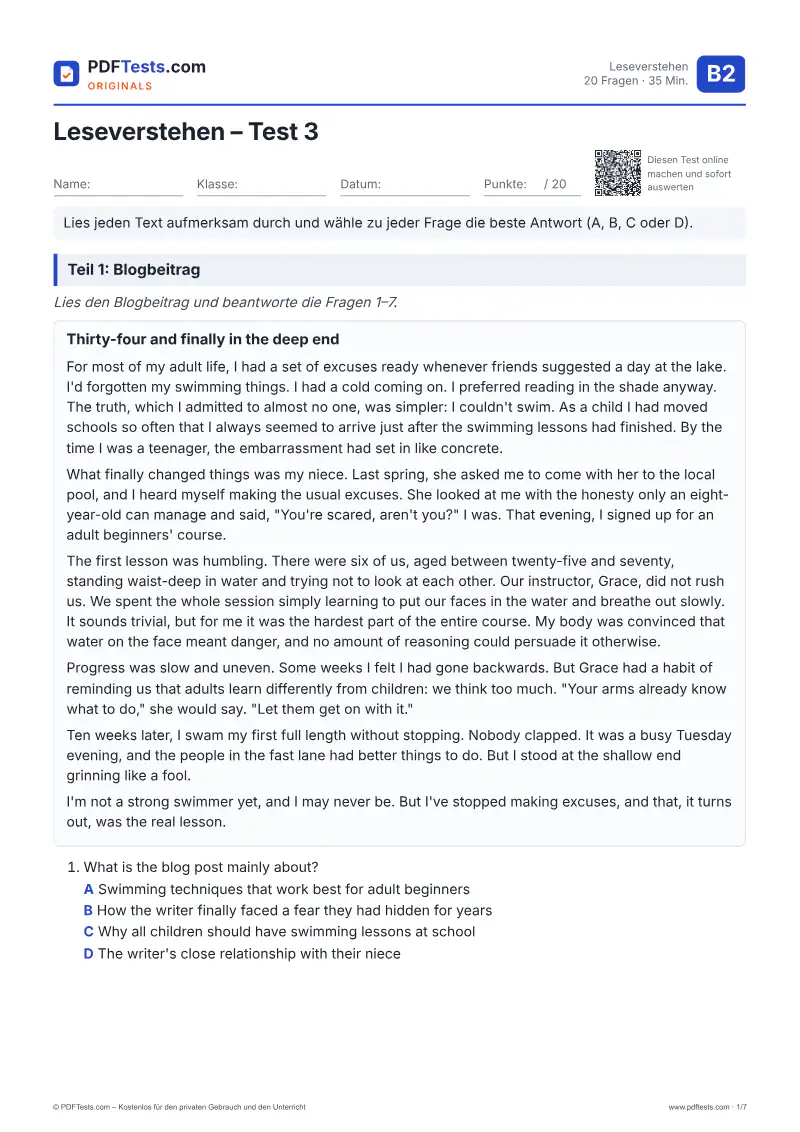
Teil 1: Blogbeitrag

Lies den Blogbeitrag und beantworte die Fragen 1–7.

Thirty-four and finally in the deep end

For most of my adult life, I had a set of excuses ready whenever friends suggested a day at the lake. I'd forgotten my swimming things. I had a cold coming on. I preferred reading in the shade anyway. The truth, which I admitted to almost no one, was simpler: I couldn't swim. As a child I had moved schools so often that I always seemed to arrive just after the swimming lessons had finished. By the time I was a teenager, the embarrassment had set in like concrete.

What finally changed things was my niece. Last spring, she asked me to come with her to the local pool, and I heard myself making the usual excuses. She looked at me with the honesty only an eight-year-old can manage and said, "You're scared, aren't you?" I was. That evening, I signed up for an adult beginners' course.

The first lesson was humbling. There were six of us, aged between twenty-five and seventy, standing waist-deep in water and trying not to look at each other. Our instructor, Grace, did not rush us. We spent the whole session simply learning to put our faces in the water and breathe out slowly. It sounds trivial, but for me it was the hardest part of the entire course. My body was convinced that water on the face meant danger, and no amount of reasoning could persuade it otherwise.

Progress was slow and uneven. Some weeks I felt I had gone backwards. But Grace had a habit of reminding us that adults learn differently from children: we think too much. "Your arms already know what to do," she would say. "Let them get on with it."

Ten weeks later, I swam my first full length without stopping. Nobody clapped. It was a busy Tuesday evening, and the people in the fast lane had better things to do. But I stood at the shallow end grinning like a fool.

I'm not a strong swimmer yet, and I may never be. But I've stopped making excuses, and that, it turns out, was the real lesson.

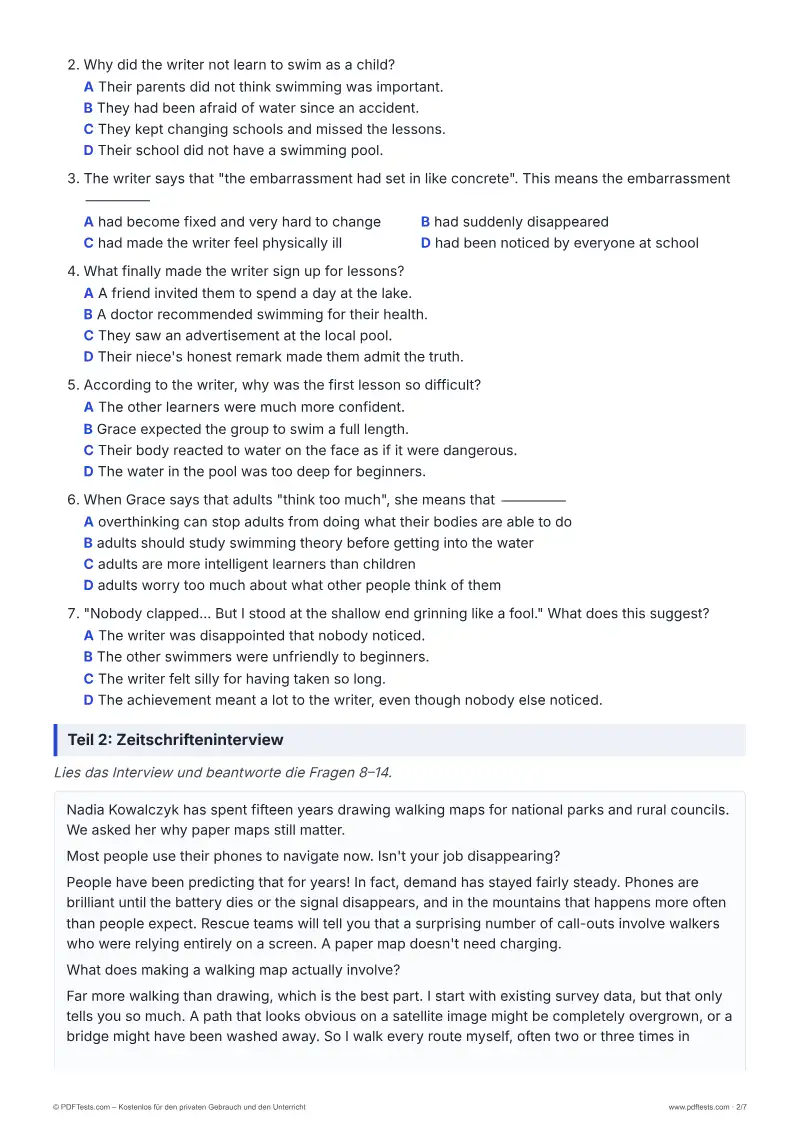
  1. What is the blog post mainly about?

  2. Why did the writer not learn to swim as a child?

  3. The writer says that "the embarrassment had set in like concrete". This means the embarrassment _____

  4. What finally made the writer sign up for lessons?

  5. According to the writer, why was the first lesson so difficult?

  6. When Grace says that adults "think too much", she means that _____

  7. "Nobody clapped... But I stood at the shallow end grinning like a fool." What does this suggest?

Teil 2: Zeitschrifteninterview

Lies das Interview und beantworte die Fragen 8–14.

Nadia Kowalczyk has spent fifteen years drawing walking maps for national parks and rural councils. We asked her why paper maps still matter.

Most people use their phones to navigate now. Isn't your job disappearing?

People have been predicting that for years! In fact, demand has stayed fairly steady. Phones are brilliant until the battery dies or the signal disappears, and in the mountains that happens more often than people expect. Rescue teams will tell you that a surprising number of call-outs involve walkers who were relying entirely on a screen. A paper map doesn't need charging.

What does making a walking map actually involve?

Far more walking than drawing, which is the best part. I start with existing survey data, but that only tells you so much. A path that looks obvious on a satellite image might be completely overgrown, or a bridge might have been washed away. So I walk every route myself, often two or three times in different seasons. I make notes on things like gates, steep sections and places where people often take a wrong turn.

How do you decide what to include?

That's the real skill. The temptation is to put everything in, but a cluttered map is almost as unhelpful as an empty one. I'm constantly asking: what does a tired walker in the rain actually need to know? Usually it's where the path goes, where there's water, and where you can get off the hill quickly if the weather turns. A beautiful viewpoint is nice to mark, but it isn't going to keep anyone safe.

Has the job changed much since you started?

The tools have, enormously. I used to draw with pens on film; now it's all software. But the basic questions haven't changed. If anything, maps matter more now, because many walkers go out with no sense of the bigger picture. A screen shows you the next few hundred metres. A map shows you the whole valley.

Any advice for walkers?

Take a map, and learn to read it before you need it. The middle of a storm is not the time to work out which way is north.

  1. According to Nadia, why is there still demand for paper maps?

  2. Why does Nadia mention rescue teams?

  3. Why does Nadia walk each route several times?

  4. What does Nadia mean when she says "a cluttered map is almost as unhelpful as an empty one"?

  5. Which of these would Nadia probably consider LEAST important to include on a walking map?

  6. When Nadia says "the basic questions haven't changed", she means that _____

  7. What does Nadia's final piece of advice suggest?

Teil 3: Buchrezension

Lies die Buchrezension und beantworte die Fragen 15–20.

The Salt Orchard by Elena Marsh

Elena Marsh's third novel opens with a funeral and closes with a wedding. In between, it covers forty years in the life of a fruit-growing family on a windy stretch of coast. It is an ambitious book, occasionally a frustrating one, and for long stretches a genuinely moving one.

The story is told mostly through the eyes of Ruth, the eldest daughter. She inherits the family orchard after her father's death, despite having spent most of her twenties trying to escape it. Marsh is excellent on the small, unglamorous details of farming life: the early mornings, the anxiety about late frosts, the arguments over money that are never really about money. Ruth herself is a wonderfully complicated character: stubborn, funny and often unfair to the people who love her most. It is a pleasure to watch her slowly grow into a role she never wanted.

The problems begin when Marsh moves away from Ruth. In the middle section, the story jumps between five or six other family members. Several of them feel less like real people than devices for moving the plot along. Ruth's younger brother, in particular, seems to exist mainly to make bad decisions at convenient moments. Readers who are less patient than I am may be tempted to give up at this point.

They should resist. The final hundred pages, which return firmly to Ruth, are the strongest in the book. Without giving too much away, a long-buried family secret finally comes to light, and Marsh handles it with remarkable restraint. There are no dramatic speeches and no tearful confessions, just two sisters sitting in a kitchen, saying far less than they mean. It is the quietest scene in the novel and by far the most powerful.

The Salt Orchard is not a perfect book. At nearly five hundred pages, it is at least a hundred pages too long, and a stricter editor might have saved it from its weaker passages. But Marsh writes with real warmth and intelligence, and Ruth is a character who stays with you long after the last page. Flaws and all, it is well worth your time.

  1. What is the reviewer's overall opinion of the novel?

  2. What does the reviewer especially praise in the description of farming life?

  3. The phrase "arguments over money that are never really about money" suggests that _____

  4. What is the reviewer's main criticism of the middle section?

  5. "They should resist." Here the reviewer is advising readers to _____

  6. In paragraph 4, the word "restraint" is closest in meaning to _____

War diese Seite hilfreich?

Fehler melden

Falsche Lösung, Tippfehler oder unklare Erklärung? Schreiben Sie uns, wir korrigieren es.

Vorschau

Über diesen Test

Dieser Test zum Leseverstehen auf Niveau B2 enthält drei Originaltexte aus unterschiedlichen Textsorten: einen persönlichen Blogbeitrag, ein Zeitschrifteninterview und eine Buchrezension. Die 20 Multiple-Choice-Fragen prüfen, ob die Hauptaussage, wichtige Einzelheiten, indirekt Gemeintes und Wortschatz im Kontext verstanden werden. Der Test eignet sich für Lernende auf der oberen Mittelstufe, die sich auf Prüfungen der Stufe B2 vorbereiten, und für Lehrkräfte, die eine fertige Lernzielkontrolle zum Leseverstehen suchen.

Themen

Globales Lesen (Reading for gist)Detailliertes Lesen (Reading for detail)Schlussfolgerungen ziehen (Inference)Wortschatz im KontextHaltung und Meinung des VerfassersBlogbeiträge, Interviews und Rezensionen

So nutzen Sie diesen Test

  1. Laden Sie das PDF herunter und drucken Sie es aus – oder machen Sie den Test unten online.
  2. Beantworten Sie alle Fragen ohne Wörterbuch und ohne Zeitdruck.
  3. Prüfen Sie Ihre Antworten und notieren Sie, was Sie wiederholen sollten.

Hinweise für Lehrkräfte

Setzen Sie den Test als Prüfungsübung mit Zeitvorgabe ein oder bearbeiten Sie im Unterricht jeweils einen Teil pro Stunde. Viele Distraktoren greifen Wörter aus den Texten auf, verändern aber die Bedeutung. Sie zielen auf Lernende, die nur nach gleichen Wörtern suchen, statt den Inhalt zu erfassen – besonders bei den Fragen zu Schlussfolgerungen und bildhafter Sprache. Zur Nachbereitung können die Lernenden den genauen Satz im Text suchen, der jede Antwort belegt. Außerdem bietet sich an, eine kurze Rezension oder einen Blogbeitrag im gleichen Stil schreiben zu lassen.