PDFTests Originals

Leseverstehen – Test 2

B2 Gute Mittelstufe LeseverstehenEnglisch

Dieser B2-Lesetest umfasst drei Originaltexte: einen Meinungsartikel über Langeweile, einen Informationsaushang eines Gemeinschaftsgartens und eine Kurzgeschichte über eine Rezeptkiste der Familie. Die 20 Multiple-Choice-Fragen prüfen Globalverstehen, Detailverstehen, Schlussfolgerungen, Wortschatz im Kontext und die Haltung des Autors. Der Test eignet sich für Lernende auf der Mittelstufe (upper-intermediate), die sich auf B2-Prüfungen vorbereiten, und für Lehrkräfte, die eine fertige Leseverstehensaufgabe suchen.

Fragen
20
Zeit
35 Min.
PDF
6 Seiten
Lösungen
Enthalten
  • 100 % kostenlos
  • Ohne Anmeldung
  • Druckfertiges A4-PDF
Vorschau von Seite 1: Leseverstehen – Test 2 PDF öffnen

Test online machen

Lies jeden Text aufmerksam und wähle für jede Frage die beste Antwort (A, B, C oder D). Wählen Sie Ihre Antworten und klicken Sie auf „Antworten prüfen“.

Teil 1: Meinungsartikel

Lies den Artikel und beantworte die Fragen 1–7.

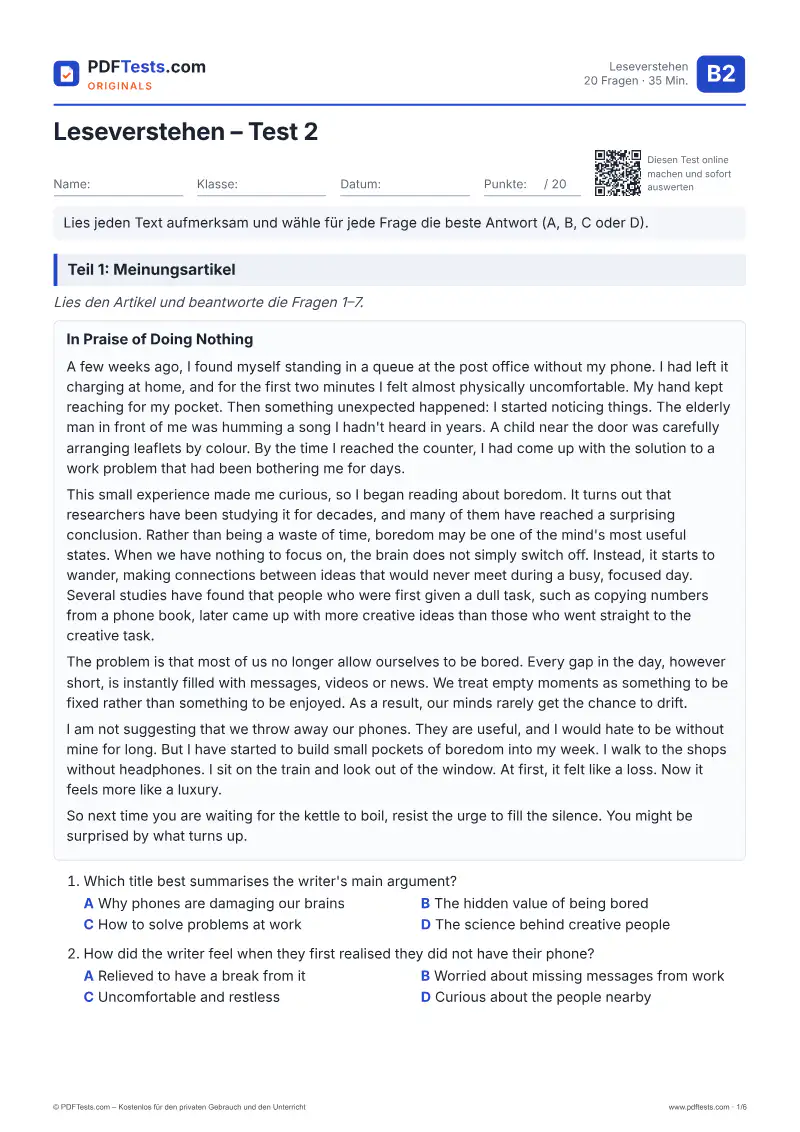
In Praise of Doing Nothing

A few weeks ago, I found myself standing in a queue at the post office without my phone. I had left it charging at home, and for the first two minutes I felt almost physically uncomfortable. My hand kept reaching for my pocket. Then something unexpected happened: I started noticing things. The elderly man in front of me was humming a song I hadn't heard in years. A child near the door was carefully arranging leaflets by colour. By the time I reached the counter, I had come up with the solution to a work problem that had been bothering me for days.

This small experience made me curious, so I began reading about boredom. It turns out that researchers have been studying it for decades, and many of them have reached a surprising conclusion. Rather than being a waste of time, boredom may be one of the mind's most useful states. When we have nothing to focus on, the brain does not simply switch off. Instead, it starts to wander, making connections between ideas that would never meet during a busy, focused day. Several studies have found that people who were first given a dull task, such as copying numbers from a phone book, later came up with more creative ideas than those who went straight to the creative task.

The problem is that most of us no longer allow ourselves to be bored. Every gap in the day, however short, is instantly filled with messages, videos or news. We treat empty moments as something to be fixed rather than something to be enjoyed. As a result, our minds rarely get the chance to drift.

I am not suggesting that we throw away our phones. They are useful, and I would hate to be without mine for long. But I have started to build small pockets of boredom into my week. I walk to the shops without headphones. I sit on the train and look out of the window. At first, it felt like a loss. Now it feels more like a luxury.

So next time you are waiting for the kettle to boil, resist the urge to fill the silence. You might be surprised by what turns up.

  1. Which title best summarises the writer's main argument?

  2. How did the writer feel when they first realised they did not have their phone?

  3. According to the research described, what happens in the brain when we are bored?

  4. Why does the writer mention copying numbers from a phone book?

  5. In paragraph 3, the writer says our minds rarely get the chance to "drift". This means the mind is _____.

  6. What is the writer's attitude towards mobile phones?

  7. "At first, it felt like a loss. Now it feels more like a luxury." What does this show about the writer?

Teil 2: Informationsaushang

Lies den Aushang und beantworte die Fragen 8–14.

Hillside Community Garden – Plot Allocation: Information for Applicants

Thank you for your interest in renting a plot at Hillside Community Garden. Because of the high number of applications we received last year, we have made some changes to the way plots are allocated. Please read the following information carefully before completing the application form.

Who can apply

Applications are open to anyone living in the Hillside and Marsh Lane areas. Each household may submit one application only. Schools, youth groups and local charities are also welcome to apply for one of our four shared plots, which are larger and located near the main gate for easier access.

How plots are allocated

In previous years, plots were given out on a first-come, first-served basis. This led to long queues outside the office on the opening day and was unfair to residents who work during the day. This year, all applications received between 3 and 21 March will be treated equally, and plots will be allocated by random draw on 28 March. Current plot holders who wish to keep their plot do not need to enter the draw, provided that they have paid this year's fee by 1 March.

Your responsibilities

Plot holders are expected to keep their plot in good condition throughout the growing season. Plots that appear neglected for more than six weeks will receive a written warning. If no improvement is seen within a further month, the plot may be offered to the next person on the waiting list. We understand that illness or family circumstances can make gardening difficult at times. If this applies to you, please let us know and we will do our best to be flexible.

Fees and tools

The annual fee is €35 for a standard plot, reduced to €15 for students and residents over 65. Basic tools can be borrowed free of charge from the shed, but they must be returned by the end of the same day.

How to apply

Application forms are available from the garden office (open Saturdays, 9 a.m.–1 p.m.) or can be downloaded from the community noticeboard website. Completed forms can be posted through the office letterbox at any time.

  1. Who is this notice mainly written for?

  2. Why has the way of allocating plots been changed?

  3. What must current plot holders do if they want to keep their plot without entering the draw?

  4. Which of the following is NOT mentioned as a group that can apply for a shared plot?

  5. What will happen if a plot looks neglected for more than six weeks?

  6. When the organisers say they "will do our best to be flexible", they mean they will _____.

  7. A student borrows a spade from the shed on a Saturday morning. What must she do?

Teil 3: Kurzgeschichte

Lies die Geschichte und beantworte die Fragen 15–20.

The Recipe Box

When her grandmother moved into a care home, Mei was given the job nobody else wanted: clearing out the kitchen. Her brothers had taken the furniture and the old car. What was left were cupboards full of chipped plates, mysterious jars and a small wooden box that rattled when she picked it up.

Inside were dozens of recipe cards, each written in her grandmother's neat, sloping handwriting. Mei had expected instructions for the dishes she remembered from childhood: the sesame noodles, the ginger biscuits that were always slightly burnt at the edges. Those were there. But many of the cards had notes added at the bottom, in a different pen and clearly written years later.

"Made this for Arun's first day at school. He refused to eat it," said one. "Too much salt. Tom said nothing, bless him," said another. On the card for a plum cake, the note simply read: "The day the letter came. Baked it anyway."

Mei sat down on the kitchen floor and read every card twice. She had always thought of her grandmother as a practical, rather quiet woman who did not waste words. Now she found herself holding forty years of small jokes, disappointments and private victories, hidden between measurements for flour and sugar.

She did not know which letter the plum cake card referred to, and the thought of asking made her nervous. Her grandmother's memory was unreliable these days, and Mei worried that the question might upset her.

That weekend, she baked the plum cake and took a slice to the care home. Her grandmother tasted it slowly, frowning slightly as if checking it for mistakes.

"You used too much cinnamon," she said at last. Then, after a long pause, she added, "Your grandfather always said the same thing. Even on the day he was offered the job abroad and we thought he would have to leave us."

Mei waited, but nothing more came. Her grandmother simply took another bite, looked out of the window and smiled.

Mei did not ask again. She decided that some stories were meant to arrive in their own time, like the notes at the bottom of the cards.

  1. Why did Mei end up clearing out the kitchen?

  2. What surprised Mei about the recipe cards?

  3. Why did the grandmother write "bless him" about Tom?

  4. How did reading the cards change Mei's view of her grandmother?

  5. Why did Mei feel nervous about asking about the letter?

  6. Why does Mei compare some stories to "the notes at the bottom of the cards"?

Vorschau

Über diesen Test

Dieser B2-Lesetest umfasst drei Originaltexte: einen Meinungsartikel über Langeweile, einen Informationsaushang eines Gemeinschaftsgartens und eine Kurzgeschichte über eine Rezeptkiste der Familie. Die 20 Multiple-Choice-Fragen prüfen Globalverstehen, Detailverstehen, Schlussfolgerungen, Wortschatz im Kontext und die Haltung des Autors. Der Test eignet sich für Lernende auf der Mittelstufe (upper-intermediate), die sich auf B2-Prüfungen vorbereiten, und für Lehrkräfte, die eine fertige Leseverstehensaufgabe suchen.

Themen

LeseverstehenGlobalverstehen und HauptaussageDetailverstehen und selektives Lesen (Scanning)Schlussfolgerungen ziehen (Inference)Wortschatz im KontextHaltung des AutorsInformationen anwenden

So nutzen Sie diesen Test

  1. Laden Sie das PDF herunter und drucken Sie es aus – oder machen Sie den Test unten online.
  2. Beantworten Sie alle Fragen ohne Wörterbuch und ohne Zeitdruck.
  3. Prüfen Sie Ihre Antworten und notieren Sie, was Sie wiederholen sollten.

Hinweise für Lehrkräfte

Jeder Teil kann als eigene Unterrichtsaufgabe eingesetzt werden, oder der gesamte Test wird in einer Sitzung von etwa 35 Minuten bearbeitet. Die Distraktoren zielen auf typische Fehler beim Leseverstehen auf B2-Niveau: eine Option wählen, weil sie Wörter aus dem Text wiederholt, das tatsächlich Gesagte mit bloß Plausiblem verwechseln und eine Regel auf den falschen Fall anwenden (zum Beispiel die Fristen im Gartenaushang). Zur Nachbereitung können die Schülerinnen und Schüler die Textbelege für jede Antwort unterstreichen. Außerdem bietet es sich an, eine kurze Antwort auf den Meinungsartikel zu schreiben oder die Geschichte aus der Sicht der Großmutter weiterzuerzählen.