PDFTests Originals

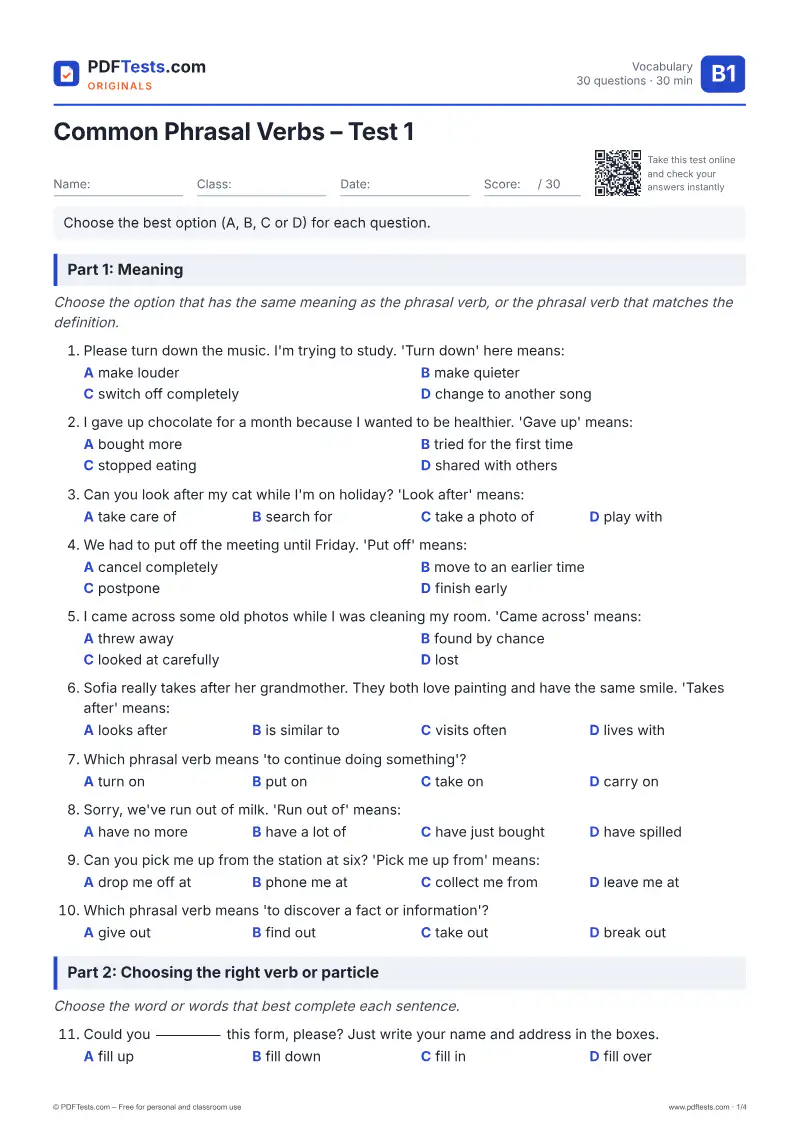
Common Phrasal Verbs – Test 1

B1 Intermediate VocabularyEnglish

This B1 vocabulary test checks how well learners understand and use common English phrasal verbs in everyday situations. It covers meanings, choosing the right verb or particle, word order with pronouns, nouns formed from phrasal verbs and typical responses in conversation. It suits intermediate learners, classroom revision and self-study.
Questions
30
Time
30 min
PDF
4 pages
Answer key
Included
  • 100% free
  • No sign-up or email
  • Print-ready A4 PDF
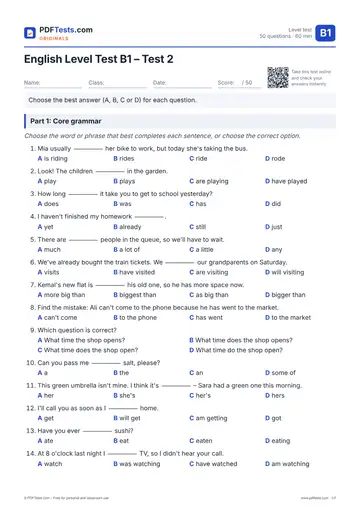
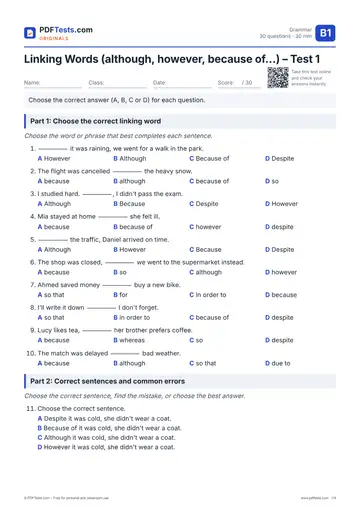
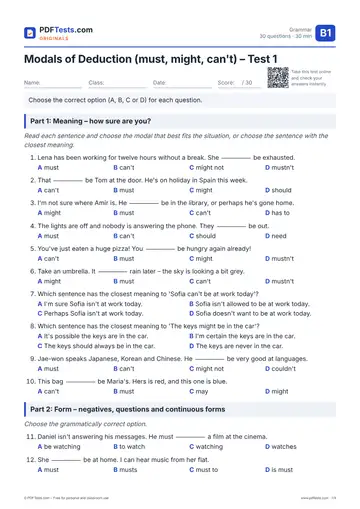
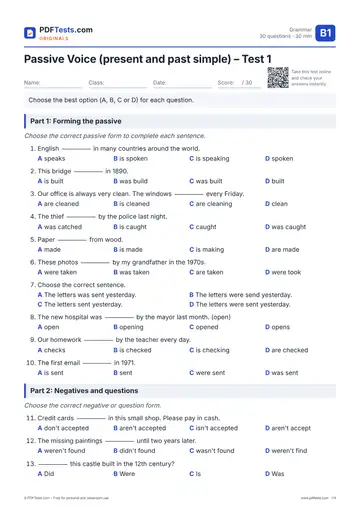
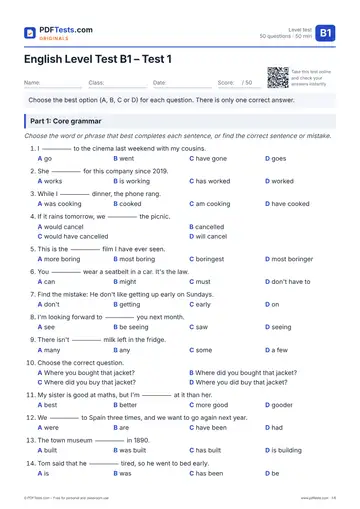
Preview of page 1 of Common Phrasal Verbs – Test 1 Open PDF

Take the test online

Choose the best option (A, B, C or D) for each question. Choose your answers, then press “Check my answers”.

Part 1: Meaning

Choose the option that has the same meaning as the phrasal verb, or the phrasal verb that matches the definition.

  1. Please turn down the music. I'm trying to study. 'Turn down' here means:

  2. I gave up chocolate for a month because I wanted to be healthier. 'Gave up' means:

  3. Can you look after my cat while I'm on holiday? 'Look after' means:

  4. We had to put off the meeting until Friday. 'Put off' means:

  5. I came across some old photos while I was cleaning my room. 'Came across' means:

  6. Sofia really takes after her grandmother. They both love painting and have the same smile. 'Takes after' means:

  7. Which phrasal verb means 'to continue doing something'?

  8. Sorry, we've run out of milk. 'Run out of' means:

  9. Can you pick me up from the station at six? 'Pick me up from' means:

  10. Which phrasal verb means 'to discover a fact or information'?

Part 2: Choosing the right verb or particle

Choose the word or words that best complete each sentence.

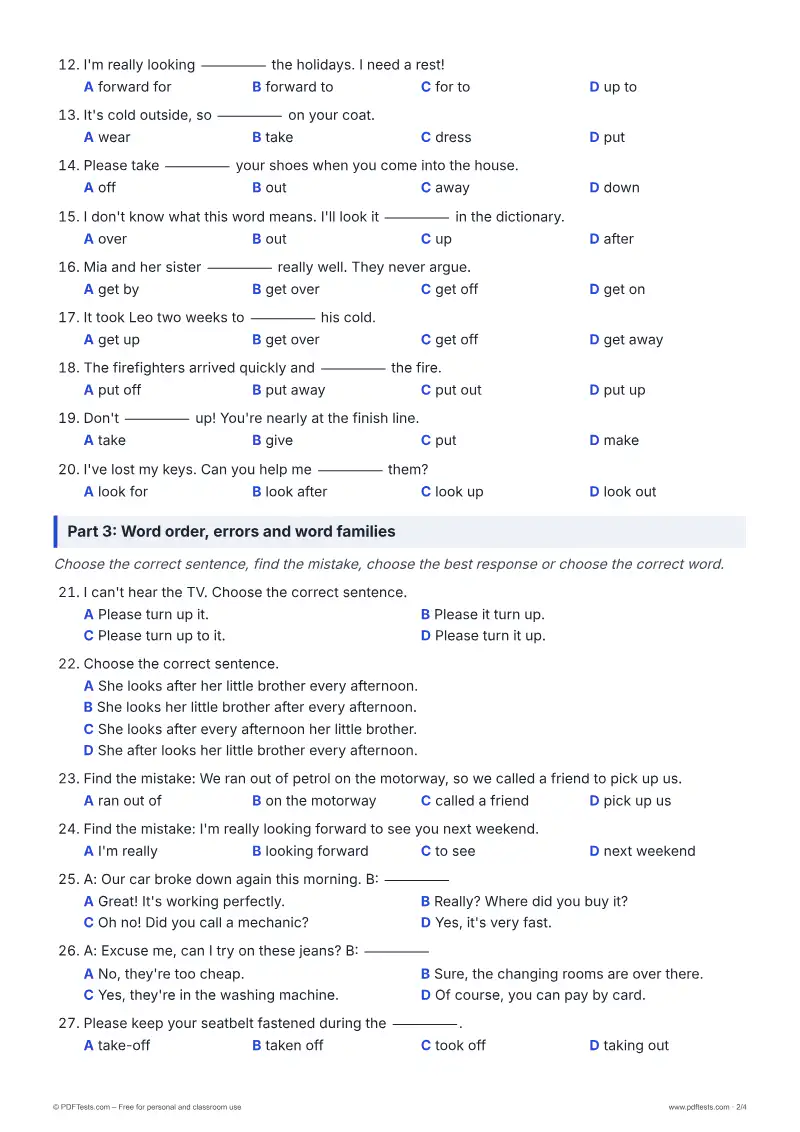
  1. Could you _____ this form, please? Just write your name and address in the boxes.

  2. I'm really looking _____ the holidays. I need a rest!

  3. It's cold outside, so _____ on your coat.

  4. Please take _____ your shoes when you come into the house.

  5. I don't know what this word means. I'll look it _____ in the dictionary.

  6. Mia and her sister _____ really well. They never argue.

  7. It took Leo two weeks to _____ his cold.

  8. The firefighters arrived quickly and _____ the fire.

  9. Don't _____ up! You're nearly at the finish line.

  10. I've lost my keys. Can you help me _____ them?

Part 3: Word order, errors and word families

Choose the correct sentence, find the mistake, choose the best response or choose the correct word.

  1. I can't hear the TV. Choose the correct sentence.

  2. Choose the correct sentence.

  3. Find the mistake: We ran out of petrol on the motorway, so we called a friend to pick up us.

  4. Find the mistake: I'm really looking forward to see you next weekend.

  5. A: Our car broke down again this morning. B: _____

  6. A: Excuse me, can I try on these jeans? B: _____

  7. Please keep your seatbelt fastened during the _____.

  8. We were late because of a _____ on the motorway: a lorry had stopped working.

  9. Jamal set up his own small business last year. 'Set up' means:

  10. In which sentence does 'turn up' mean 'arrive'?

Preview

About this test

This B1 vocabulary test checks how well learners understand and use common English phrasal verbs in everyday situations. It covers meanings, choosing the right verb or particle, word order with pronouns, nouns formed from phrasal verbs and typical responses in conversation. It suits intermediate learners, classroom revision and self-study.

Topics covered

Phrasal verb meaningsParticles in contextSeparable and inseparable verbsNouns from phrasal verbsEveryday conversationCommon learner errors

How to use this test

  1. Download the PDF and print it, or take the test online below.
  2. Answer every question without a dictionary or time pressure.
  3. Check your answers and note the topics you need to review.

Notes for teachers

Use Part 1 as a warm-up on meaning, Part 2 to check particle choice and collocation, and Part 3 for word order, error spotting and word families. Typical errors targeted include putting a pronoun after the particle (pick up us), separating inseparable verbs (look her after) and using an infinitive after 'look forward to'. As a follow-up, ask students to write a short story that uses ten of the phrasal verbs from the test.