PDFTests Originals

Daily Routines – Test 1

A1 Beginner VocabularyEnglish

This A1 vocabulary test checks the everyday words learners need to talk about their day: getting up, meals, going to work or school, and evening activities. It covers common collocations such as 'have a shower' and 'do homework', time expressions, and a short reading text. It suits beginner learners, young teens and adults.
Questions
30
Time
30 min
PDF
4 pages
Answer key
Included
  • 100% free
  • No sign-up or email
  • Print-ready A4 PDF
Preview of page 1 of Daily Routines – Test 1 Open PDF

Take the test online

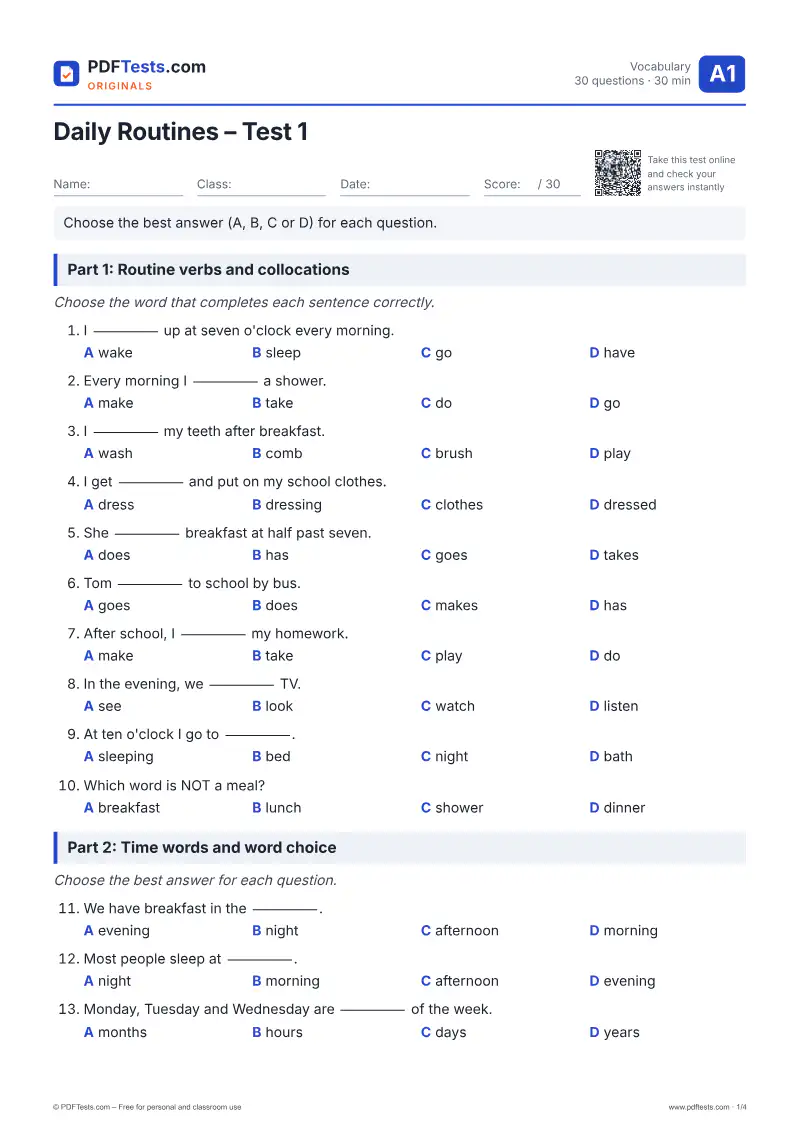
Choose the best answer (A, B, C or D) for each question. Choose your answers, then press “Check my answers”.

Part 1: Routine verbs and collocations

Choose the word that completes each sentence correctly.

  1. I _____ up at seven o'clock every morning.

  2. Every morning I _____ a shower.

  3. I _____ my teeth after breakfast.

  4. I get _____ and put on my school clothes.

  5. She _____ breakfast at half past seven.

  6. Tom _____ to school by bus.

  7. After school, I _____ my homework.

  8. In the evening, we _____ TV.

  9. At ten o'clock I go to _____.

  10. Which word is NOT a meal?

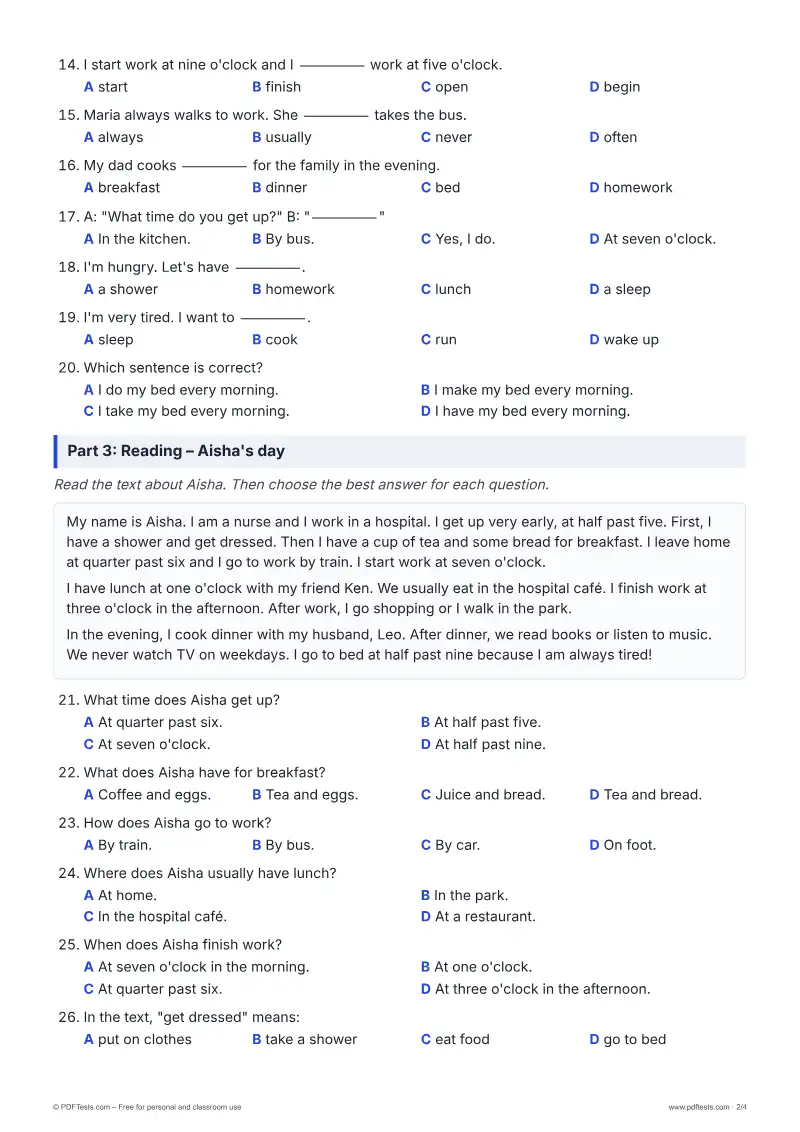
Part 2: Time words and word choice

Choose the best answer for each question.

  1. We have breakfast in the _____.

  2. Most people sleep at _____.

  3. Monday, Tuesday and Wednesday are _____ of the week.

  4. I start work at nine o'clock and I _____ work at five o'clock.

  5. Maria always walks to work. She _____ takes the bus.

  6. My dad cooks _____ for the family in the evening.

  7. A: "What time do you get up?" B: "_____"

  8. I'm hungry. Let's have _____.

  9. I'm very tired. I want to _____.

  10. Which sentence is correct?

Part 3: Reading – Aisha's day

Read the text about Aisha. Then choose the best answer for each question.

My name is Aisha. I am a nurse and I work in a hospital. I get up very early, at half past five. First, I have a shower and get dressed. Then I have a cup of tea and some bread for breakfast. I leave home at quarter past six and I go to work by train. I start work at seven o'clock.

I have lunch at one o'clock with my friend Ken. We usually eat in the hospital café. I finish work at three o'clock in the afternoon. After work, I go shopping or I walk in the park.

In the evening, I cook dinner with my husband, Leo. After dinner, we read books or listen to music. We never watch TV on weekdays. I go to bed at half past nine because I am always tired!

  1. What time does Aisha get up?

  2. What does Aisha have for breakfast?

  3. How does Aisha go to work?

  4. Where does Aisha usually have lunch?

  5. When does Aisha finish work?

  6. In the text, "get dressed" means:

  7. What does Aisha do after work?

  8. Who cooks dinner?

  9. "We never watch TV on weekdays." Weekdays are:

  10. Why does Aisha go to bed at half past nine?

Was this page helpful?

Report a mistake

Spotted a wrong answer, a typo or an unclear explanation? Tell us and we will fix it.

Practise with a worksheet: Daily Routines – Worksheet 1

Preview

About this test

This A1 vocabulary test checks the everyday words learners need to talk about their day: getting up, meals, going to work or school, and evening activities. It covers common collocations such as 'have a shower' and 'do homework', time expressions, and a short reading text. It suits beginner learners, young teens and adults.

Topics covered

Routine verbsCollocations (make, do, have, take)MealsTimes of dayDays of the weekFrequency adverbsReading for detail

How to use this test

  1. Download the PDF and print it, or take the test online below.
  2. Answer every question without a dictionary or time pressure.
  3. Check your answers and note the topics you need to review.

Notes for teachers

Use this test after teaching basic daily routine vocabulary and telling the time. Part 1 targets common collocation errors such as 'make homework', 'make a shower' and 'see TV'. Part 2 checks time phrases (in the morning, at night) and word choice in context, and Part 3 checks reading for detail. As a follow-up, ask students to write five sentences about their own day using words from the test.