PDFTests Originals

Past Simple (regular and irregular verbs) – Worksheet 1

A2 Elementary WorksheetEnglish

This worksheet practises the past simple with regular and irregular verbs, including spelling changes, negatives with didn't and questions with did. It is designed for A2 learners who want to talk about finished actions in the past with confidence.
items
38
Time
35 min
PDF
5 pages
Answer key
Included
  • 100% free
  • No sign-up or email
  • Print-ready A4 PDF
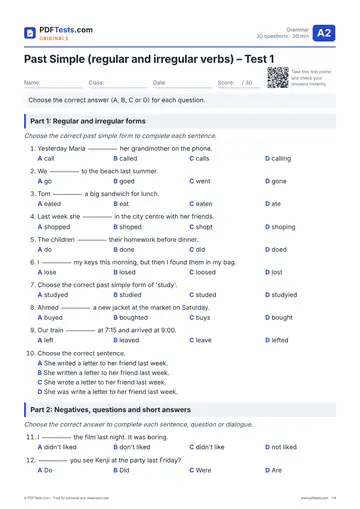
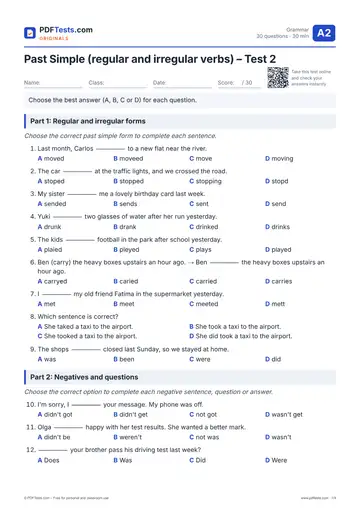
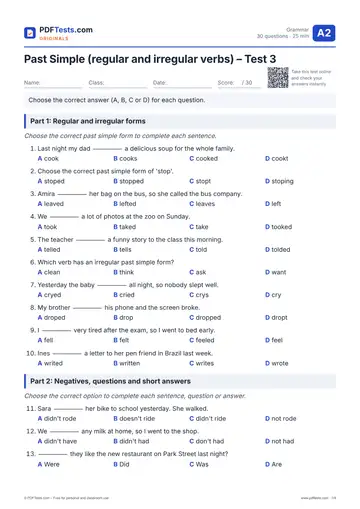
Preview of page 1 of Past Simple (regular and irregular verbs) – Worksheet 1 Open PDF
New to this topic? Read the guide first: Past Simple: Regular and Irregular Verbs, Rules and Examples

Do the worksheet online

Type your answers, then press “Check my answers”. Alternative correct answers are accepted.

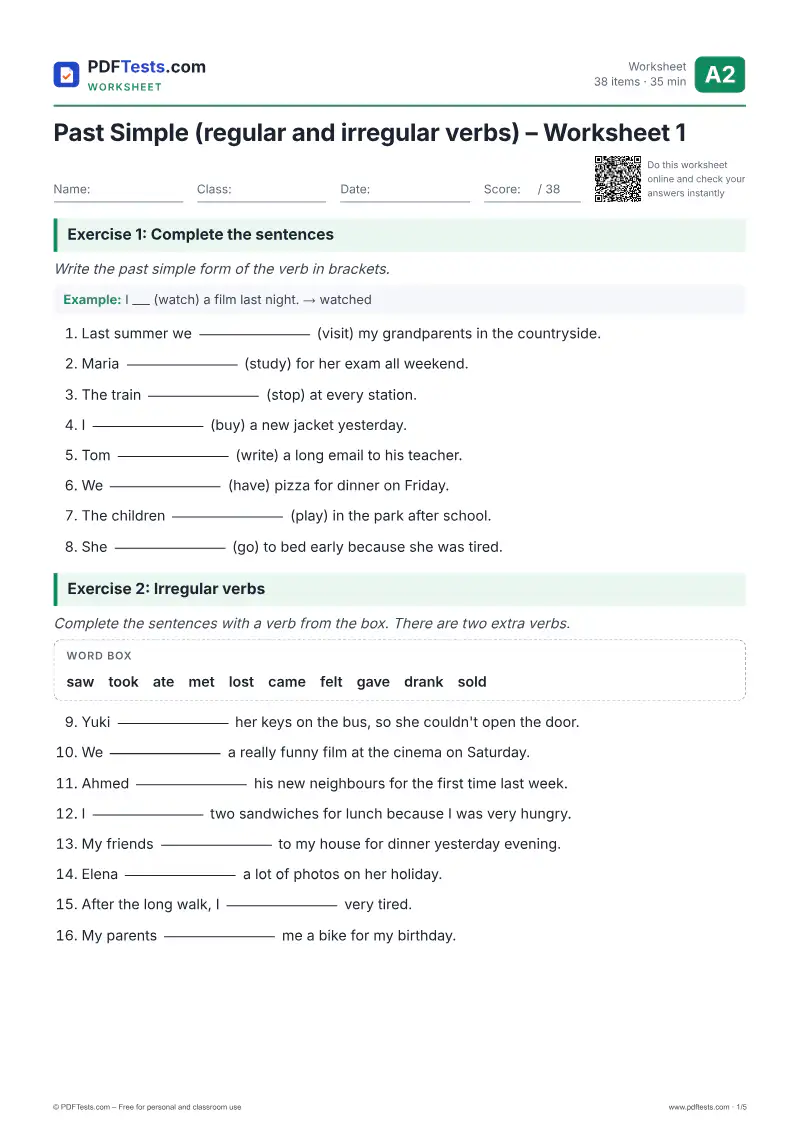
Exercise 1: Complete the sentences

Write the past simple form of the verb in brackets.

Example: I ___ (watch) a film last night. → watched

  1. Last summer we (visit) my grandparents in the countryside.

  2. Maria (study) for her exam all weekend.

  3. The train (stop) at every station.

  4. I (buy) a new jacket yesterday.

  5. Tom (write) a long email to his teacher.

  6. We (have) pizza for dinner on Friday.

  7. The children (play) in the park after school.

  8. She (go) to bed early because she was tired.

Exercise 2: Irregular verbs

Complete the sentences with a verb from the box. There are two extra verbs.

Word box sawtookatemetlostcamefeltgavedranksold

  1. Yuki her keys on the bus, so she couldn't open the door.

  2. We a really funny film at the cinema on Saturday.

  3. Ahmed his new neighbours for the first time last week.

  4. I two sandwiches for lunch because I was very hungry.

  5. My friends to my house for dinner yesterday evening.

  6. Elena a lot of photos on her holiday.

  7. After the long walk, I very tired.

  8. My parents me a bike for my birthday.

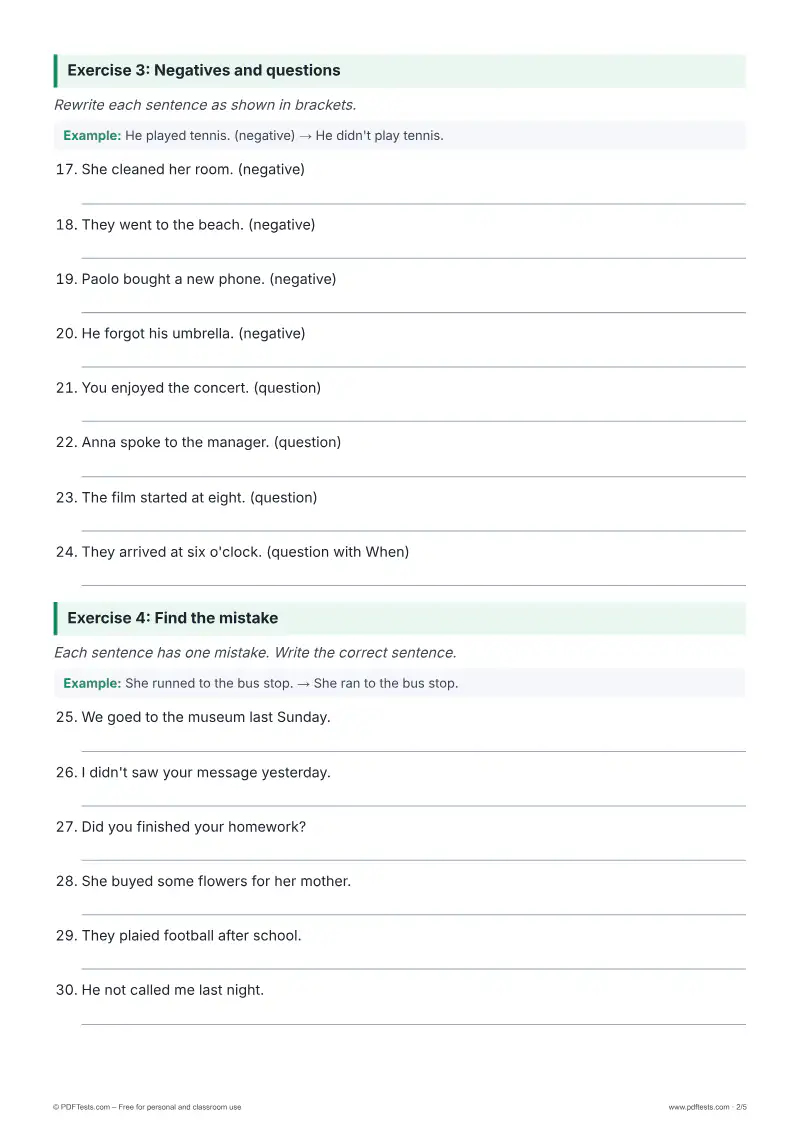
Exercise 3: Negatives and questions

Rewrite each sentence as shown in brackets.

Example: He played tennis. (negative) → He didn't play tennis.

  1. She cleaned her room. (negative)

  2. They went to the beach. (negative)

  3. Paolo bought a new phone. (negative)

  4. He forgot his umbrella. (negative)

  5. You enjoyed the concert. (question)

  6. Anna spoke to the manager. (question)

  7. The film started at eight. (question)

  8. They arrived at six o'clock. (question with When)

Exercise 4: Find the mistake

Each sentence has one mistake. Write the correct sentence.

Example: She runned to the bus stop. → She ran to the bus stop.

  1. We goed to the museum last Sunday.

  2. I didn't saw your message yesterday.

  3. Did you finished your homework?

  4. She buyed some flowers for her mother.

  5. They plaied football after school.

  6. He not called me last night.

  7. Where you went on holiday last year?

  8. My brother studyed Italian at university.

Exercise 5: Put the words in order

Put the words in the correct order to make sentences or questions.

Example: did / you / sleep / well → Did you sleep well?

  1. did / what / you / eat / for breakfast

  2. didn't / I / my homework / finish

  3. go / did / she / to the party

  4. did / they / arrive / late

  5. where / you / did / your bag / leave

  6. we / a taxi / took / to the airport

Was this page helpful?

Report a mistake

Spotted a wrong answer, a typo or an unclear explanation? Tell us and we will fix it.

Preview

About this test

Printable A2 worksheet on the past simple: regular and irregular verbs, negatives and questions. Five exercises with answers.

Topics covered

Past simple affirmativeRegular verbs and spellingIrregular verbsNegatives with didn'tQuestions with did

Notes for teachers

Start with a quick review of -ed spelling rules (study → studied, stop → stopped) and a few common irregular verbs before Exercise 1. A typical mistake is using the past form after did or didn't (Did you went? / I didn't saw). Learners also often add -ed to irregular verbs (goed, buyed). As a follow-up, ask pairs to interview each other about last weekend using Did you...? and Wh- questions.

All English A2 tests →